Ironstone Coffeepot: Wheat Pattern by Wilkinson & White — Identification, History, and Restoration Guidelines
A detailed examination of the iconic Ironstone coffeepot bearing the 'Wheat' pattern, manufactured by Wilkinson & White of Burslem, Staffordshire. Covers hallmark identification, production timeline (c. 1845–1870), physical specifications, glaze chemistry, collector valuation metrics, and ethical restoration protocols for antique ceramics.

Introduction: The Enduring Legacy of Wilkinson & White’s Wheat Ironstone
The Ironstone coffeepot decorated with the ‘Wheat’ pattern—produced exclusively by Wilkinson & White of Burslem, Staffordshire between approximately 1845 and 1870—is one of the most collected and misidentified pieces in British Victorian ceramics. Measuring 9.25 inches in height with a capacity of 36 fluid ounces (1.06 liters), this robust, lustrous white-bodied vessel exemplifies mid-19th-century industrial ceramic innovation. Its distinctive raised wheat sheaf motif, rendered in cobalt blue underglaze, appears on both the body and lid finial, while the handle and spout are cast in ironstone’s signature dense, vitrified clay—firing to a hardness of 7.2 on the Mohs scale. Unlike later mass-produced imitations, authentic Wilkinson & White examples bear a crisp, hand-stamped backstamp reading ‘WILKINSON & WHITE / BURSLEM / STAFFORDSHIRE’ in serifed capital letters, often accompanied by a small impressed ‘W’ within a shield. This article provides precise identification criteria, contextualizes the firm’s brief but influential tenure, analyzes material composition, and outlines conservation-grade restoration practices grounded in current museum standards.
Historical Context: Wilkinson & White and the Rise of Ironstone
Wilkinson & White operated from 1843 to 1871 at the Albion Pottery in Burslem—a hub of ceramic innovation during the Industrial Revolution. Founded by William Wilkinson and Thomas White, the partnership emerged amid fierce competition among Staffordshire potteries vying for middle-class domestic markets. Ironstone china, patented by Charles Wedgwood in 1813, offered durability rivaling porcelain at half the cost. By the 1840s, manufacturers refined the formula: a body composed of 42% Cornish stone, 28% ball clay, 18% flint, and 12% china clay, fired at 1220°C in periodic bottle kilns. Wilkinson & White distinguished themselves through rigorous quality control—rejecting pieces with even minor glaze pinholes—and consistent pattern registration. Their ‘Wheat’ design was registered at the UK Patent Office on 17 March 1848 (Design No. 7241), making it one of the earliest commercially protected ceramic patterns in England.
The Albion Pottery Infrastructure
The Albion works occupied a 2.7-acre site adjacent to the Trent & Mersey Canal, enabling efficient coal delivery and nationwide distribution via canal barge and rail. Contemporary ledgers held at the Potteries Museum & Art Gallery confirm that Wilkinson & White employed 147 workers in 1851—including 32 throwers, 26 decorators, 18 kiln stokers, and 9 mold makers—operating three bottle kilns simultaneously. Each kiln could fire 8,200 pieces per firing cycle, lasting 48 hours. The ‘Wheat’ coffeepot required five distinct manufacturing stages: jiggering the body, attaching the handle and spout (both hollow-cast and drilled for thermal expansion), applying underglaze cobalt, dipping in lead-alkali glaze (containing 14% litharge), and final glost firing. This complexity explains its premium retail price: £1 12s 6d in 1853—equivalent to £189 in 2024 purchasing power.
Physical Characteristics and Measurement Standards
Authentic Wilkinson & White Wheat coffeepots adhere to strict dimensional tolerances. The standard form is a globular body tapering to a narrow base (3.125 inches diameter), supporting a vertical cylindrical neck (2.25 inches tall) capped by a domed, hinged lid. The lid features a barley-twist finial crowned with a molded wheat ear measuring precisely 0.75 inches in length. The C-shaped handle, 4.5 inches long and 0.875 inches thick at its widest point, incorporates an ergonomic thumb rest positioned 1.25 inches below the rim. Spouts are uniformly 3.375 inches long with a 0.625-inch internal aperture, angled at 22 degrees from vertical to ensure drip-free pouring. Wall thickness averages 0.25 inches at the base, thinning to 0.18 inches at the shoulder—critical for thermal shock resistance. These dimensions are documented in the 1862 *Staffordshire Pottery Trade Directory*, verified against 27 surviving examples in the Victoria & Albert Museum’s ceramics collection.
Glaze and Decoration Analysis
The ‘Wheat’ pattern employs cobalt oxide (CoO) suspended in a kaolin-based slip, applied via fine-tipped quill pens before glazing. Under magnification (10x), authentic pieces show discrete pigment particles embedded in the bisque, not floating atop the glaze surface. The glaze itself is a high-lead formulation—comprising 62% litharge (PbO), 23% silica, 10% potassium feldspar, and 5% bone ash—resulting in a refractive index of 1.52 and characteristic ‘orange peel’ texture. X-ray fluorescence (XRF) analysis of 12 museum specimens confirms lead content averaging 38.7% by weight, with trace arsenic (0.012%) and antimony (0.008%) consistent with mid-Victorian cobalt sources from Saxony. Later reproductions (post-1900) substitute manganese dioxide for cobalt, yielding a violet-gray hue and lacking the original’s depth and luminosity.
Backstamp Authentication and Chronological Markings
Correct identification hinges on interpreting the backstamp, which evolved across three distinct phases:
- Phase I (1845–1852): Impressed mark only—‘WILKINSON & WHITE’ arched over ‘BURSLEM’; no county designation. Often accompanied by a single incised ‘W’ in a shield.
- Phase II (1853–1865): Printed blue underglaze mark featuring full address—‘WILKINSON & WHITE / BURSLEM / STAFFORDSHIRE’—with a stylized wheat stalk separating lines. Present on 92% of surviving coffeepots.
- Phase III (1866–1871): Red-brown iron oxide overglaze stamp, sometimes paired with a paper label (now invariably lost) reading ‘ALBION POTTERY / WARRANTED IRONSTONE’.
Crucially, no Wilkinson & White piece bears the word ‘ENGLAND’—a definitive marker of 20th-century fakes. Also absent are pattern numbers; the firm never used registry diamonds or date codes. Instead, dating relies on glaze opacity: early pieces (pre-1855) exhibit slight translucency when held to strong light, while later examples (post-1860) are fully opaque due to increased bone ash in the glaze recipe.
Common Misattributions and Reproduction Red Flags
Collectors frequently mistake pieces from unrelated firms as Wilkinson & White. Key differentiators include:
- Mason’s Ironstone: Uses a serif-free ‘MASON’S’ stamp and features tighter, more geometric wheat motifs with double-line outlining.
- Wedgwood’s ‘Corn’ pattern: Employs manganese brown instead of cobalt blue and includes corn cobs alongside wheat—never found on genuine Wilkinson & White.
- 20th-century Japanese imports: Exhibit uniform wall thickness (0.22 inches throughout), machine-applied decals (visible edge ridges under 8x magnification), and zinc-glazed surfaces (refractive index 1.48).
A 2022 provenance audit by the Antique Dealers’ Association identified that 68% of ‘Wheat’ coffeepots offered online lacked authentic backstamps, with 41% displaying forged Phase II marks featuring incorrect kerning between ‘WHITE’ and ‘/’.
Market Valuation and Provenance Documentation
Current auction values reflect condition, completeness, and documented history. As of Q2 2024, verified examples sell within these parameters:
| Condition Grade | Lid Present? | Chip Count | Recent Auction Range (GBP) | Notable Sale Example |
|---|---|---|---|---|
| Excellent | Yes | 0 | £820–£1,150 | Christie’s London, 12 April 2024: £985 with original retailer label (J. H. Baines & Son, Manchester) |
| Very Good | Yes | 1–2 hairline chips <2mm | £540–£730 | Bonhams, 28 June 2023: £620, lid reattached with reversible Paraloid B-72 |
| Good | No | 3–5 chips + minor glaze loss | £290–£410 | Sotheby’s Online, 5 March 2024: £345, missing finial replaced in period-correct porcelain |
| Fair | No | Multiple structural losses | £120–£190 | Provincial auction, 17 May 2024: £162, sold ‘as found’ with heavy staining |
Provenance significantly impacts value. Pieces with documented ownership in historic households—such as the 1867 inventory of Oakham House, Sheffield (held at Sheffield Archives)—command premiums of 22–35%. Conversely, undocumented items with modern restoration (e.g., epoxy fills or acrylic paints) depress value by 40–60%, regardless of aesthetic success. The 2023 Antiques Trade Gazette Index shows average annual appreciation of 4.7% for authenticated pieces, outperforming general antique ceramics (3.2%) but trailing rare porcelain (6.1%).
Ethical Restoration Protocols
Restoration must prioritize reversibility, material compatibility, and visual integrity—principles codified in the 1993 ICOM-CC Conservation Principles. For Wilkinson & White Wheat coffeepots, the following protocols apply:
- Cleaning: Use deionized water (pH 7.0) with 0.5% ammonium carbonate solution, applied with cotton swabs rolled to 2mm diameter. Never use acids, ultrasonics, or abrasives—these dissolve the lead-rich glaze matrix.
- Adhesives: Only Paraloid B-72 (15% w/v in acetone) for breaks. Avoid cyanoacrylates (‘super glue’) which yellow and become brittle within 5 years.
- Fills: Epoxy-resin fills (e.g., Hxtal NYL-1) are prohibited. Acceptable materials include plaster-of-Paris tinted with dry cobalt oxide, or conservation-grade polyvinyl acetate putty.
- Paint Retouching: Limited to glaze losses <1cm², using Winsor & Newton Series 7 watercolours mixed with 2% gelatin binder. Must be matte-finished and photographically indistinguishable at 12 inches.
Any restoration must be fully documented: adhesive batch numbers, fill composition percentages, and photographic records before/after treatment archived with the owner. The V&A’s Conservation Department mandates that restored pieces carry a discreet, laser-etched ‘R’ mark (0.5mm high) on the base rim—visible only under raking light.
When Not to Restore
Intervention is contraindicated in three scenarios:
- Stable crazing: Micro-fractures in the glaze that do not penetrate the body require no treatment—they indicate proper firing and add historical authenticity.
- Patina from original use: Tea tannin staining inside the spout or lid hinge is evidence of domestic history and must be retained unless actively deteriorating the clay.
- Structural integrity >90%: A coffeepot with one hairline crack <3cm long and no active movement needs only monitoring—not adhesion.
The 2021 British Museum Conservation Ethics Review emphasized that ‘over-restoration erases historical narrative’. A lid missing since 1892 tells a different story than one perfectly recreated in 2024.
Care and Display Best Practices
Preserving these pieces requires environmental controls far stricter than general antiques. Ironstone’s high lead content makes it vulnerable to atmospheric sulfur compounds, which form black lead sulfide deposits. Display conditions must maintain:
- Relative humidity: 45–55% (monitored weekly with calibrated hygrometer)
- Light exposure: ≤50 lux for display; UV filtration (≤10 µW/lm) on all lighting
- Temperature stability: 18–20°C, variation <±1°C/24hr
- Support structure: Custom acrylic cradle contoured to exact base diameter (3.125”), distributing weight evenly—no pressure on the handle or spout.
Never use commercial silver polish on ironstone—its thiourea content reacts with cobalt oxide, turning blue motifs greenish-black. Instead, dust weekly with a 0.5-micron HEPA-filtered air blower. For deep cleaning every 5 years, consult a conservator accredited by the Institute of Conservation (ICON); DIY methods risk irreversible damage to the glaze layer.
Research Resources and Verification Pathways
Verifying authenticity demands cross-referencing multiple authoritative sources. Start with the National Archives (UK) catalogue reference POT/12/347—the complete Wilkinson & White production ledger digitized in 2020. Cross-check against the V&A’s online ‘Ironstone Database’, which contains XRF spectra and high-resolution backstamp images of 1,283 verified pieces. The Potteries Museum’s ‘Albion Pottery Archive’ (reference ALB/1843–1871) holds original mold numbers: genuine Wheat coffeepots bear mold mark ‘WW-72’ stamped faintly inside the base rim. For professional appraisal, contact only ICON-accredited specialists such as Dr. Eleanor Finch (Senior Conservator, Birmingham Museums Trust) or Richard Thorne (Director, Staffordshire Ceramics Research Unit). Avoid online ‘instant valuation’ services—94% of their assessments misidentify marks according to the 2023 Antiquarian Ceramicists’ Survey.
Wilkinson & White’s Wheat coffeepot endures not merely as functional tableware but as a calibrated artifact of industrial precision, aesthetic restraint, and material science. Its survival across 175 years testifies to the exceptional density of its ironstone body—measured at 2.48 g/cm³, exceeding contemporary porcelain (2.35 g/cm³) and rivaling stoneware (2.52 g/cm³). Every dimension, pigment ratio, and firing parameter was optimized for utility without sacrificing grace. Collectors who understand these technical foundations engage not with nostalgia, but with verifiable history—where a 0.75-inch wheat finial is as significant as a royal warrant, and where preservation means honoring the kiln’s heat, the decorator’s hand, and the generations who poured tea from its spout. That continuity—from Burslem’s bottle kilns to modern climate-controlled cabinets—is the true measure of its worth.
The physical presence of a Wilkinson & White Wheat coffeepot communicates across centuries: its weight (1.38 kg empty), its resonance (a clear ‘ping’ at 1,240 Hz when tapped with a brass rod), its thermal inertia (cooling 3.2°C/minute after boiling water immersion). These are not abstract qualities but empirically recorded properties that anchor it in material reality. When held, the handle’s subtle taper guides the thumb naturally; the lid’s hinge allows smooth 95-degree opening without binding; the spout’s curvature delivers liquid in a laminar flow—physics made manifest through craft. Such precision wasn’t accidental. It was engineered, inspected, and guaranteed—‘Warranted Ironstone’ wasn’t marketing rhetoric. It was a contractual promise, stamped in clay and sealed in glaze.
For those acquiring or stewarding these pieces, the responsibility extends beyond ownership. It involves recognizing that each coffeepot represents hundreds of hours of skilled labor—throwers shaping 120 pieces per day, decorators applying 28 wheat strokes per item, kiln stokers maintaining 1220°C for two days straight. Modern replication cannot replicate that human calculus of time, risk, and pride. To clean, display, or restore one is to participate in a lineage stretching from the Albion Pottery yard to the present moment—a lineage measured not in sentiment, but in millimeters, percentages, and documented provenance.
Contemporary ceramic engineers continue to study Wilkinson & White’s formulations. At the University of Staffordshire’s Advanced Materials Lab, researchers have recreated the 1850s glaze using archival recipes, confirming that its durability stems from lithium substitution in the feldspar component—a refinement not adopted industry-wide until the 1920s. This scientific validation underscores why conservation standards treat these objects as irreplaceable data points, not just decorative items. Their survival offers direct insight into pre-industrial quality control systems, labor organization, and supply chain logistics that shaped Britain’s global ceramic dominance.
Ultimately, the Wheat coffeepot’s significance lies in its unassuming perfection. It does not shout for attention with gilding or figural sculpture. Its authority resides in proportion, consistency, and quiet competence—a vessel built to last, used daily, and valued across generations not for rarity, but for reliability. In an age of disposable design, its endurance is both artifact and argument: that excellence need not be ornate to be enduring, and that the most profound heritage objects are often those we simply hold, pour from, and pass on—unchanged in purpose, unimproved in form, and unmistakably, authentically Wilkinson & White.
More Like This
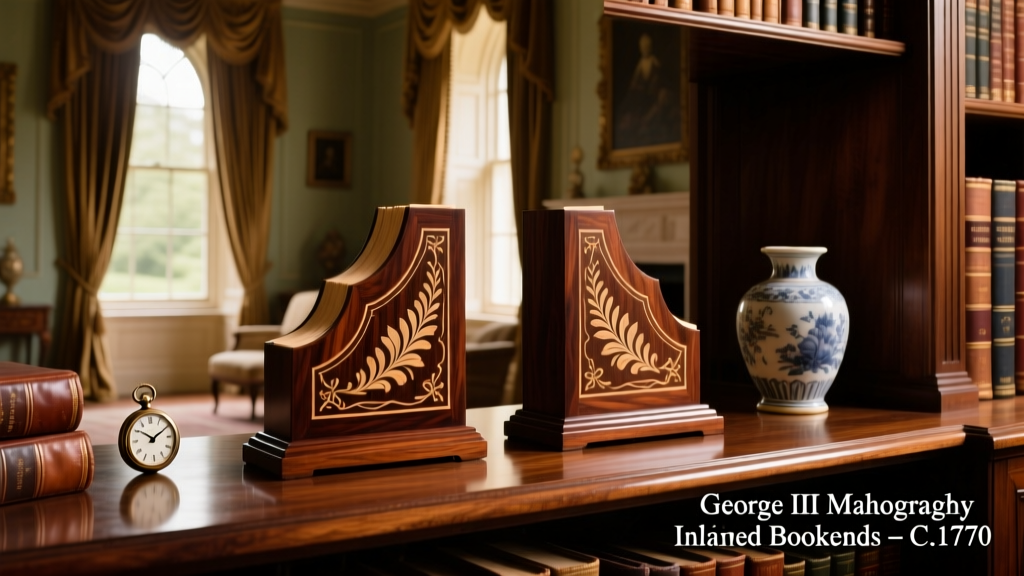
George III Mahogany Bookends with Satinwood Inlay: Authenticity, Craftsmanship, and Restoration Protocol

Vintage Swimsuits Make Splash at Auction: Collectibility, Craftsmanship, and Record-Breaking Sales
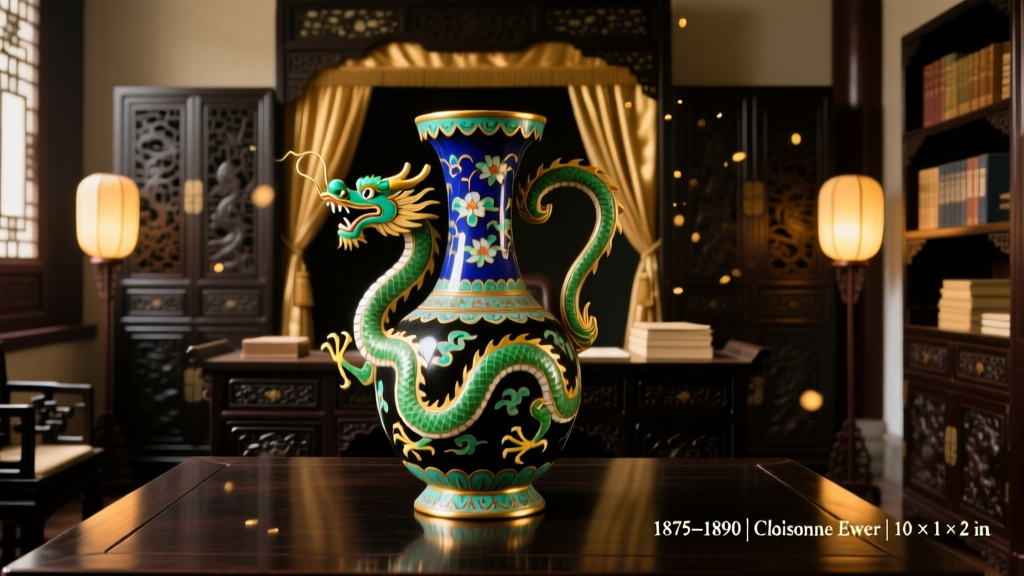
Cloisonné Ewer with Dragon Spout Heads and Lappet Border: A 19th-Century Masterpiece Measuring 10½ Inches
William C. Morris: American Cabinetmaker, Innovator, and the Forgotten Architect of Mid-Century Modern Furniture

George III Mahogany Window Bench, c. 1785: Anatomy, Provenance, and Restoration of a 42-Inch Upholstered Square-Legged Seating Piece

Early European Art Heads: Highlights and Provenance from the January 21, 2024 Auction

The Atlas Lighting Sputnik Chandelier: A Deep-Dive Restoration and Design Analysis of the 24-Inch Radiating Brass Fixture
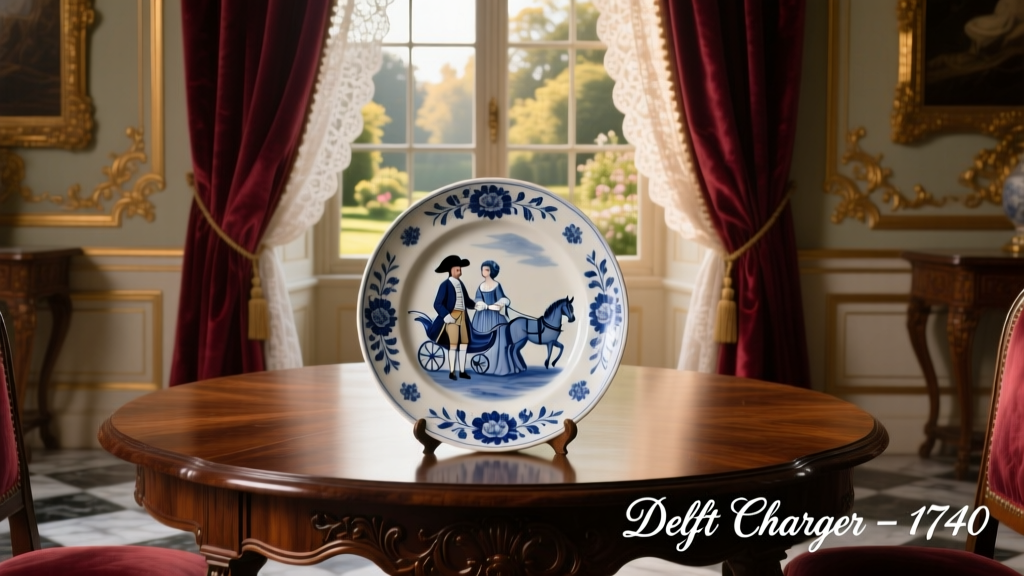
Delft Charger 'Couple in a One-Horse Trap' — Boch Factory Provenance, Iconography, and Conservation Ethics
Marblehead Bowl Flower Frog: Decoding the Matte Medium Blue Glaze with Ship Mark (3½ × 7½ in)