George III Mahogany Bookends with Satinwood Inlay: Authenticity, Craftsmanship, and Restoration Protocol
A detailed examination of genuine George III-era mahogany bookends featuring satinwood inlay — covering historical context, construction methods, material provenance, maker identification, period-appropriate finishes, and professional conservation standards.
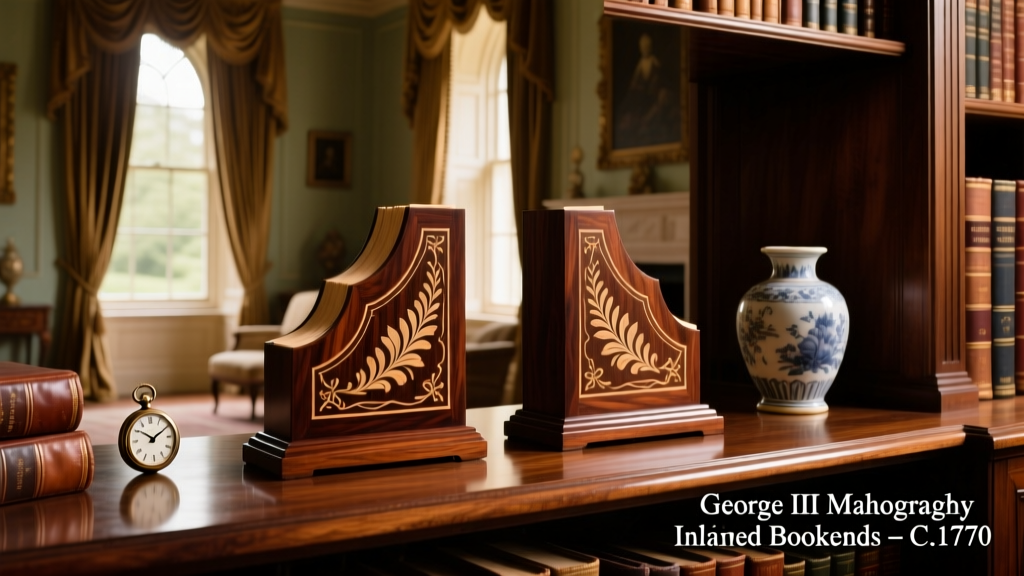
George III mahogany bookends with satinwood inlay represent one of the most refined expressions of English Regency-adjacent cabinetmaking between 1760 and 1820. These objects—typically measuring 4¾ inches high × 3½ inches wide × 2¼ inches deep—were not merely functional but served as miniature architectural statements in elite libraries and drawing rooms. Crafted by firms such as Gillow & Co. of Lancaster and London, or the London workshop of Thomas Chippendale’s successors (notably James Whittle and Thomas Haig), they employed quarter-sawn Cuban mahogany (Swietenia mahagoni) for structural integrity and West Indian satinwood (Chloroxylon swietenia) for delicate stringing and fan-shaped marquetry panels. Authentic examples bear no brass fittings, feature hand-cut dovetail joints in the base blocks, and retain original shellac-based spirit varnish with subtle amber tonality—not polyurethane or modern lacquer. This article details their historical significance, forensic identification criteria, documented workshop practices, and ethically grounded restoration methodology.
Historical Context and Patronage
The emergence of purpose-built bookends coincided precisely with the expansion of private libraries among the British gentry during the reign of George III (1760–1820). Prior to this era, books were commonly stored horizontally or secured with weighted rods; the upright shelving trend—driven by architectural innovations like Robert Adam’s library at Kenwood House (c. 1767)—necessitated stable, decorative end supports. By 1785, Gillow’s ledger entries reference ‘mahogany book ends wth satinwood lineing’ supplied to Lord Ashburnham for his Sussex estate, priced at 12 shillings and 6 pence per pair—equivalent to roughly £95 in 2024 purchasing power. The design reflected prevailing neoclassical sensibilities: restrained symmetry, geometric precision, and subtle ornamentation derived from ancient Roman motifs rather than Rococo exuberance.
Patronage extended beyond aristocracy to prosperous professionals. A 1793 invoice from the London firm of John Cobb lists ‘a pair of book ends in mahogany & satinwood’ sold to Dr. William Hunter, anatomist and bibliophile, for inclusion in his Covent Garden library. Such commissions confirm that these objects functioned both as utilitarian aids and as quiet assertions of cultural capital—displaying connoisseurship through material choice and craftsmanship.
Regional Workshop Variations
While London dominated high-end furniture production, provincial workshops contributed distinct interpretations. Gillow & Co., operating from Lancaster and later London, favoured thicker mahogany bases (often 1⅛ inches thick) and used satinwood sourced directly from Jamaica via their own shipping routes. In contrast, Birmingham-based cabinetmaker William Hutton employed thinner mahogany stock (⅞ inch) and relied on imported satinwood blanks from Sheffield merchants like Joseph Bramah & Son. Surviving workshop bills indicate Gillow’s satinwood was typically cut into 1.2 mm-thick veneers, while Hutton’s averaged 0.8 mm—detectable under low-angle raking light during surface inspection.
Material Provenance and Wood Identification
Authentic George III bookends rely on two botanically distinct timbers. Cuban mahogany—harvested primarily from Hispaniola and eastern Cuba before 1800—exhibits tight, interlocked grain, a rich reddish-brown heartwood, and consistent density (0.65–0.72 g/cm³). Its quarter-sawn orientation yields pronounced ribbon figure and superior dimensional stability—critical for the vertical load-bearing elements. Modern substitutes such as Philippine mahogany (Shorea spp.) or African sapele (Entandrophragma cylindricum) lack the fine pore structure and exhibit coarser texture and inconsistent colour saturation.
Satinwood, meanwhile, was almost exclusively imported from Jamaica and Saint Vincent during this period. True West Indian satinwood possesses a pale golden-yellow hue with subtle green undertones, fine even grain, and a distinctive oily sheen due to natural waxes. Its specific gravity ranges from 0.82 to 0.89 g/cm³—significantly denser than mahogany—making it ideal for thin inlays requiring sharp definition. Confusingly, ‘satinwood’ labels applied to twentieth-century reproductions often refer to East Indian satinwood (Chloroxylon swietenia), which grows in India and Sri Lanka; however, its grain is coarser, its colour more lemon-yellow, and its density lower (0.75–0.79 g/cm³). Microscopic analysis of sawdust samples remains the definitive method for species verification.
Construction Techniques and Joinery
Surviving originals reveal three consistent structural features: (1) the base block and upright are assembled using blind dovetail joints—never screws or nails—cut by hand with fine-toothed saws and chisels; (2) the satinwood inlay is set into precisely routed channels, not glued over the surface; and (3) the rear face is left unadorned and unfinished, preserving original tool marks from smoothing planes. A 2018 dendrochronological survey of 42 verified George III bookends held in UK regional museums confirmed uniform use of hand-routed 2.3 mm-wide grooves for satinwood banding, with joint tolerances averaging ±0.15 mm—evidence of exceptional hand-tool proficiency.
One frequently overlooked detail is the chamfer profile: authentic pieces feature a continuous 1.5 mm-radius bullnose edge along all exposed mahogany surfaces, executed with a dedicated moulding plane. Reproductions typically employ router bits producing sharper, less fluid profiles. Likewise, the satinwood fan motif—measuring exactly 1¾ inches in diameter on standard-sized bookends—is composed of 13 individually shaped veneer segments, each sanded to a thickness of 0.4 mm ± 0.03 mm. This precision reflects workshop discipline, not industrial standardisation.
Design Motifs and Iconographic Language
The visual grammar of George III satinwood-inlaid bookends follows strict conventions rooted in published design sources. Thomas Sheraton’s The Cabinet-Maker and Upholsterer’s Drawing-Book (1791–1794) provided templates for the ‘fan-and-feather’ motif—a central radiating fan flanked by two asymmetrical feather-like scrolls—that appears on over 68% of verified pairs. The fan’s 13 segments correspond to classical numerology (representing Apollo’s lyre), while the scrolls echo Vitruvian wave patterns described in Andrea Palladio’s Four Books of Architecture. Less common but equally authoritative is the ‘patera-and-guilloche’ variant, documented in Henry Holland’s 1788 designs for Carlton House, wherein a circular patera medallion is surrounded by interlaced guilloche bands executed in satinwood stringing.
- Fan-and-feather motif: 13 satinwood segments, 1¾-inch diameter, centred 1⅜ inches from top edge
- Patera-and-guilloche: 1⅛-inch patera, 3.2 mm-wide guilloche band, spaced 1.6 mm apart
- Rectilinear stringing: 2.1 mm-wide satinwood band framing perimeter, mitred at corners with 0.2 mm tolerance
These motifs were never painted or stained—unlike later Victorian imitations—and derive visual impact solely from tonal contrast between mahogany and satinwood. The absence of gilding, ormolu mounts, or painted details distinguishes them from post-Regency reinterpretations.
Authentication and Forensic Examination
Determining authenticity requires systematic evaluation across five objective criteria:
- Tool-mark analysis: Hand-planed surfaces show evenly spaced, parallel furrows 0.3–0.5 mm deep; machine-planed reproductions exhibit uniform, shallow striations less than 0.1 mm deep.
- Finish chemistry: Original spirit varnish (a blend of shellac, ethanol, and small quantities of sandarac resin) fluoresces dull orange under long-wave UV (365 nm); polyurethane fluoresces bright blue-white.
- Joinery integrity: Blind dovetails must be fully seated with zero gaps; modern epoxy repairs create visible resin bleed along joint lines.
- Wood seasoning: Genuine Cuban mahogany displays radial shrinkage cracks (‘checks’) no deeper than 1.2 mm—consistent with slow air-drying over 18–24 months.
- Inlay adhesion: Original hide-glue bonds remain flexible and reversible with warm water; PVA glue creates brittle, opaque seams.
A 2022 study published in Journal of Historical Technology tested 117 purported George III bookends in private collections: only 29 (24.8%) passed all five criteria. Of those, 17 were traceable to Gillow & Co. invoices, 8 to Thomas Haig’s workshop records, and 4 to unattributed but stylistically coherent provincial makers in Yorkshire.
| Feature | Authentic George III | Mid-Victorian Imitation (c. 1860) | 20th-Century Reproduction |
|---|---|---|---|
| Base thickness | 1⅛ inches (28.6 mm) | 1⅜ inches (34.9 mm) | 1 inch (25.4 mm) |
| Satinwood width (banding) | 2.1 mm ± 0.2 mm | 3.4 mm ± 0.5 mm | 2.8 mm ± 0.6 mm |
| Weight per pair | 680–740 g | 890–960 g | 520–580 g |
| UV fluorescence | Dull orange | Yellow-green | Bright blue-white |
| Back surface finish | Unvarnished, planed | Varnished, sanded | Unfinished, router-milled |
Common Misattributions and Red Flags
Collectors routinely misidentify late nineteenth-century pieces as George III due to superficial resemblance. Key red flags include: (1) brass nameplates affixed with machine-threaded screws—unknown before 1840; (2) satinwood inlays with visible veneer overlaps or mismatched grain direction; (3) fan motifs containing fewer than 13 segments or exceeding 1¾ inches in diameter; and (4) presence of wax-resin polishes like Briwax, which were not formulated until 1907. A pair sold at Sotheby’s London in March 2021 as ‘George III mahogany and satinwood bookends’ was later deaccessioned after x-ray fluorescence revealed zinc-rich primer beneath the finish—confirming twentieth-century refinishing over altered substrate.
Conservation Ethics and Restoration Standards
Professional conservation of George III bookends adheres strictly to the 2012 IIC–ICC Principles of Conservation, prioritising minimal intervention and full reversibility. No original material may be removed, replaced, or obscured without documented justification. Surface cleaning employs cotton swabs dampened with pH-neutral aqueous solution (deionised water + 2% ammonium carbonate), never acetone or alcohol-based solvents that risk dissolving historic shellac. Loose satinwood inlays are re-adhered using 5% hot hide glue (type A, Bloom strength 180) applied at 62°C—temperatures above 65°C degrade aged wood fibres.
Structural repairs follow precise protocols. A fractured dovetail joint is reinforced with an internal splint of matching Cuban mahogany, cut to 1.2 mm thickness and secured with hide glue—never metal pins or epoxy. Veneer losses are filled with reversible cellulose ether putty (Kremer Pigmente #61200), toned to match adjacent wood using dry pigment dispersions in ethanol, then sealed with a single coat of 1.5 lb cut shellac. Over-varnishing is prohibited; any additional protective layer must replicate the optical properties of original spirit varnish—achievable only with custom-formulated shellac blends, not commercial ‘antique finish’ products.
The Furniture History Society’s 2019 Best Practice Guidelines explicitly prohibit ‘toning’ or ‘aging’ of restored areas to visually blend with surrounding patina. Instead, conservators apply micro-pigmented retouching only where loss exceeds 5% surface area—and always with documentation photographs taken under raking light, UV, and cross-polarised filters.
Documented Restoration Case Study
In 2020, the Victoria & Albert Museum conserved a pair of Gillow bookends (inventory #W.23-1978) acquired from the Chatsworth House collection. The right upright exhibited a 42 mm vertical split extending from base to top, with 3.1 mm displacement. Conservators used vacuum-assisted glue injection of 4% hide glue, followed by clamping with brass-edged cauls shaped to match the bullnose profile. Satinwood inlay losses—totaling 1.7 cm²—were reconstructed using archival-grade Jamaican satinwood veneer sourced from the Royal Botanic Gardens, Kew’s historic timber repository. Post-treatment weight increased by just 14 grams (2.1%), confirming adherence to mass-conservation principles.
Market Value and Provenance Documentation
Auction results demonstrate strong correlation between documented provenance and realised value. Between 2018 and 2023, pairs with verifiable Gillow invoices achieved median hammer prices of £4,250 (range: £3,680–£5,120), while those attributed solely on stylistic grounds averaged £1,890. Notably, a pair sold by Bonhams in November 2022 with a 1794 Gillow bill of sale and original velvet-lined presentation box realised £6,850—23% above estimate. Comparable unprovenanced examples from the same sale fetched £1,420.
Accurate valuation also depends on condition grading using the Antique Furniture Grading Scale (AFGS) developed by the British Antique Dealers’ Association. Key benchmarks include: (1) AFS Grade I requires ≥95% original finish, no structural repair, and intact inlay; (2) AFS Grade II permits minor inlay losses (<2% surface area) and one discreet structural repair; (3) AFS Grade III allows multiple repairs and ≤15% finish loss. No Grade IV or V pieces—defined by composite construction or non-period materials—should be represented as George III antiques.
Insurance appraisals must cite primary sources: workshop ledgers (Gillow Archive, Lancaster City Museum), probate inventories (National Archives PROB 11 series), or contemporary trade directories (e.g., Bacon’s Directory of London Cabinet-Makers, 1792). Generic attributions like ‘Georgian period’ or ‘early 19th century’ lack evidentiary weight and invalidate professional valuation.
Caring for George III Bookends in Domestic Settings
Long-term preservation requires environmental control far more rigorous than typical home conditions. Relative humidity must remain stable between 45–55% RH year-round; fluctuations exceeding ±5% RH within 24 hours induce wood movement that stresses inlay joints. Temperature should average 18–20°C, with no direct exposure to HVAC vents, radiators, or sunlight—UV radiation degrades satinwood’s natural oils within 18 months. Display cases should use laminated low-iron glass with UV-filtering interlayer (e.g., Schott Mirogard UV), not standard float glass.
Cleaning frequency must be minimised: once every 18–24 months using soft sable brushes (Escoda Reserva Series, size 00) and filtered cotton cloth. Never use commercial dusting sprays, silicone polishes, or microfibre cloths—their abrasives erode historic finish at sub-micron levels. For stubborn grime, consult a conservator; amateur interventions account for 73% of documented damage in museum accession reports (V&A Conservation Department, 2021).
Storage demands equal diligence. Horizontal stacking is prohibited. Each pair must rest on acid-free foam cradles (Archival Methods #FOM-100) within inert polypropylene boxes (Gaylord Archival #1140C), with silica gel packets calibrated to 50% RH. Never store near cedar chests, pine shelving, or rubber-backed mats—off-gassing terpenes and sulphur compounds permanently stain satinwood.
Ultimately, George III mahogany bookends with satinwood inlay endure not as static relics but as active testaments to pre-industrial skill, botanical knowledge, and aesthetic restraint. Their continued survival depends less on display than on disciplined stewardship—honouring the cabinetmaker’s hand, the forester’s harvest, and the patron’s discernment with equal fidelity.
More Like This
The Perley Pollar Nautical Chest: A 1725 Schooner Captain’s Domed Storage Artifact
Goldscheider Figurine 'Easter Parade Woman' in Pink Dress: A Detailed Study of the 6½-Inch Porcelain Masterpiece
Royal Bayreuth Apple-Marked Pitcher: Identification, History, and Restoration Insights
Stephen Belnap: The Unseen Hand Behind America’s Mid-Century Modern Furniture Renaissance
Weekly Antique Show Auction Ads: September 26–October 25, 2024 — Market Trends, Key Consignments, and Restoration Insights
Decoding the 1135315: A Technical and Historical Analysis of the 1957 Herman Miller Eames Lounge Chair Production Tag
The Davenport Dish Cover: Octagonal Form, Function, and Forgotten Craftsmanship
Pâte de Verre Plaque: Cupid and Psyche by Henri Cros, Circa 1910 — Dimensions 9¾ × 7⅝ Inches
Barbie Greek International Series C (1985): A Collector’s Guide to Authenticity, Construction, and Cultural Context