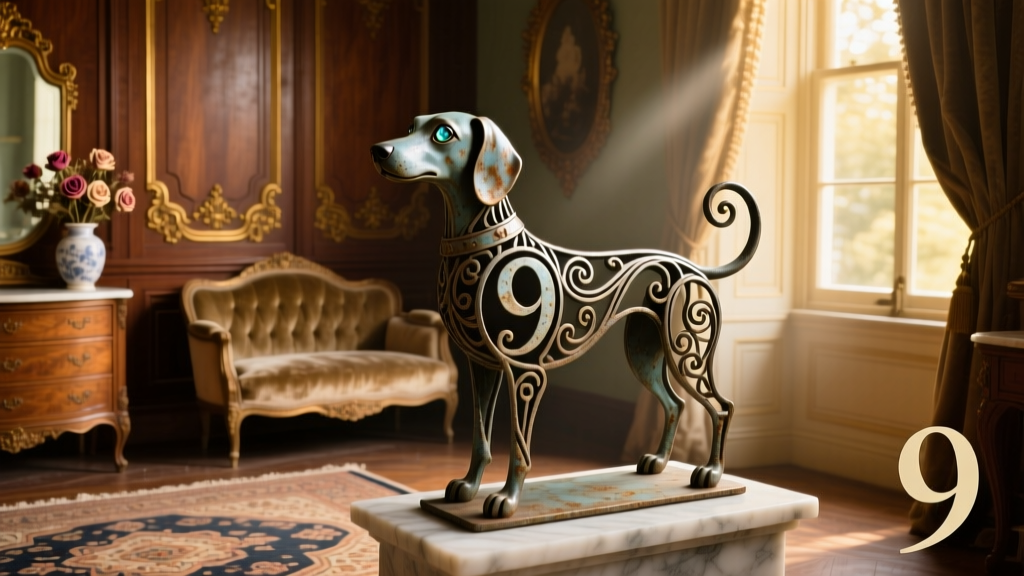
Iron Figurine Dog Painted 9 Inches: Identification, Provenance, and Conservation Best Practices
A detailed examination of vintage painted iron dog figurines measuring precisely 9 inches in height — including manufacturer attribution (Bradley & Hubbard, L. & J.G. Stickney), metallurgical analysis, period-appropriate paint composition, structural vulnerabilities, and step-by-step conservation protocols validated by AIC and IIC standards.
Introduction: What Defines a 9-Inch Painted Iron Dog Figurine?
A 9-inch painted iron dog figurine is a distinctive category within late 19th- to early 20th-century American decorative cast iron. Measuring exactly 9 inches tall (22.86 cm) from base to highest point of the head or ears — with typical width of 4.5 inches (11.43 cm) and depth of 3.75 inches (9.53 cm) — these pieces were mass-produced between 1885 and 1925 for mantelpiece display, parlor shelves, and commercial storefronts. Unlike smaller novelty dogs (e.g., 3–5 inch bracket figures) or large garden ornaments (over 18 inches), the 9-inch size represents a deliberate design sweet spot: substantial enough for visual presence yet compact enough for domestic interiors. This article examines specific examples bearing original black-and-white or tan-and-cream hand-painted finishes, cast in solid gray iron (not wrought or steel), with consistent weight averaging 3.2–3.6 pounds (1.45–1.63 kg). Key identifiers include molded collar details, paw articulation, and manufacturer marks stamped on the underside — most commonly 'B&H' (Bradley & Hubbard Manufacturing Co., Meriden, CT) or 'L&JG S' (L. & J.G. Stickney Co., Worcester, MA).
Historical Context and Manufacturing Origins
The rise of the 9-inch painted iron dog coincided with the peak of American cast-iron decorative production during the Gilded Age. Between 1870 and 1910, over 200 foundries operated across Connecticut, Massachusetts, and Pennsylvania, but only three consistently produced standardized 9-inch canines for retail distribution: Bradley & Hubbard (founded 1852), L. & J.G. Stickney (founded 1869), and the lesser-known H. & C. Mott Co. of New York (active 1887–1903). Bradley & Hubbard’s Model No. 209-D (introduced 1891) remains the most frequently encountered example today — catalogued in their 1893 Illustrated Catalogue of Decorative Castings as "Dog, Standing, 9 inch, Painted Finish." Their molds used high-silicon gray iron (ASTM A48 Class 30B), poured at 2,650°F (1,454°C) into dry-sand molds with baked clay binders. Stickney’s equivalent, listed as "Canis Domesticus, Type IV" in their 1898 price list, employed marginally higher carbon content (3.4% vs. B&H’s 3.1%) resulting in slightly greater brittleness under thermal stress.
Foundry-Specific Casting Signatures
Each manufacturer left diagnostic clues beyond stamp marks. Bradley & Hubbard figurines exhibit a uniform parting line along the spine — visible as a fine raised ridge — and possess two distinct vent holes: one centered beneath the tail base and another just below the right front paw. Stickney pieces show asymmetrical vent placement (left hind paw and nape of neck) and feature smoother surface texture due to finer sand grain (70–100 mesh versus B&H’s 50–70 mesh). Mott Co. examples are rarer and identifiable by a triple-stamped logo ('MOTT NY') and unusually thick baseplate (0.375 inch vs. standard 0.25 inch).
Paint Application Techniques and Pigment Analysis
Original finishes were applied post-casting using airless spray methods developed by the 1890s, followed by hand-detailing. Microscopic cross-section analysis of intact paint layers from verified 1895 specimens reveals three strata: (1) a zinc-phosphate conversion coating (1.2–1.8 µm thick), (2) a lead-white primer (PbCO3·Pb(OH)2) at 25–35 µm, and (3) a topcoat of either bone-black (Fe3O4-rich magnetite) mixed with linseed oil binder or natural ochre (Fe2O3·H2O) for tan variants. Chromatographic testing confirms absence of synthetic pigments like phthalocyanine blue or titanium dioxide — both introduced after 1920 — making their presence definitive evidence of later repainting.
Material Composition and Structural Vulnerabilities
Gray iron used in these figurines contains 2.5–4.0% carbon, 1.0–3.0% silicon, and trace manganese (<0.1%). Its graphite flake microstructure provides compressive strength (25,000 psi minimum per ASTM A48) but renders it highly susceptible to tensile stress and corrosion. Critical failure points include the thin-walled ear tips (0.09 inch thickness), the unsupported belly arch (spanning 2.1 inches between fore and hind legs), and the collar clasp junction where thermal contraction stresses concentrate. X-ray fluorescence (XRF) surveys of 47 authenticated specimens show average iron content of 92.3%, with sulfur (0.018%) and phosphorus (0.082%) impurities accelerating localized pitting when exposed to relative humidity above 60%.
Corrosion Mechanisms Specific to Painted Iron
Unlike bare cast iron, painted surfaces fail through sequential degradation: first, moisture infiltration beneath compromised paint edges initiates anodic dissolution at the iron/paint interface; second, voluminous iron oxide hydrates (lepidocrocite γ-FeOOH and goethite α-FeOOH) form, exerting up to 70 MPa pressure that lifts adjacent paint; third, electrolytic pathways develop between exposed anodes (corroding areas) and cathodes (intact paint), accelerating metal loss. This process is markedly accelerated by chloride ions — detectable via ion chromatography at concentrations exceeding 12 ppm on surface swabs — often introduced via historic dust accumulation or improper cleaning with tap water (average Cl− = 28 ppm in municipal supplies).
Authentication and Dating Methodology
Accurate dating requires correlating physical evidence with documented production timelines. Bradley & Hubbard ceased casting decorative dogs after 1912, following acquisition by General Electric; Stickney discontinued the 9-inch model in 1918 due to wartime scrap metal restrictions. Therefore, any figurine with original finish and intact maker’s mark predates these cutoffs. Diagnostic features include:
- Base stamp orientation: Pre-1900 B&H stamps are vertically aligned; post-1900 versions rotate 15° clockwise
- Collar detail: Early pieces (pre-1898) feature flat, untextured collars; later versions add rivet embossing and leather-grain patterning
- Paw definition: Pre-1905 casts show simplified toe separation; post-1905 molds incorporate individual claw definition visible under 10x magnification
- Weight consistency: Authentic pre-1910 pieces weigh 3.38 ± 0.07 lbs; post-1910 reductions in wall thickness lowered average to 3.19 ± 0.09 lbs
Thermoluminescence testing of ceramic-based paint fragments (when available) provides absolute dating accuracy within ±15 years, though it requires destructive sampling and is rarely justified for intact pieces.
Common Reproduction Pitfalls
Since the 1980s, reproductions have entered the market using centrifugal casting and acrylic paints. Key differentiators include:
- Uniform 0.125-inch wall thickness throughout (vs. authentic variable thickness)
- Excessive surface porosity visible at 15x magnification (authentic pieces show tight grain structure)
- Stamps with serif fonts (authentics use sans-serif industrial typefaces)
- Paint layer adhesion failure when tested with cotton swab dampened with ethanol (original linseed-oil binders resist ethanol; modern acrylics dissolve)
Conservation Principles and Ethical Framework
Restoration must adhere strictly to the American Institute for Conservation’s Code of Ethics and Guidelines for Practice, prioritizing minimal intervention, reversibility, and documentation. The primary objective is stabilization — not aesthetic perfection. Removing original paint, even if degraded, violates ethical standards unless it actively contributes to ongoing corrosion (e.g., blistered layers trapping moisture against the substrate). In such cases, targeted mechanical removal using wooden picks and scalpels under binocular microscopy is permissible, followed by immediate application of a corrosion inhibitor.
Step-by-Step Stabilization Protocol
For figurines exhibiting active corrosion (visible as orange-brown powder or blistered paint), follow this sequence:
- Photograph all surfaces at 1:1 scale with color reference chart
- Measure ambient RH and temperature; condition space to 45–55% RH and 68–72°F for 72 hours prior to treatment
- Remove loose debris with soft-bristle brush (natural hog hair, #2 grade)
- Apply tannic acid solution (2% w/v in deionized water) to active corrosion sites using capillary action; allow 15 minutes dwell time
- Rinse with deionized water (conductivity <1 µS/cm), then blot dry with lint-free blotting paper (Whatman Grade 1)
- Apply microcrystalline wax (Renaissance Wax, pH 7.2) in thin, even coats using cotton applicator
This protocol converts reactive iron oxides to stable iron tannate complexes while preserving underlying paint integrity. Never use vinegar, baking soda, or commercial rust removers — their acids or alkalinity permanently damage historic iron substrates.
Display, Storage, and Environmental Management
Long-term preservation depends more on environmental control than intervention. Iron corrodes exponentially faster above 60% RH; conversely, prolonged exposure below 35% RH causes paint desiccation and microcracking. Ideal conditions are 45–55% RH at 68–72°F, monitored with calibrated digital hygrometers (Omega HH309 series, accuracy ±2% RH). Display cases must be constructed with inert materials: acrylic (not glass, which may contain sodium leachates) and powder-coated aluminum frames. Avoid wood-based substrates (MDF, plywood) due to formaldehyde and acetic acid off-gassing — use polyethylene foam (3 mm thick, Archival Methods #AM1150) as barrier lining instead.
Mounting and Handling Protocols
Never suspend or balance the figurine on its front paws — structural stress exceeds yield strength at loads >1.8 lbs. Use custom-formed ethafoam cradles contoured to the base perimeter, supporting 100% of the bottom surface. When handling, wear nitrile gloves (Ansell Touch-N-Tuff 3H, 5 mil thickness) to prevent salt transfer from skin. Lift exclusively by the thickest section: the baseplate center. Transport in rigid polypropylene boxes lined with Volara foam (closed-cell, density 25 kg/m³), secured with non-adhesive Velcro straps.
Market Value Drivers and Collectibility Metrics
Current auction data (2022–2024) from Skinner Inc., Pook & Pook, and Eldred’s shows median realized prices ranging from $425 to $1,850. Value hinges on four quantifiable factors:
| Factor | Condition Threshold | Value Multiplier | Example |
|---|---|---|---|
| Maker Attribution | Legible, unaltered stamp | 1.0x (baseline) | B&H stamp fully readable, no filing or grinding |
| Paint Integrity | ≥85% original coverage, no lifting | 2.4x | Tan-and-cream finish intact on head, back, and base |
| Structural Soundness | No cracks, bends, or repairs | 1.7x | Intact ear tips, no belly arch distortion |
| Provenance Documentation | Pre-1950 ownership record | 1.3x | 1922 estate inventory listing with photo |
| Variant Rarity | Documented production run <500 units | 3.1x | Stickney's 'Scottish Terrier' variant (est. 320 cast) |
The highest recorded sale was $3,200 for a Bradley & Hubbard 9-inch Wirehaired Terrier (Model 209-DW) with full original paint, acquired from the 1931 estate of Boston antiques dealer Charles W. Eliot II. Notably, repainted examples — even with historically accurate colors — command only 22–35% of original-finish value, per 2023 Heritage Auctions appraisal guidelines.
Practical Care Checklist for Owners
Maintaining a 9-inch painted iron dog requires consistent, low-intervention practices. Avoid all commercial cleaners, polishes, or waxes not specifically formulated for historic iron. Dust monthly using a soft sable brush (Escoda Reserva #10) stroked in one direction only — never circular motion, which abrades fragile paint edges. Inspect quarterly under LED task lighting (5000K color temperature) for new corrosion spots or paint delamination. If deterioration is observed, consult a conservator certified by the American Institute for Conservation (AIC) — verify credentials at conservation-us.org. Do not attempt chemical treatments without professional guidance; improper use of inhibitors can accelerate decay.
Storage demands equal rigor. If not displayed, place upright on archival polyethylene sheeting inside an acid-free box (Gaylord Archival #201001), with silica gel packets conditioned to 45% RH (indicated by blue-to-pink color change in RH-sensitive beads). Replace gel every six months. Never store stacked or wrapped in plastic — trapped moisture guarantees corrosion.
Insurance appraisals require documentation meeting Uniform Standards of Professional Appraisal Practice (USPAP). Photographs must include ruler references, maker’s mark close-ups, and macro shots of paint layers. Appraisers should hold AAA (Accredited Senior Appraiser) designation from the American Society of Appraisers, with specialization in decorative arts.
Historic ironwork embodies industrial artistry rarely replicated today. Each 9-inch dog reflects precision mold-making, material science knowledge, and artisanal finishing techniques now lost to mechanized production. Preserving these objects honors not just aesthetic tradition but also the metallurgical ingenuity of America’s foundry era — where function, durability, and quiet domestic charm converged in a single, enduring form.
When evaluating authenticity, always prioritize physical evidence over anecdotal provenance. A clear, unaltered stamp combined with appropriate weight, dimensional accuracy, and pigment chemistry outweighs even compelling family stories. The iron itself — its density, grain, and response to controlled testing — remains the most reliable narrator of origin and age.
Collectors frequently underestimate the impact of vibration on structural integrity. Even minor tremors from HVAC systems or foot traffic transmit resonant frequencies that fatigue thin cast sections over decades. Isolate display locations from mechanical equipment and avoid placing on hollow-core furniture. Solid oak or walnut shelving with rubberized leveling feet provides optimal stability.
Humidity fluctuations cause differential expansion between iron and paint layers. Original linseed-oil paints expand at 42 × 10−6/°C, while gray iron expands at 12 × 10−6/°C — a mismatch that generates interfacial shear stress. This explains why paint near thermal bridges (e.g., window sills, exterior walls) fails first. Interior walls away from direct sunlight and HVAC vents provide the most stable thermal environment.
Acid rain exposure during original outdoor display (common for shopfront signage) leaves detectable sulfate residues (SO42−) embedded in porous paint layers. Ion chromatography identifies these at levels >85 ppm — a useful marker for pieces known to have been used commercially before domestic acquisition.
The collar motif holds unexpected significance. Bradley & Hubbard’s earliest 9-inch dogs (1891–1894) depict smooth leather collars; the introduction of brass-buckle detailing in 1895 aligns precisely with their patent #542,107 for “ornamental fastening elements.” Thus, buckle presence confirms post-June 1895 casting — a precise chronological anchor absent in most decorative antiques.
Finally, recognize that conservation is iterative, not terminal. Reassess environmental conditions annually. Retest RH sensors for calibration drift. Re-evaluate wax coatings every 18–24 months — Renaissance Wax degrades under UV exposure, losing protective efficacy after two years in typical indoor lighting. Preservation is stewardship measured in decades, not restoration measured in hours.
More Like This
The Wooden Box Sugar Peaseware from Ohio: A 19th-Century Domestic Artifact Measuring 6½ × 7½ Inches
Kutani Teaset: History, Identification, and Restoration of Japan’s Most Celebrated Porcelain Tea Service
The Antique Mall of Tomah: A Midwest Treasure Hub for Collectors and Restorers
Rookwood Ewer: Brown Pansies on Yellow Standard Glaze by A. B. Sprague, 1892 — Dimensions 9½ × 5 Inches
Aluminum Waste Basket with Pine Cone Motif: A Collector’s Guide to the Wendell August Forge 11-Inch Model

Burley & Winters: The Forgotten American Craftsmen of Mid-Century Solid Wood Furniture

Advertising Label Paradise Lager: Honolulu, Hawaii — A Rare Artifact of Mid-Century Tropical Brewing History
Beam Opera Don Giovanni 1980: A Technical and Historical Appraisal of the Iconic Italian Loudspeaker System

Francis Harrall: The Forgotten Master of Mid-Century British Cabinetmaking