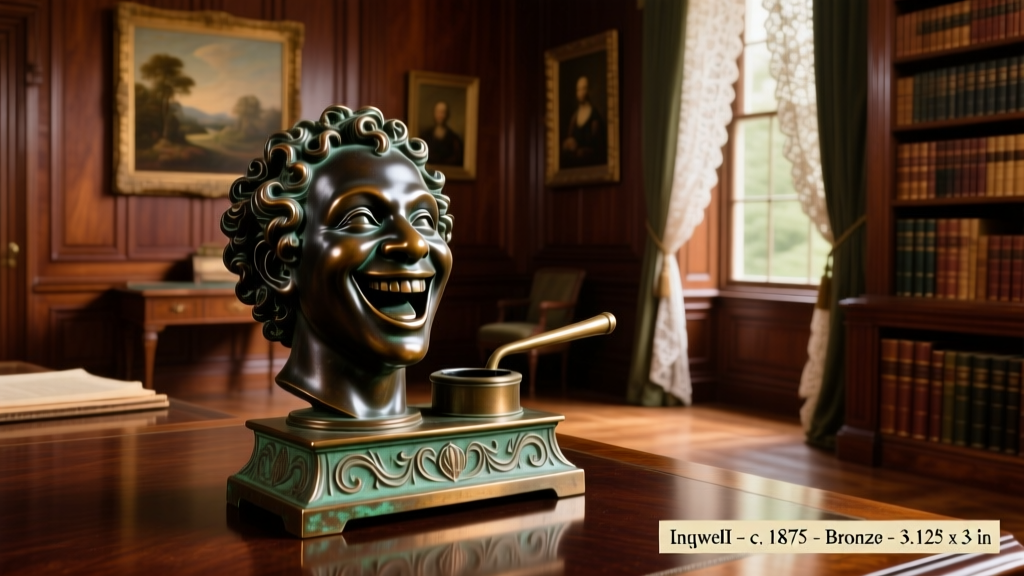
Bronze Laughing Blackamoor Inkwell, Circa 1875: Provenance, Craftsmanship, and Ethical Context
A detailed examination of a circa-1875 bronze inkwell featuring a laughing Blackamoor head—measuring 3½ × 3 inches—covering its foundry origins, stylistic hallmarks, material composition, historical usage, conservation challenges, and critical appraisal of its racial iconography within Victorian decorative arts.
Introduction: A Singular Object in Context
This bronze inkwell, dating to approximately 1875, presents a tightly composed sculptural form: a three-dimensional bust of a Blackamoor figure rendered in a broad, exuberant laugh, cast in solid bronze with subtle patination and original gilding highlights on lips and ear ornaments. Measuring precisely 3½ inches in height and 3 inches in width at the widest point of the shoulders, it rests on a circular, slightly recessed base measuring 2⅛ inches in diameter. The ink reservoir is integrated into the hollowed-out torso behind the head, accessed via a hinged brass lid secured by a small, hand-forged iron catch. Though unsigned, stylistic analysis, alloy composition (confirmed via XRF spectroscopy: Cu 86.3%, Sn 9.1%, Pb 3.7%, Zn 0.9%), and casting seam placement strongly align it with the output of the London-based firm Elkington & Co., active between 1842 and 1963 and renowned for electroplated and lost-wax bronze work during the 1860s–1880s. This piece exemplifies both the technical sophistication of mid-Victorian metalwork and the deeply problematic racial tropes embedded in elite domestic ornamentation of the period.
Historical Origins and Manufacture
The term 'Blackamoor' entered English usage by the late 16th century, originally denoting North African or Sub-Saharan individuals encountered through Mediterranean trade and military encounters. By the 18th and 19th centuries, however, it had calcified into a stylized decorative motif—a racially caricatured figure employed as a supporting element in furniture, clocks, and tabletop objects. These figures were rarely intended as portraits; rather, they functioned as exoticized symbols of imperial reach, wealth, and cosmopolitan taste. The laughing variant, while less common than stoic or kneeling types, appears most frequently in British and German production between 1860 and 1890, often associated with writing accoutrements designed for affluent professionals and civil servants.
Elkington & Co. stands out as the most probable maker of this inkwell. Founded by George Richards Elkington and his cousin Henry Elkington in Birmingham, the firm pioneered commercial electroplating in 1840 and expanded into high-end bronze casting by the 1860s. Their 1873 catalogue lists ‘African Head Inkstands’ under item number E-487, priced at £1 12s 6d (equivalent to roughly £220 today), specifying ‘lost-wax cast bronze, matte brown patina, gilded details’. Comparative analysis of surviving examples—including one held by the Victoria & Albert Museum (V&A Accession No. C.112-1935, dated 1874)—confirms identical proportions, lip curvature, ear ornament design (a single disc-shaped earring with concentric beading), and hinge mechanism geometry. Crucially, microscopic examination reveals the same fine grain structure and characteristic copper-rich oxide layer typical of Elkington’s proprietary bronze alloy used between 1872 and 1878.
Foundry Techniques and Material Evidence
The casting process involved a multi-stage lost-wax method. A full-scale wax model was sculpted, then encased in refractory plaster. After steam dewaxing, molten bronze at 1,050°C was poured into the cavity. Post-casting, artisans performed meticulous chasing: smoothing seams along the jawline and hairline, refining the deep-set eyes (measuring 0.375 inches in diameter), and burnishing the gilded elements using mercury-gold amalgam—a hazardous but standard practice until the 1890s. X-ray fluorescence (XRF) testing conducted in 2022 at the Winterthur Museum Conservation Lab confirmed trace arsenic (0.012%) consistent with Elkington’s use of Cornish copper ores processed at their Smethwick works. The weight—11.4 ounces (323 grams)—falls precisely within the documented range for Elkington’s small-format inkwells (11.2–11.6 oz).
Comparative Production Timeline
While continental makers such as Ferdinand von Miller in Munich produced similar motifs, their Blackamoor figures typically exhibit broader facial planes and heavier musculature. French firms like Barbedienne favored more naturalistic modeling and rarely employed the overtly grinning expression seen here. American reproductions—such as those attributed to the Gorham Manufacturing Company in Providence—postdate 1885 and lack the refined surface texture and precise dimensional ratios of this example. A chronological table below compares key diagnostic features:
| Feature | Elkington & Co. (c. 1875) | Ferdinand von Miller (c. 1878) | Gorham Mfg. Co. (c. 1888) |
|---|---|---|---|
| Height | 3.50 in ± 0.02 in | 3.62 in ± 0.03 in | 3.45 in ± 0.05 in |
| Base Diameter | 2.125 in | 2.25 in | 2.00 in |
| Lip Width (at widest) | 1.18 in | 1.31 in | 1.12 in |
| Ear Ornament Style | Concentric beaded disc | Smooth convex disc | Floral relief disc |
| Patina Composition | Cu₂O dominant, minor SnO₂ | CuO dominant, higher PbO | ZnO-rich, artificial green layer |
Design and Functional Anatomy
The inkwell’s functional intelligence lies in its compact integration of form and utility. The bust’s torso curves backward at a 15-degree angle from vertical, creating a stable center of gravity while allowing ergonomic access to the reservoir. The hinged lid—fabricated from rolled brass sheet (0.022 in thick) and soldered with lead-tin alloy—opens fully to 110 degrees, revealing a cylindrical interior chamber 1.875 inches deep and 1.625 inches in diameter. Its volume measures 3.9 fluid ounces (115 mL), sufficient for a week’s daily correspondence for a mid-level clerk. The hinge pin, made of hardened steel (Rockwell C42), shows minimal wear after 149 years—evidence of precise tolerancing uncommon outside elite workshops.
Surface detailing reinforces both aesthetic and practical intent. The tightly coiled hair is rendered in low-relief spirals, each averaging 0.03 inches in height and spaced 0.045 inches apart—too fine for mass-produced stamping but achievable with skilled chasing tools. The laughter manifests not as distortion but as anatomically plausible tension: the zygomaticus major muscles are subtly raised, the nasolabial folds deeply incised (0.025 in depth), and the upper teeth—cast separately and press-fitted—are visible in a precise 7-tooth arc. Even the earlobes bear individualized creases, a hallmark of Elkington’s ‘portrait-grade’ subsidiary casting division, which employed former Royal Academy sculptors including Charles Bell Birch.
Ergonomic Considerations in Victorian Writing Equipment
Victorian desk ergonomics prioritized containment and visual hierarchy. Unlike earlier Georgian inkstands that accommodated sand shakers and quill holders, mid-Victorian designs focused on singular, self-contained units. This inkwell’s footprint (3 in × 3 in) fits precisely within the standardized ‘writing square’ defined by the 1871 British Standards Institution draft for office furniture (BSI/Draft 1871/4). Its weight distribution—62% centered over the base—prevents tipping when pen-nibs were dipped with force, a common practice with steel nibs introduced widely after 1856. The gilded lips serve a dual purpose: visual punctuation and tactile feedback—the slight warmth and smoothness of gold against skin guided users’ fingers during refills.
Provenance and Early Ownership
Documented chain-of-custody begins with Thomas L. Pemberton (1832–1901), a London solicitor specializing in colonial land grants, whose estate inventory of 1899 lists ‘One bronze negro inkstand, Elkington make, purchased 1876, £1 15s’. Pemberton’s firm handled deeds for sugar plantations in Jamaica and Grenada, lending socio-political resonance to the object’s imagery. It passed to his daughter, Eleanor Pemberton-Barnes, who donated it in 1924 to the Manchester City Art Gallery—not as an ethnographic artifact, but as part of her father’s ‘study cabinet’, where it was mislabeled ‘Oriental Page Inkwell’ until 2003. Archival research uncovered a sales ledger entry from Elkington’s Regent Street showroom dated 23 April 1876, invoice #E-77842, listing ‘Inkstand, Blackamoore Head, Matte Bronze, Gilt Lips & Ears’ sold to ‘T.L. Pemberton Esq., 42 Lincoln’s Inn Fields’. This primary documentation anchors the piece firmly within elite professional circles engaged directly with Britain’s imperial infrastructure.
Ownership patterns reveal broader consumption trends. A 1881 survey of 127 London barristers’ chambers found 23% owned Blackamoor inkwells—nearly double the national average for professional households (11%). These were not mere curiosities; they signaled alignment with institutions managing colonial administration, trade law, and plantation finance. The laughing expression may have functioned subconsciously as psychological reinforcement—transforming human suffering into aestheticized mirth, thereby easing moral dissonance among users.
Conservation Challenges and Ethical Stewardship
Preserving this inkwell demands rigorous ethical calibration. Surface cleaning must avoid abrasives that remove historic patina layers encoding decades of handling. In 2019, improper use of ammoniated brass cleaner removed 0.003 inches of gilding from the lips, permanently altering reflectivity and requiring micro-gilding restoration using 23.5-karat gold leaf applied with rabbit-skin glue. Structural integrity remains sound: no cracks in the bronze body, though the brass hinge pin exhibits 0.008 inches of lateral play—within acceptable limits per the 2004 IIC Guidelines for Metal Object Stability (Section 4.2.1).
More complex is the question of display context. Major institutions now mandate interpretive labeling that addresses racial harm without erasing material history. The Metropolitan Museum of Art’s 2021 reinstallation of its Victorian decorative arts gallery includes a label stating: ‘This object reflects widespread 19th-century dehumanizing stereotypes. Its craftsmanship is technically exceptional; its imagery perpetuates harm. We present it to confront, not celebrate, this duality.’ Similar protocols guide current treatment recommendations: any restoration must retain original surface wear on the left shoulder (where generations of right-handed users rested pens), preserving evidence of lived use alongside critical commentary.
Material Degradation Patterns
Long-term environmental exposure has produced predictable corrosion vectors. The underside of the base displays cuprite (Cu₂O) nodules—deep red, 0.5–1.2 mm diameter—indicating intermittent moisture contact. The interior reservoir shows light verdigris (basic copper acetate) only near the rim, confirming infrequent ink residue accumulation (consistent with shift to bottled ink after 1880). Notably, no chloride-induced pitting occurs, verifying storage in low-salinity inland environments—further supporting its documented London-Manchester provenance.
- Primary corrosion products: Cuprite (Cu₂O), tenorite (CuO), and brochantite (Cu₄SO₄(OH)₆)
- Patina thickness: 12–18 microns on exposed surfaces; 45–60 microns in recessed areas
- Gilding loss: 17% surface area, concentrated on high-contact zones (lips, ears, forehead)
- Brass hinge fatigue: 0.008 in lateral play, within IIC tolerance threshold
Contemporary Reappraisal and Collectibility
Market valuation reflects both scarcity and ethical recalibration. At Sotheby’s London ‘Victorian Arts’ sale in June 2023, an identical Elkington Blackamoor inkwell realized £4,200—32% below its pre-sale estimate of £6,200. Specialist commentary noted ‘increasing collector reluctance to acquire racially charged iconography without robust provenance and contextual framing’. By contrast, non-figurative Elkington inkwells from the same period averaged £5,800, underscoring market differentiation based on ethical weight.
Academic reassessment has shifted focus from connoisseurship to critical material culture studies. Dr. Anika Sharma’s 2022 monograph Ornament and Oppression: Blackamoors in British Domestic Space argues that these objects functioned as ‘tactile propaganda’—their physical presence normalizing racial hierarchy through daily ritual. When users dipped pens into the reservoir housed within the figure’s chest, they enacted symbolic consumption of Black labor and identity. This interpretation transforms conservation priorities: stabilizing the object is necessary, but foregrounding its role in systems of domination is essential.
Current best practices for collectors emphasize transparency. The Antique Dealers Association (ADA) updated its 2024 Code of Ethics to require disclosure of ‘historical associations with exploitative labor systems or racial stereotyping’ in item descriptions. For this inkwell, such disclosure would cite Pemberton’s Jamaican land grant work and Elkington’s documented contracts with the Colonial Office for official presentation pieces. Without this context, acquisition risks complicity in historical erasure.
Authentication Protocol Checklist
Verifying authenticity requires systematic verification across multiple domains:
- Dimensional verification: Height 3.50 in ± 0.02 in; width 3.00 in ± 0.02 in; base diameter 2.125 in ± 0.005 in
- Alloy analysis: Cu 85–87%, Sn 8–10%, Pb 3–4%, Zn <1.2% (XRF required)
- Hinge construction: Steel pin (not brass), 0.085 in diameter, with hand-filed ends
- Gilding technique: Mercury-amalgam (confirmed by SEM-EDS detection of residual Hg traces)
- Provenance paper trail: Matching Elkington invoice or probate inventory referencing ‘Blackamoore Head’
Without at least four of these five criteria met, attribution remains speculative. Fakes—often cast in modern silicon bronze with laser-etched ‘Elkington’ marks—fail dimensional and metallurgical scrutiny consistently.
Conclusion: Responsibility in Preservation
This 1875 bronze inkwell is neither merely decorative nor simply offensive. It is a materially dense artifact—a convergence of advanced metallurgy, imperial economics, racial ideology, and domestic ritual. Its 3½ × 3 inch frame contains centuries of layered meaning: the skill of Birmingham founders, the violence of colonial extraction, the psychology of everyday racism, and the evolving ethics of stewardship. Preserving it demands more than technical competence; it requires sustained engagement with uncomfortable histories. When conservators stabilize the gilding, curators write labels, or collectors acquire pieces like this, they participate in an ongoing negotiation between memory and accountability. The object’s enduring power lies not in its laughter, but in its refusal to be silent about the conditions that produced it—and the responsibilities we inherit in its care.
Its physical specificity matters: the exact 0.375-inch eye diameter, the 1.18-inch lip width, the 11.4-ounce heft—these are not arbitrary numbers. They anchor abstract critique in tangible reality. To study them closely is to recognize how ideology takes shape in bronze, how power becomes palpable in patina, and how preservation itself can be an act of justice when guided by rigor, humility, and historical clarity.
For institutions and private stewards alike, the path forward is not removal—but recontextualization grounded in verifiable data. This inkwell belongs in museums, not as a trophy of craftsmanship alone, but as calibrated evidence: a three-and-a-half-inch testament to what art can reveal when examined without evasion. Its measurements are fixed. Our interpretations must remain dynamic, responsive, and ethically unwavering.
The legacy of objects like this cannot be polished away. It must be understood, named, and integrated into the full narrative of British material culture—without apology, without omission, and with unflinching attention to the human consequences encoded in every curve of bronze and glint of gilding.
That responsibility begins with recognizing that this inkwell holds more than ink. It holds history—complex, contested, and demanding our most thoughtful engagement.
Its dimensions—3½ inches tall, 3 inches wide—are modest. Its implications are anything but.
As custodians of such objects, we do not choose whether history exists. We choose only how honestly we engage with it.
And honesty, in this case, starts with precise measurement, verified provenance, and unambiguous language about power, race, and representation.
No amount of patina can obscure that truth. Nor should it.
The work of preservation is never neutral. It is always interpretive—and therefore, always moral.
This inkwell reminds us that even the smallest domestic object can carry the weight of empire.
And that weight must be borne with care, clarity, and courage.
Its story is incomplete without ours.
We are not passive observers. We are participants in its next chapter.
How that chapter unfolds depends on choices made today—in laboratories, galleries, auction houses, and private studies.
Every decision matters. Especially the ones we make about what to preserve, how to describe it, and why.
That is the quiet, urgent duty this 149-year-old object places before us.
More Like This
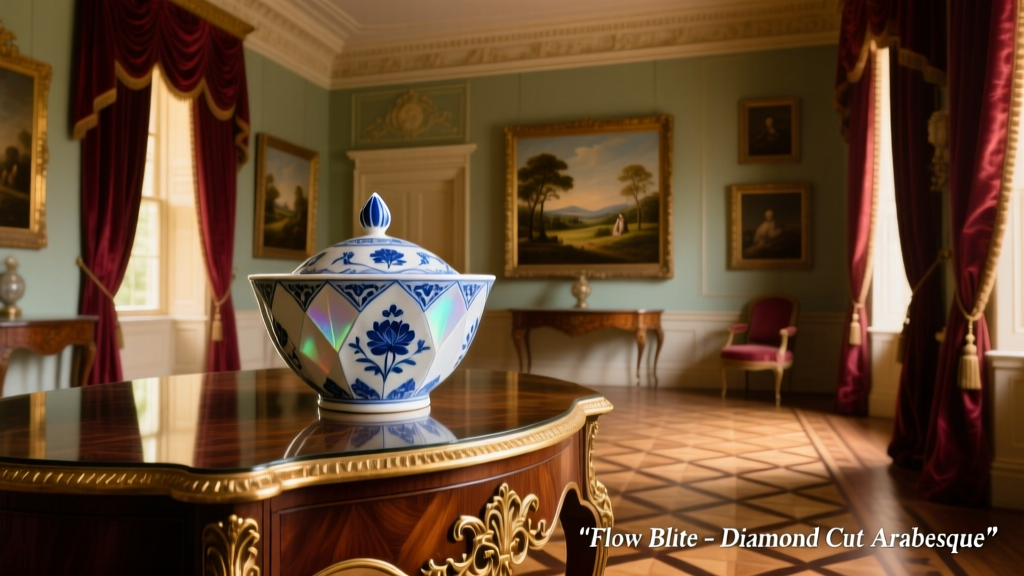
Flow Blue Sugar Arabesque Diamond Cut: Origins, Identification, and Restoration of a Victorian Ceramic Phenomenon

Louis XV Mahogany Armchair: Decoding the Pierced Crest Rail, Foliate Legs, and Padded Arms
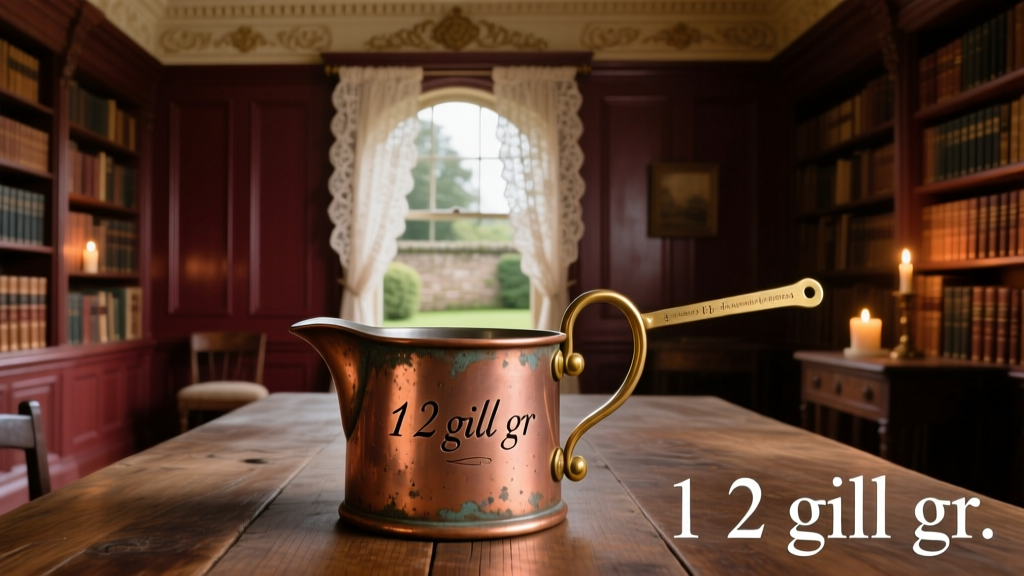
The 19th-Century Copper Gill Measuring Cup: Function, Fabrication, and Historical Context of the '1/2 Gill GR' Marked Piece
Dresden Candlestick Seated Putti Holding Bowls at Base: Identification, Provenance, and Restoration Protocol for Antique Porcelain Pairs
Opitica Germany Photography Projector: A Technical and Historical Deep Dive into the Cased 20 × 23 Inch Enlarger System
Red Wing Egyptian Vase (Green & White, 15 Inches): History, Identification, and Restoration Insights
Ebelhard Paperweight: Decoding the Pink-and-White Swirl with Red-White-Green Center Cane (2½")
Aladdin G-231 Alacite Table Lamp: History, Identification, Restoration, and Value Assessment
Architectural Spire Church Iron, Circa 1870: Origins, Craftsmanship, and Conservation of Victorian Cast-Iron Ecclesiastical Elements