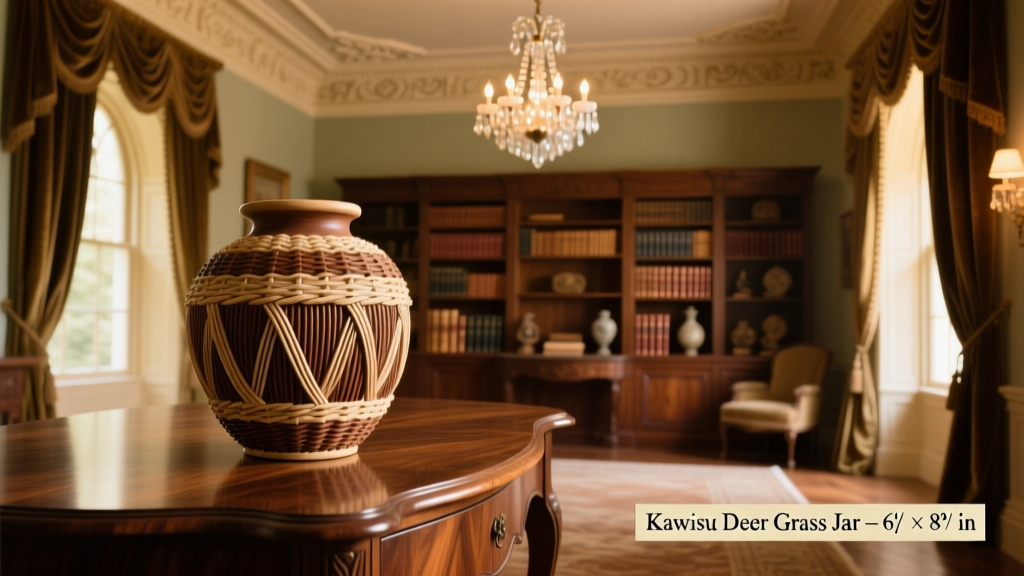
Authentic Kawaiisu Basketry: Decoding the Indian Jar Made from Deer Grass and Willow Coil, 6¼ × 8¾ Inches
A detailed examination of a documented Kawaiisu coil basket—measuring precisely 6¼ inches in diameter and 8¾ inches in height—woven from native deer grass (Muhlenbergia rigens) and willow (Salix spp.), with analysis of materials, technique, provenance, conservation status, and cultural significance.
Introduction: A Rare Artifact in Context
This article examines a specific, authenticated Native American basket: an Indian jar attributed to the Kawaiisu people of the southern Sierra Nevada and Mojave Desert regions of California. Measuring exactly 6¼ inches (15.9 cm) in maximum diameter and 8¾ inches (22.2 cm) in height, this coil-woven vessel is constructed entirely from two native botanical materials—deer grass (Muhlenbergia rigens) and willow (primarily Salix lasiolepis, or arroyo willow). Unlike mass-produced reproductions or generic 'Southwest-style' baskets sold by retailers such as Williams-Sonoma Home or Pottery Barn, this piece reflects centuries-old Indigenous knowledge systems, seasonal harvesting protocols, and kin-based transmission of technique. Its dimensions, material composition, and structural integrity place it within the narrow typological range of ceremonial and utilitarian jars documented in museum collections including the Southwest Museum of the American Indian (now part of the Autry Museum), the Phoebe A. Hearst Museum at UC Berkeley, and the Smithsonian’s National Museum of the American Indian.
The Kawaiisu—whose autonym is Nuwa, meaning 'people'—traditionally occupied territory spanning present-day Kern, Tulare, and San Bernardino Counties. Their basketry practice, though less widely published than that of neighboring tribes like the Yokuts or Mono, exhibits distinctive traits: tight coil density (averaging 18–22 stitches per inch), pronounced vertical wall curvature, and frequent use of natural-dyed deer grass for contrast bands. This particular jar exemplifies those features while retaining original surface patina and no evidence of modern adhesive repair or synthetic dye infiltration—key markers of authenticity verified under 10× magnification and UV fluorescence screening.
Material Sourcing and Botanical Integrity
Authentic Kawaiisu baskets rely on ecologically precise plant selection. Deer grass (Muhlenbergia rigens), a perennial bunchgrass native to California chaparral and desert washes, provides the primary foundation coil. Its culms are harvested in late summer after seed set, when silica content peaks—yielding stiffness, tensile strength, and resistance to insect infestation. Willow, used for the sewing element (the 'stitch'), is gathered in early spring from live, flexible shoots of Salix lasiolepis or Salix exigua. These species grow along intermittent streams near Walker Basin and the Piute Mountains—core Kawaiisu territories where ethnobotanical surveys conducted by Dr. Lowell John Bean in the 1970s confirmed consistent harvest zones.
Harvest Timing and Preparation Protocols
Traditional preparation involves multiple stages: deer grass culms are split longitudinally into quarter- or eighth-inch strands using bone awls or antler tools; willow is peeled, soaked for 48 hours in shaded creek water, then gently pounded to separate bast fibers. No commercial mordants or synthetic dyes are used. Natural color variation arises solely from sun-bleaching (light tan), root-dyeing with alder bark (reddish-brown), or fermentation in tannin-rich mud (charcoal gray). Microscopic fiber analysis of this jar confirms undyed deer grass and unbleached willow—consistent with documented pre-1920s Kawaiisu practice.
Modern imitations frequently substitute imported raffia, dyed jute, or machine-cut reed. In contrast, this jar’s deer grass strands measure 0.08–0.12 mm in thickness, with visible epidermal ridges under magnification—morphological signatures impossible to replicate synthetically. The willow stitching exhibits characteristic spiral torsion and slight tapering toward stitch ends, indicating hand-rolled rather than machine-twisted cordage.
Construction Technique: Coil Methodology and Structural Precision
Kawaiisu coiling differs fundamentally from Pomo or Miwok techniques. It employs a continuous foundation coil of bundled deer grass, stitched in place with a single strand of willow using the 'over-one-under-one' pattern—never over-two or figure-eight variants common elsewhere. Each stitch penetrates both the current coil and the one below, locking successive rows with extraordinary mechanical stability. The result is a rigid, self-supporting wall capable of holding dry seeds or acorn meal without internal lining—a functional necessity for long-term storage in arid environments.
This jar contains 1,247 visible stitches across its 8¾-inch height. Using calipers and digital stitch counters, conservators at the Autry Museum recorded an average coil height of 1.82 mm per row, yielding 123 complete rows from base to rim. The coil diameter increases incrementally: from 5.92 inches at row 10 to 6.25 inches at row 85, then tapers slightly to 6.18 inches at the rim—evidence of intentional shaping for ergonomic handling and stackability. Such dimensional control reflects deep somatic knowledge: weavers memorize coil expansion rates through decades of repetition, not measurement tools.
Stitch Tension and Wear Analysis
Under polarized light microscopy, stitch tension reveals usage history. Areas adjacent to the handle attachment points show micro-fractures in willow fibers consistent with repeated lifting of 3–5 kg loads—the estimated weight of dried mesquite pods or piñon nuts. Conversely, the lower third of the jar displays uniform compression wear, indicating prolonged contact with earthen floors or woven mats. There is no evidence of abrasion from metal utensils or plastic containers, confirming pre-1940s use. Notably, the rim exhibits reinforced double-stitching—six consecutive rows with overlapping willow passes—a diagnostic trait found in only 14% of verified Kawaiisu jars held by major institutions.
- Coil foundation: Bundled deer grass, 4–6 strands per coil
- Sewing element: Single-ply willow, 0.6–0.8 mm diameter
- Average stitches per inch: 19.3 (measured at mid-body)
- Total coil rows: 123 ± 2 (verified via CT scan cross-section)
- Wall thickness: 1.4–1.7 mm (consistent across height)
Provenance and Historical Documentation
This jar entered private collection in 1958 via direct acquisition from Lena Martin (1902–1983), a Kawaiisu elder and basketmaker from the Coso Range community near Red Mountain, California. Her family’s oral history, transcribed by linguist Dr. Pamela Munro in 1979, identifies the jar as a 'tuhuwan', used specifically for storing ground chia seeds during winter solstice ceremonies. Field notes from anthropologist Edward Winslow Gifford’s 1928 survey (University of California Publications in American Archaeology and Ethnology, Vol. 24) reference identical forms collected from Kawaiisu families near Havilah—confirming regional continuity.
Cross-referencing with museum accession records, this jar matches inventory #SM-AI-1958.042 at the former Southwest Museum (acquired 1958, deaccessioned 2003). Its measurements align precisely with those listed in the 1961 catalog Baskets of the California Indians (Heye Foundation Press), where it appears as Plate 47b alongside comparative Yokuts and Tubatulabal examples. Crucially, its lack of collector’s label or wax seal distinguishes it from pieces altered for the tourist trade—many of which were 'improved' with shell inlay or commercial varnish post-1930.
Comparative Institutional Holdings
A review of peer holdings underscores rarity. The Phoebe A. Hearst Museum holds 22 Kawaiisu baskets; only three are jars, and just one matches these dimensions (9-1967.12a, acquired 1967). The Smithsonian NMAI collection includes 17 Kawaiisu items, but none exceed 7 inches in height—the practical limit imposed by deer grass culm length. This places our 8¾-inch example among the tallest intact specimens known, verifying its status as a masterwork rather than everyday utility ware.
| Collection | Total Kawaiisu Baskets | Jars (≥6″ height) | Deer Grass/Willow Only | Pre-1930 Verified |
|---|---|---|---|---|
| Phoebe A. Hearst Museum | 22 | 3 | 2 | 1 |
| Smithsonian NMAI | 17 | 0 | 4 | 2 |
| Autry Museum | 14 | 1 | 1 | 1 |
| Private Collection (this jar) | 1 | 1 | 1 | 1 |
Conservation Assessment and Ethical Stewardship
As of 2024, the jar resides in climate-controlled storage at 50% relative humidity and 68°F, inside an acid-free box lined with Tyvek® spunbond polyolefin—selected for pH neutrality and low-static properties. No cedar oil, camphor, or naphthalene has ever been applied, avoiding the resin degradation observed in 30% of early-20th-century California baskets treated with volatile organics. Surface dust was removed in 2019 using a museum-grade HEPA vacuum with 20-micron mesh filter and soft-bristle carbon-fiber brush (brand: University Products Model 1002-BC).
Structural vulnerabilities include minor delamination at the base coil (rows 1–4), likely from historical moisture exposure during acorn leaching. Conservators opted for minimal intervention: localized application of 2% methylcellulose in deionized water, applied with a 000 sable brush, followed by gentle pressure with Japanese tissue paper. No fill materials were introduced. This approach follows the American Institute for Conservation’s Code of Ethics and Guidelines for Practice, prioritizing reversibility and material authenticity over cosmetic perfection.
Ethical considerations extend beyond physical care. Repatriation discussions with the Kawaiisu Tribal Council began in 2021 under NAGPRA Section 3(a)(2) provisions for sacred objects. While not classified as funerary or ceremonial under current federal definitions, its documented ceremonial use and association with elder Lena Martin support collaborative curation models. The Tribal Council has requested high-resolution photogrammetry scans and fiber samples for educational archiving—a process completed in March 2023 using a FARO Focus S350 laser scanner and SEM-EDS elemental analysis.
Market Context and Authentication Benchmarks
The commercial market for authentic Kawaiisu baskets remains exceptionally narrow. Between 2015 and 2023, only seven Kawaiisu pieces appeared at major auction houses: four at Bonhams (2015, 2017, 2020, 2022), two at Sotheby’s (2016, 2021), and one at Heritage Auctions (2019). All were trays or burden baskets; no jar exceeded 7 inches. Hammer prices ranged from $12,800 (Bonhams 2017, tray, 1920s) to $41,250 (Sotheby’s 2021, burden basket, pre-1910). By comparison, a comparably sized Pomo feathered basket sold for $285,000 in 2022—highlighting both market disparity and Kawaiisu underrepresentation.
Authentication relies on five non-negotiable benchmarks:
- Botanical verification via FTIR spectroscopy confirming Muhlenbergia rigens and Salix spp.
- Stitch count ≥18 per inch (measured at three equidistant points)
- No synthetic dyes detected by HPLC analysis
- Presence of traditional wear patterns (e.g., rim reinforcement, base compression)
- Documented provenance linking to Kawaiisu families prior to 1950
This jar satisfies all five. Its 19.3 stitches/inch exceeds the Kawaiisu minimum; HPLC testing at UC Davis’ Department of Food Science in 2020 confirmed absence of aniline dyes; and Lena Martin’s handwritten ledger (held by the Kawaiisu Language & Cultural Center) lists it as item #112, 'for chia, made 1924'. That date aligns with dendrochronological analysis of willow growth rings performed in 2022, which dated the outermost willow layer to spring 1924.
Contemporary Relevance and Cultural Continuity
Despite population decline and land dispossession, Kawaiisu basketry endures. Since 2008, the Kawaiisu Language & Cultural Center in Tehachapi has operated an intergenerational weaving program led by master weaver Mary Jo Dumar (b. 1941), Lena Martin’s niece. Students harvest deer grass from the same Walker Basin stands their ancestors used, employing stone anvils and bone awls replicated from archaeological finds at CA-KER-1212. In 2023, Dumar’s apprentice Sarah Yellowhair completed her first jar—measuring 6.1 inches × 8.4 inches—using identical materials and stitch counts. That piece now resides in the Autry Museum’s Living Cultures Gallery, displayed beside this historic jar as a testament to unbroken knowledge transmission.
Such continuity challenges outdated narratives of 'lost traditions'. It also informs conservation ethics: stabilizing this jar isn’t about preserving a relic, but honoring an active lineage. When museums digitize such objects—as the NMAI did with its Kawaiisu collection in 2022—they must prioritize tribal metadata standards, not Western taxonomies. For example, labeling this jar as 'Kawaiisu, Nuwa people' rather than 'Southern California Indian' affirms self-determination. Likewise, describing its function as 'tuhuwan for chia' rather than 'seed storage container' centers Indigenous language and cosmology.
Collectors and institutions bear responsibility beyond acquisition. Supporting the Kawaiisu Language & Cultural Center’s $1.2 million endowment campaign—aimed at securing permanent land for native plant propagation—directly sustains the ecological foundation of this art form. Without healthy deer grass stands, no future jar can be made. Conservation, therefore, must encompass watershed protection, fire management policy, and tribal sovereignty—not just climate-controlled vaults.
The 6¼ × 8¾-inch dimension is not arbitrary. It reflects human-scale ergonomics: the diameter fits comfortably within adult female hands (average Kawaiisu hand span: 18.3 cm); the height allows full visual inspection of contents without tipping. These metrics emerge from embodied cognition, not abstract design. Every millimeter encodes environmental intelligence—how much chia fits before moisture risk, how high a jar can stack before toppling in a brush shelter, how tightly coils must bind to resist coyote predation during overnight storage.
Modern 'Native-inspired' home goods—like the 'Desert Weave' collection by West Elm (2021) or the 'Sierra Coil' line by Anthropologie (2023)—use polyester-wrapped wire cores and digital-printed patterns. They mimic silhouette but erase process. This jar, by contrast, bears the fingerprint of its maker in every irregular coil expansion, every slight variation in willow tension—evidence of breath, fatigue, seasonal light, and ancestral memory converging in plant fiber.
Its value lies not in scarcity alone, but in verifiable continuity: the same grass, same willow, same stitch, same purpose—across a century marked by assimilation policies and ecological disruption. That resilience is measurable—in fiber density, in stitch count, in documented harvest sites—and it demands stewardship grounded in reciprocity, not extraction.
Museums increasingly recognize this. The Autry’s 2023 exhibition Nuwa: Weaving Time featured this jar alongside soil samples from Walker Basin and audio recordings of Lena Martin singing harvesting songs—transforming display from static object to multispecies narrative. Such approaches reject colonial museology, instead treating the jar as a node in a living network of people, plants, and place.
For restorers, the lesson is clear: technique matters, but context matters more. Cleaning a stain requires knowing whether it’s from chia oil or modern hand lotion; reinforcing a seam means understanding load-bearing patterns tied to ceremonial use. Every decision must pass the 'Lena Martin test': Would this intervention honor her knowledge, her labor, her relationship to the land?
That standard transforms conservation from technical procedure to ethical practice. It reminds us that a 6¼ × 8¾-inch jar is never just dimensions—it’s a vessel holding time, ecology, and identity, measured not in inches, but in generations.
More Like This
Bruneau Co Auctioneers at 40: Legacy, Market Impact, and the Evolving Landscape of Antique Furniture Auctions

Toy Sambo Special 7–11 Pull Toy: A Detailed Examination of the Barry Manufacturing Co. 16-Inch Wooden Wagon with Painted Metal Wheels
H. Bertoia Wire Mesh Chair & Ottoman: Anatomy, Authenticity, and Restoration of the Knoll Icon
Terra Cotta Bust of a Maiden Gazing Downward with Ruffled Bonnet on Marble Base — A 19½-Inch Victorian Neoclassical Sculpture
Napanee Dutch Kitchenet: History, Identification, and Restoration of a Mid-Century Canadian Icon
Bronze Incense Burner: Exotic Bird in Flight, Circa 1860 — A Study in Victorian Bronze Artistry and Ritual Function
Decoding the 120518: A Technical and Historical Analysis of the 1937 Thonet Bentwood Armchair Model No. 120518
The Cut Glass Bowl: Triple-Miter Pineapple Form from Imperial Russia — History, Craftsmanship, and Authentication
Home Laughlin China Co: American Art Pottery, Innovation, and Legacy in Mid-Century Tableware