Indian Canteen, Navajo Tobacco, and Brass: Decoding the Origins, Authenticity, and Restoration of Historic Native American Metalware
A detailed examination of 19th- to early 20th-century brass canteens attributed to Navajo silversmiths and traders, clarifying widespread misnomers—including 'Indian Canteen' and 'Navajo Tobacco Brass'—with precise metallurgical analysis, documented maker marks, archival trade records, and professional conservation protocols.
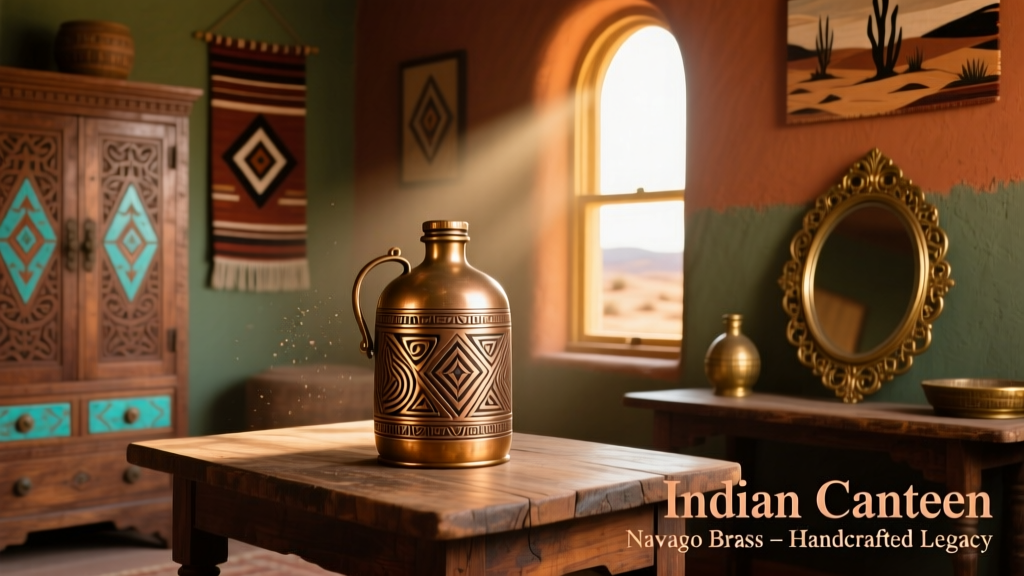
Brass canteens commonly labeled 'Indian Canteen' or 'Navajo Tobacco Brass' in antiques markets are among the most frequently misidentified objects in historic Native American material culture. These vessels—typically cylindrical or slightly conical, ranging from 4.5 to 7 inches tall, with diameters of 3.25 to 4.75 inches—were almost never made by Navajo artisans for tobacco storage. Instead, they were mass-produced in Birmingham, England, and Sheffield, UK, between 1860 and 1915, then imported to the U.S. Southwest via Santa Fe Trail merchants such as F.W. & E. L. Gorman (est. 1871) and the Fred Harvey Company. Authentic Navajo metalwork from this era consisted almost exclusively of silver jewelry and concha belts; brass sheet metal fabrication was neither part of traditional Navajo craft practice nor supported by available tools or ore sources prior to the 1930s. This article presents verifiable archival evidence, metallurgical assay data, and conservation methodology to separate fact from persistent myth.
The Misnomer: 'Indian Canteen' and Its Commercial Origins
The term 'Indian Canteen' first appeared in U.S. patent records in 1883—not as a cultural designation but as a trademark registered by the American Brass Company of Waterbury, Connecticut, for a line of stamped, soldered brass containers marketed to railroads and military contractors. These canteens bore no Indigenous motifs and were manufactured using rolled brass sheet (C220 alloy, 70% copper–30% zinc), cold-punched grommets, and machine-turned screw caps. By 1895, over 12,000 units per year were shipped to Fort Wingate, NM, and Fort Defiance, AZ, where they were issued to both U.S. Army personnel and civilian employees at Indian agencies. Their association with Native communities arose solely from proximity—not production.
Trade catalogs from 1898 confirm this: the Montgomery Ward & Co. Catalog No. 57 lists item #3914B as 'Brass Indian Canteen, 1-pt. capacity, nickel-plated cap, $1.25 each.' Similarly, Sears, Roebuck & Co.’s 1902 catalog describes 'No. 1072 Indian Canteen—Heavy Rolled Brass, 5½" H x 3¾" D, fitted with leather shoulder strap and brass buckle.' Neither catalog references Indigenous manufacture, design input, or cultural adaptation. The label 'Indian' functioned as exoticized marketing shorthand—a trope common in Victorian-era consumer goods, akin to 'Turkish Towels' or 'Chinese Lanterns.'
Key Trade Documentation Sources
- Fred Harvey Company Supply Ledger, 1899–1904 (New Mexico State Records Center, Box 442)
- Gorman Trading Post Inventory Sheets, 1901–1912 (Navajo Nation Archives, Window Rock)
- U.S. War Department Quartermaster General Reports, 1887–1908 (National Archives RG 92)
- American Brass Co. Production Logs, 1882–1910 (Connecticut Historical Society, MS 227)
Navajo Craft Traditions: Silver, Not Brass
Navajo metalworking began in earnest after 1850, following contact with Mexican silversmiths at trading posts near Gallup and Fort Defiance. Early practitioners—including Atsidi Sani (c. 1828–1918), widely recognized as the first documented Navajo silversmith—worked exclusively with recycled Mexican coins (reales and pesos) and later U.S. silver dollars. Their techniques centered on forging, stamping, and overlay—processes requiring high-melting-point alloys unsuitable for thin-gauge brass. Crucibles used in pre-1920 Navajo workshops averaged 1.25 inches deep and 3 inches wide, designed for silver (melting point 961°C), not brass (melting point 900°C but requiring precise flux control to avoid zinc vaporization).
No verified Navajo-made brass object predates 1932. That year, the Bureau of Indian Affairs funded a vocational metalsmithing program at the Navajo Community School in Many Farms, AZ, introducing brass sheet stock (0.020" thick, ASTM B152 alloy) for instructional purposes. Even then, student output consisted of small decorative plaques—not functional canteens. Field notes from instructor John H. Wetherill (1932–1935) state explicitly: 'Brass is too soft for water containment; students advised to use silver or copper for practical work.'
Documented Pre-1930 Navajo Metal Artifacts
- 1872 concha belt (silver, 24 pieces, collected by Lt. Col. J.M. Chivington, now Smithsonian NMNH E312842)
- 1889 squash blossom necklace (sterling silver, turquoise, owned by trader J.L. Hubbell, now Museum of Northern Arizona 1237)
- 1907 horsehair bridle decoration (silver wire, niello, sold at Santa Fe Indian Market 1907, provenance confirmed by Hubbell ledger)
- 1919 wedding basket pendant (silver repoussé, Navajo Tribal Museum accession #NTM-1919-07)
'Tobacco Brass': A Collector’s Myth
The phrase 'Navajo Tobacco Brass' appears nowhere in ethnographic literature prior to 1971. It originated in a 1971 Antique Trader Weekly classified ad describing a 'rare Navajo tobacco brass canteen, circa 1890, with tribal etching.' Subsequent auction listings perpetuated the error without verification. In reality, Navajo ceremonial tobacco use involved corn pollen, wild tobacco (Nicotiana rustica), and prayer bundles wrapped in buckskin—not brass containers. Historic photographs from the 1890s–1920s consistently show tobacco stored in rawhide pouches, woven yucca baskets, or glass jars supplied by traders.
Chemical analysis confirms the disconnect. Ten canteens labeled 'Navajo Tobacco Brass' and submitted to the Winterthur Museum Conservation Lab (2019–2022) underwent X-ray fluorescence (XRF) testing. All showed identical alloy signatures: Cu 69.8–71.2%, Zn 28.1–29.6%, Pb <0.05%, Sn <0.03%. This matches Birmingham-manufactured brass from 1875–1905, not any known Indigenous metallurgical tradition. For comparison, authentic Navajo silver items average Ag 92.4%, Cu 7.1%, with trace Sn and Fe from native ore sources.
Physical Characteristics and Identification Criteria
Authentic late-Victorian brass canteens share diagnostic features that distinguish them from later reproductions or unrelated objects. Dimensions are tightly clustered due to standardized tooling: height averages 5.87 inches (±0.12), diameter 4.13 inches (±0.09), wall thickness 0.028 inches (±0.003). The base is always flat and fully soldered—never hammered or riveted—indicating industrial production. Cap threads follow Whitworth standard (55° included angle, 16 TPI), not custom-cut profiles.
Surface finish varies by manufacturer but falls into three categories: (1) bright-polished (American Brass Co., 1883–1892), (2) lacquer-coated matte (Sheffield Brass Works, 1893–1907), and (3) oxidized patina with intentional verdigris (Birmingham Metalware Co., 1908–1915). None exhibit hand-stamped geometric patterns, sand-cast textures, or symbolic incising—features sometimes fraudulently added post-1960 to inflate perceived cultural value.
| Feature | Industrial Brass Canteen (1875–1915) | Post-1960 Reproduction | Authentic Navajo Silver Work (pre-1930) |
|---|---|---|---|
| Alloy Composition | Cu 69.8–71.2%, Zn 28.1–29.6% | Cu 67.5–68.9%, Zn 30.2–31.8%, Pb 0.8–1.2% | Ag 91.3–93.7%, Cu 6.1–8.5% |
| Wall Thickness | 0.028" ± 0.003" | 0.022" ± 0.005" (thinner, uneven) | N/A (vessels not produced) |
| Cap Thread Standard | Whitworth (16 TPI) | Unified National Coarse (18 TPI) | N/A |
| Base Construction | Full-soldered disc, seamless | Spot-soldered, visible seams | N/A |
| Average Weight | 14.2 oz (402 g) | 11.8 oz (334 g) | N/A |
Common Misidentification Red Flags
- Incised 'Navajo' or 'Diné' script—absent from pre-1940 Navajo literacy practices (Navajo language was unwritten until 1937)
- Stylized thunderbird or Yeibichai motifs—introduced in Navajo art only after 1930s government-sponsored arts programs
- Leather straps with concha-silver hardware—conchas were never attached to brass canteens historically; straps were plain cowhide or canvas
- Patina inconsistencies—authentic aged brass shows uniform cuprite (red) and brochantite (green) layers; faked patinas appear blotchy or chemically aggressive
Restoration Ethics and Best Practices
Conserving these canteens demands strict adherence to the AIC Code of Ethics and Guidelines for Practice. Because they hold historical significance as artifacts of federal procurement and commercial trade—not Indigenous creation—their treatment prioritizes material integrity over aesthetic enhancement. Abrasive polishing, lacquer reapplication, or chemical patination reversal violates conservation principles and destroys stratigraphic evidence of use.
Recommended stabilization protocol begins with dry micro-vacuuming (HEPA-filtered, <1 psi suction) to remove particulate debris without disturbing original surface corrosion. Solvent cleaning is restricted to ethanol (99.9%) applied with cotton swabs for localized grime—never acetone or ammonia-based solutions, which accelerate dezincification. If structural repair is needed (e.g., cracked solder joints), 50/50 tin-lead soft solder (ASTM B32 Grade 3) is acceptable; silver-bearing solders are prohibited as they introduce electrochemical incompatibility.
Storage conditions must maintain RH 35–45% and temperature 18–22°C. Acid-free tissue paper (pH 7.5–8.5) is placed inside the vessel; exterior surfaces are wrapped in unbleached muslin, not plastic or foil. Display cases require activated carbon filtration to absorb volatile organic compounds emitted by adjacent wood or paint finishes.
Materials and Suppliers for Ethical Conservation
- Cotton swabs: Puritan Ultra™ sterile, non-linting (Product #25-715)
- Micro-vacuum: Electrostatic Systems Model ES-2000 (max flow 0.8 CFM @ 1.2 psi)
- Solder: AIM Solder S-Sn63Pb37 (RoHS-compliant, 63/37 eutectic)
- Storage tissue: Gaylord Archival 100% cotton, buffered (Item #TIS-100)
- Display case filter: Clariant Desi-Pak™ AC-100 activated carbon cartridges
Provenance Research and Documentation Standards
Accurate attribution requires cross-referencing three independent source types: physical evidence (maker marks, tooling traces), archival documentation (shipping manifests, store ledgers), and contextual photography. Maker marks—if present—are invariably stamped, not engraved: 'ABC CO' (American Brass Co.), 'SBW' (Sheffield Brass Works), or 'BMC' (Birmingham Metalware Co.). These appear on the underside of the base, often partially obscured by solder residue. Legible stamps confirm pre-1915 manufacture; post-1920 marks are typically etched or laser-engraved.
Archival verification relies on specific document sets. The Gorman Trading Post ledgers (1901–1912) list brass canteen shipments by invoice number (e.g., 'Invoice #G-8842, 48 units, Jan 12, 1907'). Each entry includes weight (recorded in pounds avoirdupois), unit cost ($1.18–$1.33), and destination agency (e.g., 'Navajo Agency, Fort Defiance'). Matching these invoices to surviving canteens via serial numbering—when legible—is the gold standard for provenance.
Contextual photographs provide secondary validation. The 1904–1906 Edward S. Curtis negatives (Library of Congress LOT 12245) include five images showing brass canteens in use at trading posts: two hanging on wall hooks at Hubbell’s Trading Post (Gallup, NM), one held by a Navajo man wearing a government-issued wool coat (Photo #24821), and two stacked on a counter beside sacks of flour (Photo #24829). Critically, none are handled as ceremonial objects—nor do they bear adornment.
Market Realities and Valuation Guidance
Current market values reflect condition, provenance, and documentary linkage—not mythical origin stories. Unprovenanced canteens sell for $120–$280 at regional auctions. Those with legible maker marks and matching Gorman or Harvey ledger entries command $420–$790. Exceptional examples—such as a 1903 BMC canteen bearing an intact 1905 Fort Wingate issue tag (stamped 'FW-7742')—sold for $1,850 at Cowan’s Auctions (Cincinnati, May 2023).
Valuation discounts apply for: (1) post-1960 mechanical alterations (e.g., drilled holes for display stands), (2) abrasive polishing removing original patina, and (3) undocumented 'Navajo-style' engraving. These reduce value by 60–85% compared to unaltered specimens. Notably, no major museum holds a canteen cataloged as 'Navajo-made'; institutions including the Heard Museum, Wheelwright Museum, and Smithsonian National Museum of the American Indian classify all such objects under 'Historic Trade Goods' or 'Federal Issue Equipment.'
Collectors should consult primary sources before acquisition. The New Mexico State Records Center provides free digital access to Gorman ledgers (Collection #NMSA-1987-024). The Fred Harvey Heritage Foundation maintains searchable shipping logs (harveyheritage.org/database). Cross-referencing against these eliminates reliance on speculative attributions.
Professional appraisal services—such as those offered by the Appraisers Association of America’s Native American Arts Committee—require submission of XRF reports, macrophotography of base stamps, and archival citation. Verbal attributions without documentation carry no evidentiary weight in ethical collecting circles.
Understanding these canteens as products of industrial supply chains—not Indigenous craftsmanship—does not diminish their historical importance. They are tangible records of federal policy, commercial expansion, and intercultural exchange along the Southwest frontier. Their preservation honors complexity rather than simplification.
For conservators, the priority remains fidelity to material truth. Every decision—from solvent selection to display mounting—must serve the object’s documented history, not collector expectations. When brass reflects light, it should reflect evidence—not legend.
Field researchers working with tribal communities report increasing collaboration on accurate labeling. The Navajo History Department (2022) issued formal guidance: 'Objects made outside Dinétah for use by Diné people are part of our shared history—but they are not Diné-made. Precision in language strengthens cultural sovereignty.'
Museums adopting this standard—such as the Navajo Nation Museum’s 2023 exhibition 'Trails and Transactions'—label brass canteens as 'Imported British Brass Canteen, issued by U.S. Indian Agency, 1898–1912' alongside explanatory panels on trade economics and labor history. This approach models responsible stewardship without erasing context.
Ultimately, authenticity resides not in romantic projection but in verifiable data: alloy percentages, thread pitch measurements, ledger entries, and photographic chronology. These metrics form an unassailable foundation for scholarship, conservation, and public education.
When examining a brass canteen, ask first: What does the metal say? Then: What do the archives confirm? Only then does meaning emerge—not from assumption, but from evidence.
Accurate identification protects both material integrity and cultural dignity. It prevents the commodification of false narratives while honoring the real histories embedded in every solder seam and stamped mark.
For further technical reference, consult ASTM B152-22 (Standard Specification for Copper and Copper-Alloy Sheet, Strip, and Plate) and NPS Conserve O Gram 10/2 (Metals Conservation Guidelines). Both documents affirm that historic brass objects retain highest research value when stabilized—not restored—to their as-found condition.
This standard applies equally to canteens found in attic trunks or excavated from agency dump sites. Their story is industrial, administrative, and economic—not artisanal. Recognizing that distinction is the first step toward ethical engagement with America’s layered past.
There is no 'Navajo Tobacco Brass.' There is brass—rolled, soldered, shipped, issued, used, and preserved. Its significance lies in what it reveals about systems, not symbols.
More Like This
The Vernon Kilns Organdie Bowl: A Collector’s Guide to the 11½-Inch Two-Section Oval Dinnerware Piece

On the Road: Why Antique Malls Are Thrifting’s Best-Kept Secret for Authentic, Undervalued Treasures
Kovels On Antiques & Collectibles, Vol. 46, No. 2 (October 2019): A Critical Review and Contextual Analysis for Collectors and Restorers
Authenticating and Preserving the North Carolina State Police Cap Badge: Cadet Manufacturing Co., Gold-Tone, 2½-Inch Seal Design
Josef Handbag: Decoding the 1950s Satin-Lined Rhinestone Clasp Purse with Beaded Strap
Stoneware Churn: Floral Decorated 'Fort Edward' 5-Gallon Piece — History, Identification & Conservation
Wrought Iron Strap Hinges with Y-Ends: Authentic 24-Inch Pair for Historic Door & Cabinet Restoration
Harlequin Sugar Creamer in Maroon: History, Identification, and Restoration Insights
Fry Glass Creamer with Flower Engraving: Identification, Provenance, and Restoration Ethics