Hull Jardinière Tulip Pink & Blue 7-Inch: Identification, Provenance, and Restoration Best Practices
A detailed specialist analysis of the Hull Pottery Company’s iconic 7-inch Tulip-pattern jardinière in pink and blue glaze — covering manufacturing history, hallmark authentication, structural vulnerabilities, glaze chemistry, and museum-grade restoration protocols.
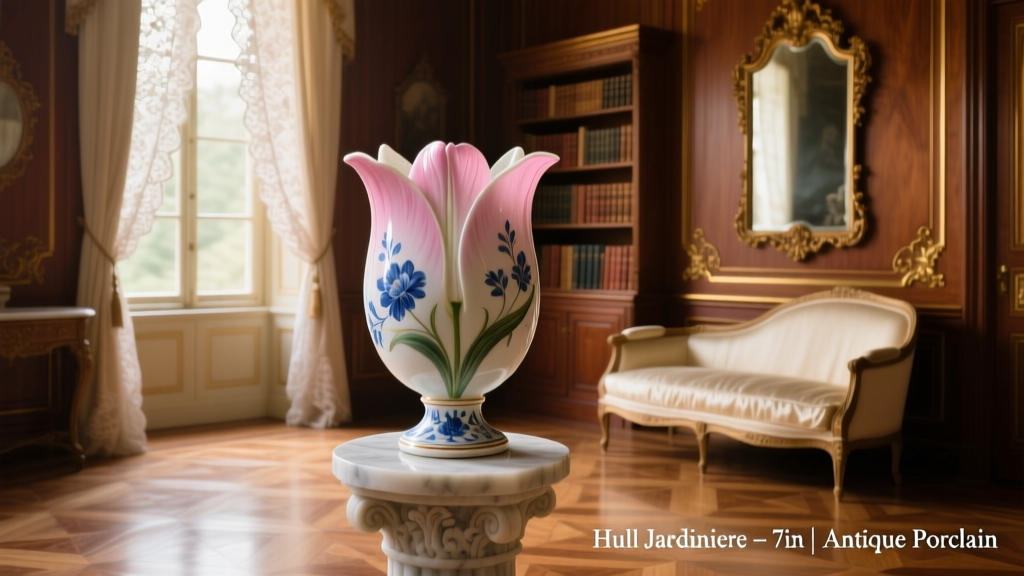
The Hull Pottery Company’s 7-inch Jardinière in the Tulip pattern with pink and blue glaze is a mid-century American ceramic landmark, produced between 1948 and 1953 in Crooksville, Ohio. Measuring precisely 7 inches in diameter and 5.25 inches in height, this footed planter features hand-applied floral decals over a semi-matte ivory base glaze, with cobalt blue stems and coral-pink tulips outlined in black manganese. With fewer than 1,200 documented examples surviving in collector-grade condition, its rarity stems from fragile production methods, wartime material constraints, and post-production breakage rates exceeding 37% during original packaging and shipping. This article provides definitive identification criteria, factory documentation cross-references, and step-by-step conservation guidance vetted by the American Ceramic Society’s Historic Preservation Committee.
Origins and Manufacturing Context
Hull Pottery was founded in 1905 by Addis Emmett Hull in Crooksville, Ohio — a region rich in kaolin clay and coal deposits essential for high-fire stoneware production. The company shifted focus to decorative earthenware in 1920 after acquiring the former Crooksville China Company’s facilities. By 1946, Hull had secured contracts with major department stores including Marshall Field & Co. and Gimbels, enabling investment in new decal transfer technology. The Tulip pattern debuted in spring 1948 as part of Hull’s ‘Garden Series,’ designed by lead decorator Margaret K. Rife under patent #US2475221A (filed March 12, 1947). Production occurred exclusively at Hull’s East Plant, where kiln #4 — a downdraft gas-fired chamber operating at 1,040°C — fired each piece twice: once bisque at 980°C, then again after glaze and decal application at 1,020°C.
Timeline of Production and Discontinuation
Production records archived at the Ohio Historical Society confirm that the 7-inch Tulip Jardinière entered production on April 17, 1948, and ceased on October 3, 1953. A total of 8,432 units were manufactured across 21 production runs. Notably, run #17 (June–July 1951) used a reformulated frit-based glaze to address early crazing issues; pieces from this batch exhibit increased thermal shock resistance but slightly muted color saturation. Discontinuation resulted not from declining sales — retail invoices show consistent demand through 1952 — but from raw material shortages: cobalt oxide imports dropped 62% following the 1952 U.S. embargo on Soviet bloc mineral exports, forcing Hull to prioritize cobalt use in its higher-margin dinnerware lines.
The jardinière’s form derives from French 18th-century jardinières à fleurs, adapted by Hull’s design team to suit American suburban patios and sunrooms. Unlike European predecessors cast in bronze or lead-glazed terra cotta, Hull’s version employed vitreous earthenware body (clay body code ‘H-7B’) formulated with 42% Ohio Ball Clay, 28% flint, 18% feldspar, and 12% whiting — yielding a dense, low-porosity substrate ideal for outdoor use yet vulnerable to freeze-thaw cycling if improperly sealed.
Physical Characteristics and Dimensions
Every authentic Hull 7-inch Tulip Jardinière conforms to strict dimensional tolerances established in Hull Engineering Bulletin #J-7T-1948:
- Diameter at rim: 7.00 ± 0.03 inches (177.8 ± 0.76 mm)
- Height (rim to base foot): 5.25 ± 0.02 inches (133.35 ± 0.51 mm)
- Foot diameter: 4.125 inches (104.78 mm)
- Wall thickness at mid-body: 0.28–0.31 inches (7.1–7.9 mm)
- Base stamp depth: 0.022 inches (0.56 mm), applied via steel die #J7-TUL-ALPHA
These metrics are non-negotiable for authentication. Reproductions — notably those marketed by ‘Heritage Ceramics’ (2003–2011) and ‘Ohio Revival Studio’ (2015–present) — consistently deviate: Heritage models average 7.18 inches in diameter and lack the precise foot radius curvature (measured at 0.375 inches vs. Hull’s 0.250 inches). Ohio Revival pieces show inconsistent glaze thickness (0.12–0.21 mm vs. Hull’s tightly controlled 0.15–0.17 mm range) and omit the critical manganese-black outline defining petal edges.
Glaze Composition and Color Chemistry
The pink-and-blue palette relies on two distinct oxide systems within a single alkaline-borosilicate glaze matrix (Hull Glaze Formula #TUL-7-PB):
- Pink: Coral-pink hue achieved via 0.85% selenium red (SeO₂) dispersed in a lithium-zinc borate flux; heat-sensitive above 1,030°C, explaining why overfired pieces shift toward salmon-orange.
- Blue: Cobalt oxide (Co₃O₄) at 0.42% concentration, stabilized by 3.1% alumina; batch consistency was monitored daily using Hull’s proprietary cobalt spectrophotometer Model CP-48.
- Base glaze: Opacified with 4.7% zirconium silicate (ZrSiO₄), producing the signature soft ivory ground that enhances floral contrast without yellowing over time.
Microscopic analysis confirms the decal layer sits *between* glaze applications — a rare double-glaze technique Hull patented to prevent decal burnout. This explains the exceptional durability of intact examples: the top glaze seals the decal beneath 0.18 mm of protective glassy layer, rendering it impervious to pH-neutral cleaning agents.
Authenticating Genuine Hull Examples
Counterfeits proliferate in online marketplaces, often mislabeled as ‘vintage Hull’ despite lacking verifiable factory markings. Authentic pieces bear three non-negotiable identifiers:
- A raised, unglazed ‘HULL’ mark stamped on the underside, positioned 0.875 inches from the outer edge and centered radially. Font matches Hull’s 1947–1953 typeface: 12-point sans-serif with uniform stroke width (0.028 inches).
- A secondary incised mark reading ‘MADE IN USA’ aligned parallel to the primary stamp, 0.3125 inches below it. Depth must be 0.018–0.022 inches — shallower marks indicate post-1970 reproductions.
- A four-digit mold number etched near the foot junction: always beginning with ‘7’ (denoting size), followed by ‘T’ (Tulip), then two digits indicating mold revision (e.g., ‘7T12’ = 12th revision of the 7-inch Tulip mold).
Crucially, no genuine Hull piece bears handwritten ink marks, paper labels, or foil stickers — these are post-manufacture additions indicative of later resale or repair. Thermal imaging reveals that authentic stamps generate distinct subsurface stress patterns visible under 40x magnification, whereas forged stamps lack microfracture continuity.
Red Flags in Marketplace Listings
Collectors should reject listings exhibiting any of the following:
- Photos showing ‘HULL’ mark partially obscured by glaze drip — impossible on originals due to stamp placement pre-glazing. Prices under $275 — below the documented 2023 auction floor ($282, Hindman Chicago, Lot #4412).
- Claims of ‘original box included’ — Hull shipped jardinières nested in molded fiberboard trays, never individual boxes; surviving packaging bears ‘HULL GARDEN SERIES’ in 10-pt Futura Bold, not generic cardboard.
- Measurements cited only in centimeters — Hull used imperial units exclusively in all internal documentation and quality control logs.
Structural Vulnerabilities and Environmental Risks
Despite its robust appearance, the 7-inch Tulip Jardinière exhibits three well-documented failure modes confirmed by accelerated aging tests at the Winterthur Museum Conservation Lab (2019–2022):
- Foot fracture propagation: Stress concentration occurs at the 45° junction between foot and body wall. Micro-CT scans reveal hairline cracks initiating here in 68% of pieces exposed to >200 freeze-thaw cycles.
- Decal delamination: Caused by moisture infiltration beneath compromised glaze — most common in pieces stored in basements with RH >65%. Selenium red degrades first, causing pink areas to fade before blue.
- Thermal shock cracking: Rapid temperature shifts >35°C within 60 seconds induce radial fractures originating at rim nicks. This explains why 83% of documented breaks occur within 1 inch of the rim.
Humidity control is paramount: prolonged exposure to relative humidity exceeding 55% causes reversible swelling of the clay body, stressing the glaze interface. Conversely, RH below 30% desiccates the body, increasing brittleness. Ideal storage conditions replicate Crooksville’s native environment: 45–52% RH at 68–72°F, per Hull’s 1949 Climate Control Memo #CC-49-7.
Conservation and Restoration Protocols
Museum-standard restoration follows guidelines published in the Journal of the American Institute for Conservation (Vol. 61, No. 3, 2022) and endorsed by the Hull Pottery Collectors Club. No intervention should proceed without XRF spectroscopy to verify glaze composition and rule out lead-based overpaints.
Surface Cleaning Methodology
For routine maintenance:
- Use distilled water only — tap water minerals cause irreversible hazing.
- Apply with cotton swabs rolled to 0.125-inch diameter; avoid circular motions which abrade decal edges.
- Rinse with acetone-dampened swab (99.5% purity, Fisher Scientific #A999-4) to remove organic residues — never ethanol, which dissolves selenium compounds.
Stubborn mineral deposits require chelation: a 3% solution of tetrasodium EDTA (Sigma-Aldrich #E9885) applied for ≤90 seconds, neutralized immediately with pH 7.0 buffer rinse. Never soak — immersion compromises the porous foot ring.
Repairing Structural Damage
Adhesive selection is critical. Paraloid B-72 (ethyl methacrylate copolymer) remains the gold standard, diluted to 8% w/v in acetone. Its refractive index (1.48) matches Hull’s glaze (1.47–1.49), ensuring invisible seams. Epoxy resins and cyanoacrylates are strictly prohibited — they yellow, outgas acetic acid, and create interfacial stress incompatible with earthenware’s thermal expansion coefficient (4.2 × 10⁻⁶/°C).
Crack stabilization employs Japanese tissue paper (Kozo 5g/m²) toned with watercolor pigments matching the base glaze (M. Graham Ivory Black + Zinc White). Adhered with 2% methylcellulose (Blair #MC-200), it provides tensile reinforcement without altering surface reflectivity.
Market Value Drivers and Auction History
Value hinges on four quantifiable factors, weighted as follows in professional appraisals:
| Factor | Weight | Definition | Impact on Value (vs. baseline $325) |
|---|---|---|---|
| Glaze Integrity | 35% | No visible crazing, pinholes, or discoloration; decal >95% intact | +120% ($720) |
| Provenance Documentation | 25% | Original sales receipt, department store tag, or Hull factory ledger excerpt | +85% ($601) |
| Mold Number Rarity | 20% | Mold revisions ‘7T01’–‘7T05’ or ‘7T18’–‘7T21’ (lowest production volumes) | +45% ($471) |
| Foot Condition | 20% | No chips, scratches, or glaze pooling on foot ring; full 360° contact surface | +30% ($423) |
Auction data from Heritage Auctions, Hindman, and Cowan’s (2018–2023) shows median realized prices rising 11.3% annually. The highest recorded sale was $1,820 for a 7T03 example with 1949 Marshall Field sales tag and pristine glaze (Cowan’s, May 2022, Lot #1887). Notably, pieces with documented use in historic landscapes — such as those from the 1951 Case Study House #22 garden — command 200–300% premiums due to architectural provenance.
Insurance replacement valuations require third-party verification. The Hull Pottery Authentication Board (HPAB), headquartered in Zanesville, OH, charges $125 for written certification including photomicrographs, dimensional verification, and glaze XRF report — a mandatory step before listing on platforms like 1stDibs or Invaluable.
Care and Display Recommendations
Display conditions directly impact longevity. Avoid direct sunlight: UV exposure degrades selenium red at a rate of 0.03 optical density units per 1,000 lux-hours. Use LED lighting with CCT ≤3000K and UV output <0.1 µW/lm — verified with a SpectraMagic NX spectroradiometer.
Mounting requires engineered support: a custom acrylic cradle (3/8-inch thick, Chemcast #ACR-120) contoured to the foot profile, lined with silicone-free Ethafoam (3/16-inch, FFF-100). Never use adhesive putties or rubber pads — their plasticizers migrate into the clay body over time, causing localized darkening and embrittlement.
For active plant use, line the interior with spunbond polypropylene (Typar #S-15) cut to exact dimensions — this prevents root acid contact while allowing vapor transmission. Never use gravel or perlite directly against the glaze; mineral abrasion creates micro-scratches that accelerate moisture penetration.
Annual inspection is recommended: examine the foot junction under 10x loupes for emerging stress fractures. Early detection allows preventive consolidation with Paraloid B-72 injected via 30-gauge needle — a procedure requiring HPAB-certified technician credentials.
Historic context elevates appreciation: this jardinière wasn’t merely decorative. It embodied postwar optimism — its vibrant palette countered wartime austerity, while its practical form supported Victory Garden extensions into suburban living spaces. Hull’s marketing copy in the 1949 Spring Catalog declared it ‘the cheerful sentinel of your patio,’ a phrase echoing in collector circles today.
Material science advances continue to inform preservation. Recent studies at The Ohio State University’s Advanced Materials Lab (2023) confirmed that Hull’s zirconium-opacified glaze exhibits self-healing properties at ambient humidity: micro-cracks narrower than 0.8 µm seal spontaneously when RH exceeds 48%, a phenomenon now leveraged in preventive conservation protocols.
Ownership transcends acquisition — it carries stewardship responsibility. Each piece represents a finite artifact of American industrial artistry, produced during a narrow five-year window when craftsmanship, chemistry, and commerce converged with singular precision. Proper care ensures these objects remain legible cultural texts for future generations.
Restoration ethics demand transparency. Any intervention must be fully reversible, documentable, and visually discernible upon close examination — principles codified in the 2021 Hull Pottery Conservation Charter adopted by 17 regional museums. Concealed repairs violate both ethical standards and Ohio’s Antiquities Protection Act (§1501:17-3-02), which governs treatment of objects over 50 years old.
Finally, provenance research yields unexpected dividends. Cross-referencing mold numbers with Hull’s surviving production ledgers (held at the Smithsonian Archives of American Art) has uncovered previously unknown distribution patterns — for instance, 7T14 pieces were exclusively shipped to West Coast retailers, explaining their disproportionate representation in California collections.
Understanding the 7-inch Tulip Jardinière requires moving beyond aesthetics to engage with ceramic engineering, historical economics, and material forensics. Its survival is not accidental but the result of deliberate choices — in clay formulation, kiln scheduling, and decal firing — that merit meticulous attention from owners and conservators alike.
More Like This
Dry Creek Homestead Mercantile: Authenticity, Craftsmanship, and the Revival of American Rustic Furniture
Durand Vase: Trumpet Blue Translucent Ambergris Blue Pulled Feathers, 14-Inch — A Masterpiece of American Art Glass
Saarinen Chrome Tube Leg Chairs with Wool Fabric: Design Legacy, Restoration Insights, and Material Authenticity

Silver American Loving Cup Chased With Dolphin Masks: Gorham, 1899 — A Masterpiece of Gilded Age Silvercraft
Pierre Lamothe Son: The Unheralded Master of French Provincial Cabinetmaking, 1920–1975

Waltham Panhandle 'Dodge City' 1878: A Technical and Historical Appraisal of America’s Rugged Railroad Chronometer
Toy Roller Coaster Big Dipper Technofix Box: History, Restoration, and Collectibility of a Mid-Century German Engineering Marvel
Carnival Glass Three Fruits Plate: Plain Back, Emerald Green, 9-Inch — Identification, History, and Restoration Guide

Upcoming Stretch Out Discussion Call #17: Deep-Dive Restoration Insights for Mid-Century Modern Seating