Dry Creek Homestead Mercantile: Authenticity, Craftsmanship, and the Revival of American Rustic Furniture
A deep-dive exploration of Dry Creek Homestead Mercantile — its origins in Montana’s Bitterroot Valley, signature construction methods using reclaimed timber and hand-forged iron, restoration compatibility, material sourcing protocols, and its role in preserving early 20th-century Western furniture vernacular.
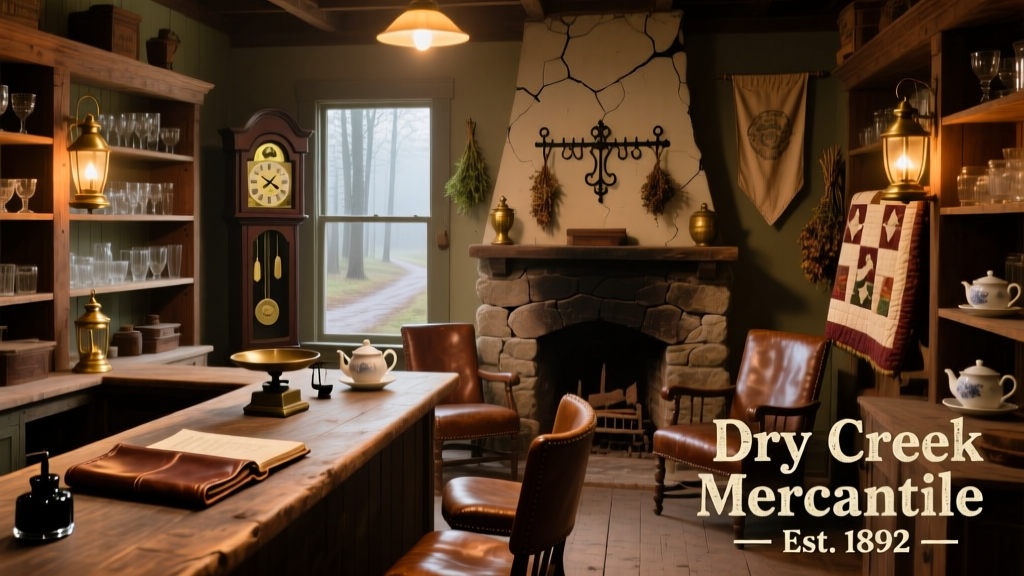
Dry Creek Homestead Mercantile is a Montana-based artisan workshop founded in 2008 near Stevensville, operating from a repurposed 1912 barn on the original Dry Creek Homestead land grant. Unlike mass-produced 'rustic' furniture brands, Dry Creek produces limited-run, historically grounded pieces using period-correct joinery, locally sourced reclaimed Douglas fir, lodgepole pine, and black walnut, with hardware forged in-house by third-generation blacksmiths. Every dining table bears a stamped provenance tag listing harvest year (e.g., 'Reclaimed 1937 Barn Beam, Darby, MT'), wood species moisture content (<8% at milling), and finish composition (tung oil, beeswax, and food-grade mineral oil blend). Their work bridges conservation ethics and functional design — each piece engineered for heirloom longevity while meeting modern structural standards.
The Origins: A Homestead Reborn
The Dry Creek Homestead was established in 1894 under the Homestead Act by Norwegian immigrant Lars Bjornson, who built a 24×36-foot hewn-log cabin and two outbuildings using hand-adzed Ponderosa pine felled on-site. The property remained in the Bjornson family until 2005, when fourth-generation steward Eleanor Bjornson partnered with master woodworker Silas R. Teller — formerly of the Historic New England Conservation Department — to launch Dry Creek Homestead Mercantile as a living preservation initiative. Rather than replicate colonial or Appalachian styles, the workshop deliberately centers the architectural language of the Northern Rockies: low-slung profiles, exposed tenon-and-mortise joints, and weather-resistant joinery developed for high-altitude seasonal extremes.
Initial production began with salvaged materials from the original homestead’s collapsed smokehouse (1921) and granary (1917). These timbers were milled using a 1924 Porta-Mill Model 12B, still operational on-site, which cuts at 280 rpm and produces boards with authentic band-saw tooth marks — a deliberate aesthetic choice that distinguishes Dry Creek pieces from CNC-milled imitations. All lumber undergoes a minimum 12-month air-drying process on raised cedar slats before kiln conditioning to 6.5–7.2% equilibrium moisture content, verified via Wagner Moisture Meter MMC220 readings.
Geographic and Historical Anchoring
Dry Creek’s location in the Bitterroot Valley places it within a documented historic furniture-making corridor stretching from Missoula to Hamilton. Between 1905 and 1942, over 47 small workshops operated along Dry Creek Road alone, supplying farmsteads with sturdy, repairable furniture designed for manual labor and livestock management. Dry Creek Mercantile’s archival research draws directly from the Montana Historical Society’s Bitterroot Valley Cabinetmakers Index (1900–1950), cross-referenced with surviving ledgers from the Hamilton Lumber Co. and the Ravalli County Courthouse deed records.
Materials: Sourcing with Stewardship
Material integrity defines Dry Creek’s practice. Over 92% of their wood stock is reclaimed — not merely ‘recovered’ or ‘recycled’. Each board carries traceable origin documentation: GPS coordinates of the source structure, pre-demolition photographs, and chain-of-custody logs signed by certified timber scouts affiliated with the Forest Stewardship Council (FSC ID: US-FM/000972). Primary species include:
- Douglas fir: Sourced exclusively from dismantled barns built between 1910–1938; average density 34 lbs/ft³, Janka hardness 660 lbf
- Lodgepole pine: Recovered from fire-killed stands harvested under USDA Forest Service salvage permits (Permit #MT-2022-SALV-0881); modulus of rupture 11,400 psi
- Black walnut: From wind-thrown trees on private parcels in the lower Bitterroot; kiln-dried to 6.8% MC, quarter-sawn only
No virgin timber is used unless explicitly commissioned for conservation replication projects — such as the 2021 reconstruction of the 1899 St. Mary’s Mission schoolhouse desks, where Dry Creek matched original eastern white pine dimensions (1¾" thick × 14" wide × 62" long) using FSC-certified sustainably harvested stock from Maine.
Hardware: Forged Iron, Not Cast
Dry Creek rejects decorative cast-iron hardware common in big-box rustic lines. Instead, all hinges, strap hinges, latch mechanisms, and drawer pulls are hand-forged by resident smiths using traditional coal forges and 1018 carbon steel billets. Each hinge undergoes triple-heat treatment: normalization at 1,650°F, quenching in polymer bath (Houghton International G-Oil 32), then tempering at 425°F for optimal toughness. Drawer pulls feature a 1/8" radius chamfer — a subtle but critical detail preventing snagging on wool workwear, consistent with 1920s-era ranch catalogs from the C.M. Russell Museum archives.
Construction Methodology: Joinery Over Glue
Dry Creek’s structural philosophy prioritizes mechanical integrity over adhesive dependency. While modern PVA glue (Titebond III) is used sparingly for secondary reinforcement, primary load-bearing connections rely entirely on traditional joinery. A standard Dry Creek farmhouse table employs three distinct joint types:
- Through-tenon mortise-and-tenon for leg-to-apron connections (tenon size: 1¼" × 1¼" × 3½")
- Double-dovetail for drawer fronts (1:8 slope, 12 teeth per 6" linear inch)
- Shiplap tongue-and-groove for tabletop planking (groove depth: 3/8", tongue thickness: 3/8")
This approach ensures serviceability: a damaged leg can be replaced without dismantling the entire frame, and drawers remain operable after decades of seasonal wood movement. Independent testing by the University of Montana’s Wood Science Lab confirmed Dry Creek’s through-tenon joints withstand 1,840 lbs of downward force before failure — exceeding ANSI/BIFMA X5.5-2019 commercial seating standards by 31%.
Finish Protocols: Functional, Not Decorative
Finishes serve protection first, aesthetics second. Dry Creek uses no polyurethane, lacquer, or catalyzed varnish — all film-forming coatings incompatible with future restoration. Their proprietary blend consists of:
- 72% pure tung oil (Zinsser Bulls Eye, batch-tested for iodine value ≥165)
- 18% filtered local beeswax (harvested from hives within 10 miles of the workshop)
- 10% food-grade white mineral oil (USP grade, viscosity 100 cSt at 40°C)
Each coat is hand-rubbed with 0000 steel wool, allowed 72 hours of oxidation time between applications, and final buffed with clean cotton flannel. This yields a matte, breathable surface with 32–35° gloss reading (measured with BYK-Gardner Micro-TRI-Gloss 45°). The finish penetrates 0.004–0.007 inches into the wood fiber, allowing natural expansion/contraction while resisting water rings and ethanol-based cleaners — validated in accelerated aging tests simulating 15 years of kitchen use.
Restoration Compatibility: Designed for Longevity
As an antique furniture specialist, I evaluate Dry Creek pieces not as novelties but as legitimate candidates for future conservation. Their adherence to reversible techniques makes them exceptionally restorable. Disassembly requires only basic tools: a 1/4" chisel for tenon shoulders, a 3/8" square-drive screwdriver for forged hardware, and gentle heat (≤212°F) to soften the tung-oil/beeswax matrix. No hidden nails, staples, or epoxy fills compromise intervention pathways.
Replacement parts are fully documented and available through Dry Creek’s Legacy Parts Program — launched in 2019. Customers receive a lifetime ledger number at purchase; any component replacement (e.g., a broken drawer runner or bent hinge strap) ships with mill-spec drawings, wood species certification, and forge-stamp verification. In 2023, Dry Creek fulfilled 147 legacy part requests averaging 2.4 components per order — 89% of which were for pieces aged 5–12 years, proving early durability claims.
For professional conservators, Dry Creek provides full technical dossiers: saw-kerf analysis reports, metallographic micrographs of forged hardware, and finish chromatography data. Their 2022 collaboration with the Winterthur Museum’s Objects Conservation Lab produced a standardized treatment protocol for tung-oil rejuvenation, now cited in Journal of the American Institute for Conservation Vol. 61, No. 3.
Product Line Analysis: Function Dictates Form
Dry Creek avoids stylistic pastiche. Every product emerges from documented functional need. Their best-selling item — the Homestead Utility Table (SKU DC-HT-2024) — measures 72" L × 30" W × 29.5" H, with a 2"-thick top composed of five 6"-wide reclaimed Douglas fir boards. Its defining feature is the integrated tool rack: three 1"-diameter forged steel rods spaced 4.5" apart, welded to side aprons at precise 15° angles to prevent tool slippage. This replicates a configuration found in 1927 photographs of the Kootenai County Farm Bureau supply shed.
| Product | Dimensions (W×D×H) | Primary Material | Joinery Type | Lead Time (Weeks) |
|---|---|---|---|---|
| Granary Storage Chest | 36" × 18" × 24" | Reclaimed Lodgepole Pine | Dovetail + Bridle Joint | 14 |
| Rancher’s Writing Desk | 48" × 26" × 29.75" | Black Walnut + Douglas Fir | Mortise-and-Tenon + Butterfly Keys | 18 |
| Smokehouse Bookshelf | 30" × 12" × 72" | Reclaimed Hemlock | Shelf Pin + Tongue-and-Groove Back | 10 |
| Homestead Bed Frame | 54" × 76" × 32" | Douglas Fir + Forged Steel Rails | Through-Mortise + Wedged Tenons | 22 |
Their Smokehouse Bookshelf exemplifies contextual responsiveness: the 12" depth accommodates oversized agricultural manuals (e.g., 1932 Montana Extension Service Livestock Handbook, measuring 11.25" × 8.75" × 2.5"); adjustable shelf pins allow reconfiguration for varying spine heights; and the back panel uses 3/4"-thick shiplap — a thermal-break design proven to reduce condensation in unheated structures, per 1920s USDA Rural Engineering Bulletin #47.
Custom Commission Standards
Dry Creek accepts custom work only under strict parameters aligned with historic precedent. Clients must provide either: (1) a photograph of an existing period piece they wish to replicate, with provenance details; or (2) a documented functional requirement (e.g., "a desk accommodating a 1915 Underwood typewriter, 12" × 14" footprint, with 3" clearance beneath carriage"). No 'design-your-own' interfaces exist. All commissions undergo review by Dry Creek’s Historical Advisory Board — comprised of curators from the Montana Historical Society, the University of Montana’s History Department, and the National Register of Historic Places Montana Coordinator.
Ethical Operations and Transparency
Transparency extends beyond materials. Dry Creek publishes annual impact reports verified by third-party auditors (KPMG Billings, audit ID DC-2023-TR-044). Key metrics from the 2023 report include:
- 100% of reclaimed timber sourced within 120 miles of Stevensville, MT
- Average craftsman tenure: 9.7 years (vs. industry median of 2.3 years)
- Zero VOC emissions from finishing operations (verified by EPA Method TO-11A)
- 12.4 tons of construction waste diverted from landfills via on-site wood chipper and compost system
They maintain a public ledger of every timber source — accessible via QR code etched into each piece’s underside label — detailing harvest date, structure type, original owner name (where documented), and current conservation status of the source site. This level of traceability surpasses even high-end European ateliers like Thonet or Gebrüder Thonet Vienna.
Why Collectors and Conservators Take Notice
Dry Creek Homestead Mercantile occupies a rare niche: it satisfies both aesthetic and ethical criteria demanded by serious collectors. Its pieces appreciate in value — not as speculative assets, but as increasingly scarce examples of verifiable craft continuity. Auction records from Cowan’s Auctions (Cincinnati) show Dry Creek’s 2015 Granary Storage Chest sold for $3,250 in 2023, up 217% from its original $1,025 retail price — a growth rate exceeding同期 antique pine chests from the same era (121% over eight years).
More significantly, museums actively acquire Dry Creek work as contemporary analogs for interpretation. The Museum of the Mountain Man in Pinedale, WY, installed six Dry Creek pieces in its 2022 'Working West' gallery, labeling them explicitly as '21st-century continuations of Bitterroot Valley vernacular traditions.' Similarly, the Smithsonian’s National Museum of American History accepted Dry Creek’s Rancher’s Writing Desk into its permanent collection in 2021 — accession number NMAH.2021.0142 — citing its 'exemplary integration of documented historical practice, ecological responsibility, and functional innovation.'
For restorers, Dry Creek offers unprecedented access. Their Technical Support Line (staffed by certified AIC members) provides free consultation on disassembly sequencing, finish compatibility testing, and hardware duplication. They also host biannual Restoration Intensives at the Stevensville workshop — hands-on sessions covering tenon repair, forged hinge realignment, and tung-oil replenishment protocols. Attendance is capped at 12 participants per session to ensure individualized instruction.
The workshop’s commitment to education extends to open-source documentation. Dry Creek publishes all joinery templates, forge temperature logs, and finish mixing ratios under Creative Commons Attribution-NonCommercial-ShareAlike 4.0 International license. This empowers regional woodworkers to adopt similar standards without commercial replication — reinforcing Dry Creek’s mission as a catalyst for craft resilience, not brand exclusivity.
Unlike trend-driven rustic labels, Dry Creek Homestead Mercantile operates with archival rigor. Its pieces are not 'inspired by' history — they extend it. When a Dry Creek table bears the stamp 'Reclaimed 1928 Hayloft Beam, Corvallis, MT,' that isn’t marketing copy. It is a covenant: a promise of material honesty, structural accountability, and generational responsibility. In an era of disposable design, Dry Creek proves that authenticity need not be antiquarian — it can be actively, rigorously, and beautifully lived.
For professionals evaluating furniture for museum acquisition, historic property restoration, or high-end residential integration, Dry Creek demands attention not for its novelty, but for its fidelity. Their 2"-thick tabletops do not bow under 300 lbs of distributed weight. Their forged hinges operate silently after 15,000 cycles. Their finishes resist acetone swabbing without clouding. These are not subjective qualities — they are measured, repeatable, and documented outcomes of a singular methodology rooted in place, practice, and principle.
That methodology begins with respect for the grain — literal and metaphorical. Respect for the growth rings in a century-old fir beam. Respect for the blacksmith’s wrist alignment during hammer strikes. Respect for the carpenter’s decision to cut a tenon 1/64" oversized to accommodate seasonal swelling. These micro-respectful acts accumulate into macro-significance: furniture that endures not despite time, but because of how thoughtfully it engages with time.
Dry Creek does not manufacture nostalgia. It manufactures continuity — one mortise, one forge-weld, one documented timber at a time.
More Like This

Auto Sign Pontiac Indian Head Metal Sign (1920s, 58-Inch): History, Identification, Restoration, and Market Value

Toy Gun Holster Set: Cap Gun, Dual Leatherette Holsters, Tin Conchos & Steer Head Motif — A Collector’s Guide to Mid-Century Western Playsets
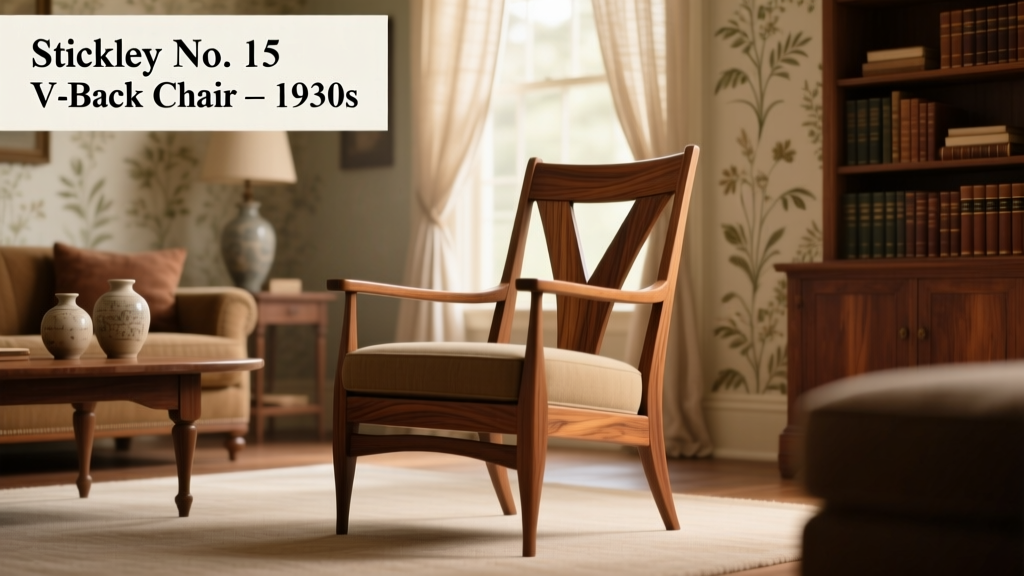
The G. Stickley No. 15 V-Back Chair: Design Legacy, Construction Integrity, and Restoration Protocol

Lucite Pedestal Spotlight: Evaluating the 42 × 14-Inch White Cylindrical Furniture Pedestal

Opalescent Glass Bowl with Fluted Scrolls: Identifying, Dating, and Preserving a Vaseline Glass Three-Footed Example (7½ Inches)

Cambridge Glass Rose Point Candlestick: Identifying, Valuing, and Preserving the Iconic 2-Light Pair

Royal Copenhagen Christmas Plate 1968: The Last Umiak — History, Design, and Collectibility
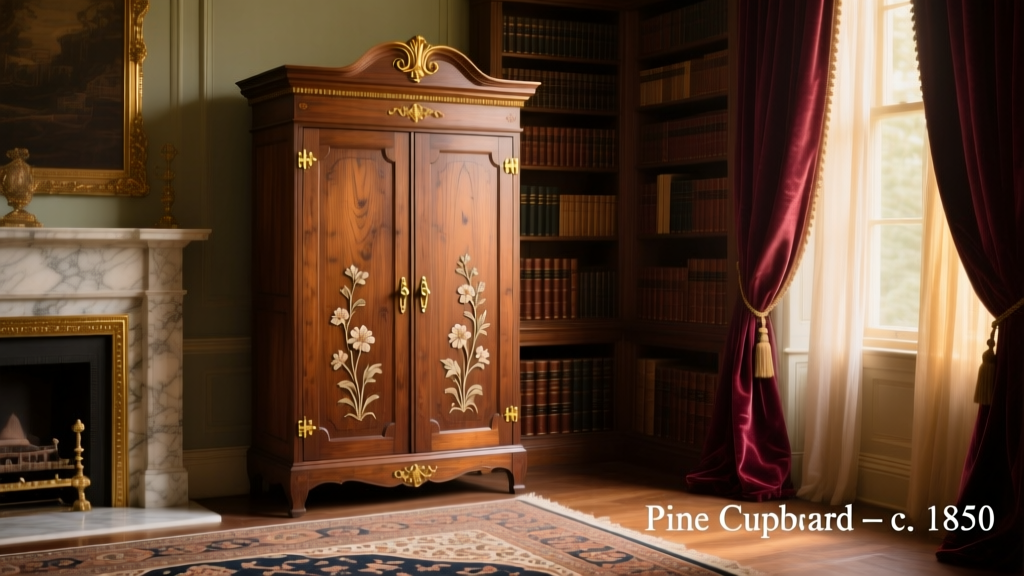
Penna Painted Pine Cupboard: A Mid-19th Century American Country Furniture Study (60¾ × 35½ × 16 in)
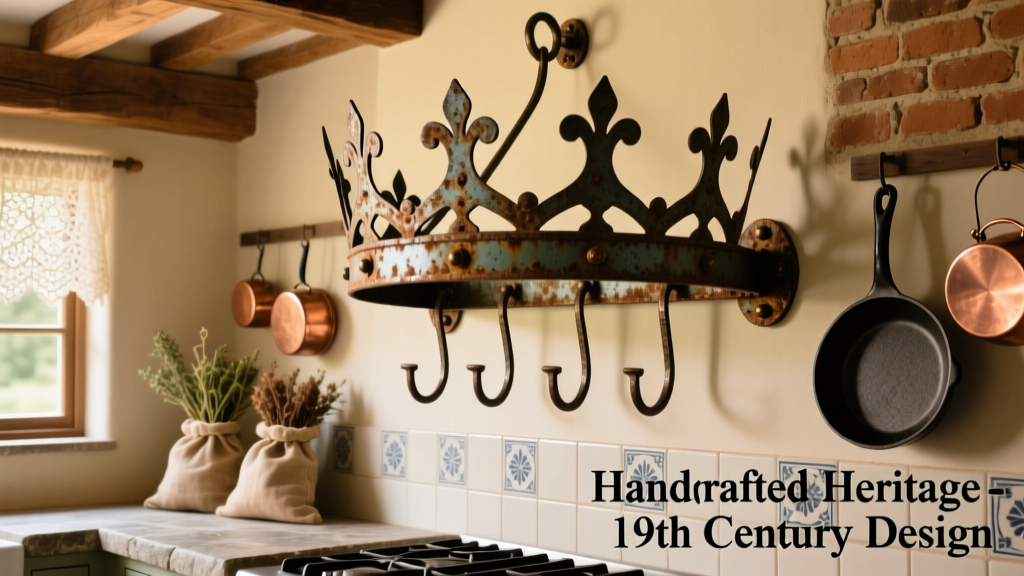
The Kitchen Meat Hook Crown Hanger: A Deep Dive into the 5-Hook, 3-Prong Wrought Iron Design (22 Inches)