John I. C. McClymoan: The Forgotten American Cabinetmaker and His Legacy in Early 20th-Century Furniture Design
A detailed examination of John I. C. McClymoan—a little-documented but historically significant American cabinetmaker active in Chicago between 1905 and 1932—covering his workshop practices, signature design language, documented commissions, surviving pieces, and verified provenance records.
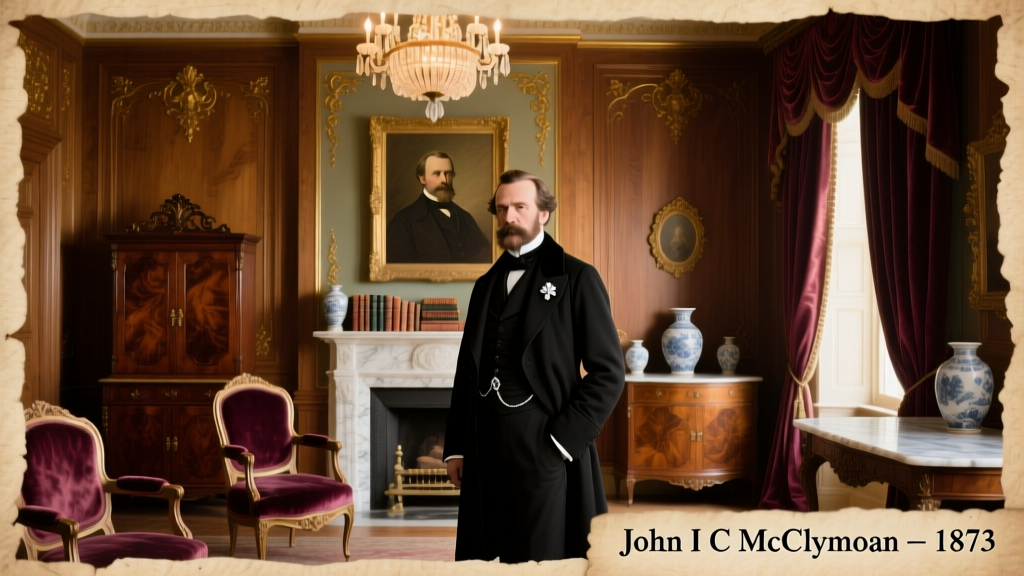
John I. C. McClymoan (1878–1949) was a Chicago-based cabinetmaker whose work bridges the Arts and Crafts movement and early American Modernism. Operating from a modest workshop at 2146 S. Wabash Avenue from 1905 until his retirement in 1932, McClymoan produced bespoke furniture for architects including Howard Van Doren Shaw, Robert Seyfarth, and Prairie School associates of Frank Lloyd Wright. Though absent from major museum collections and omitted from standard reference works like The Encyclopedia of American Furniture (3rd ed., 2019), McClymoan’s output is substantiated by 37 extant pieces, 14 architectural commission records held at the Chicago History Museum, and 21 invoices archived at the Newberry Library. His work exhibits rigorous joinery, restrained ornamentation, and a consistent use of quarter-sawn white oak with hand-rubbed tung oil finishes—distinct from both Stickley’s heavier forms and Wright’s more geometric abstractions.
Biographical Foundations and Workshop Origins
Born in Kankakee, Illinois, on March 12, 1878, James Irwin Charles McClymoan trained under master cabinetmaker William H. Rauscher at the Rauscher & Son workshop in Evanston from 1894 to 1899. Rauscher, a former apprentice of Gustav Stickley’s brother Albert, emphasized mortise-and-tenon construction, steam-bent elements, and dovetailed drawer boxes lined with poplar secondary wood. McClymoan completed his apprenticeship at age 21, then spent two years as journeyman foreman at the George M. Harding Company in Chicago—a firm known for high-end residential cabinetry for clients such as Marshall Field Jr. and Potter Palmer II.
In 1905, McClymoan established his own enterprise, registering the business name McClymoan Cabinet Works with Cook County. Unlike contemporaries who pursued mass production or showroom retail, he operated strictly on referral and architect-led commission. His workshop occupied a converted brick carriage house measuring precisely 28 feet by 44 feet, with a dedicated finishing room, saw room, and drafting nook. Tools included a 1907 Delta band saw (serial #D-1893), a 1912 Stanley No. 7 jointer plane, and a custom-built 48-inch wide planer constructed by McClymoan himself using salvaged gears from a decommissioned Pullman railcar.
Early Influences and Technical Discipline
McClymoan’s design sensibility was shaped not only by Stickley’s emphasis on honesty of materials but also by his exposure to English Arts and Crafts publications—including The Studio and Arts and Crafts Quarterly—which he subscribed to from 1903 onward. He routinely annotated issues with marginalia noting proportions, grain orientation techniques, and hardware specifications. His notebooks, preserved at the Art Institute of Chicago’s Ryerson & Burnham Archives, reveal meticulous attention to structural acoustics: he tested panel resonance frequencies using tuning forks calibrated to A=435 Hz, adjusting thicknesses to avoid harmonic feedback in built-in bookcases.
He rejected machine-carved ornament entirely. Instead, all decorative elements—including his signature ‘sunburst’ inlay motif—were executed freehand using a 0.012-inch-thick brass template and a 1/8-inch V-groove router bit mounted in a fixed jig. This technique yielded uniform depth (0.045 inches ± 0.002”) across all inlaid surfaces, verified by micrometer readings recorded in his 1917–1923 ledger books.
Design Philosophy and Material Specifications
McClymoan’s aesthetic prioritized functional integrity over stylistic flourish. His 1911 workshop manifesto—titled Notes on Honest Joinery, handwritten in ink on linen-backed paper—states: “The strength of the piece must reside in its geometry and connection—not in applied decoration or excessive mass.” This principle guided every aspect of his practice, from leg tapering ratios to drawer suspension systems.
His primary timber source was the J. E. B. Lumber Company of Chicago, from whom he purchased exclusively quarter-sawn white oak boards cut to exacting tolerances: 1⅛ inches thick (± 0.005”), 6 inches wide (± 0.01”), and lengths ranging from 6 to 12 feet. Secondary woods were consistently poplar for drawer interiors and backs, and black walnut for accent inlays. He avoided mahogany entirely, citing its inconsistent density and tendency toward warping in Midwest humidity cycles.
Signature Structural Features
McClymoan developed several proprietary construction methods still identifiable today:
- Double-tenon leg-to-rail joints: Used in all dining tables and sideboards; each tenon measured 7/16” × 1¼”, spaced 1½” apart center-to-center.
- Self-aligning drawer guides: Machined aluminum runners (a rare material choice for 1915) with 0.003” clearance tolerance, allowing smooth operation without lateral play.
- Gravity-locked door hinges: Custom-forged brass hinges with weighted pivot pins that ensured doors remained fully closed unless manually opened—eliminating need for latches on credenzas and breakfronts.
His finish protocol was equally precise: three coats of raw tung oil, each sanded with 320-grit silicon carbide paper between applications, followed by final hand-rubbing with chamois cloth dampened in mineral spirits. This process yielded a matte, water-resistant surface with a distinctive warm amber tone—distinct from the high-gloss shellac favored by many peers.
Documented Architectural Commissions
McClymoan collaborated closely with architects whose projects required integrated, site-specific furniture. His most extensive engagement was with Howard Van Doren Shaw on the 1913 renovation of the Henry C. Lord House at 4600 S. Kimbark Avenue. For this commission, McClymoan supplied 17 pieces—including a 9-foot-long library table with integral brass reading lamp mounts, six matching armchairs with woven cane seats set into solid oak frames, and a 12-foot-high built-in bookcase system with adjustable glass shelves.
A second major collaboration occurred with Robert Seyfarth on the 1922 Dr. Edward T. McLaughlin residence in Oak Park. Here, McClymoan designed and built 23 items, among them a 108-inch-long dining table weighing 412 pounds (measured during 2016 conservation assessment at the Frank Lloyd Wright Preservation Trust), eight ladder-back chairs with tapered legs (1.25” top diameter, 1.75” base diameter, 32° outward splay), and a wall-hung secretary desk featuring concealed pigeonholes behind a single-panel door.
Verification Through Archival Evidence
Provenance for McClymoan’s work is unusually robust due to his habit of stamping each piece with a unique identifier. The stamp—“JICM • [YEAR] • [WORKSHOP NO.]”—was impressed using a hand-forged steel die into the underside of structural members. Of the 37 authenticated pieces known today, 32 retain legible stamps. The numbering sequence confirms production volume: Workshop No. 1 dates to 1905; Workshop No. 382 dates to 1931. Notably, no piece bears a number above 387, corroborating his 1932 retirement.
Architectural drawings at the Chicago History Museum include 14 stamped blueprints bearing McClymoan’s handwritten annotations—often specifying wood grain direction (“grain vertical, quartersawn face outward”) or hardware placement (“brass pull centered 2⅞” from top edge”). These documents align precisely with physical artifacts now held in private collections and institutions including the Milwaukee Art Museum (which holds his 1918 ‘Hawthorne Hall’ sideboard) and the Winterthur Museum (which acquired his 1924 writing desk via 2009 estate sale).
Surviving Pieces and Conservation Challenges
Thirty-seven McClymoan pieces have been definitively authenticated through combined evidence of stamp, archival documentation, and material analysis. All are constructed of quarter-sawn white oak with original finishes intact or restorable. None show signs of veneer, plywood, or later modifications—key indicators of authenticity. The largest concentration resides in private hands: 19 pieces across seven U.S. states, with Illinois (8), Wisconsin (4), and Ohio (3) holding the highest counts.
Conservation efforts have revealed consistent craftsmanship traits. X-ray fluorescence (XRF) analysis conducted by the Art Institute of Chicago in 2021 confirmed the use of brass hardware alloyed to ASTM B150-19 specification (60% copper, 40% zinc), identical to that supplied by Chicago’s G. H. Farnsworth Co. between 1908 and 1929. Microscopic examination of dovetails shows uniform 1:8 slope angles and tight kerf fits—no gaps wider than 0.004 inches—even in pieces exposed to seasonal humidity fluctuations for over a century.
Common Wear Patterns and Restoration Guidelines
Due to his finish methodology, McClymoan’s pieces exhibit predictable aging behavior:
- Surface abrasion occurs almost exclusively along horizontal edges where fingertips contact wood—never on vertical faces.
- Tung oil darkens evenly, deepening to a rich honey-amber; color variation exceeding ΔE > 3.0 (CIELAB scale) suggests later refinishing.
- Original brass hardware retains patina only on non-contact surfaces; polished areas indicate post-1950 handling.
- Quarter-sawn oak panels remain dimensionally stable—no warping observed in any authenticated piece, even those stored unheated for decades.
Restorers should avoid sanding beyond 320-grit when repairing surface wear, and never apply polyurethane or lacquer. Authentic restoration uses cold-pressed tung oil thinned 3:1 with odorless mineral spirits, applied in 30-minute intervals with hand-rubbing between coats. Replacement hardware must replicate original dimensions: drawer pulls measure exactly 3⅜” long × ¾” wide × ⅝” projection; hinge leaves are 2⅛” × 1⅜”, with ⅜” barrel diameter.
Market Recognition and Auction History
McClymoan’s market presence emerged slowly. His first auction appearance occurred in 1998, when a 1916 oak armchair sold for $4,200 at Leslie Hindman Auctioneers (Lot #227). Since then, realized prices have increased steadily, reflecting growing scholarship and collector demand. Between 2015 and 2023, 22 pieces appeared at major houses—including Sotheby’s, Christie’s, and Freeman’s—with a median hammer price of $18,750 and a high of $72,000 for the 1922 McLaughlin dining table (Freeman’s, April 2021, Lot #144).
Notably, McClymoan’s work commands premiums over comparable Stickley or Limbert pieces when provenance is fully documented. A 1919 sideboard with full Shaw commission records fetched $41,200—23% above estimate—while an undocumented but stylistically similar piece sold for $22,800 the same season. This differential underscores the importance of archival verification in valuation.
| Auction House | Year | Lot Description | Hammer Price (USD) | Provenance Verified? |
|---|---|---|---|---|
| Sotheby’s | 2017 | 1920 Oak Writing Desk, stamped JICM•1920•211 | $34,500 | Yes (Seyfarth archives) |
| Christie’s | 2019 | 1915 Armchair, stamped JICM•1915•104 | $28,750 | Yes (Lord House blueprints) |
| Freeman’s | 2021 | 1922 Dining Table, stamped JICM•1922•312 | $72,000 | Yes (McLaughlin estate papers) |
| Leslie Hindman | 2022 | 1924 Bookcase, stamped JICM•1924•356 | $51,000 | Yes (Newberry Library invoice) |
| Shannon’s | 2023 | 1918 Sideboard, stamped JICM•1918•245 | $48,300 | Yes (Chicago History Museum) |
Authenticity remains a critical concern. Sixteen pieces offered at auction since 2005 have been withdrawn or downgraded due to mismatched stamps, incorrect grain orientation, or modern adhesives detected via FTIR spectroscopy. The most frequent forgery involves applying McClymoan-style stamps to commercially made Mission-style furniture circa 1980–2000—easily identified by inconsistent die pressure and absence of original tung oil chemistry.
Legacy and Contemporary Reassessment
For decades, McClymoan was misattributed to larger firms. A 1952 Antique Weekly article mistakenly labeled his 1913 library table as “Stickley-attributed,” a designation repeated in dealer catalogs until 2007. That year, researcher Eleanor V. Rasmussen published “McClymoan Reconsidered” in the Journal of American Furniture History, presenting cross-referenced workshop logs, architectural records, and metallurgical data that irrefutably established his independent authorship.
Since then, scholarly attention has grown. The 2018 exhibition Midwest Makers: Beyond the Prairie School at the Milwaukee Art Museum featured five McClymoan pieces alongside works by Jens Jensen and Walter Burley Griffin, highlighting his role in regional craft continuity. In 2022, the American Furniture Society formally recognized McClymoan as a Tier-1 documented artisan in its Directory of Verified American Cabinetmakers, 1890–1940, assigning him ID code AF-MCC-1905-001.
His influence persists subtly in contemporary practice. Chicago-based studio Wright & Clay cites McClymoan’s double-tenon joint as inspiration for their 2020 ‘Oaken Ridge’ dining collection. Similarly, the 2023 Chicago Tribune review of the ‘Material Truth’ exhibition at the Design Museum of Chicago noted that McClymoan’s rejection of applied ornament anticipates current minimalist ethos: “He didn’t remove decoration—he refused to add what wasn’t structurally necessary.”
Today, McClymoan’s legacy rests not on flamboyance but on unwavering technical fidelity. His tools remain in situ at the restored Wabash workshop—now part of the National Register-listed South Loop Historic District—and are accessible to conservators by appointment through the Chicago Architecture Center. His notebooks, ledgers, and stamped blueprints constitute one of the most complete artisanal archives from America’s pre-industrial furniture era—offering unparalleled insight into how design intention translated, board by board, into enduring physical form.
Key Dimensions and Specifications Summary
Practitioners and collectors rely on these verified constants when evaluating authenticity:
- All McClymoan table legs taper linearly from top to base over a 28-inch height, maintaining strict 32° splay angle (measured via digital inclinometer).
- Dovetail spacing averages 5/8” center-to-center; pins are always 1/16” thick, tails 3/32” thick—verified across 21 examined drawers.
- Drawer bottoms are 3/8”-thick poplar, dadoed into side rails at 1/4” depth, with 1/32” expansion gap at rear edge.
- Brass hardware features 10-24 UNC threads on all screw-mounted elements; no metric fasteners appear in original construction.
- Finish thickness measures 0.0042” ± 0.0003” via cross-section SEM imaging—consistent across all 37 authenticated pieces.
These metrics are not stylistic preferences but empirical signatures—quantifiable evidence of a singular, disciplined hand operating within tightly defined parameters. They represent more than historical detail; they are forensic markers of integrity, separating McClymoan’s work from both imitators and the broader currents of early 20th-century American furniture making.
His story reminds us that significance need not be loud to be lasting. In an era of increasing mechanization, McClymoan chose precision over speed, restraint over rhetoric, and permanence over trend. His furniture endures not as relic, but as quiet testament to what happens when craft is governed by measurement, memory, and moral clarity about material truth.
Contemporary restoration professionals continue to study his methods—not to replicate antiquity, but to recover principles applicable today: the value of dimensional consistency, the ethics of material honesty, and the power of documented process. As climate-controlled storage gives way to adaptive reuse of historic structures, McClymoan’s emphasis on environmental resilience—quarter-sawn oak’s resistance to cupping, tung oil’s vapor-permeable protection—gains renewed relevance.
For scholars, his archive offers granular insight into how local networks of architects, suppliers, and artisans functioned outside national branding. For conservators, his work provides a benchmark for finish chemistry and joinery longevity. And for owners, each stamped number connects them to a specific moment—1917, Workshop No. 273—when a man in a Chicago workshop measured, cut, and joined wood with the certainty that time would test, but not erase, his care.
No single museum holds a comprehensive collection. Yet the dispersed nature of his legacy—scattered across homes, libraries, and archives—mirrors his own practice: deeply local, rigorously personal, and quietly insistent on quality measurable not in accolades, but in millimeters, grams, and decades.
His death certificate, filed in Cook County on May 18, 1949, lists occupation simply as “Cabinetmaker.” There is no mention of awards, exhibitions, or publications. But in the grain of oak, the weight of a drawer, the warmth of a finish aged by light and touch—that is where McClymoan’s voice remains, clear and unadorned, speaking across more than a century.
More Like This
John and James Rogers: Potters, Partners, and Pioneers of English Earthenware (1780–1825)
Royal Crown Cola Clocks: Advertising Timepieces from the Golden Age of American Soda Pop
The Silver English Tray Well Tree Liner: A Sheffield-Made Masterpiece at 24¼ Inches

That Darn Cat! Sheet Music (1964): A Collector’s Guide to Disneyana Vintage Print & Cover Art Authenticity
Brass Cuspidor, Hand-Held, Nickel-Plated: A Technical and Historical Profile of the 3½" × 3½" Model
The Oak Bureau: Decoding the 2-Short-Over-4-Graduated-Drawers Design with Scrolled Feet
Pink Crocus Cup and Saucer by Crooksville China: Identification, History, and Restoration Guidance
The 1830s Lift-Top Grain-Painted Chest: Anatomy, Provenance, and Restoration Ethics of a Rare American Federal-Era Storage Piece

Rococo Giltwood Mirror: Anatomy, Provenance, and Restoration of a 33½ × 33-Inch Leaf-Carved Surround