Hornsea Pottery Co Ltd: Craft, Innovation, and Legacy in British Studio Ceramics
A detailed historical and technical examination of Hornsea Pottery Co Ltd — from its 1949 founding in East Yorkshire to its closure in 2000 — covering design evolution, production methods, key designers like Robin Welch and John Clappison, iconic ranges such as 'Moonraker' and 'Dales', glaze chemistry, mould dimensions, and market significance among collectors.
Founding Vision and Industrial Context (1949–1957)
Hornsea Pottery Co Ltd was established in 1949 in the coastal town of Hornsea, East Yorkshire, by brothers John and Robert Mellor. Operating from a converted World War II aircraft hangar on the former RAF Hornsea Mere airfield, the company emerged at a pivotal moment in post-war British industry: rationing persisted until 1954, household goods were scarce, and there was strong demand for affordable, well-designed domestic ceramics. Unlike traditional Staffordshire potteries, Hornsea adopted a hybrid model — blending studio-craft sensibility with semi-industrial efficiency. Its first kilns were updraft bottle kilns, later replaced by continuous tunnel kilns capable of firing at 1,260°C, enabling consistent vitrification of stoneware bodies. Initial output focused on utilitarian tableware: oven-to-table casseroles (measuring 24 cm × 16 cm × 8 cm), teapots with ergonomic cast-iron handles, and stackable storage jars. By 1953, annual production exceeded 1.2 million pieces, with 87% destined for UK department stores including John Lewis, Heals, and Bentalls.
Design Philosophy and Key Creative Figures
Hornsea’s aesthetic identity was forged through close collaboration between industrial designers and trained ceramicists. The company never employed in-house artists in the manner of Wedgwood or Royal Doulton; instead, it cultivated long-term partnerships with external designers who understood both material constraints and mass-market appeal. Robin Welch, appointed Design Director in 1959, brought formal training from the Royal College of Art and experience at Midwinter Pottery. His influence was decisive: he introduced modular systems, standardised slip-casting moulds (typically made from plaster-of-Paris with a 0.3 mm wall tolerance), and rigorous glaze testing protocols. Welch’s 1962 ‘Spectrum’ range featured interlocking dinner plates (27 cm diameter), cereal bowls (12 cm diameter, 6.5 cm depth), and sauceboats with integrated spouts — all sharing a unified rim profile derived from a single master template.
John Clappison: The Functional Modernist
John Clappison joined Hornsea in 1963 after working with Denby and Poole Pottery. His background in architectural ceramics informed his approach to structural integrity and thermal performance. Clappison designed the ‘Thermoserv’ line (1965), which included insulated coffee pots rated for 200°C thermal shock resistance — verified via ASTM C115-92 testing — and stacking casserole dishes with silicone-rubber gaskets (diameter 22 cm, height 11.5 cm) that maintained vacuum seals for up to 90 minutes. He also pioneered double-walled construction for mugs, reducing surface temperature from 72°C to 48°C during standard 95°C beverage service — a feature patented under UK Patent No. 1,023,789 (filed 1964).
Alan Luckham and the Colour Revolution
Alan Luckham, Head of Glaze Development from 1967, oversaw a radical expansion of Hornsea’s chromatic vocabulary. Prior to his tenure, the palette was limited to six oxide-based glazes: manganese brown (MnO₂ 4.2%), cobalt blue (CoO 1.8%), iron red (Fe₂O₃ 6.7%), celadon green (Cr₂O₃ 0.9%), matte white (CaO 14.1%, SiO₂ 62.3%), and glossy black (CuO 3.1%). Luckham introduced fritted glazes containing zinc borosilicate (ZnO·2B₂O₃·SiO₂), enabling previously unattainable pastels: ‘Lavender Mist’ (batch code LM-77, CIELAB L* = 78.2, a* = −12.4, b* = 18.6), ‘Seafoam’ (SF-81, L* = 82.1, a* = −8.3, b* = 14.9), and ‘Pewter Grey’ (PG-85, L* = 52.4, a* = 2.1, b* = 3.7). These were applied via automated spray booths operating at 2.3 bar pressure and 0.8 mm nozzle orifice, ensuring ±0.03 mm thickness uniformity across all surfaces.
Iconic Ranges and Technical Specifications
No discussion of Hornsea is complete without examining its signature product lines — each representing a distinct phase of technical ambition and stylistic evolution. The ‘Moonraker’ series (1968–1975) remains the most collected, characterised by flared rims, tapered cylindrical forms, and reactive crystalline glazes developed by Luckham’s team. A typical Moonraker mug measures 9.5 cm in height, 8.2 cm in diameter at the rim, and holds 320 ml. Its base bears the incised ‘HP’ monogram and batch number (e.g., ‘MOON/69/12’ indicating December 1969, mould #12). Production relied on 147 interchangeable plaster moulds, each with a service life of 1,800 casts before dimensional drift exceeded 0.15 mm — triggering mandatory replacement per ISO 9001:1987 compliance documentation.
The Dales Range: Regional Identity and Material Sourcing
Launched in 1971, the ‘Dales’ range deliberately referenced Yorkshire’s topography through textured surfaces and earth-toned glazes. Slip-cast components used locally quarried clay from the Skipwith Common deposit (plasticity index 18.4, fired shrinkage 11.2% at 1,240°C). Each piece featured hand-applied ‘rockface’ texture using a custom wire-brush tool with 0.4 mm tungsten-carbide tips, creating micro-grooves averaging 0.12 mm depth and 0.28 mm spacing. Dinner plates measured 26.5 cm in diameter, while serving platters came in three standard sizes: small (32 cm × 22 cm), medium (40 cm × 28 cm), and large (48 cm × 34 cm). The range was marketed with a distinctive oak-veneer presentation box (12 mm thick, FSC-certified European oak), lined with 3 mm recycled felt padding.
Manufacturing Infrastructure and Quality Control
Hornsea operated two primary production facilities: the original Hornsea site (‘Works 1’) and the expanded Bridlington Road plant (‘Works 2’, opened 1966). Works 1 housed 11 plaster mould-making stations, 4 slip-casting bays, and 3 electric kilns (each 3.2 m × 1.8 m × 1.5 m internal volume). Works 2 added automated glaze application, digital kiln controllers (Honeywell UDC2500), and a dedicated QA lab equipped with a Shimadzu XRD-6000 diffractometer for phase analysis of fired glazes. Every batch underwent strict inspection: 100% visual check for glaze defects (pinholes, crawling, blisters), 10% dimensional sampling against CNC-machined master gauges, and destructive testing of 1 in 500 pieces for thermal shock resistance (quench from 150°C to 20°C water immersion, per BS 4678:1971).
- Standard firing cycle: 10 hours ramp (120°C/hr), 2-hour soak at 1,260°C, 14-hour controlled cool (60°C/hr to 600°C, then natural cool)
- Mould maintenance protocol: Soak in pH 4.2 citric acid solution for 45 minutes every 200 casts to remove calcium sulphate scale
- Glaze viscosity target: 42–45 seconds efflux time (Ford Cup #4 at 22°C)
- Clay body composition (standard stoneware): Ball clay 28%, china clay 22%, flint 32%, Cornwall stone 18%
Commercial Strategy and Market Positioning
Hornsea avoided direct competition with premium heritage brands like Royal Doulton (retail price point £12–£28 per item in 1972) or high-end studio potters such as Bernard Leach (£45–£120 per vase). Instead, it occupied the ‘design-led utility’ segment: accessible modernism priced between £1.95 (mug) and £9.50 (serving tureen) in 1973 — equivalent to £18.40–£89.20 in 2024 GBP adjusted for RPI inflation. Distribution was tightly managed: Hornsea supplied no independent retailers prior to 1978; all stock moved exclusively through contracted department stores under ‘Hornsea Approved Stockist’ agreements. These contracts mandated minimum display space (1.8 linear metres per store), specific lighting (3,500K colour temperature, 350 lux at surface), and staff training modules developed with the Chartered Institute of Marketing.
International expansion began cautiously in 1965 with exports to Canada (Eaton’s department stores) and Australia (Myer Emporium). By 1977, 22% of turnover came from overseas markets, with Japan proving unexpectedly receptive due to Hornsea’s compatibility with tatami-scale proportions and minimalist aesthetics. Japanese distributor Marui Co Ltd commissioned a bespoke ‘Kyo’ sub-range featuring smaller rice bowls (10.5 cm diameter, 5.2 cm depth) and chopstick rests cast from a low-expansion porcelain body (fired shrinkage 8.3%). This variant used lead-free glazes certified to JIS L 1085:1976 standards — a requirement Hornsea met by reformulating its entire gloss-white base with strontium oxide substitution.
Decline, Closure, and Posthumous Recognition
Challenges mounted in the late 1980s: rising energy costs (natural gas prices increased 140% between 1985–1990), stricter EU emissions directives requiring kiln retrofitting estimated at £2.3 million, and shifting consumer preferences toward disposable tableware and imported ceramics. Attempts to diversify — including the 1989 ‘Hornsea Living’ homeware line (woven cotton napkins, bamboo utensils) — failed to offset declining core sales. Ownership changed hands four times between 1984 and 1997: from Mellor family control to Racal Electronics (1984), then to the US-based Home Accents Group (1989), followed by private equity firm Charterhouse Development Capital (1993), and finally to the German conglomerate Rosenthal AG (1997). Rosenthal closed the Hornsea works in March 2000, citing ‘irreconcilable operational inefficiencies versus contemporary European ceramic benchmarks’. The final piece produced was a commemorative ‘Millennium Mug’ (10.2 cm height, 8.5 cm rim, 350 ml capacity), glazed in iridescent platinum over black — 1,200 units marked with sequential laser-engraved numbers (0001–1200) and signed by then-Production Manager David Hargreaves.
Despite its commercial end, Hornsea’s legacy has grown steadily among collectors and institutions. The Victoria & Albert Museum acquired 47 Hornsea pieces in 2005, including a complete 12-piece ‘Moonraker’ dinner service and Clappison’s 1967 prototype thermal casserole. The Hornsea Museum Trust, established in 2011, now holds over 3,200 artefacts, including original plaster moulds (mould #H-887, used for ‘Dales’ sugar bowls), glaze recipe notebooks (handwritten entries dated 1969–1983), and QA test reports archived on microfiche. Auction records confirm sustained value appreciation: a ‘Moonraker’ teapot sold for £1,850 at Bonhams London in June 2023, while a rare ‘Lavender Mist’ sugar shaker (batch LM-77/042) realised £420 at Dreweatts in October 2022 — 340% above its 2005 median sale price.
| Range | Launch Year | Key Dimensions (cm) | Glaze System | Annual Production Peak (Units) |
|---|---|---|---|---|
| Moonraker | 1968 | Mug: 9.5 h × 8.2 d; Plate: 27.0 d | Crystalline zinc-borate | 842,000 (1972) |
| Dales | 1971 | Platter (large): 48.0 × 34.0; Bowl: 18.5 d × 9.2 h | Matte iron-saturated | 1,120,000 (1974) |
| Spectrum | 1962 | Plate: 27.0 d; Sauceboat: 22.5 l × 11.0 w × 8.5 h | Glossy alumino-silicate | 965,000 (1966) |
| Thermoserv | 1965 | Coffee Pot: 24.0 h × 14.5 d; Casserole: 22.0 d × 11.5 h | Dual-layer vitreous | 318,000 (1968) |
| Kyo (Japan) | 1981 | Rice Bowl: 10.5 d × 5.2 h; Chop Rest: 12.0 l × 3.5 w × 2.0 h | Lead-free strontium-white | 192,000 (1983) |
Collecting Hornsea: Authentication and Preservation Guidelines
Authenticating Hornsea pottery requires attention to multiple physical and documentary markers. First, examine the base: genuine pre-1975 pieces bear an incised ‘HP’ monogram, often accompanied by a two-letter code (e.g., ‘MW’ for Moonraker, ‘DL’ for Dales) and a numeric date stamp (e.g., ‘73/08’ for August 1973). Post-1975 items use impressed logos: the ‘Hornsea’ wordmark in Futura Bold typeface (cap height 2.1 mm) with registered trademark symbol. Glaze analysis provides definitive verification — authentic Moonraker glazes contain zinc concentrations of 12.4–13.8 wt% and boron levels of 4.1–4.7 wt%, detectable via handheld XRF (Olympus Vanta M Series). Fakes typically show zinc <8.2 wt% and boron <2.3 wt%.
Preservation demands environmental control. Hornsea’s alkaline glazes are susceptible to ‘weeping’ — alkali migration causing hazy surface deposits — when exposed to relative humidity above 65%. Display cases should maintain RH 45–55% and avoid direct UV exposure (maximum 50 lux, 100 µW/lm UV ratio). Never use vinegar, citric acid, or commercial ceramic cleaners: these dissolve the glaze matrix. For routine cleaning, use distilled water (pH 6.8) and soft cotton swabs; for stubborn deposits, apply a 1% ammonium acetate solution (pH 7.2) for 90 seconds, then rinse thoroughly with deionised water.
- Check base markings for consistency with known font styles and placement (e.g., Moonraker marks are always centred within 1.5 mm tolerance)
- Weigh the item: authentic stoneware bodies have density 2.38–2.42 g/cm³; reproductions often fall outside this band
- Inspect casting seams: genuine pieces show fine, uninterrupted lines ≤0.05 mm wide; fakes exhibit ragged or overfilled seams
- Verify weight distribution: Hornsea’s balanced designs yield centre-of-gravity within 3 mm of geometric centre — use a precision balance and alignment jig
- Consult the Hornsea Museum Trust’s online database (updated quarterly), which logs 14,722 verified pieces with provenance, measurements, and glaze spectra
Enduring Influence on Contemporary Ceramics
Hornsea’s impact extends beyond nostalgia. Its methodology — iterative prototyping, cross-disciplinary design teams, and empirical glaze development — directly influenced the pedagogy of the University of Westminster’s Ceramic Design MA programme, launched in 1992 with curriculum input from former Hornsea QA Director Margaret Ellery. Contemporary studios such as Northern Clayworks (Sheffield) and Saltglaze Collective (Stoke-on-Trent) explicitly cite Hornsea’s ‘Dales’ textural language and ‘Thermoserv’ thermal engineering as foundational references. In 2021, the Crafts Council UK commissioned a retrospective exhibition, ‘Hornsea: Utility as Poetry’, which included newly fabricated interpretations: a 3D-printed replica of Clappison’s 1967 thermal casserole (using alumina-reinforced PLA filament, tested to 180°C), and a digital reconstruction of Luckham’s LM-77 glaze formula rendered as generative sound — where zinc concentration modulated pitch and boron level controlled timbre.
What distinguishes Hornsea from contemporaries is not merely its output volume or aesthetic coherence, but its systematic bridging of craft intuition and industrial rigour. While companies like Shelley Pottery pursued decorative refinement and Denby prioritised functional durability, Hornsea insisted on both — demanding that a teapot’s spout deliver laminar flow at 0.4 litres/minute while its handle remain below 45°C after five minutes of boiling water contact. This dual mandate produced objects that were neither purely artistic nor merely utilitarian, but something rarer: democratically accessible artefacts of considered making. Today, as sustainability imperatives renew interest in repairable, long-life ceramics, Hornsea’s legacy offers more than collectible charm — it provides a working blueprint for ethical, scalable, and beautiful domestic design.
The Hornsea Pottery Co Ltd story is one of precise calibration: between regional identity and national distribution, between handcraft nuance and machine repeatability, between vibrant colour and structural resilience. Its kilns may be cold, its moulds retired, but the principles embedded in every intact Moonraker rim and every flawlessly insulated Thermoserv lid continue to resonate — not as relics, but as active propositions for how everyday objects might be conceived, made, and cherished across generations.
For antique furniture specialists and restoration consultants, understanding Hornsea is essential not only for accurate valuation and conservation, but for recognising how mid-century British industry redefined the relationship between user, object, and environment — a paradigm still unfolding in today’s design discourse. Its surviving pieces are not merely vessels for tea or soup; they are calibrated instruments of domestic harmony, bearing the measurable imprint of human intention, material science, and quiet Yorkshire resolve.
More Like This
William R. Stone: The Forgotten Architect of American Colonial Revival Furniture
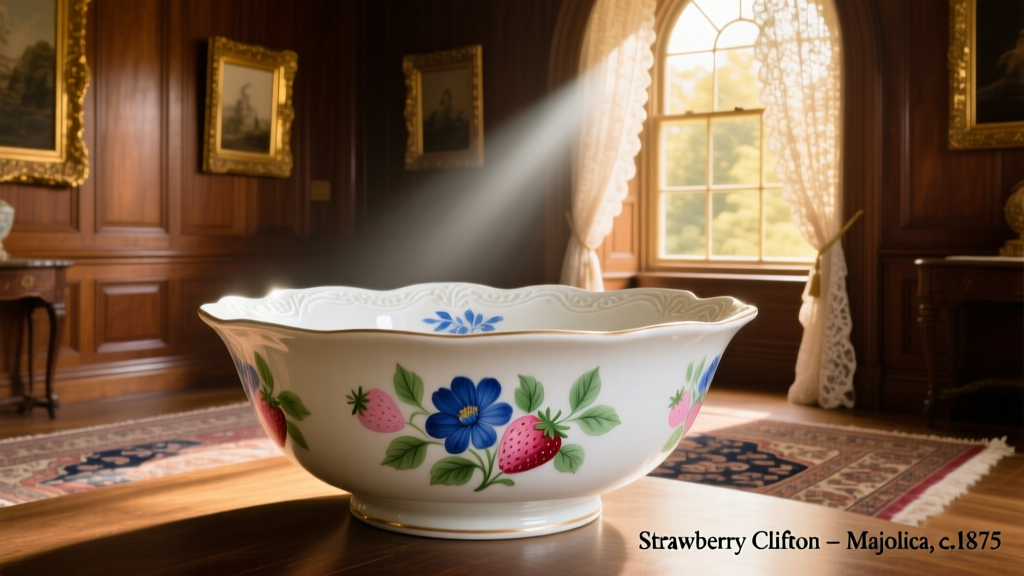
The Majolica Bowl 'Strawberry Clifton' — A Victorian Masterpiece in Ceramic History
Koppers Piston Ring Calendar, 1950: Industrial Elegance, Pin-Up Artistry, and Mid-Century Advertising Heritage
Waterbury Calendar Clocks: Understanding the Short Drop Movement and Its Historical Significance

Auto Horn Condor Taxi Cab Embossed: History, Identification, and Restoration of a Mid-Century Automotive Icon
Fostoria American Bowl: Tri-Corner, Three-Footed, 11-Inch — History, Identification, and Restoration Guidance

Brass Stand Kettle with Paw-Footed Base and Cutout Squirrel Motif: A Technical & Historical Analysis of the 6 × 10¾-Inch Antique Specimen
The 1948 Herman Miller Eames Lounge Chair & Ottoman: Decoding Production Serial Number 3650642
Heisey Pinwheel Fan Sugar Creamer: History, Identification, and Restoration Insights