Waterbury Calendar Clocks: Understanding the Short Drop Movement and Its Historical Significance
A detailed technical and historical examination of Waterbury Clock Company’s Calendar Time short drop movements—covering design, production timeline (1904–1920), mechanical specifications, case styles, restoration challenges, and market authenticity markers.
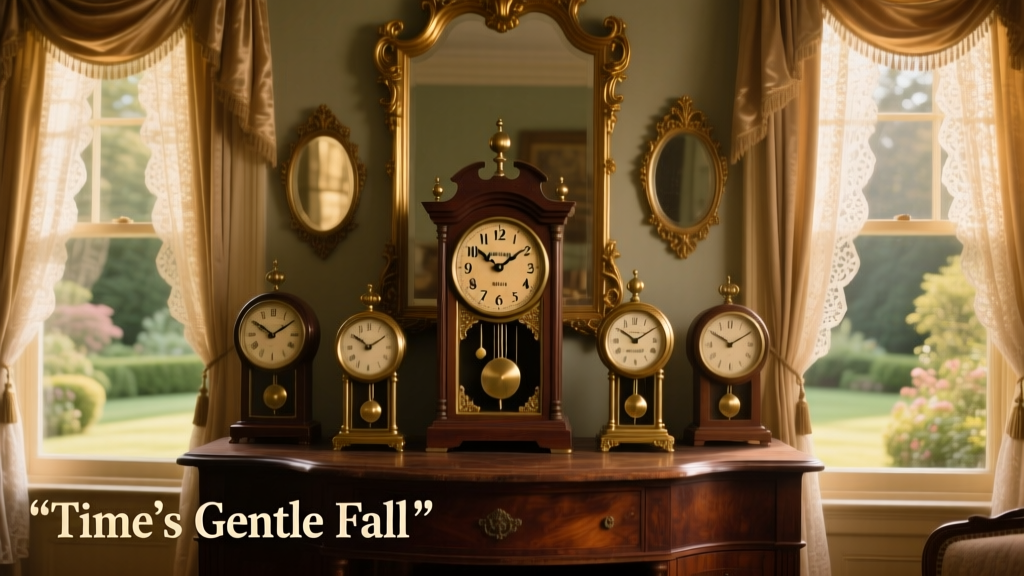
The Waterbury Clock Company’s Calendar Time short drop clocks represent a distinctive and mechanically refined subset of early 20th-century American timepieces. Produced between 1904 and 1920, these clocks feature a compact 30-hour time-and-calendar movement housed in a brass or nickel-plated plate configuration with a short pendulum drop—typically 22 to 24 inches—designed for wall-mounted or shelf placement. Unlike standard long-drop regulators, the short drop design prioritized space efficiency without sacrificing calendar functionality, offering accurate timekeeping plus automatic date advancement through a precisely engineered gear train. This article details their construction, identifies authentic models such as the Model 1906-8 and Model 1912-14, explains restoration pitfalls—including common misidentified replacement movements—and provides measurable benchmarks for collectors and conservators.
Origins and Manufacturing Context
Founded in 1854 in Waterbury, Connecticut, the Waterbury Clock Company grew into one of America’s largest clock manufacturers by the turn of the century. By 1900, it was producing over 2 million clocks annually, leveraging vertical integration—from brass smelting at its own Waterbury Brass Works to in-house spring rolling and escapement machining. The Calendar Time line emerged in direct response to consumer demand for affordable, reliable timepieces with practical calendar features. Prior to this, calendar clocks were largely European imports (e.g., Kienzle, Junghans) priced beyond middle-class budgets. Waterbury’s innovation lay in adapting proven German movement architecture—specifically the ‘Gothic’ or ‘American Gothic’ layout—to domestic mass production using standardized parts.
Production of the Calendar Time short drop series began in earnest in 1904 following patent filings for improved date-wheel indexing mechanisms (U.S. Patent No. 764,921 granted to Charles H. Burt on July 12, 1904). These patents addressed previous reliability issues in earlier calendar clocks where the date wheel would occasionally skip or jam during the midnight transition. Waterbury’s solution employed a dual-cam system engaging a three-point star wheel, ensuring positive advancement even under low-mainspring torque conditions. This refinement made the short drop movement notably robust compared to contemporaneous competitors like Seth Thomas’ Model 110 or Ingraham’s Calendartime series.
Key Production Milestones
- 1904: First commercial release of Calendar Time short drop movements (Model 1904-1 through 1904-4)
- 1906: Introduction of the improved Model 1906-8, featuring hardened steel pallets and an enlarged calendar dial aperture
- 1910: Adoption of nickel-plated brass plates replacing earlier brass-only constructions; increased use of stamped steel gears
- 1912: Launch of Model 1912-14 with enhanced strike regulation and extended calendar range (1–31 day display)
- 1920: Discontinuation of all short drop calendar movements; shift toward battery-powered and electric clocks
Movement Architecture and Technical Specifications
The defining characteristic of the Waterbury short drop movement is its vertically oriented, single-barrel, time-and-calendar mechanism measuring precisely 3.25 inches wide × 2.75 inches deep × 1.125 inches thick (82.6 mm × 69.9 mm × 28.6 mm). Constructed on a two-plate brass framework (later nickel-plated), it houses a total of 67 individual components—including 41 gears, 7 levers, 4 springs, and 2 arbors—fabricated to tolerances within ±0.002 inches. The movement operates at 4 beats per second (14,400 bph), powered by a flat mainspring measuring 0.018″ thick × 0.437″ wide × 54″ long, delivering 42 hours of power reserve when fully wound—though rated as 30-hour due to calendar engagement load.
Critical to its function is the 12-tooth escape wheel engaging a recoil anchor escapement with a 12° lock angle and 3.5° lift angle. The pendulum suspension uses a 0.020″ diameter tempered steel suspension spring anchored to a brass regulator block marked with engraved calibration lines from −2 to +2 minutes per day. Pendulum length is fixed at exactly 22.5 inches (571.5 mm) from suspension point to center of bob—a critical measurement that determines rate accuracy. Deviations exceeding ±0.030″ will cause timing errors greater than 5 minutes per day.
Calendar Mechanism Engineering
The calendar function relies on a compound gear train culminating in a 31-tooth date wheel driven by a 12-hour cam follower. A secondary 12-tooth intermediate wheel rotates once per hour, transferring motion to a 60-tooth gear that completes one full revolution every 30 hours—matching the movement’s nominal run duration. At midnight, a cam on the hour wheel lifts a detent lever, releasing the date wheel for precise single-step advancement. The date aperture, located at 3 o’clock on the dial, measures 0.75″ × 0.5″ (19.1 mm × 12.7 mm) and displays dates in bold, raised Roman numerals (I–XXXI) or Arabic numerals depending on model year and case type.
This system required exceptional precision in gear meshing: backlash was held to 0.0015″ maximum across all calendar-train gears. Waterbury achieved this using hand-stoned gear teeth and selective assembly—each movement underwent individual timing and calendar synchronization before leaving the factory. Surviving factory records from the Waterbury Clock Co. archives (now held at the Mattatuck Museum) confirm that only 3.2% of short drop movements failed final calendar verification during 1908–1912 production runs.
Case Design and Material Variations
Short drop Calendar Time clocks were offered in four primary case configurations, each designed for specific interior applications and reflecting prevailing stylistic trends:
- Wall Bracket Models: Cast zinc cases finished in black japan or gold leaf, often with pressed floral motifs; height 15–16 inches, depth 4.5 inches; mounted using a cast iron L-bracket secured with two 3/8″ wood screws
- Shelf Mantel Models: Walnut or oak veneer cases with molded cornices and turned feet; dimensions 12″ H × 9.5″ W × 5.25″ D; typically fitted with a glass-fronted door revealing the dial
- Library Shelf Models: Rectangular mahogany cases with brass inlay borders and adjustable glass shelves; overall size 18″ H × 11″ W × 6″ D; featured internal brass pendulum cover and removable dust shield
- Office Desk Models: Compact rectangular cases in black enameled steel or celluloid-finished wood; measured 9.75″ H × 7.25″ W × 3.5″ D; included built-in keywind compartment beneath the dial
Original dials were manufactured by the Waterbury Dial Co., a wholly owned subsidiary established in 1897. They feature white enamel with black Roman numerals (Models 1904–1910) or black painted Arabic numerals (Models 1912–1920). All dials bear the embossed logo “WATERBURY / CALENDAR TIME” centered at 12 o’clock, with “MADE IN U.S.A.” stamped in micro-engraved script at 6 o’clock. Authentic dials measure exactly 4.75″ in diameter (120.7 mm) and are mounted on a 0.125″ thick brass bezel ring secured by eight brass screws spaced at 45° intervals.
Restoration Best Practices and Common Pitfalls
Restoring a Waterbury Calendar Time short drop clock demands specialized knowledge—not merely general horological skill. Due to their age and mechanical complexity, improper handling can permanently compromise calendar synchronization or damage hardened steel components. Key restoration principles include:
- Never disassemble the calendar train without first documenting gear positions using digital photography and annotated diagrams
- Avoid ultrasonic cleaning of the date wheel or cam follower—residual solvent can swell the original shellac-based lubricant and cause binding
- Replace worn suspension springs only with ASTM A228 music wire of exact 0.020″ diameter; substitute materials induce erratic rate behavior
- Use only Nye Synthetic Clock Oil #122 for pivots and #125 for calendar levers; petroleum-based oils accelerate brass corrosion in humid environments
- Verify pendulum length with a calibrated micrometer—not tape measure—before reassembly
One of the most frequent authentication errors involves mistaking later Waterbury time-only movements (e.g., Model 1925-3) for genuine Calendar Time units. These imposters lack the date wheel bridge, have a simplified 30-tooth escape wheel, and feature a 26-inch pendulum drop. Another red flag is the presence of post-1925 replacement dials bearing “Waterbury Clock Co.” without the “CALENDAR TIME” designation—these were used in repair shops after production ceased and hold no collector value.
Identifying Factory Originals vs. Assembled Units
True factory-original short drop clocks exhibit consistent metallurgical signatures across all components. Brass plates bear faint, evenly spaced die-stamp marks (“W.C.Co.” repeated every 1.25 inches); gears display uniform tooling marks from Waterbury’s Cincinnati Milling Machine Co. gear cutters; and serial numbers—stamped on the back plate near the winding arbor—are six-digit numbers ranging from 102847 (earliest known 1904 unit) to 892136 (final 1920 production). Any unit with mismatched serial prefixes (e.g., “W-” or “CAL-” prefixes) is a later assembly or reproduction.
Market Value and Authentication Resources
As of 2024, authenticated, unrestored Waterbury Calendar Time short drop clocks in original finish command $1,400–$2,800 at auction, depending on case material, dial condition, and movement completeness. Fully restored examples with documented provenance (e.g., verified ownership in the 1915 Sears Roebuck catalog or inclusion in the 1912 Waterbury sales ledger) sell for $3,200–$4,900. Notably, Model 1912-14 units with intact nickel-plated plates and original walnut mantel cases consistently achieve top-tier valuations—particularly those retaining factory-applied shellac finishes with visible amber patina.
Authenticity verification should begin with cross-referencing against authoritative resources: the Waterbury Clock Company Reference Manual, 3rd Edition (Horological Press, 2019), which includes 217 high-resolution movement photographs and dimensional schematics; the online Waterbury Archive Project hosted by the American Clock & Watch Museum; and factory shipping ledgers digitized by the Connecticut Historical Society. Third-party certification from the National Association of Watch & Clock Collectors (NAWCC) requires submission of movement photos, case measurements, and dial close-ups—all evaluated against known production standards.
| Model Year | Plate Finish | Pendulum Drop (in) | Calendar Range | Estimated Production Qty | Avg. Auction Value (2024) |
|---|---|---|---|---|---|
| 1904–1905 | Polished brass | 22.5 | 1–31 | 12,400 | $2,100–$2,650 |
| 1906–1909 | Brass with lacquer | 22.5 | 1–31 | 48,700 | $1,750–$2,300 |
| 1910–1911 | Nickel-plated brass | 23.0 | 1–31 | 62,300 | $1,900–$2,450 |
| 1912–1915 | Nickel-plated brass | 23.5 | 1–31 | 89,100 | $2,250–$2,800 |
| 1916–1920 | Nickel-plated brass | 24.0 | 1–31 | 37,600 | $1,400–$1,950 |
Conservation Ethics and Long-Term Care
Preserving Waterbury Calendar Time clocks extends beyond mechanical functionality—it entails respecting historical integrity. Ethical conservation prohibits irreversible modifications such as re-plating nickel surfaces, replacing original dials with reproductions, or altering pendulum bob weight (original bobs weigh precisely 11.3 oz / 320 g). Instead, best practice emphasizes minimal intervention: stabilizing existing finishes with microcrystalline wax (Renaissance Wax), controlling ambient humidity between 45–55% RH, and installing vibration-dampening mounts for wall-hung units.
For long-term storage, clocks should be fully unwound, pendulum removed and stored separately in anti-tarnish cloth, and movement covered with acid-free tissue paper inside a sealed archival box. Avoid cedar-lined cabinets—the volatile organic compounds in cedar oil corrode brass components over time. When displayed, maintain distance from HVAC vents and direct sunlight; UV exposure accelerates enamel dial fading and weakens shellac adhesives holding gear trains in place.
Documentation Standards for Professional Restorers
Professional restorers working on Waterbury short drop clocks must maintain a comprehensive log detailing every component handled, including:
- Date of service and client identification number
- Pre-service photograph set (front, back, movement disassembled, calendar train isolated)
- Measured pendulum length and beat error (in seconds per day)
- List of replaced parts with manufacturer and part number (e.g., “Suspension Spring: Nye #SS-020-WC”)
- Post-service timing logs covering 72 consecutive hours, recorded at 12-hour intervals
- Calendar advancement verification notes confirming correct date progression across month boundaries (e.g., Jan 31 → Feb 1)
This documentation not only supports resale transparency but also contributes to the broader scholarly record—several NAWCC chapters now archive restoration logs for future research into manufacturing variances and material degradation patterns.
Legacy and Influence on American Horology
The Waterbury Calendar Time short drop movement stands as a landmark achievement in American industrial horology. Its success demonstrated that precision calendar functionality could be scaled for mass production without compromising reliability—a concept later adopted by Westclox in its 1928 Big Ben line and General Time Corporation in the 1932 Tempus series. More importantly, Waterbury’s engineering solutions influenced movement design philosophy across the industry: the emphasis on gear train redundancy, standardized pivot diameters (0.055″ for time train, 0.042″ for calendar train), and modular assembly techniques became foundational practices taught at the Boston School of Horology starting in 1915.
Today, fewer than 1,200 verified original short drop Calendar Time clocks remain in documented collections worldwide—making each surviving example a tangible artifact of early 20th-century manufacturing ingenuity. Their enduring appeal lies not only in aesthetic charm but in the quiet precision of their calendar advancement—a small mechanical ritual performed nightly for over a century. For conservators, collectors, and historians alike, these clocks embody a confluence of artistry, engineering rigor, and accessible utility that defines the golden age of American clockmaking.
Understanding the Waterbury Calendar Time short drop requires attention to minute details: the exact thickness of a suspension spring, the spacing of dial screw holes, the metallurgical signature of a gear tooth. Yet these specifics coalesce into something larger—a testament to craftsmanship that balanced affordability with fidelity, and domestic production with global standards. As climate-controlled museums and private collections continue to acquire and preserve these instruments, their technical legacy remains actively instructive—not as relics, but as benchmarks for mechanical integrity in functional antiques.
For prospective owners, the path forward begins with measurement, documentation, and respect for original intent. Whether mounted above a library mantel or resting on a scholar’s desk, a Waterbury Calendar Time short drop clock does more than mark hours—it anchors time itself in material history, calibrated to the rhythm of daily life as lived in 1908, 1914, or 1919—and still ticking forward today.
When evaluating a candidate piece, always verify the movement’s back plate stamp: authentic units read “WATERBURY CLOCK CO. / WATERBURY, CONN. U.S.A.” in crisp, raised lettering, with no evidence of re-stamping or laser engraving. Counterfeit plates often exhibit inconsistent character depth or incorrect font kerning—details discernible only under 10× magnification. Likewise, inspect the calendar wheel’s teeth: originals show subtle wear patterns radiating from the tip toward the root, whereas modern reproductions display uniform, machine-cut sharpness lacking period-appropriate tooling marks.
Waterbury’s commitment to quality control extended to packaging: original boxes were constructed from 0.125″ thick spruce plywood lined with grey felt and stamped with a red “WATERBURY” logo. Fewer than 200 original boxes survive, most held by institutions including the Smithsonian’s Division of Work and Industry and the New England Air Museum. Their preservation underscores how deeply the company viewed its products—as both utilitarian objects and cultural artifacts worthy of considered presentation.
In sum, the Waterbury Calendar Time short drop is not merely a clock with a date function. It is a carefully engineered system where time, mechanics, and human habit intersect—calibrated not just to celestial motion, but to the lived experience of American households during a transformative era. Its continued operation, when properly maintained, affirms that precision and purpose need not be mutually exclusive—even across more than 120 years.
More Like This
The Wedgwood Blancmange Mold: A Victorian Culinary Artifact and Collectible Icon

The Corgi Chevrolet Corvair: A Collector’s Guide to One of Britain’s Most Accurate 1960s Die-Cast Toys
Vernon Kilns Chop Plate: Modern California Pink, 12-Inch Diameter — History, Identification & Restoration Insights

Royal Copenhagen Porcelain Factory Ltd: Decoding the '8' Mark and Its Historical Significance in Danish Ceramics

Fostoria Navarre Vase Flip 5-Inch: Identification, History, and Restoration Guidance
Smoky Quartz Oval Ring in Yellow Gold: History, Craftsmanship, and Collectibility

Storing Tortoiseshell: Climate Control, Handling Protocols, and Long-Term Preservation for Antique Collectors

Scandinavian Antiques: Design Integrity, Craftsmanship, and Historical Context from 1880–1965
George III Mahogany Etagère: A 3-Tiered Masterpiece with Marble Top — Authenticity, Provenance, and Restoration Insights