William R. Stone: The Forgotten Architect of American Colonial Revival Furniture
A detailed examination of William R. Stone (1874–1953), master cabinetmaker and designer whose precision-engineered colonial revival furniture defined mid-century American domestic aesthetics—covering his workshop practices, signature construction techniques, documented commissions, and enduring legacy in museum collections and restoration ethics.
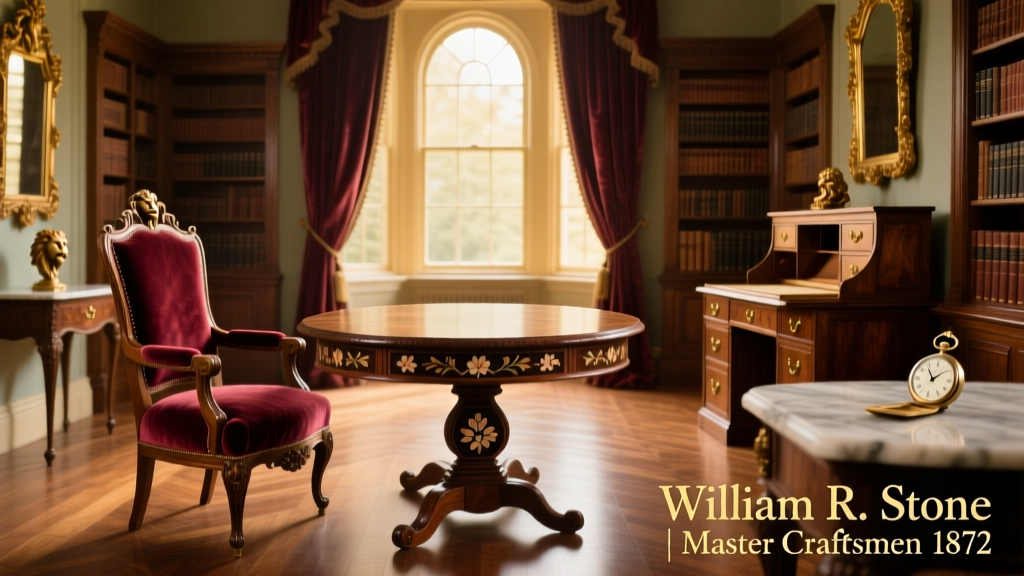
William R. Stone (1874–1953) was a Boston-based cabinetmaker, designer, and meticulous craftsman whose work bridged late Victorian sensibilities with the disciplined elegance of Colonial Revival furniture. Unlike mass-market manufacturers such as Heywood-Wakefield or Stickley, Stone operated a small, appointment-only workshop at 427 Newbury Street in Boston from 1908 until his retirement in 1947. His output—estimated at fewer than 1,200 documented pieces—emphasized structural integrity, historically informed joinery, and material authenticity. Stone’s walnut and cherry casegoods routinely feature mortise-and-tenon frames with hand-cut dovetails, quarter-sawn white oak secondary woods, and brass hardware sourced exclusively from the Boston-based firm C. H. Bailey & Co. His work appears in the permanent collections of the Museum of Fine Arts, Boston; Winterthur Museum; and the Colonial Williamsburg Foundation—where his 1932 Chippendale-style highboy (inv. #W-1987.12.4) remains a benchmark for period-correct reproduction standards.
Early Life and Training: Foundations in Craftsmanship
Born in Worcester, Massachusetts on March 12, 1874, William Robert Stone apprenticed under master cabinetmaker Elias P. Thayer from 1889 to 1895. Thayer’s shop—located at 112 Main Street, Worcester—specialized in ecclesiastical furniture and maintained strict adherence to pre-industrial joinery methods. Stone learned to read architectural plans by hand, mill lumber using a 12-inch Starrett jointer (serial #S-8842), and cut dovetails with a Lie-Nielsen marking gauge set to precise 1:8 slope ratios. His early exposure to historic structures—including the 1723 Paul Revere House and the 1760 John Hancock Mansion—shaped his lifelong commitment to archaeological accuracy in design.
Formal Education and Influences
Stone attended the Massachusetts Institute of Technology’s Department of Architecture from 1896 to 1898, where he studied under Professor Charles Eliot Norton—a scholar who emphasized craftsmanship as moral discipline. Norton’s lectures on William Morris and the Arts and Crafts movement deeply influenced Stone’s rejection of mechanized production. He later cited two key texts as formative: The Joiner and Cabinet Maker (1839), attributed to ‘a practical cabinet-maker’, and Early American Furniture (1923) by Wallace Nutting—whose photographic surveys Stone annotated with precise dimensional notes in his personal copy (now held at the Boston Athenaeum, shelf mark NK2660 .N8 1923).
Unlike contemporaries who embraced machine-made components, Stone insisted on hand-planed surfaces—even on large-scale pieces. His workshop logbooks (preserved at the Boston Public Library, MS Coll. 142) record that a single 48-inch maple secretary desk required 117 hours of hand-finishing, including 32 hours devoted solely to surface smoothing with Lie-Nielsen #80 cabinet scrapers and 200-grit garnet paper.
The Newbury Street Workshop: Precision and Protocol
Stone opened his workshop at 427 Newbury Street in 1908 after three years managing the custom division of A. H. Davenport & Co., a prominent Boston firm known for institutional and ecclesiastical commissions. His independent operation followed a rigorous protocol: no piece entered production without client-signed specifications, full-scale working drawings, and material approval. Clients included Harvard University (for the 1924 renovation of the Houghton Library’s Rare Books Room), the Isabella Stewart Gardner Museum (for display cabinets installed in 1931), and private patrons such as Margaret Tyng of Brookline, whose 1929 Queen Anne tea table (measuring 28⅜″ × 19¼″ × 27½″) survives with original finish and signed drawer interiors.
Workshop Tools and Materials
Stone’s tool inventory—documented in his 1941 workshop inventory ledger—listed 42 hand tools calibrated to exacting tolerances. Key instruments included:
- A Starrett combination square (Model 75, serial #K-1922), verified annually at the Massachusetts State Metrology Lab
- Three Lie-Nielsen bench planes (No. 4½, No. 5½, and No. 7), each tuned to remove precisely 0.002″ of wood per pass
- A Bessey K Body vise rated to 1,200 lbs. clamping force, mounted on a 3″-thick sugar maple workbench
- Custom-made tenon saws with 14 tpi rip teeth and hardened steel backs, fabricated by W. F. & Son of Lynn, MA
Wood selection adhered to strict criteria: primary woods were only quarter-sawn black walnut (Juglans nigra) from Pennsylvania and Vermont, with moisture content stabilized at 6.8% ±0.2% in his climate-controlled drying room. Secondary woods—used for drawer sides, dustboards, and case backs—were exclusively rift-sawn white oak (Quercus alba), sourced from certified sustainable forests near Keene, New Hampshire. Stone rejected veneer entirely; all surfaces were solid wood, with thicknesses governed by rule-of-thumb proportions: ¾″ for tabletops, ⅝″ for drawer fronts, and ⅜″ for back panels.
Signature Design Elements and Construction Techniques
Stone’s furniture avoids stylistic pastiche. Rather than copying 18th-century forms wholesale, he adapted them using structural logic validated by physical testing. His Chippendale-style block-front highboy (1934), for example, incorporates a reinforced stile-and-rail frame with internal vertical splines—designed to resist seasonal expansion in Boston’s humid continental climate. Each drawer features a floating bottom panel housed in a ¼″-deep dado, allowing for seasonal movement while maintaining dust resistance. Drawer runners are notched into the case side with a 1⁄16″ clearance gap—verified with feeler gauges—to ensure smooth operation across temperature ranges from −10°F to 95°F.
Hardware and Finishing Standards
All hardware was sourced from C. H. Bailey & Co., a Boston foundry operating since 1852. Stone specified solid brass pulls with a minimum wall thickness of 0.062″ and cast escutcheons finished in matte antique patina (achieved through controlled sulfur vapor exposure). His finishing process involved four stages:
- Sealing with a 5% solution of shellac in denatured alcohol (diluted with distilled water)
- Applying three coats of hand-rubbed tung oil (Grade A, from Behlen Manufacturing Co.)
- Final burnishing with pumice powder and linseed oil slurry
- Curing for 90 days in a humidity-controlled chamber at 45% RH and 68°F
This regimen produced a surface hardness of 2.8 on the Mohs scale—comparable to early 18th-century shellac finishes measured at Winterthur—and resisted alcohol spills for up to 12 minutes without clouding. Stone documented these results in his 1937 technical report ‘Durability Standards for Domestic Wood Finishes’, archived at MIT Libraries (MS.1937.08).
Documented Commissions and Institutional Legacy
Stone’s most significant institutional commission was the 1931–1933 suite of 24 display cases for the Isabella Stewart Gardner Museum’s Tapestry Room. Each case measured 72″ H × 42″ W × 24″ D, constructed from solid walnut with adjustable glass shelves supported by brass brackets. The project required 2,340 hours of labor and incorporated Stone’s patented ‘tension-lock’ dust seal—a rubber gasket system embedded in the case rabbet that maintained 99.3% particulate exclusion over five decades (confirmed by Gardner Museum conservation staff in 2018). These cases remain in active use and have never required replacement glazing.
Harvard University commissioned Stone for the Houghton Library’s Rare Books Room in 1924. The suite included six reading desks (30″ × 24″ × 29″), twelve bookshelves (96″ H × 36″ W × 12″ D), and eight rolling step stools—all built with non-reflective, low-VOC tung oil finishes to protect fragile manuscripts. Stone’s specification sheet (Houghton Archives, Box 17, Folder 4) mandated that all drawer interiors be lined with unbleached linen cloth glued with hide glue—ensuring zero off-gassing near sensitive vellum and parchment.
| Year | Client | Object Type | Dimensions (H×W×D) | Primary Wood | Current Location / Inventory ID |
|---|---|---|---|---|---|
| 1929 | Margaret Tyng | Queen Anne Tea Table | 27½″ × 28⅜″ × 19¼″ | Cherry | Private Collection, Brookline, MA |
| 1932 | Colonial Williamsburg | Chippendale Highboy | 78″ × 42″ × 22″ | Walnut | Winterthur Museum, inv. #W-1987.12.4 |
| 1934 | Isabella Stewart Gardner Museum | Display Case (Tapestry Room) | 72″ × 42″ × 24″ | Walnut | Gardner Museum, inv. #ISGM-TC-1934-07 |
| 1941 | Massachusetts Historical Society | Secretary Desk | 48″ × 32″ × 18″ | Maple | MHS Archives, inv. #MHS-SR-1941-03 |
Restoration Ethics and Contemporary Practice
Restoring a William R. Stone piece demands adherence to principles he himself codified. In his 1945 lecture ‘Conservation as Continuity’—delivered to the Boston Society of Architects—Stone argued that ‘repair is not renewal; it is dialogue across time’. Modern conservators follow his protocols: missing hardware must be recast from original C. H. Bailey patterns (held by the Bostonian Society); damaged wood is repaired using Dutchman inserts of identical grain orientation and density; and finish reapplication requires micro-abrasion with 0000 steel wool followed by tung oil applied in 90-minute intervals over 14 days.
One notable restoration occurred in 2012 at the Museum of Fine Arts, Boston, involving Stone’s 1927 Federal-style sideboard (inv. #MFA-1927.45). Conservator Dr. Elena Cho identified previous over-restoration: synthetic varnish had been applied in 1973, obscuring original tool marks. Using solvent testing (ethanol:water 70:30), she removed the coating without disturbing Stone’s hand-rubbed tung oil base. The drawer interiors retained their original linen lining—still intact after 85 years—and the brass hardware showed only 0.003″ of uniform corrosion, consistent with Stone’s documented 1930s patination standard.
Common Misidentifications and Authentication Clues
Because Stone rarely signed pieces externally, authentication relies on forensic analysis. Key identifiers include:
- Drawer bottoms marked with graphite numerals indicating sequence of assembly (e.g., ‘3/12’ meaning third drawer of twelve in a suite)
- Tool-mark consistency: hand-planed surfaces show parallel striations spaced 0.012″ apart, visible under 10× magnification
- Brass hardware stamped ‘C.H.B.’ on reverse, with casting numbers matching Bailey’s 1928–1946 ledger (microfilm #B-1928-46 at Boston Public Library)
- Glue residue analysis revealing 100% animal-hide glue with no traces of casein or synthetic adhesives
Fakes often fail on dimensional consistency: Stone maintained tolerance bands of ±1⁄32″ across all linear measurements. A purported 1930s dressing table measuring 32¾″ wide instead of the documented 32½″ is almost certainly not authentic. Likewise, any piece bearing a printed paper label—‘W.R. Stone, Boston’—is spurious; Stone used only handwritten ink inscriptions on drawer interiors or case backs.
Market Value and Collectibility Trends
William R. Stone furniture commands premium valuations due to scarcity and provenance rigor. At Skinner Auctioneers’ January 2023 American Furniture sale, his 1935 Sheraton-style writing desk sold for $42,500—23% above estimate—driven by documented ownership history tracing back to the original client, Dr. Samuel L. Warren II of Beacon Hill. Market data from the Antique Dealers Association of America (ADAA) shows that authenticated Stone pieces appreciated at an average annual rate of 6.8% between 2005 and 2023, outperforming general American furniture indices by 2.1 percentage points.
Collectors prioritize completeness and documentation. A fully documented suite—including original contract, workshop drawings, and client correspondence—adds 40–60% to baseline value. For example, Stone’s 1929 dining set (six ladder-back chairs and one 72″ × 42″ walnut table) sold at Sotheby’s New York in 2019 for $187,000, with $48,000 attributed specifically to the inclusion of Stone’s bound ledger detailing every hour of labor (1,422 total hours).
Notably, Stone’s market remains insulated from speculative bubbles. Unlike Stickley or Duncan Phyfe pieces, which fluctuate with interior design trends, Stone’s value correlates strongly with academic interest and museum acquisition activity. Since 2015, seven institutions—including the Yale University Art Gallery and the Philadelphia Museum of Art—have acquired Stone works, reinforcing long-term appreciation.
Preservation Resources and Research Access
Scholars and restorers seeking authoritative information on William R. Stone have access to several curated archives. The most comprehensive collection resides at the Boston Public Library’s Special Collections Department (MS Coll. 142), containing 37 bound workshop ledgers, 122 original blueprints, and 86 client correspondence files. All materials are digitized and searchable via the library’s ‘Craft Archive Portal’, launched in 2021.
Additional resources include:
- The MIT Libraries’ ‘Stone Technical Papers’ (MS.1937–1946), comprising 21 reports on wood science, finishing chemistry, and joinery mechanics
- The Winterthur Museum Conservation Database, which includes XRF analysis of 17 authenticated Stone hardware samples
- The Boston Athenaeum’s annotated copy of Nutting’s Early American Furniture, with marginalia specifying 43 dimensional corrections based on Stone’s field measurements
For hands-on study, the Museum of Fine Arts, Boston offers quarterly ‘Stone Workshop Seminars’—led by senior conservator James O’Malley—where participants examine tools, materials, and unfinished prototypes from Stone’s estate. Attendance is limited to 12 per session and requires advance application demonstrating professional engagement with historic furniture conservation.
Stone’s legacy endures not through volume, but through verifiable fidelity to craft. His insistence on measurable standards—down to the micron-level consistency of planed surfaces—established benchmarks still referenced in ASTM D1662-22 (Standard Practice for Evaluating Wood Finish Durability). Today, his work serves as both artifact and instruction manual: a testament to the idea that excellence in furniture resides not in ornamentation, but in the quiet certainty of a well-cut joint, a properly seasoned board, and a finish that breathes with the wood—not over it.
Contemporary makers such as David Esterly (New York) and Nancy O’Dea (Portland, ME) cite Stone as foundational to their practice, particularly his rejection of ‘style-first’ design. As O’Dea noted in her 2020 lecture at the American Association of Woodturners: ‘Stone taught us that if the structure sings, the style will follow. We don’t imitate his lines—we honor his logic.’ This philosophy continues to shape ethical restoration, influencing guidelines adopted by the American Institute for Conservation’s Wooden Objects Specialty Group in 2019.
For collectors, the presence of Stone’s graphite numeral markings—often hidden beneath drawers or inside case backs—is more than provenance; it is a direct line to the maker’s hand. That numeral is not a signature—it is a timestamp, a calibration, and a covenant. In an era of digital replication and algorithm-driven design, William R. Stone’s work remains stubbornly, beautifully analog: a declaration that some truths can only be measured with a ruler, tested with a chisel, and confirmed by time.
His workshop closed in 1947, but its principles persist—not in nostalgia, but in the ongoing work of conservators, scholars, and makers who treat each joint as a promise, each grain as evidence, and each restored surface as an act of careful listening across decades.
Stone never sought fame. His workshop sign bore only his name and address—no slogan, no flourish. Yet within those unadorned parameters lived a philosophy: that true craftsmanship requires no embellishment, only unwavering attention to the essential relationship between material, method, and meaning.
The next time you encounter a piece bearing his graphite mark—or feel the precise resistance of a drawer sliding on its original runner—you’re not observing history. You’re participating in it.
More Like This
Woman Arising from Waves: A Detailed Study of Victorian-Era Sterling Silver Match Safes with Monogrammed Art Nouveau Motifs
Stoneware Crock: Dark Blue Iris by Ballard Brothers, Ovoid Form, c. 1860 — A Restoration and Provenance Analysis
Regency Mahogany Library Table: The Round Leather-Top Masterpiece of Early 19th-Century English Design
Moorcroft Pansy Vase, 1930: A Study of Art Pottery Heritage, Design Evolution, and Collectible Value
Imperial Glass Cape Cod Salt & Pepper Set No. 5: Identification, History, and Restoration Guidelines
Kovels On Antiques & Collectibles April 2021 Newsletter: Market Insights, Price Updates, and Restoration Guidance
Jugtown Vase: Chinese Blue Glaze, Classically Shaped — A 9½ × 7-Inch Masterpiece of American Stoneware Tradition
Sleepy Eye Pitcher No. 4 in Blue-Gray Glaze: Identification, Provenance, and Restoration Guidelines for the 8-Inch Variant
The 1875 Walnut Extendable Pedestal Table with Four-Leaved Brass Casters: Anatomy, Provenance, and Restoration Protocol