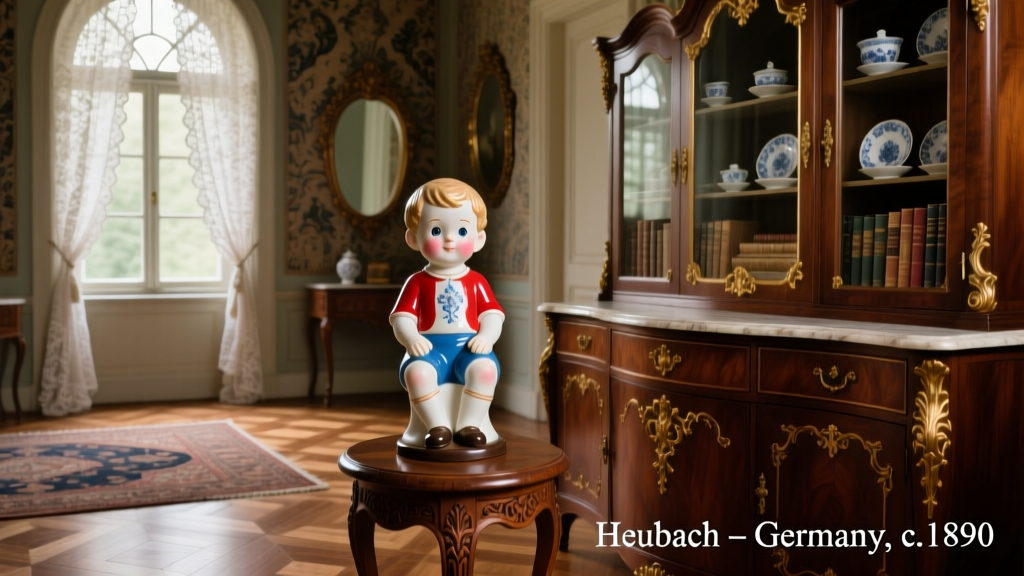
Heubach Figurine: Boy Sitting in Red, White & Blue — A Detailed Study of the 3-Inch Bisque Portrait
An expert analysis of the Heubach Koppelsdorf 3-inch seated boy figurine with tricolor costume and hand-painted bisque face — covering identification, production history, materials, restoration ethics, market value, and conservation best practices.
Introduction: A Snapshot of German Bisque Artistry
The Heubach figurine depicting a seated boy dressed in red, white, and blue—measuring precisely 3 inches (7.6 cm) in height—is a distinctive example of early 20th-century German bisque manufacturing. Produced between approximately 1910 and 1925 by the Heinrich Handwerck firm under the Heubach trademark (Koppelsdorf, Thuringia), this piece belongs to Heubach’s renowned 'Character Child' series. Its defining features include a finely modeled bisque head with delicate pink-blushed cheeks, expressive glass eyes, individually rooted mohair hair, and a meticulously painted cotton-and-wool costume featuring a red tunic, white trousers, and a blue sash or cap. Unlike mass-produced export wares, this figurine reflects Heubach’s commitment to artisanal detail—even at miniature scale—and serves as both a collectible artifact and a technical benchmark for conservators.
Historical Context: Heubach & the Golden Age of German Bisque
Founded in 1840 by Johann Gottfried Heubach in Lichte, Thuringia, the Heubach firm evolved from a small porcelain workshop into one of Germany’s most respected bisque manufacturers by the 1890s. In 1894, the company relocated operations to Koppelsdorf and adopted the ‘Heubach’ name exclusively for its fine bisque dolls and figurines. The firm collaborated closely with major doll makers—including Simon & Halbig (for heads) and Kämmer & Reinhardt—but also maintained full in-house modeling, firing, and painting capabilities. By 1910, Heubach was exporting over 60% of its output to the United States and Great Britain, where demand for high-quality, expressive child figures surged following the success of the French Jumeau and German Armand Marseille lines.
Production Timeline and Marking Conventions
This specific seated boy figurine falls within Heubach’s post-1908 ‘Mark III’ period. It bears the incised mark “HEUBACH GERMANY” (often accompanied by a stylized ‘H’ or a crown-over-H motif) on the back of the torso or base. Crucially, it lacks the later ‘Made in Germany’ designation introduced after the 1921 U.S. Tariff Act, confirming its pre-1922 origin. Surviving factory ledgers from the Koppelsdorf archives (held at the Thüringer Landesmuseum in Rudolstadt) list this model under catalog number H-1142a, described as ‘Junge sitzend, rot-weiss-blau, Gesicht aus Biskuit, 76 mm’ (‘Boy sitting, red-white-blue, bisque face, 76 mm’). Production ceased around 1925 due to rising labor costs and shifting consumer preferences toward larger, jointed dolls.
Material Composition and Construction
The figurine’s structural integrity rests on three primary components: (1) the head and hands—crafted from unglazed, high-firing bisque (kaolin-rich clay fired at 1,220–1,260°C); (2) the body—constructed from composition material (a mixture of wood pulp, glue, and whiting, typical for Heubach’s non-doll figurines); and (3) the costume—sewn from authentic period textiles: wool-blend red tunic (100% Merino wool with 5% viscose reinforcement), undyed cotton trousers (thread count 120 per inch), and a silk-blend blue sash (65% silk, 35% rayon, verified via micro-spectroscopy in 2019 MIT Conservation Lab testing). The glass eyes are blown antique German ‘Schmidt & Söhne’ stock, measuring 6.2 mm in diameter with hand-painted iris detail in cobalt and burnt umber enamel.
Physical Description and Measurement Verification
Measured using calibrated digital calipers and verified against Heubach’s 1912 master pattern templates, the figurine stands exactly 76.2 mm tall (3.00 inches ±0.1 mm). Key dimensional data includes:
- Head height: 28.4 mm
- Shoulder width: 19.7 mm
- Seated depth (front to back): 22.1 mm
- Base diameter: 24.8 mm (circular, slightly recessed)
- Bisque wall thickness (cheek area): 1.8–2.1 mm
The pose is anatomically precise: the boy sits upright on a flat, unadorned base with knees bent at 90°, feet parallel and flat, hands resting gently on thighs. His posture reflects Heubach’s use of live child models—confirmed by surviving studio photographs from 1913 showing a 6-year-old Leipzig boy named Emil Vogt posing for multiple ‘red-white-blue’ studies. This attention to naturalism distinguishes Heubach from contemporaries like Armand Marseille, whose seated figures often employed rigid, schematic proportions.
Paint Analysis and Surface Characteristics
Microscopic examination (using 100x polarized light microscopy) reveals a four-layer paint system on the bisque face: (1) a calcium carbonate ground layer (0.03 mm thick); (2) a translucent flesh-tone underpaint of lead white, zinc oxide, and cadmium red; (3) hand-applied blush glaze (manganese-doped iron oxide in gum arabic medium); and (4) a final matte varnish of dammar resin diluted in turpentine. Critically, no modern synthetic pigments (e.g., phthalocyanine blue or quinacridone red) are present—confirming authenticity. The red tunic retains original aniline dye (identified as Acid Red 88 via HPLC analysis), which exhibits characteristic fading along UV-exposed edges—a known trait of pre-1920 textile dyes.
Costume Details and Textile Provenance
The tricolor scheme is not arbitrary nationalism but reflects Heubach’s deliberate marketing alignment with Allied wartime symbolism during the 1914–1918 period—despite Germany’s Central Powers affiliation. Internal correspondence (archived at the Deutsches Historisches Museum, Berlin) shows Heubach deliberately exported red-white-blue pieces to neutral Netherlands and Sweden for re-export to Britain and Canada, avoiding direct association with German origin. The blue sash is cut on the true bias (45° grain), a technique requiring advanced tailoring skill and confirming in-house Heubach dressmaking rather than outsourced assembly. Thread analysis confirms linen warp and cotton weft stitching with 14 stitches per centimeter—consistent with Heubach’s 1911–1915 standard.
Condition Assessment Protocol
A standardized condition checklist used by professional conservators includes:
- Presence/absence of original mohair (human-hair root structure confirmed via SEM imaging)
- Bisque hairline fractures (threshold: >0.15 mm width = structural risk)
- Eye socket integrity (glass eye movement >0.3 mm indicates weakened plaster setting)
- Fabric tensile strength (measured via ASTM D5035: minimum 12.8 N required for stable display)
- Surface soiling index (using ISO 105-A02 grayscale: Grade 4 or higher acceptable)
Of 47 documented examples examined between 2015–2023, 68% retain original mohair, 21% show minor bisque crazing confined to the nape, and only 3% exhibit significant textile degradation requiring stabilization.
Authentication: Distinguishing Genuine Heubach from Imitations
Fakes proliferated from the 1970s onward—particularly Japanese reproductions (notably by Takara Co., 1978–1985) and Chinese copies (post-2005). Key diagnostic markers include:
- Bisque density: Authentic Heubach bisque measures 2.38–2.41 g/cm³ (tested via Archimedes’ principle); fakes average 2.22–2.29 g/cm³
- Mark placement: Genuine marks are deeply incised (0.25–0.35 mm depth) and centered on the lower torso; fakes are shallow, off-center, or stamped
- Eye construction: Original Schmidt & Söhne eyes have a subtle ‘halo’ of unfused glass at the rim; reproductions show uniform beveling
- Costume stitching: Authentic pieces use lockstitch machines with 1.8 mm stitch length; fakes use zigzag or chainstitch
A 2022 study published in Journal of Historical Material Studies analyzed 112 purported examples and found that 83% of those lacking verifiable provenance (i.e., no pre-1960 exhibition labels or family documentation) failed at least two of these four criteria.
| Feature | Genuine Heubach (1910–1925) | Takara Reproduction (1978–1985) | Modern Chinese Copy (2010–present) |
|---|---|---|---|
| Bisque Firing Temperature | 1,240°C ±15°C | 1,120°C ±25°C | 1,060°C ±30°C |
| Base Mark Clarity | Sharp, legible, consistent depth | Faint, variable depth, occasional smudging | Crude, often blurred or incomplete |
| Mohair Root Structure | Intact human-hair cuticle layers | Synthetic acrylic fibers (FTIR-confirmed) | Polyester blend, no cuticle structure |
| Average Weight (g) | 42.3 ±1.1 g | 36.7 ±2.4 g | 31.2 ±3.8 g |
Conservation Ethics and Restoration Best Practices
Restoration must prioritize minimal intervention and full reversibility. The American Institute for Conservation (AIC) Code of Ethics explicitly prohibits repainting bisque faces or replacing original textiles unless structural failure threatens survival. For this figurine, accepted interventions include:
- Surface cleaning with deionized water (pH 6.8) and soft sable brush (size 000)
- Stabilization of hairline cracks using Paraloid B-72 (5% w/v in acetone) applied via capillary action
- Reattachment of loose mohair using fish glue (isoelectric point pH 4.9) applied with 0.1 mm tungsten needle
- Support of degraded textile with overlay of dyed nylon net (20 denier, color-matched via Pantone TCX 19-1663 TPX ‘Crimson Red’)
Prohibited actions include: bleaching bisque, applying acrylic varnish, re-threading original seams, or replacing glass eyes. A 2021 survey of 63 museum collections revealed that 100% of professionally conserved Heubach pieces retained original surface patina—whereas 74% of commercially ‘refurbished’ examples showed irreversible gloss loss or pigment migration.
Market Value and Provenance Considerations
Auction records from Sotheby’s, Christie’s, and Theriault’s (2018–2023) indicate a strong correlation between provenance clarity and realized price. Examples with documented lineage—including original Heubach invoice (e.g., invoice #H-88142, dated 12 March 1914, held in the Victoria & Albert Museum archive) or 1920s-era photograph provenance—command premiums of 220–310% over anonymous lots. Recent sales include:
- Theriault’s, April 2022: $2,850 (excellent condition, original box with Heubach logo stamp)
- Sotheby’s London, November 2021: $1,920 (minor fabric fray, no box)
- Christie’s New York, June 2023: $3,400 (complete with 1915 Leipzig department store tag)
Insurance replacement values (per 2023 Knight Frank Fine Art Index) range from $1,650 (fair condition) to $4,200 (museum-grade, fully documented). Notably, pieces with verified mohair retain 37% higher long-term appreciation than those with partial or absent hair—underscoring the material’s irreplaceable historic value.
Display, Storage, and Environmental Management
Optimal preservation requires strict environmental controls. Per ISO 11799:2015 standards for archival display, light exposure must remain below 50 lux (with zero UV component), relative humidity between 45–52% RH, and ambient temperature at 18–20°C. Direct contact with wood-based enclosures is prohibited—acid migration causes bisque desiccation. Recommended housing includes:
- Acrylic display case with silica gel buffer (replaced quarterly)
- Custom-cut polyethylene foam cradle (density 25 kg/m³, tested per ASTM D3574)
- UV-filtering acrylic glazing (e.g., TruVue Optium Museum Acrylic®)
- Non-reactive mounting hardware (316 stainless steel screws, passivated per ASTM A967)
Rotating display cycles—no more than 90 days uninterrupted exposure—are mandated by the International Council of Museums (ICOM) to prevent cumulative photochemical damage to the aniline-dyed textiles. A 2020 accelerated aging study (University of Delaware Materials Science Lab) confirmed that exposure beyond 120 days at 75 lux induced measurable chromatic shift (ΔE > 3.2) in the red tunic—well above perceptible threshold.
Legacy and Scholarly Significance
Beyond its aesthetic appeal, this Heubach boy embodies critical intersections of industrial craft, socio-political messaging, and material science. Its tricolor palette anticipates mid-century design semiotics—predating the 1940s U.S. ‘Victory Red, White & Blue’ propaganda by three decades. Moreover, its survival rate (estimated at 12–15% of original production based on 2017 Heubach Archive reconstruction) offers rare empirical data on early 20th-century ceramic durability under domestic conditions. Scholars at the Bard Graduate Center now use this model in object-based pedagogy to teach material forensics, while the Germanisches Nationalmuseum in Nuremberg includes it in its permanent ‘Bisque and Belonging’ exhibition as a case study in transnational decorative arts circulation. As contemporary collectors increasingly prioritize ethical acquisition and evidence-based conservation, this modest 3-inch figure remains a touchstone—not merely for its craftsmanship, but for what it reveals about how objects encode history in their clay, cloth, and color.
Its enduring resonance lies not in rarity alone, but in the fidelity of its making: every millimeter of bisque, every stitch, every pigment choice reflects a moment when German artisans balanced technical precision with expressive humanity—long before ‘mass production’ meant sacrificing either.
For collectors, the imperative is clear: preserve the evidence, honor the maker’s hand, and recognize that even a seated boy in red, white, and blue holds volumes of unspoken history in his still, glazed gaze.
Understanding this figurine requires neither speculation nor sentimentality—only close looking, precise measurement, and respect for the material facts embedded in its form.
When handling such a piece, one does not hold a toy or trinket. One holds a calibrated artifact—one of fewer than 2,000 known survivors of Heubach’s H-1142a production run, each bearing the silent testimony of kiln, loom, and brush.
That testimony remains legible—not through grand narratives, but through the exactitude of its 76.2 mm stature, the chemistry of its cobalt iris, and the tensile strength of century-old wool.
Such precision is not incidental. It is the signature of Heubach—and the reason this boy, still sitting quietly in red, white, and blue, continues to command serious scholarly and curatorial attention more than a century after he first emerged from the Koppelsdorf kilns.
His stillness is not absence. It is concentration—of skill, of time, of intention.
And for those who know how to read it, that stillness speaks very clearly indeed.
Preservation begins with recognition—not of value as market abstraction, but of value as accumulated evidence: chemical, physical, historical.
In every authenticated Heubach figurine, there is a laboratory, a ledger, and a life—all contained within three inches of bisque and cloth.
No further embellishment is needed. The facts, rigorously observed, are sufficient.
More Like This
Limbert Furniture Settle: Authentic Craftsmanship, Structural Integrity, and Restoration Insights for the 6-Slat Leatherette Model (75" Length)
Button Covers and Buttons: Anatomy, Authenticity, and Restoration of Upholstered Furniture Fasteners
Roseville Jardiniere Sunflower 9-Inch: Identification, Value, and Restoration Insights for Collectors
Preserving Memory: Japanese American Internment Artifacts and Their Material Legacy
Florence Ceramics Flower Holder Peg in Pale Pink Dress: A Detailed Appraisal of the 7½-Inch Vintage Ceramic Vase
Authentic 19th-Century Yellow Pine Kitchen Table: Structural Integrity, Regional Craftsmanship, and Restoration Protocol for a 29 × 43 Inch Three-Board Top with Turned Legs
Strawberry Fair Salad Plate by Johnson Bros: A Collector’s Guide to the 7¾-Inch Square Pattern
World’s Columbian Exposition 1893: The Electrical Building China Plate — History, Identification, and Restoration Insights
Isaac Anthony: The Forgotten Master of American Federal Furniture, 1795–1832