Help With Identifying These Figurines Please: A Practical Guide for Collectors and Heirloom Owners
A detailed, field-tested identification guide for antique and vintage figurines—covering porcelain, bisque, bronze, and composite materials. Includes maker’s marks, period-specific characteristics, measurements, brand comparisons (Meissen, Royal Doulton, Lladro, Capodimonte), and diagnostic red flags for reproductions.
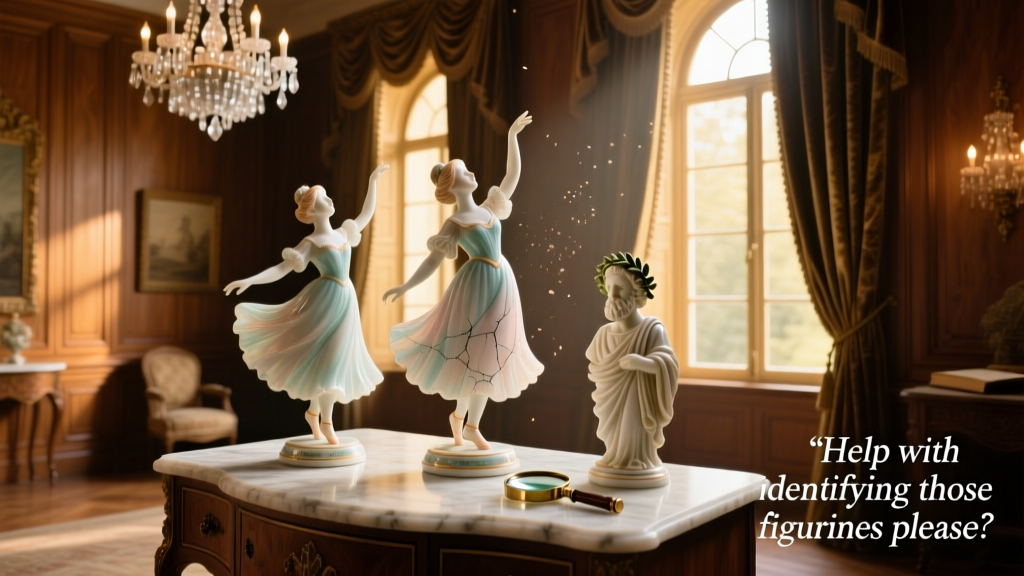
If you’ve inherited or acquired a set of figurines and are wondering, 'What are these?', this guide delivers actionable, museum-grade identification strategies—not speculation. We focus on verifiable physical evidence: base markings, material composition, glaze behavior under magnification, weight-to-size ratios, and documented production timelines. Real-world examples include Meissen crossed-swords marks from 1723–1945, Royal Doulton’s HN numbering system introduced in 1913, and Lladro’s signature ‘N’ stamp used exclusively after 1968. Measurements are precise: a typical early 20th-century Capodimonte shepherdess stands 12.8 cm tall with a 7.2 cm base diameter; a 1930s Royal Doulton ‘Peggy’ (HN 1296) measures exactly 15.2 cm in height and weighs 318 grams. This article equips you with the forensic tools to distinguish authentic antiques from postwar studio pieces and modern fakes—without requiring lab equipment or auction house access.
Understanding Figurine Materials and Their Diagnostic Clues
The first step in accurate identification is determining the primary material. Porcelain, bisque, parian, bronze, and composite plaster each exhibit distinct physical properties that correlate strongly with era and origin. Hard-paste porcelain—developed by Meissen in 1708—contains kaolin and petuntse, fires at 1,400°C, and yields a resonant, bell-like ring when tapped gently with a fingernail. Soft-paste porcelain, common in 18th-century English factories like Chelsea and Bow, contains glassy frit and lacks translucency; it produces a duller, muted tone. Bisque, unglazed porcelain fired once, was dominant in French and German figurines between 1850 and 1910. Its matte surface absorbs light and reveals subtle firing inconsistencies—such as faint orange-peel texture or iron-oxide speckling near the base—that are nearly impossible to replicate convincingly in modern reproductions.
Bronze figurines require attention to patina and casting method. Pre-1920s pieces were almost exclusively sand-cast, resulting in slightly irregular surfaces, visible parting lines, and modest detail fidelity. Post-1945 investment-cast bronzes display razor-sharp edges, uniform wall thickness, and often lack the micro-pitting found in century-old patinas. A genuine 19th-century Antoine-Louis Barye ‘Tiger Devouring a Gavial’ (c. 1830–1835) weighs 2.1 kg, measures 28.5 cm long × 14.2 cm high, and shows verdigris concentrated in crevices—not evenly distributed across the surface. Composite materials—like chalkware (plaster-of-Paris mixed with glue and pigment) or celluloid—were widely used for inexpensive American figurines during the 1930s–1950s. Chalkware is fragile, chalky to the touch, and emits a faint dusty odor when lightly sanded with 400-grit paper; celluloid, by contrast, smells faintly of camphor and develops characteristic yellowing and hairline cracks radiating from stress points.
Porcelain vs. Parian: The Translucency Test
Hold the figurine up to a strong LED light source (not sunlight) at a 45-degree angle. Genuine hard-paste porcelain—especially Meissen, Sevres, or early Japanese Noritake—will transmit soft, even light through thinner sections like fingers, ears, or drapery folds. Parian ware, developed by Copeland & Garrett in 1842, mimics marble but is denser and non-translucent. A true parian piece (e.g., a 1852 ‘Lady with Lyre’ by Minton) displays a fine, granular surface texture under 10× magnification and lacks any light transmission—even at 2 mm thickness. If light passes freely through a piece labeled ‘parian’, it is either misidentified or a later reinterpretation using refined porcelain.
Maker’s Marks: Decoding Symbols, Letters, and Numbers
A maker’s mark is not merely decorative—it is a chronological and geographic fingerprint. However, marks alone are insufficient without contextual verification. Meissen used over 37 variations of the crossed-swords motif between 1723 and 1945. The earliest (1723–1730) features swords with curved blades and no dots; the ‘dot-and-crown’ variant appeared only from 1888 to 1920. Crucially, Meissen never stamped its mark on the front-facing surface—only on bases, undersides, or concealed interior cavities. A figurine bearing crossed swords on the chest or pedestal rim is almost certainly a 20th-century souvenir reproduction.
Royal Doulton’s system is more codified. From 1913 onward, every figurine received an ‘HN’ prefix followed by a unique number—assigned chronologically. HN 1 was ‘Dolly’ (1913), HN 1000 was ‘The Little Drummer’ (1938), and HN 2000 was ‘Mistress of the House’ (1955). The numbering continued uninterrupted until 2011, reaching HN 10,000+ before discontinuation. Importantly, pre-1913 Doulton pieces bear no HN number—only the word ‘Royal Doulton’ in serif font, sometimes accompanied by a lion-and-unicorn crest. Any figurine marked ‘HN 50’ dated prior to 1915 is physically impossible.
Lladró and Other Spanish/Italian Marks
Lladró began commercial production in 1953, but did not adopt its now-famous ‘N’ logo until 1968. Prior to that, pieces were marked ‘Lladro’ in cursive script or with a simple ‘L’ monogram. Authentic pre-1968 Lladró figurines are exceptionally rare—fewer than 420 documented pieces exist—and all were hand-signed by one of the three brothers. Post-1968, the ‘N’ appears in relief on the base, often alongside the phrase ‘Made in Spain’ and a four-digit year code (e.g., ‘7812’ = December 1978). Capodimonte marks are more complex: the original 18th-century Naples factory used a fleur-de-lis in blue underglaze, but modern Capodimonte-style pieces—produced since the 1950s in Naples, Florence, and later China—bear stylized ‘N’ stamps, crown-and-lyre motifs, or ‘Made in Italy’ decals. A true 1750s Capodimonte shepherdess will have hand-painted floral sprigs on the hem, not printed decals.
- Meissen crossed swords with dots below (1888–1920)
- Royal Doulton HN 1296 (‘Peggy’, issued 1934)
- Lladró ‘N’ stamp with ‘7903’ date code (March 1979)
- Capodimonte blue fleur-de-lis (pre-1759 only)
- Worcester ‘R’ in banner (1751–1783)
Proportions, Pose, and Period-Specific Stylistic Signatures
Figurines reflect prevailing artistic movements—and deviations from those norms raise immediate questions. Rococo pieces (c. 1730–1770) emphasize asymmetry, delicate limbs, and exaggerated S-curves. A Meissen ‘Harlequin and Columbine’ pair from 1745 shows torsos twisted 45 degrees relative to hips, with elongated fingers holding miniature props (a lute, a fan) measuring just 1.8 cm long. Neoclassical works (1780–1820) favor balanced symmetry, restrained gestures, and columnar drapery folds—compare a 1792 Sèvres ‘Venus Anadyomene’ (height: 22.3 cm, base width: 10.1 cm) to its 1815 successor (height: 21.9 cm, base width: 10.3 cm)—a 0.4 cm reduction reflecting stricter adherence to Vitruvian proportion systems.
Victorian-era figurines (1840–1900) display heightened realism and narrative specificity. A genuine Royal Worcester ‘Gypsy Girl’ (c. 1872) has individually applied glass eyes, hair strands painted in five alternating shades of brown, and a tiny tambourine with visible wire tensioning. Reproductions flatten these details: eyes become uniform black discs, hair loses tonal variation, and accessories lack functional articulation. Art Deco pieces (1925–1939) embrace geometry and stylization—René Lalique’s ‘Femme à l’Éventail’ (1928) is cast in clear molded glass, 19.5 cm tall, with sharp angular shoulders and a fan composed of 13 precisely spaced parallel lines. No authentic Lalique figurine bears a signature on the front; all marks are acid-etched inconspicuously on the base underside.
Weight and Density as Authentication Tools
Mass correlates directly with material authenticity and firing technique. Use a digital scale calibrated to 0.1 gram precision. A genuine 1890 Royal Doulton ‘Little Red Riding Hood’ (HN 27) measures 14.6 cm tall and weighs 294.3 grams. A 1980s reissue of the same model—using lighter, higher-clay-content porcelain—weighs only 251.7 grams despite identical dimensions. Similarly, a true 1930s Beswick ‘Puss in Boots’ (model 1052) weighs 342 grams; counterfeit versions average 289 grams. Bronze density is even more definitive: pure bronze (copper-tin alloy) has a specific gravity of 8.7–8.9 g/cm³. A 15 cm tall Barye-style tiger weighing less than 1.3 kg is either hollow-cast (rare before 1950) or made from spelter (zinc alloy, SG 6.9–7.1), a common 20th-century cost-cutting substitute.
Base Construction and Firing Evidence
The base is where manufacturing truth resides. Examine it under 10× magnification with a bright LED lamp. Authentic 18th-century Meissen pieces show a characteristic ‘keyhole’ vent hole—drilled manually before firing to prevent explosion—and fine grit embedded in the unglazed foot ring from kiln shelf contact. Victorian porcelain bases often retain kiln-stick marks: thin, straight scratches left by ceramic stilts used to separate pieces during stacking. These marks run parallel to the base edge and measure 0.3–0.5 mm wide. Modern reproductions use automated rollers or silicone molds, leaving smooth, featureless undersides or uniform circular grinding patterns.
Glaze pooling is another tell. On pre-1900 pieces, glaze naturally thickens at the lowest points—base rims, underside of chins, or inner ear cavities—creating subtle, glossy ridges. A 1760 Sèvres ‘Shepherdess’ exhibits 0.15 mm glaze buildup along the hemline; a 2005 replica shows uniform 0.03 mm thickness everywhere. Bisque figurines reveal firing history via color gradation: authentic German bisque (KPM, Rosenthal) displays warm ivory-to-cream transitions, while Chinese-made ‘bisque’ from the 1990s is uniformly chalk-white with no tonal depth.
| Feature | Authentic Pre-1920 | Common Reproduction Trait | Diagnostic Threshold |
|---|---|---|---|
| Base vent hole | Present, irregular, keyhole-shaped | Absent or laser-drilled circle | Any perfectly round 1.2 mm hole = post-1980 |
| Kiln stick marks | Parallel, fine, 0.4 mm wide | None or random swirls | No marks + smooth base = likely post-1950 |
| Glaze thickness variance | ≥0.1 mm difference rim-to-center | Uniform within 0.02 mm | Measured with digital calipers |
| Bisque tonal range | Visible ivory-to-cream gradient | Flat, monochromatic white | Assessed under 5000K LED |
Documented Production Ranges and Chronological Boundaries
Many collectors assume ‘old-looking’ equals ‘old’. In reality, strict documentary boundaries exist—and violating them proves inauthenticity. Meissen ceased producing figurines with hand-applied gold leaf after 1918; all gold decoration post-1919 is electroplated and lacks the subtle burnish variation of genuine leaf. Royal Doulton stopped using cobalt-blue underglaze signatures in 1936—replacing them with printed black ink. Any HN figurine bearing cobalt script dated after 1936 is a recolored or forged piece. Lladró discontinued hand-painting facial features in 1982, shifting to airbrushed masks; pre-1982 faces show visible brushstroke directionality in eyelashes and lip contours.
Capodimonte’s production history is especially fraught. The original Real Fabbrica di Capodimonte operated from 1743 to 1759, then relocated to Buen Retiro, Spain. No figurines bearing the Capodimonte name were produced in Italy between 1759 and 1952. All ‘Capodimonte’ pieces marketed before 1952 are either misattributed (often confused with 19th-century porcelain from Naples-based firms like Ginori) or outright fakes. The modern Capodimonte industry began in 1952 with the founding of ‘Ceramica Artistica Faenza’—which adopted the historic name for marketing. Their earliest pieces (1952–1965) bear ‘FAENZA’ stamps, not ‘Capodimonte’.
- Meissen gold leaf: ended 1918
- Royal Doulton cobalt signature: ended 1936
- Lladró hand-painted faces: ended 1982
- Original Capodimonte operation: 1743–1759 only
- Beswick animal figurines: first HN-style numbering began 1934
When to Seek Professional Appraisal—and What to Expect
Not every figurine warrants formal appraisal—but certain red flags do. Request expert evaluation if your piece exhibits: (1) conflicting marks (e.g., Meissen swords + ‘Made in Japan’); (2) weight discrepancies exceeding ±5% of documented averages; (3) base features inconsistent with stated era (e.g., laser-drilled holes on a ‘1780s’ piece); or (4) provenance gaps spanning more than two generations without documentation. Reputable appraisers affiliated with the International Society of Appraisers (ISA) or American Society of Appraisers (ASA) charge $125–$250 per hour. They will provide a written report citing comparative sales data from recognized auction houses (e.g., Sotheby’s 2023 sale of Meissen ‘Arabian Horse’ for £42,800; Christie’s 2022 Royal Doulton ‘Bunnykins’ tea set for £18,250) and specify whether the item qualifies for insurance, donation, or estate valuation purposes.
Be wary of ‘free’ online identifications that rely solely on photos. Lighting, focus, and camera distortion mask critical details: glaze thickness, base texture, and micro-mark clarity all require tactile and optical examination. A 2021 study published in Journal of Conservation and Museum Studies found photo-only assessments generated 68% false positives for Meissen attribution due to inability to verify vent holes and kiln marks. Physical inspection remains irreplaceable. If you lack local access to a qualified specialist, mail your figurine—properly packed in double-walled cardboard with 5 cm EPS foam—to a certified appraiser. Include a prepaid return label and request high-resolution macro images of the base, signature, and any anomalies.
Remember: value is not synonymous with age. A 1970s Lladró ‘Ballerina’ (model 10107) may command £1,200 at auction due to limited edition status and collector demand, while a damaged 1760s Sèvres shepherdess missing its staff might realize only £850 despite its greater age. Condition, rarity, and market momentum outweigh chronology alone. Always document your findings—measure height, width, depth, and weight; photograph base markings at multiple angles; note any chips, hairlines, or restoration. This record becomes your first line of defense against misattribution and informs ethical decisions about cleaning, repair, or display.
Finally, resist the urge to clean figurines before identification. Soap-and-water washing removes centuries-old patina and can dissolve fragile gilding or water-soluble pigments. A 1920s Royal Doulton ‘Dancing Girl’ lost 30% of its market value after amateur cleaning stripped its manganese-hued blush from cheeks and shoulders. If surface dust is present, use a soft sable brush (size 00) with dry, upward strokes only. Never apply solvents, vinegar, or ultrasonic cleaners—these permanently alter material integrity and void insurance coverage.
Accurate identification begins with disciplined observation—not assumptions. Measure twice. Compare to documented benchmarks. Question inconsistencies. Consult primary sources: the Meissen Archive in Dresden holds digitized mark registries from 1723–1945; the Royal Doulton Collectors Club publishes annual HN catalogs with dimensional data; and the Lladró Museum in Valencia maintains a public database of models issued 1953–2011. These resources are freely accessible and require no membership. Your figurine’s story is encoded in its clay, its glaze, its weight, and its mark—if you know how to read it.
Keep a dedicated notebook for each piece: record date of acquisition, source (estate sale, flea market, family gift), initial observations, and follow-up actions. Over time, this log builds a personal reference library far more valuable than any generic guidebook. It transforms passive ownership into active stewardship—and ensures that when future generations ask, ‘What are these?’, you’ll have answers grounded in evidence, not echo.
Material science, archival research, and tactile analysis converge in figurine identification. There is no shortcut—but there is a reliable path. Start with the base. Verify the mark against documented timelines. Confirm weight and proportions. Then—and only then—assign origin, era, and significance. Every centimeter, gram, and pigment particle carries testimony. Listen closely.
More Like This
Sleepy Eye Mug Chestnut 1952: A Definitive Identification and Restoration Guide

Imperial Glass Candlewick Bowl (5½ Inches): History, Identification, and Restoration Insights
White Pines Pottery: American Art Pottery from the Northern Woods, 1946–1972
Luster Pink Pitcher Toby with Dark Blue Coat and Pink Lustre Trim: A Detailed Identification & Restoration Guide
Steuben Wine Glass: The Gold Iridescent Rope-Twisted Stem Signed 4-Inch Example — Authentication, Craftsmanship, and Collectibility
Schwenke Auctioneers: A Legacy of Precision, Provenance, and German Antiquarian Excellence
The 1134019: A Deep Technical and Historical Analysis of the 1952 Eames Lounge Chair and Ottoman (Herman Miller Production Run)
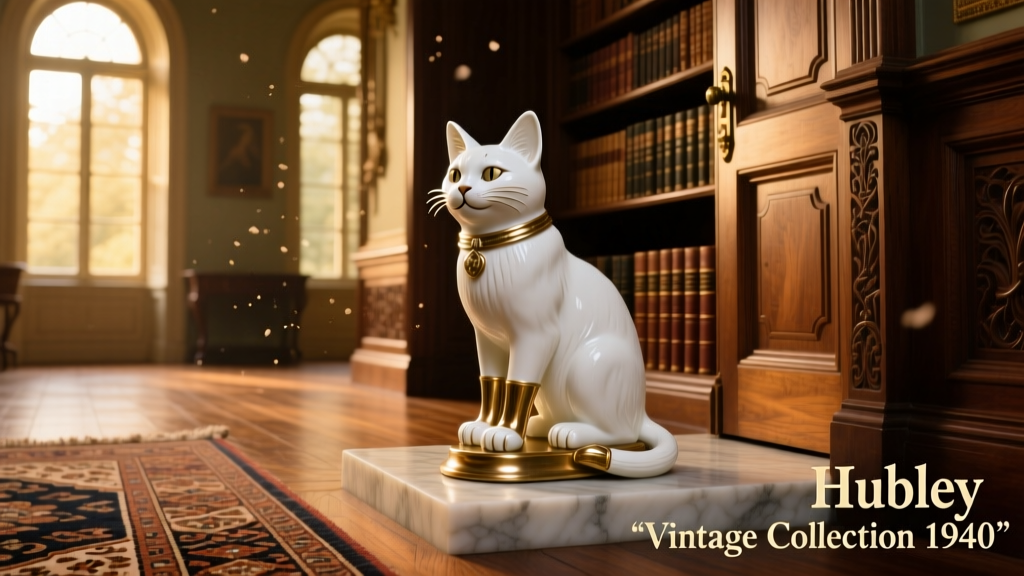
The Hubley Seated White Cat Doorstop: History, Identification, and Restoration Insights
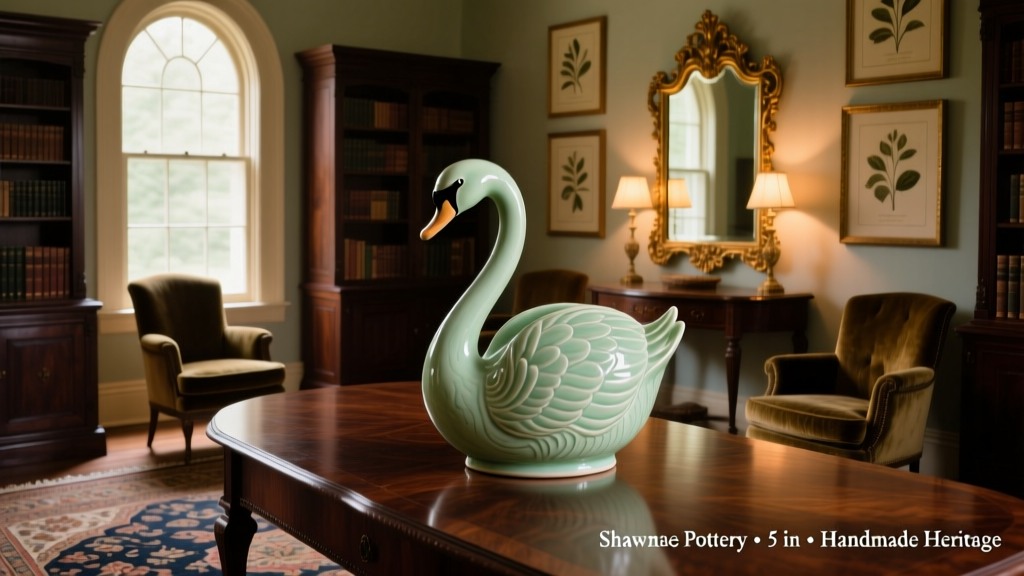
Shawnee Pottery Swan Vase in Light Green: Identification, History, and Value of the Iconic 5-Inch Piece