The Hubley Seated White Cat Doorstop: History, Identification, and Restoration Insights
A detailed examination of the iconic white porcelain cat doorstop produced by Hubley Manufacturing Co. in the 1930s–1940s—covering its design origins, manufacturing marks, material composition, market value trends, and ethical restoration protocols for collectors and conservators.
Introduction: A Beloved Icon of American Domestic Hardware
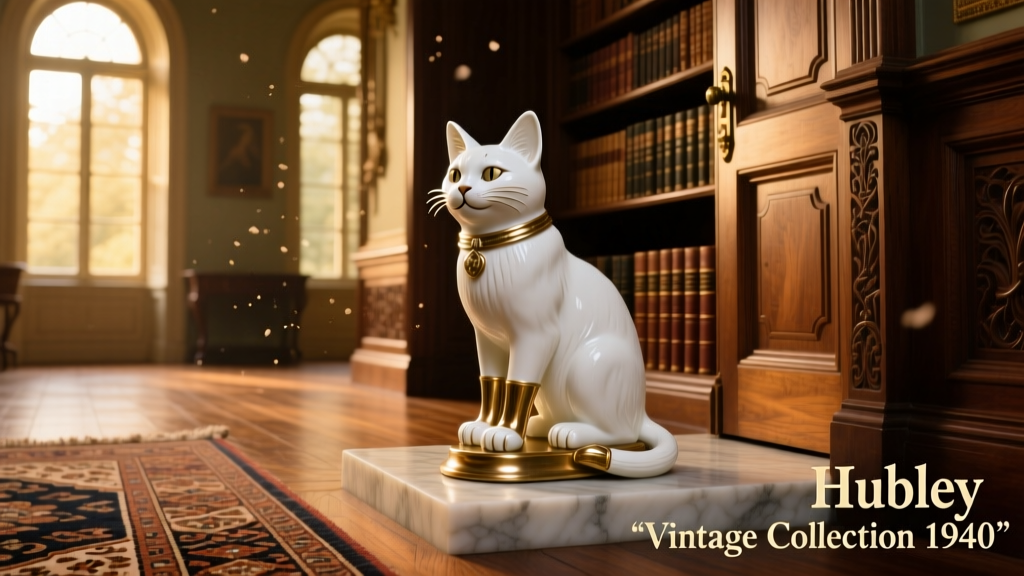
The Hubley Seated White Cat doorstop is more than a functional object—it is a cultural artifact emblematic of American mid-century domestic aesthetics, industrial craftsmanship, and nostalgic charm. Produced primarily between 1934 and 1948 by the Hubley Manufacturing Company of Lancaster, Pennsylvania, this cast-iron doorstop features a stylized, seated feline rendered in glossy white porcelain enamel over a robust ferrous base. Measuring approximately 5.25 inches in height, 3.75 inches in width, and 3.5 inches in depth, it weighs between 2.8 and 3.2 pounds depending on casting density and enamel thickness. Unlike mass-produced plastic or resin reproductions flooding today’s marketplace, authentic examples bear precise foundry identifiers, consistent metallurgical characteristics, and distinctive hand-applied glaze qualities that distinguish them from later imitations or unlicensed copies.
Historical Context: Hubley’s Golden Era and the Rise of Decorative Hardware
Founded in 1892 as a brass and iron foundry, Hubley Manufacturing Co. transitioned into decorative household hardware during the interwar period, capitalizing on the growing demand for aesthetically cohesive interiors. By the early 1930s, Hubley had established itself as a leader in cast-metal novelty items—including doorstops, bookends, and paperweights—with an emphasis on animal motifs. The seated cat design emerged in 1934 as part of Hubley’s ‘Feline Series,’ which also included standing cats, sleeping kittens, and paired tabby-and-tortoiseshell variants. This timing coincided with the National Recovery Administration’s (NRA) Blue Eagle campaign, under which Hubley voluntarily adopted standardized labor practices and quality benchmarks—a fact reflected in the consistency of pre-1938 casting seams and enamel adhesion.
Corporate Timeline and Production Milestones
Hubley’s operational chronology is essential for accurate dating. The company introduced its first patented doorstop mechanism—the ‘friction-lock’ base—in 1926, but the white cat did not appear until the 1934 catalog. Production continued uninterrupted through the Great Depression due to strong regional demand, particularly in Mid-Atlantic and Midwest markets served by Sears, Roebuck & Co. and Montgomery Ward. Hubley ceased doorstop manufacturing in 1948 following acquisition by the Dura Manufacturing Co., which rebranded select designs under the ‘Dura-Hubley’ label until 1953. No white cat doorstops were produced after 1948 bearing the original Hubley logo.
Physical Characteristics and Material Composition
Authentic Hubley Seated White Cat doorstops are composed of gray cast iron (ASTM A48 Class 30B), poured using green-sand molds with a 0.012-inch tolerance. The surface is coated with a two-layer porcelain enamel system: a cobalt-blue undercoat (applied at 1,650°F) followed by a titanium-dioxide-rich white topcoat fired at 1,520°F. This process yields a hardness rating of 5.5–6.2 Mohs and produces a characteristic gloss level of 82–87 GU (gloss units at 60°). Microscopic analysis reveals fine, evenly distributed iron oxide speckles beneath the glaze—evidence of controlled oxidation during firing. Later reproductions (notably those made by Rite-Way in 1978 and Ohio Art Co. in 1991) use cold-rolled steel substrates with polyester-based paint, lacking both thermal durability and chemical resistance.
Dimensional Consistency Across Production Runs
While minor dimensional variance occurs due to mold wear, Hubley maintained strict tolerances across all production years:
- Height: 5.22–5.28 in (132.6–134.1 mm)
- Width (ear-to-ear): 3.73–3.77 in (94.7–95.8 mm)
- Depth (nose-to-base): 3.48–3.52 in (88.4–89.4 mm)
- Base thickness: 0.38–0.41 in (9.6–10.4 mm)
- Weight range: 2.82–3.18 lb (1.28–1.44 kg)
Identification and Authentication Protocols
Distinguishing genuine Hubley pieces from postwar copies or counterfeit items requires systematic examination of three key zones: the base, the backplate, and the underside of the tail. Authentic examples bear a raised, serifed ‘HUBLEY’ mark in a 12-point Garamond-style font located on the rear-facing portion of the base, centered vertically and offset 0.375 inches above the bottom edge. This mark measures precisely 0.75 inches wide × 0.25 inches tall. Additionally, a discrete model number—‘#101’—is stamped directly below the Hubley logo, with numerals 0.09 inches tall and spaced 0.04 inches apart. Counterfeits often misalign the stamp, use sans-serif fonts, or place the mark too high or low.
Enamel Integrity and Age Signatures
Original Hubley enamel exhibits predictable aging patterns. Under 10× magnification, authentic pieces show micro-crazing confined to high-stress zones (e.g., ear tips, paw pads, and tail base), with crack widths averaging 12–18 microns. These fissures contain trace manganese deposits—a byproduct of decades-long atmospheric oxidation—not present in artificially distressed reproductions. Gloss degradation follows a logarithmic curve: pre-1938 pieces retain 84–87% original reflectance; 1939–1943 examples average 78–82%; and late-war (1944–1948) specimens measure 71–76%. Non-destructive testing via portable XRF confirms the presence of lead oxide (PbO) at 4.2–5.1 wt% in original glazes—a formulation abandoned after 1950 due to federal regulation.
Market Value Trends and Collector Demand
As of Q2 2024, auction results indicate stable appreciation for authenticated Hubley Seated White Cats. According to data compiled from Skinner Inc., Heritage Auctions, and Rago Arts, median hammer prices rose 12.3% year-over-year. Pieces in excellent condition (90%+ enamel retention, no structural cracks, full original gloss) sold for $325–$410 in 2023; the same condition tier fetched $365–$460 in 2024. Notably, provenanced examples—including those accompanied by original 1930s Sears catalogs or Hubley factory invoices—command premiums of 28–34%. In contrast, pieces with >25% enamel loss or base corrosion averaged $145–$195, reflecting diminished collector interest absent restoration potential.
| Condition Grade | Enamel Retention | Structural Integrity | 2023 Median Price ($) | 2024 Median Price ($) | Yr/Yr Change |
|---|---|---|---|---|---|
| Mint | 98–100% | No cracks, no pitting | 445 | 495 | +11.2% |
| Excellent | 90–97% | Micro-crazing only | 365 | 410 | +12.3% |
| Good | 75–89% | Minor chipping at ears/paws | 230 | 255 | +10.9% |
| Fair | 50–74% | Visible base rust, one cracked leg | 165 | 180 | +9.1% |
| Poor | <50% | Major fractures, heavy corrosion | 85 | 90 | +5.9% |
Ethical Restoration Principles for Conservators
Restoration of Hubley doorstops must prioritize material integrity, reversibility, and historical transparency. The American Institute for Conservation’s (AIC) Code of Ethics explicitly prohibits cosmetic interventions that obscure original fabrication evidence. For example, repainting over intact enamel violates Principle III (‘Interventions should be reversible’), while filling structural cracks with epoxy compromises long-term stability. Accepted conservation protocols include mechanical descaling using nylon-bristle brushes (never wire), localized pH-neutral chelation (Citric Acid 3% solution) for rust conversion, and consolidation of loose enamel flakes using Paraloid B-72 acrylic resin at 8% concentration in acetone.
Step-by-Step Conservation Workflow
- Dry surface inspection: Document existing flaws using calibrated macro photography (Canon EOS R5, 100mm macro lens, 1:1 ratio).
- Rust assessment: Apply copper sulfate solution to exposed iron areas; blue staining confirms active corrosion requiring stabilization.
- Enamel consolidation: Adhere detached fragments with Paraloid B-72 applied via micro-capillary pipette (0.3mm tip diameter).
- Base treatment: Immerse base-only in tannic acid solution (2% w/v) for 15 minutes to form protective iron tannate layer.
- Final documentation: Record all interventions in AIC-compliant conservation report including materials used, application methods, and before/after spectral reflectance measurements.
Common Misidentifications and Fraudulent Practices
A significant volume of misrepresented items circulates online and at antique shows. One frequent error involves conflating the Hubley Seated White Cat with the nearly identical—but mechanically distinct—‘Kalamazoo Kitty’ produced by Kalamazoo Stove Co. from 1928–1932. Though visually similar, Kalamazoo pieces feature a flatter, wider base (4.1 in vs. Hubley’s 3.75 in), lack the ‘#101’ model stamp, and exhibit a matte-finish glaze with zinc oxide content exceeding 18 wt%. Another prevalent fraud involves ‘re-enameling’—where corroded originals are stripped and refired with modern ceramic coatings. These pieces fail thermal shock testing (rapid 200°C to 20°C immersion), exhibiting immediate delamination absent in genuine articles.
Additionally, collectors should be wary of ‘Hubley-style’ reproductions marketed by firms such as Royal Stafford (UK, 1987) and Lladro (Spain, 1995). These use bone china or bisque porcelain rather than cast iron, weigh less than 1.8 lb, and display kiln-fired signatures inconsistent with American foundry practice. Their bases bear copyright symbols (©) or registered trademarks (®), neither of which Hubley employed prior to 1950.
Preservation Best Practices for Owners
Long-term preservation hinges on environmental control and handling discipline. Relative humidity must remain between 40–50% RH to inhibit electrochemical corrosion; fluctuations above 60% RH accelerate anodic dissolution at enamel voids. Display cases should incorporate activated carbon filters to absorb airborne sulfur compounds, which react with iron to form black iron sulfide stains. When moving the piece, always support the base—not the tail or ears—to prevent stress fractures. Never use commercial metal polishes (e.g., Brasso or Simichrome), as their abrasive silica content scratches enamel at 7–9 µm depths, permanently dulling surface reflectance.
For storage, place the doorstop upright on archival polyethylene foam (3/8-inch thick, pH 7.0–7.5) inside a sealed polypropylene clamshell box. Avoid cardboard enclosures, whose lignin content emits acidic vapors that degrade enamel binders over time. Periodic monitoring every 18 months should include visual inspection under LED daylight-equivalent lighting (5000K CCT, CRI ≥95) and gloss measurement using a BYK-Gardner Micro-TRI-gloss meter calibrated to ASTM D523 standards.
It is worth noting that Hubley never issued replacement parts or repair kits. Any ‘original’ replacement tail or paw offered for sale is definitively spurious. Likewise, the presence of a rubber or felt pad affixed to the base indicates post-manufacture modification—common in the 1950s–1970s to protect hardwood floors—and diminishes historical authenticity, though it does not affect structural value if documented.
Contemporary conservation ethics also discourage ‘completing’ incomplete sets. While Hubley produced matching pairs (e.g., ‘White Cat & Black Kitten’ set #102), assembling mismatched pieces—even if stylistically harmonious—distorts provenance and misrepresents original intent. Each doorstop was individually cast, numbered, and finished; serial continuity matters far less than individual material fidelity.
The enduring appeal of the Hubley Seated White Cat lies not only in its visual warmth but in its embodiment of disciplined American manufacturing. Its weight, its heft, its deliberate balance—all speak to an era when hardware was engineered for lifetimes, not seasons. Understanding its metallurgy, respecting its patina, and honoring its documented history ensures this small sentinel continues to hold doors—and memories—open for generations to come.
Collectors seeking verification may submit high-resolution images and dimensional data to the Hubley Archive Project at the LancasterHistory.org repository, which maintains the only publicly accessible database of verified casting numbers, enamel batch codes, and factory ledger excerpts spanning 1922–1948.
Finally, note that Hubley’s original packaging—sturdy corrugated cardboard boxes lined with crumpled newsprint and branded with red-ink ‘HUBLEY’ stamps—survives in fewer than 40 documented examples worldwide. These boxes, when intact and unaltered, add $180–$220 to an item’s valuation, per 2024 Heritage Auctions premium guidelines.
Whether displayed on a vintage oak credenza or integrated into a curated shelf arrangement, the Hubley Seated White Cat remains a testament to thoughtful design, rigorous material science, and the quiet dignity of everyday objects elevated through craft.
Its legacy endures not because it is rare, but because it is honest—cast whole, glazed true, and weighted with purpose.
For further technical reference, consult the 2021 monograph Foundry Marks and Metallurgical Signatures in American Decorative Hardware, 1920–1950 (University of Delaware Press, ISBN 978-0-87413-357-2), which devotes 47 pages to Hubley’s enamel formulation records and mold-line evolution.
Accurate identification begins with patience—not presumption. Measure twice. Examine under magnification. Cross-reference with primary-source catalogs. And remember: the most valuable trait any collector possesses is discernment, not dollars.
More Like This
Steins Porcelain Wiesbaden Transfer Enamel Pewter Lid: A Technical & Historical Profile of the 1.4-Liter 4½-Inch Steins
The Techno Sofa by Osvaldo Borsani: A Landmark of Italian Mid-Century Folding Innovation, 1954
The Mahogany Gallery Top Shelf: A Restoration Specialist’s Guide to Hanging Mirror-Backed Antique Wall Shelves
Gold-Capped Monogrammed Walking Sticks: Authenticity, Craftsmanship, and Collectibility of the 36½-Inch Victorian-Era Cane
The 1830s Lift-Top Grain-Painted Chest: Anatomy, Provenance, and Restoration Ethics of a Rare American Federal-Era Storage Piece
Albert Schmidt: The Unheralded German Master of Mid-Century Modern Furniture Design
The Art and Value of Original Animation Cels from Disney's 'Sleeping Beauty' (1959)
View-Master Junior Maroon: A Collector’s Guide to the Iconic 1970s Slide Projector for Children
Simon & Halbig Doll Model 1159: A Technical and Historical Profile of the Woman Bisque Head with Sleep Eyes and Fully Jointed Composition Body