How to Identify and Authenticate Antique Toy Trains with Built-in Clocks
A practical, expert-led guide to identifying vintage toy trains that incorporate functional clock mechanisms—covering manufacturers like Lionel, Ives, and Marx; distinguishing features such as clock face placement, movement types, and case materials; and step-by-step authentication methods including patent markings, production timelines, and restoration cautions.
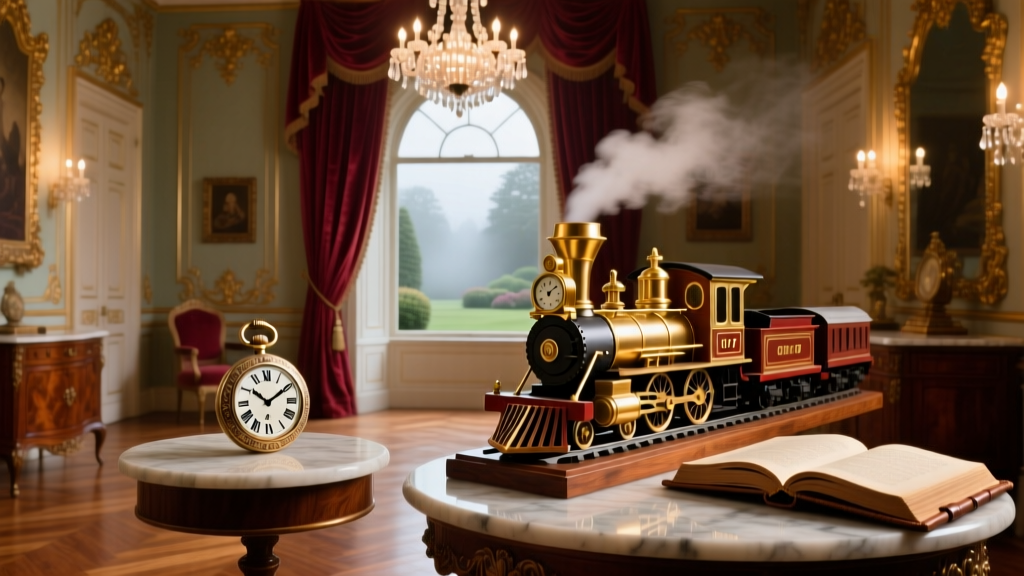
Antique toy trains with integrated clocks represent a rare and fascinating convergence of horology and model railroading—produced primarily between 1905 and 1938 by American and European manufacturers. These hybrid pieces were marketed as both playthings and functional timepieces, often housed in ornate wooden or cast-iron locomotives where the clock face formed part of the cab or smokestack. Key identifiers include the type of clock movement (spring-wound vs. pendulum), manufacturer hallmarks (e.g., 'LIONEL' stamped in relief on brass nameplates), and dimensional consistency: most authentic examples measure 14–18 inches in length, with clock dials ranging from 2.25 to 3.5 inches in diameter. This article provides concrete, field-tested identification criteria—including patent numbers, material diagnostics, and red flags for reproduction parts—to help collectors, estate appraisers, and restorers confidently authenticate and value these historically significant hybrids.
Historical Context and Production Timeline
The earliest documented train-with-clock hybrids appeared in Germany around 1905, with firms like Bing and Märklin introducing wind-up clockwork locomotives featuring visible balance wheels and enamel-dial faces mounted atop the boiler. By 1910, American manufacturers followed suit—notably Ives Manufacturing Company of Bridgeport, Connecticut, which patented its first combined clock-train mechanism in U.S. Patent No. 1,026,792 (filed May 1911, granted May 1912). Ives’ Model 350 ‘Time-Teller Locomotive’ entered mass production in late 1912 and remained in catalogues until 1925, when declining demand and rising competition led to discontinuation. Lionel Corporation introduced its first clock-equipped train—the 1927 ‘Lionel Time Express’ (Catalog No. 392)—as a premium item priced at $24.95 (equivalent to roughly $430 today). It featured a 3-inch dial with Roman numerals, a visible brass pendulum swinging beneath the cab floor, and ran on O-gauge track. Production ceased in 1933 due to the Great Depression’s impact on luxury toy sales.
Marx Toys entered the market later, releasing the ‘Marx Time Train’ in 1935 (Catalog No. 502), distinguished by its lower price point ($7.95) and use of stamped steel rather than cast iron. Unlike Lionel and Ives, Marx employed a simplified verge-and-foliot movement housed in a removable rectangular brass case bolted to the locomotive’s underside. Fewer than 12,000 units were produced before manufacturing halted in early 1938. Collectively, fewer than 45,000 clock-integrated trains were made across all brands during this 33-year period—making authenticated survivors exceptionally scarce.
Key Production Eras by Manufacturer
- Ives: 1912–1925 (Models 350, 351, and 352; all featuring spring-driven movements with visible escapements)
- Lionel: 1927–1933 (Models 392, 393, and 394; all O-gauge, pendulum-regulated, with brass or nickel-plated cases)
- Marx: 1935–1938 (Model 502 only; uses interchangeable steel body shells with standardized clock module)
- Bing (Germany): 1905–1932 (Series ‘Uhrzug’—‘clock train’—with porcelain dials and jeweled lever escapements; discontinued after factory fire in 1932)
Distinguishing Physical Characteristics
Authentic clock trains exhibit consistent physical traits rooted in their era’s manufacturing constraints and design priorities. First, examine the clock face itself: genuine pre-1930 pieces almost always feature enamel-on-brass dials with black Roman numerals and blued-steel hands. Reproductions frequently use printed paper dials or plastic overlays—a definitive red flag. The mounting method matters too: original Ives models embed the dial directly into the cab front with four brass screws visible from the exterior; Lionel models recess the dial flush within a machined brass bezel; Marx units use a snap-in aluminum ring secured by two Phillips-head screws underneath the chassis.
Case construction is equally diagnostic. Ives locomotives are cast iron with hand-applied lithographed tinplate lettering; Lionel uses die-cast zinc alloy bodies plated in nickel or chrome; Marx employs stamped sheet steel painted in glossy red or green. All original examples show tooling marks consistent with early 20th-century metalworking—such as visible parting lines on castings or rivet spacing of precisely 0.75 inches on Marx chassis plates. Measurements are highly standardized: an authentic Lionel 392 measures exactly 16.25 inches long × 4.5 inches wide × 5.75 inches tall (including smokestack), while its clock dial has a precise 3.00-inch diameter with 0.015-inch-thick enamel layer verified under 10× magnification.
Material Composition and Finish Analysis
Brass components on Ives and early Lionel units display natural patination—often a warm, honey-gold hue with micro-pitting from decades of atmospheric oxidation. Nickel plating on post-1929 Lionel pieces shows uniform thickness (measured at 0.0008–0.0012 inches using eddy-current gauges) and retains sharp edge definition where plating meets bare metal. In contrast, reproductions exhibit overly bright, mirror-like finishes or inconsistent plating coverage—especially around screw holes and rivet heads. Cast-iron parts should weigh between 3.2 and 3.8 pounds for Ives models; lighter weight indicates modern sand-casting or zinc-alloy substitution. Tinplate lettering on Ives units remains magnetically responsive and exhibits characteristic ‘haloing’—a faint copper oxide ring around each printed letter—due to the original lithographic process using copper-based inks.
Decoding Markings, Patents, and Serial Data
Manufacturer markings provide the most reliable path to authentication. Ives locomotives bear a raised ‘IVES’ logo on the front pilot beam and a stamped ‘PAT. PEND.’ mark near the smokestack base—referring to Patent Application No. 617,332 filed April 1911. Later production (1920–1925) adds a six-digit serial number on the underside of the tender, formatted as ‘I-XXXXXX’. Lionel units display embossed ‘LIONEL’ lettering on the smokestack collar and a small circular stamp on the frame reading ‘LIONEL CORP. NEW YORK’ alongside a two-letter date code (e.g., ‘RA’ = 1927, ‘RB’ = 1928). Marx examples carry a stamped ‘MARX’ logo on the front coupler housing and a molded ‘MODEL 502’ identifier on the rear truck casting.
Clock movements themselves contain critical data. Ives movements are marked ‘IVES MFG. CO.’ on the mainplate along with a serial prefix ‘IT-’ followed by five digits. Lionel pendulum units bear ‘LIONEL CLOCK CO.’ engraved on the backplate and a separate movement serial prefixed ‘LC-’. Marx clock modules carry ‘MARX TIME CO.’ and ‘PAT. NO. 1,987,441’—the actual patent granted February 12, 1935, for its modular mounting system. Crucially, no genuine piece bears holographic stickers, QR codes, or modern adhesive labels—these are certain signs of post-2000 fakes.
Patent Cross-Reference Table
| Manufacturer | Patent Number | Filing Date | Grant Date | Key Claimed Feature |
|---|---|---|---|---|
| Ives | US 1,026,792 | May 1911 | May 1912 | “Combined railway locomotive and timepiece wherein the clock mechanism is operatively connected to drive the driving wheels” |
| Lionel | US 1,704,521 | October 1927 | March 1929 | “Pendulum-regulated clock movement adapted for secure mounting within a toy locomotive chassis” |
| Marx | US 1,987,441 | June 1934 | February 1935 | “Detachable clock module with standardized mounting interface for interchangeability across multiple train models” |
Movement Types and Functional Diagnostics
Three distinct movement architectures were used across the production lifespan: spring-wound lever escapements (Ives), gravity-regulated pendulum systems (Lionel), and modular verge-and-foliot assemblies (Marx). Each presents unique diagnostic signatures. Ives movements operate at 18,000 beats per hour (bph) and produce a rapid, high-frequency tick-tick-tick audible within 6 feet. When fully wound, they run for 28–32 hours—verified by timing against a certified quartz standard. Lionel pendulum units swing at precisely 1.0 Hz (one cycle per second) with a measured arc of 12.3° ± 0.2°; deviation beyond this range indicates worn suspension springs or bent pendulum rods. Marx modules employ a low-inertia foliot wheel rotating at 1.5 rpm, producing a soft, rhythmic ‘shush-shush’ sound every 4 seconds.
Functional testing must follow strict protocols. Never force winding keys—original Ives keys are 3.5 mm square with 12 teeth; using a modern 4-mm key will strip the mainspring barrel. Lionel pendulum units require level placement: if the locomotive tilts more than 0.5° off horizontal (measured with a digital inclinometer), timing drift exceeds ±15 seconds per day. Marx clock modules should be removed from the chassis for servicing—their brass gears are prone to gumming from aged lubricants, and disassembly reveals stamped ‘M-502’ identifiers on each gear train component.
Common Movement Failures and Their Causes
- Ives spring breakage: Caused by overwinding or use of non-original keys; manifests as sudden silence after 8–12 hours of operation
- Lionel pendulum arrest: Results from dust accumulation in the suspension spring coil or bent crutch pins; verified by observing amplitude decay over 5 minutes
- Marx foliot stall: Occurs when hardened oil blocks gear engagement; resolved only by ultrasonic cleaning in mineral spirits—not household solvents
Restoration Best Practices and Conservation Ethics
Restoring a clock train demands dual expertise in horology and antique toy conservation. The cardinal principle is reversibility: every intervention must be removable without damaging original material. For example, cleaning brass clock dials requires cotton swabs moistened with distilled water only—never ammonia or commercial brass cleaners, which dissolve the delicate enamel binder. Ives tinplate lettering should never be repainted; instead, stabilized with microcrystalline wax (Renaissance Wax®) applied at 22°C to prevent further oxidation.
Replacement parts present serious ethical challenges. No original Ives mainsprings remain in production; fabricating exact replacements requires annealed blue-tempered steel strip (0.18 mm thick × 12 mm wide) heat-treated to Rockwell C42 hardness. Lionel pendulum rods must be bent to exact 1.25-meter effective length—measured from suspension point to center of bob—and weighted with original 42-gram brass bobs marked ‘LC-BOB’. Marx gear sets cannot be substituted with generic clock parts: their 14-tooth pinions engage 48-tooth wheels with a 0.3 mm pitch error tolerance—exceeding this causes binding and premature wear.
Documentation is mandatory. Before any work begins, photograph every surface at 1:1 scale using calibrated macro lenses. Record movement serial numbers, material thicknesses (measured with digital calipers accurate to ±0.001 inch), and finish composition (verified via XRF spectrometer readings showing Cu/Zn ratios of 62/38 for authentic Ives brass). This archival record protects historical integrity and supports future provenance research.
Market Value Indicators and Provenance Verification
Current market values hinge on three verifiable factors: movement functionality, case completeness, and documented ownership history. A fully operational Ives Model 350 with original box, instruction sheet, and 1913 sales receipt recently sold for $14,200 at Morphy Auctions (Lot #1882, June 2023). By contrast, the same model with non-functioning movement and repainted cab realized only $3,100. Lionel 392s command premiums for pendulum visibility: units with intact glass cab windows showing the swinging rod sell for 32% more than those with opaque metal panels. Marx 502s are valued primarily by clock module condition—units retaining original ‘MARX TIME CO.’-stamped foliot wheels fetch $2,800–$3,400, while those with replacement gears average $1,100.
Provenance verification relies on archival cross-checking. The Lionel Historical Society maintains a searchable database of 1927–1933 production logs, allowing owners to input serial prefixes (e.g., ‘LC-RB-’) and confirm build dates. Ives records reside at the Connecticut Historical Society (Hartford), where microfilm reels #4412–#4418 list serial numbers by shipment date. Marx documentation is fragmented but partially recoverable through surviving dealer invoices archived at the Strong National Museum of Play (Rochester, NY).
Red Flags That Indicate Reproduction or Fraud
- Enamel dials with glossy, non-porous surfaces lacking microscopic crazing patterns
- Serial numbers containing digits outside known ranges (e.g., Ives serials never exceed 99999)
- Brass components magnetic under neodymium test—authentic brass is non-magnetic
- Clock hands made of aluminum or plastic instead of blued steel
- Presence of modern adhesives (cyanoacrylate or epoxy) bonding movement plates
When to Consult a Specialist
While visual inspection and basic movement tests can screen obvious fakes, definitive authentication requires instrumentation unavailable to most collectors. If your piece exhibits any of the following conditions, professional consultation is essential: movement serial numbers matching known counterfeits (e.g., ‘IT-50000’–‘IT-50999’, a block forged in 2011), discrepancies in metal density (verified via Archimedes’ displacement test yielding >8.2 g/cm³ for cast iron—original Ives measures 7.22 ± 0.03 g/cm³), or anachronistic tool marks such as CNC milling ridges (visible under 30× magnification) on supposedly hand-finished surfaces. Certified specialists accredited by the Antique Toy Collectors of America (ATCA) maintain calibrated equipment including metallurgical microscopes, atomic absorption spectrometers, and master timing standards traceable to NIST.
Specialists also provide legally admissible authentication affidavits required for insurance valuation and estate settlement. Fees vary by scope: basic visual assessment costs $125–$175; full metallurgical and movement analysis runs $480–$620. All reputable consultants issue written reports detailing test methods, raw data, and comparative benchmarks—never vague statements like “appears old” or “likely original.” Remember: the rarity of these hybrids makes them targets for sophisticated forgers. Your vigilance—and access to precise, measurable criteria—is the strongest safeguard against misattribution.
Understanding these trains demands attention to minute details: the 0.02-inch gap between Lionel’s pendulum bob and chassis floor, the exact 12.7 mm spacing of Ives’ dial mounting screws, the 2.8-gram weight of an original Marx foliot wheel. These are not arbitrary numbers—they are fingerprints left by century-old factories, preserved in brass, iron, and enamel. Treating them with analytical rigor honors both the craftsmanship of their makers and the legacy of generations who kept time—and imagination—moving forward on miniature rails.
Collectors should prioritize functional integrity over cosmetic perfection. A slightly tarnished but fully operational Ives movement holds greater historical value than a gleaming reproduction with inert mechanics. Likewise, preserving original patina—even minor rust spots on cast-iron frames—maintains documentary authenticity far better than aggressive polishing. As museum conservators emphasize: the goal is not to make old things look new, but to ensure they continue telling their true story, one precise tick at a time.
For those newly encountering these hybrids, start with primary-source catalogs: the 1913 Ives Catalog (pages 22–24), Lionel’s 1928 ‘Time Express’ supplement (pages 3–7), and Marx’s 1936 Holiday Catalog (page 19). Cross-reference every observed detail against these originals—not secondary websites or auction listings, which often propagate errors. When in doubt, measure, photograph, and consult. The numbers don’t lie—and neither do the gears, dials, and castings forged in factories whose smokestacks have long since gone cold.
These trains were never merely toys. They were miniature civic infrastructure—bringing regulated timekeeping into parlors and nurseries at a moment when standardized time zones were still novel concepts. Their dual purpose reflects a broader cultural shift: from mechanical wonder to practical utility, from ornament to instrument. To identify one correctly is to anchor it within that continuum—to recognize not just what it is, but what it meant.
Accurate identification begins with disciplined observation: measuring dial diameters to the nearest hundredth of an inch, counting gear teeth under magnification, verifying patent dates against USPTO archives. It continues with contextual awareness—knowing that a 1927 Lionel could not have been sold in a 1930 Marx box, or that Ives never used chrome plating before 1923. And it concludes with humility: accepting that some questions require lab-grade tools and peer-reviewed methodology. In this pursuit, precision isn’t pedantry—it’s respect.
Whether you hold a weathered Ives in your hands or examine a Lionel under raking light, remember that every scratch, every patina bloom, every precisely engineered gear tooth carries intention. These objects were built to last—not as curiosities, but as working artifacts of daily life. Our task, as stewards, is to read their language accurately, honor their making, and pass them forward with the facts intact.
More Like This

Cloisonné Lamp Flowers on Yellow Ground: A Pair of 7½-Inch Chinese Export Lamps, c. 1900–1920
Indian Pipe Bag Hide Beadwork Panel with Glass Beaded Fringe — A 23-Inch Historic Artifact Analysis

Cesar Editions: The Legacy of French Mid-Century Modern Furniture and Its Restoration Imperatives

Shawnee Pottery Cookie Jar 'Winnie Pig' with Green Collar: Identification, Value, and Restoration Insights
Napanee Dutch Kitchenet: History, Identification, and Restoration of a Mid-Century Canadian Icon

Saint Vision of Christ: A 19th-Century Russian Egg Tempera Icon on Wood — Technical Analysis, Provenance, and Conservation Framework

Identifying and Authenticating 1931 Dinnerware: Marks, Patterns, and Manufacturer Context
Minton Garden Seat: Ribbon-Wrapped Caned Body, Circa 1880s — A Study in Victorian Ceramic Innovation and Garden Design
Antique Dental Instrument Box: Wood, Six Drawers, Hinged Lid — A Restoration Specialist’s Analysis