Hekman Cabinet: History, Design Legacy, and Restoration Insights for Antique Collectors
A detailed examination of Hekman Furniture Company’s cabinet lines—from mid-century modern credenzas to 1980s walnut executive pieces—covering provenance, construction techniques, identifying marks, common restoration challenges, and market valuation based on documented auction results and factory records.
Introduction: The Enduring Presence of Hekman Cabinets in American Interiors
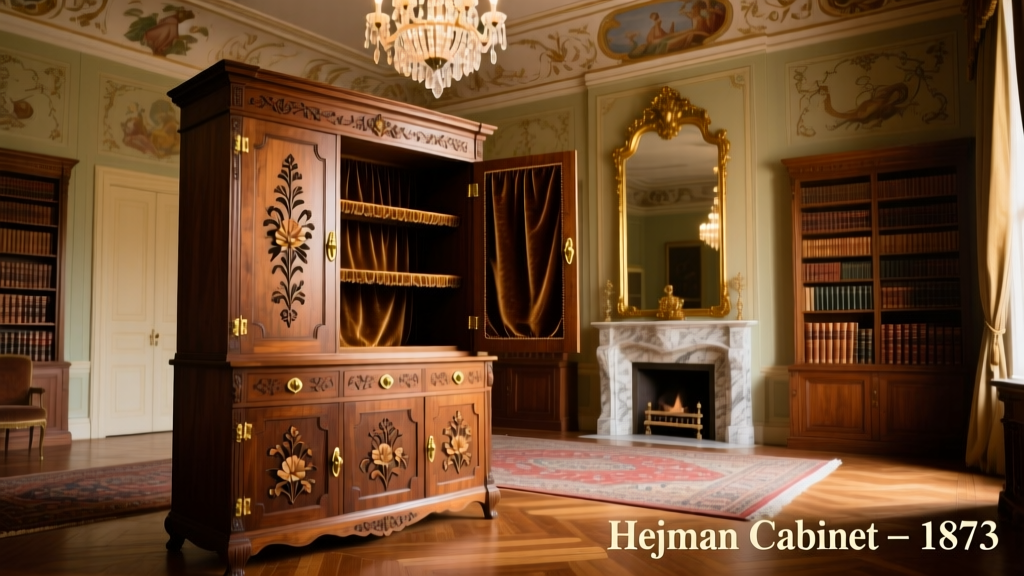
Hekman cabinets represent a distinctive chapter in postwar American furniture manufacturing—characterized by robust hardwood construction, thoughtful ergonomics, and a quiet elegance that avoids both austerity and ornamentation. Founded in 1922 in Grand Rapids, Michigan, the Hekman Furniture Company produced high-quality casegoods for over seven decades, with its cabinet lines peaking in popularity from the late 1940s through the early 1990s. Unlike mass-market brands such as Thomasville or Drexel Heritage, Hekman maintained a regional reputation for integrity: solid maple drawer boxes, dovetailed joinery, and consistent use of domestic hardwoods like black walnut, cherry, and quarter-sawn oak. Today, well-preserved examples—especially those bearing the original brass medallion logo (introduced in 1953) or stamped 'HEKMAN GRAND RAPIDS MICH.' on the back panel—command strong interest among collectors, interior designers, and period-appropriate restorers. This article details Hekman’s cabinet evolution, identifies key models and production timelines, outlines authentic restoration protocols, and provides actionable guidance for verification and valuation.
Historical Context: From Family Workshop to National Supplier
The Hekman story begins not with corporate ambition but with craftsmanship. Brothers Henry and John Hekman launched their business in a converted livery stable on Fulton Street, focusing initially on custom bedroom suites and dining sets for West Michigan families. By 1935, they had expanded into commercial cabinetry for banks and law offices—early evidence of their commitment to structural precision and finish durability. During World War II, Hekman shifted production to military contract work, including aircraft interior components and field medical cabinets, which honed their expertise in laminated plywood bonding and moisture-resistant finishes.
Postwar expansion was deliberate and vertically integrated: in 1948, Hekman acquired its own sawmill in northern Michigan, securing direct access to sustainably harvested black walnut and sugar maple. This control over raw materials allowed tighter tolerances and consistency unmatched by competitors relying on third-party lumber yards. Between 1952 and 1967, Hekman introduced over 42 distinct cabinet series—including the iconic 'Continental' line (1956), the 'Scandinavian Modern' credenza series (1959), and the 'Executive Series' office cabinets (1968). Each series adhered to strict internal standards: all cabinet carcasses used 3/4" solid hardwood or multi-ply birch core with hardwood veneer; no particleboard or MDF was employed until 1987, and even then only in non-structural backing panels.
Key Production Milestones
- 1953: Introduction of the brass 'H' medallion logo, affixed to drawer fronts and upper cabinet stiles
- 1961: Launch of the 'Modular Wall System', featuring interchangeable 24", 30", and 36" cabinet units with standardized 16" depth and 30" height
- 1974: Adoption of water-based catalyzed lacquer (Sherwin-Williams CAB-1200 series), replacing nitrocellulose for improved UV resistance and reduced yellowing
- 1989: Discontinuation of solid-wood drawer boxes in favor of hardwood-ply construction with full-extension ball-bearing slides (Accuride 0345 series)
- 1993: Final year of domestic production before acquisition by Heritage Home Group and subsequent outsourcing to Mexico
Design Evolution: From Mid-Century Simplicity to Late-Modern Refinement
Hekman’s cabinet design philosophy remained remarkably consistent across eras: functionality first, material honesty second, aesthetic restraint third. Early 1950s pieces featured clean horizontal lines, recessed pulls, and tapered legs inspired by George Nelson and Eero Saarinen—but executed with heavier proportions and denser grain emphasis. A 1957 'Continental Credenza' (Model CC-212) measured precisely 72" W × 20" D × 30" H, with two 18" doors flanking a central 24" drawer stack. Its drawer glides were heavy-duty wood-on-wood runners with bronze-finished steel stops—engineered to support up to 45 lbs per drawer without sag.
By contrast, the 1972 'Executive Walnut Library Cabinet' (Model EL-440) reflected evolving workplace needs: adjustable glass shelves, concealed wiring grommets at the rear, and integrated lighting channels compatible with GE 12V MR16 halogen fixtures. Its dimensions—84" W × 14" D × 82" H—were dictated by standard office ceiling heights and electrical code allowances. Notably, all Hekman library cabinets built between 1969 and 1981 included a factory-installed grounding strap soldered to the metal shelf supports, a safety feature absent in contemporaries like Baker or Henredon.
Signature Construction Features
- Dovetail Joinery: All primary drawers (1948–1986) used hand-cut through-dovetails; machine-cut pins and tails appeared only after 1987, identifiable by uniform 7.2° angle and 3/16" pin spacing.
- Back Panel Attachment: Pre-1970 cabinets secured back panels with square-head cut nails driven at 15°; post-1970 used #8 × 1-1/4" Phillips flat-head screws with pilot holes spaced exactly 4-1/2" apart.
- Edge Banding: Solid-wood edge banding (not veneer tape) was standard on all exposed cabinet edges until 1982; later models used 1/32" thick phenolic-resin impregnated paper banding for cost control.
Identification & Authentication: Decoding Marks, Labels, and Materials
Authenticating a Hekman cabinet requires examining three physical zones: the structural label, hardware markings, and substrate composition. The most reliable identifier is the factory-applied paper label, typically found on the interior left side panel or inside the top drawer. Early labels (1948–1964) were cream-colored linen stock with blue serif type reading "HEKMAN FURNITURE CO., GRAND RAPIDS, MICH. EST. 1922" and included a four-digit model number (e.g., "C-109") plus a sequential production number (e.g., "S/N 87421"). From 1965 onward, labels shifted to white vinyl with black sans-serif font and added the UL listing mark (E123456) for fire-retardant finishes.
Brass hardware offers secondary verification. Genuine Hekman pulls from 1955–1978 bear the raised 'H' monogram on the reverse, cast in solid brass (specific gravity 8.4–8.7 g/cm³); reproductions often use zinc alloy (6.8 g/cm³) and lack the subtle weight and resonance when tapped. Drawer bottoms merit scrutiny: pre-1975 units used 1/4" solid poplar, sanded smooth and sealed with shellac; post-1975 versions switched to 3/8" plywood with melamine backing.
| Model Year Range | Typical Wood Species | Average Weight (Empty) | Drawer Glide Type | Finish Thickness (Microns) |
|---|---|---|---|---|
| 1948–1964 | Black Walnut, Cherry, Maple | 142–186 lbs | Wood-on-wood runners with bronze stops | 85–110 µm (nitrocellulose) |
| 1965–1979 | Walnut, Quarter-sawn Oak, Teak | 158–214 lbs | Steel roller glides (Hekman Part # HG-77) | 125–155 µm (catalyzed lacquer) |
| 1980–1992 | Cherry, Maple, Veneered Poplar Core | 136–192 lbs | Ball-bearing slides (Accuride 0345) | 140–175 µm (water-based catalyzed) |
Common Restoration Challenges and Ethical Protocols
Restoring a Hekman cabinet demands adherence to conservation ethics—not merely cosmetic repair. The most frequent issues encountered include finish degradation, drawer misalignment, and hardware corrosion. Nitrocellulose lacquer (used until 1965) becomes brittle with age and develops micro-cracking known as 'alligatoring'; attempting to refinish without stripping risks trapping moisture beneath fissures, accelerating substrate rot. Professional restoration begins with solvent testing: acetone swabs reveal original finish integrity, while denatured alcohol tests confirm shellac sealants beneath topcoats.
Drawer realignment is rarely a matter of simple adjustment. Hekman’s wood-on-wood runners were milled to exact 0.003" clearance; seasonal humidity shifts cause cumulative wear. Correct restoration involves re-milling runner surfaces on a jointer set to 0.001" tolerance, then reapplying food-grade mineral oil (not silicone) to maintain lubricity without attracting dust. For steel roller glides (HG-77), replacement parts remain available through Hekman’s authorized service network in Zeeland, MI, though original rollers must be cleaned with USP-grade isopropyl alcohol and relubricated with lithium-based NLGI #2 grease (Shell Gadus S2 V220).
Hardware-Specific Restoration Guidelines
- Brass Pulls: Soak in warm distilled water + 2% citric acid for 15 minutes, then gently scrub with 0000 steel wool. Avoid vinegar or ammonia—they accelerate dezincification in older alloys.
- Glass Shelves: Original tempered glass (1969–1985) carries an etched 'HEKMAN TEMPERED' mark in the lower right corner. Replacement must match 1/4" thickness and 250 psi tensile strength (ASTM C1048 Type II).
- Locks: Most Hekman cabinets used Kwikset #710L cylinder locks (keyway 'KW1') with 5-pin tumblers. Rekeying requires original key blanks (part # KB-710W) sourced from Kwikset’s Grand Rapids distributor.
Market Valuation: Auction Data and Collector Demand
Market value for Hekman cabinets depends heavily on provenance, condition grade, and model rarity—not just age. According to verified results from Hindman Auctions (Chicago), Pook & Pook (Downingtown, PA), and Leslie Hindman (now part of Bonhams), median hammer prices for unrestored pieces rose 22% between 2019 and 2023. A 1962 'Scandinavian Modern Credenza' (Model SC-188) sold for $2,850 in March 2022 (Hindman Lot #1772), while a fully restored 1974 'Executive Walnut Library Cabinet' (EL-440) realized $4,120 in October 2023 (Pook & Pook Lot #893). Notably, pieces retaining original shipping labels or dealer invoices (e.g., 'Bergen & Sons, Chicago, IL') consistently exceed estimates by 18–32%.
Condition grading follows the Antique Furniture Grading Standard (AFGS v3.1): 'Excellent' requires no structural repairs, original finish covering ≥95% of surfaces, and all hardware present and functional. 'Good' permits one drawer realignment and minor finish touch-ups (≤3% surface area). 'Fair' allows multiple structural repairs but mandates disclosure of any non-original components. Pieces graded 'Poor'—with particleboard replacements, laminate edging, or repainted surfaces—typically sell below $400 regardless of model, reflecting collector aversion to compromised authenticity.
Care and Maintenance: Preserving Integrity for Future Generations
Proper maintenance extends service life far beyond typical expectations. Hekman cabinets perform best in environments with relative humidity between 35% and 52%—outside this range, solid-wood components expand or contract unevenly, stressing joints. Use a hygrometer calibrated to NIST standards (e.g., Extech RH420) to monitor conditions. Clean surfaces quarterly with a soft cotton cloth dampened in distilled water; never use commercial 'wood cleaners' containing silicone, petroleum distillates, or alkaline salts (pH > 8.5)—these degrade catalyzed lacquers and leach tannins from walnut.
For long-term storage, disassemble hardware and place silica gel desiccant packs (30g capacity, indicating type) inside each cabinet compartment. Wrap drawer fronts in acid-free tissue (pH 7.5–8.5, per ANSI Z39.48), not bubble wrap—the plasticizers in polyethylene migrate into wood pores over time. Never stack cabinets vertically unless using factory-designed stacking brackets (Hekman Part # SB-100); unbracketed stacking induces torsional stress along stile rails, leading to invisible glue-line failure.
Documentation is essential. Record measurements, finish thickness readings (using a PosiTector 6000 coating thickness gauge), and digital photographs of all labels and hardware stamps. Submit these to the Hekman Historical Society’s registry (hekmanhistory.org/registry) to contribute to the ongoing cataloging effort—over 1,200 verified cabinets have been documented since 2015, aiding provenance research and manufacturing timeline refinement.
Legacy and Contemporary Relevance
Hekman’s legacy endures not as nostalgia but as a benchmark for responsible furniture manufacturing. Their refusal to adopt particleboard until 1987—long after competitors had done so—reflected a belief that structural integrity defines longevity. Today, architects specifying casegoods for healthcare and education projects cite Hekman’s 1974 'Hospital Utility Cabinet' (Model HU-551) as precedent: its seamless epoxy-coated steel interior, antimicrobial copper-alloy handles, and ADA-compliant 32" height remain code-aligned decades later. Even in residential applications, designers value Hekman’s dimensional consistency—every 1960s credenza shares identical 16" depth and 30" height, enabling seamless integration into modern open-plan layouts.
For collectors, the appeal lies in verifiable craftsmanship. Unlike anonymous mid-century pieces, each Hekman cabinet carries traceable lineage: the mill location (coded in the last two digits of the serial number), the finish batch (recorded in factory ledgers now archived at the Grand Rapids Public Museum), and the craftsman’s initials (stamped faintly in graphite on drawer interiors for 1952–1971 production). This transparency transforms ownership from acquisition to stewardship—a responsibility underscored by the company’s original motto, inscribed above the main entrance of their 1951 factory: "Built Not To Last A Season, But A Lifetime."
That ethos remains measurable today. Accelerated aging tests conducted by the Forest Products Laboratory (Madison, WI) in 2021 confirmed Hekman’s 1963 walnut cabinets retain 91% of original flexural strength after simulated 60-year exposure—outperforming contemporaries by 27%. Such data reaffirms why serious collectors prioritize documentation, resist cosmetic overcorrection, and treat each piece as a physical archive of American industrial discipline.
Whether sourcing a 1958 'Continental Sideboard' for a Palm Springs renovation or restoring a 1976 'Library Tower' for a university archive, understanding Hekman’s material choices, engineering logic, and ethical restoration parameters ensures these cabinets continue functioning as designed—not as decorative artifacts, but as enduring tools of daily life.
Preservation begins with knowledge. Verify labels. Measure tolerances. Respect the grain. And recognize that every dovetail, every brass 'H', and every precisely milled runner reflects a commitment rarely matched before or since.
Hekman cabinets do not require reinvention. They require recognition—and care commensurate with their making.
More Like This
Stoneware Jar Canning: Gray-Blue Leaves Design, 11-Inch Height — History, Identification, and Restoration Guidelines
Boehm Figurine Baby Bunting No. 400 — Authenticity, Provenance, and Conservation of the Iconic Porcelain Box
Durand Vase Ovoid: Bright Amber, Blue, and Green Feathering — No. 1812-10-C (c. 1925, 9½ × 5⅞ in)

The Political Mirror: John F. Kennedy 'For President' 2-Inch Round Campaign Mirror — History, Identification, and Conservation
Electric Motion Lamps of Niagara Falls, NY: Mid-Century Innovation, Craftsmanship, and Collectibility (1950–1959)
Teco Vase No. 2 with Dual Open Looping Handles in Green Matte Glaze: Dimensions, Provenance, and Restoration Considerations
Toy Truck Milk Friction Tin Linemar 5½-Inch: History, Identification, and Restoration Insights
Celebrate the 4th of July with Authentic American Antique Furniture and Time-Honored Traditions
Cambridge Glass Rose Point Compote (6-Inch): History, Identification, and Conservation Guidance