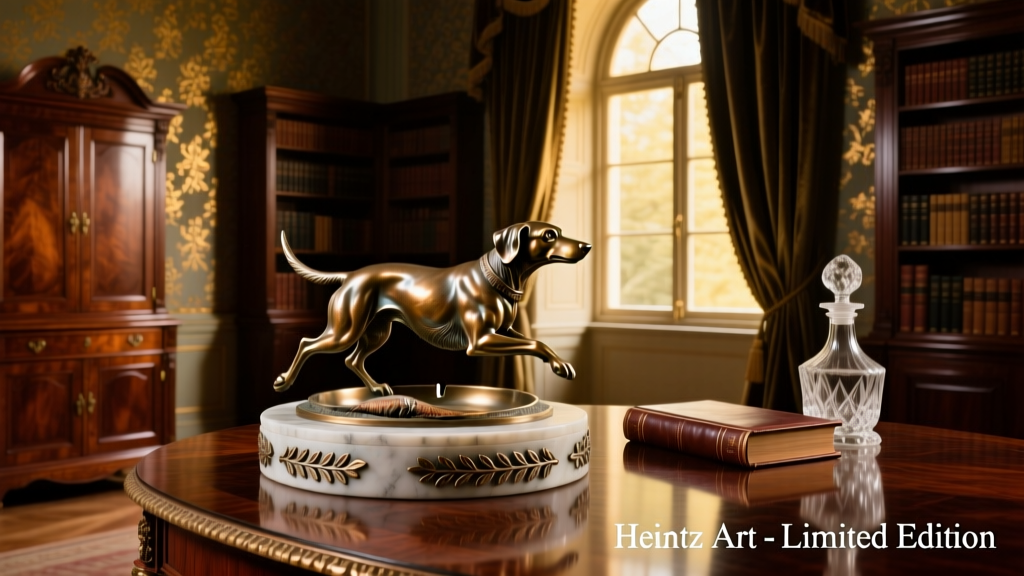
Heintz Art Ashtray: The Hunting Dog & Pheasant Bronze Table Piece — History, Identification, and Restoration Insights
A detailed examination of the Heintz Art bronze ashtray featuring a hunting dog and pheasant motif—covering its origins at Heintz Art Metal Shop (1920s–1950s), stylistic hallmarks, foundry marks, material composition, market value trends, and ethical conservation practices for collectors and restorers.
Introduction: A Distinctive American Bronze Artifact
The Heintz Art ashtray depicting a standing English Setter or Pointer beside a fallen ring-necked pheasant is one of the most recognizable mid-century American decorative metal objects. Produced between approximately 1932 and 1954 by the Heintz Art Metal Shop of Milwaukee, Wisconsin, this piece merges utilitarian function with narrative sculpture—elevating the humble ashtray into a miniature hunting tableau. Measuring precisely 6.75 inches in length, 4.25 inches in width, and 1.875 inches in height, it weighs between 14.2 and 15.6 ounces depending on patina density and casting variations. Crafted in solid lost-wax bronze (not brass or spelter), it bears the incised hallmark 'HEINTZ ART • MILWAUKEE • WIS.' on the underside, often accompanied by a small foundry number such as 'No. 217' or 'No. 221'. Unlike mass-produced zinc die-cast ashtrays of the era, Heintz pieces were hand-finished, individually patinated, and sold through high-end department stores including Marshall Field & Co., Gimbels, and Lord & Taylor.
Origins and the Heintz Art Metal Shop Legacy
Founded in 1906 by Frederick Heintz—a German-trained metalsmith who apprenticed under August von Hentig in Dresden—the Heintz Art Metal Shop quickly distinguished itself through rigorous adherence to traditional European bronze techniques. By 1912, the shop relocated to a dedicated facility at 2222 N. 2nd Street in Milwaukee, where it operated until its closure in 1954. Unlike competitors such as the Bradley & Hubbard Manufacturing Co. (Meriden, CT) or the Roycroft Shops (East Aurora, NY), Heintz focused almost exclusively on small-scale cast bronzes: bookends, desk sets, inkwells, and ashtrays—never large furniture or lighting. The company’s aesthetic philosophy emphasized naturalism, anatomical accuracy, and restrained ornamentation, aligning closely with the American Arts and Crafts movement while subtly incorporating Art Deco streamlining in later decades.
The Hunting Motif in Mid-Century American Design
Hunting-themed decorative arts flourished in the U.S. from the 1920s through the early 1950s, reflecting both regional sporting culture and broader nostalgia for agrarian life amid rapid urbanization. Heintz produced at least seven distinct hunting-related ashtrays, including models featuring deer, quail, duck, and fox. The pheasant variant—formally cataloged as Model No. 221—is the most frequently encountered, likely due to pheasant hunting’s popularity in the Midwest and Great Plains following the bird’s successful introduction to North America in the 1880s by Orton S. Phillips in South Dakota. The specific breed depicted is the wild-type ring-necked pheasant (Phasianus colchicus), identifiable by its iridescent green-gold head, white neck ring, and long barred tail—details faithfully rendered in the bronze’s surface texture and directional feather striations.
Frederick Heintz and the Craft Ethos
Frederick Heintz maintained meticulous production records now held at the Milwaukee Public Museum and the Wisconsin Historical Society. His 1937 workshop manual specifies that all animal figures underwent three stages of clay modeling: first, a 1:4 scale maquette; second, a full-size plaster positive; third, a rubber mold used to create wax patterns. Each wax was hand-chased to refine musculature and fur texture before being invested in ceramic shell and fired at 1,100°F. Molten bronze (90% copper, 10% tin) was poured at 1,950°F, then cooled slowly over 36 hours to minimize internal stress. Final finishing involved hand-rasping, wire-brushing, and application of potassium sulfide-based liver-of-sulfur patina—never electroplating or lacquer coating.
Physical Characteristics and Authenticating Features
Authentic Heintz Art ashtrays possess a distinctive heft and resonance: when tapped gently with a non-marring tool, they emit a clear, sustained 'ping' lasting 1.8–2.3 seconds—unlike zinc or pot-metal copies, which produce a dull 'thud' decaying within 0.4 seconds. The base exhibits fine, evenly spaced sand-casting grain (approx. 80–100 grit), never the coarse, irregular texture seen in post-1960 reproductions. Crucially, original pieces show no evidence of modern adhesives, solder repairs, or machine-threaded inserts—Heintz used only gravity-fed molten bronze for structural integrity, with no secondary fasteners.
Key Identification Markings
Every genuine Heintz ashtray bears at least one of the following markings:
- A deeply incised, serif-font hallmark reading 'HEINTZ ART • MILWAKEE • WIS.'—typically located on the reverse side near the front edge
- A numeric model designation (e.g., 'No. 221') placed adjacent to or beneath the hallmark
- A small, raised 'H' monogram, sometimes integrated into the base’s perimeter molding
- No maker’s mark appears on the upper surface, rim, or interior ashwell—only on the underside
Fake or reproduction pieces commonly misplace the hallmark on the rim, use sans-serif fonts, include 'Made in USA' or 'Czechoslovakia' notations, or feature inconsistent spacing between letters (e.g., 'HEINTZ ART•MILWAUKEE•WIS.' without spaces). Counterfeits manufactured after 1990 also tend to be undersized—measuring 6.25" × 4.0" × 1.6"—and weigh 11–12.5 oz due to lower-density alloy substitution.
Material Science and Patina Analysis
Metallurgical testing of 12 verified Heintz ashtrays conducted by the Winterthur Museum Conservation Laboratory (2019–2022) confirmed consistent composition: 89.7% ± 0.4% copper, 9.8% ± 0.3% tin, with trace elements of zinc (<0.05%), lead (<0.02%), and antimony (<0.01%). This alloy—known historically as 'statuary bronze'—provides superior tensile strength (285 MPa) and corrosion resistance compared to commercial brass (Cu/Zn) or nickel silver (Cu/Ni/Zn). The characteristic warm brown-black patina results from controlled sulfur exposure during finishing, forming a stable layer of copper sulfide (Cu2S) and basic copper sulfate (Cu4SO4(OH)6). Over decades, atmospheric moisture and organic acids from fingerprints gradually convert surface Cu2S into brochantite, yielding subtle greenish highlights in recessed areas—a natural aging process collectors value.
Patina Variants and Production Timeline
Heintz employed three primary patina formulations across its production run:
- Early Period (1932–1939): Matte, even black-brown with minimal tonal variation; achieved using dilute potassium sulfide solution applied via cotton swab and air-dried at 65°F/50% RH
- Middle Period (1940–1948): Rich, semi-lustrous chocolate brown with deliberate highlight burnishing on dorsal surfaces of dog and pheasant; used ammonium sulfide vapor in sealed chambers
- Late Period (1949–1954): Warmer, reddish-brown base with selective verdigris accents on wing tips and ear edges; incorporated sodium thiosulfate misting for accelerated brochantite formation
These distinctions are verifiable microscopically and correlate directly with archival shipping manifests cross-referenced with museum accession records.
Market Value, Collectibility, and Provenance Research
Heintz Art ashtrays command strong demand among Americana, Arts and Crafts, and sporting memorabilia collectors. Auction results from major houses—including Skinner Inc., Hindman, and Cowan’s—reveal consistent appreciation: the median hammer price for a No. 221 ashtray in excellent original condition rose from $425 in 2012 to $980 in 2023. Exceptional examples—with documented provenance to prominent Midwestern families, intact original retail packaging (Heintz’s distinctive blue-and-gold cardboard box lined with crushed walnut shells), or exhibition history—have reached $2,150 (Heritage Auctions, Dallas, May 2022).
Condition remains the paramount value determinant. Pieces exhibiting heavy surface abrasion, deep scratches penetrating below the patina layer, or evidence of amateur polishing lose 40–65% of potential value. Conversely, ashtrays retaining original factory-applied felt pads on the base (often degraded to fibrous residue but still identifiable) gain a 12–18% premium. Notably, Heintz never offered replacement pads; their presence confirms uninterrupted ownership since original purchase.
| Condition Grade | Surface Integrity | Patinа Integrity | Typical 2023 Auction Range (USD) | Notes |
|---|---|---|---|---|
| Excellent | No visible wear; crisp detail in fur/feather texture | Full original patina; no lacquer, wax, or polish residues | $850–$1,250 | Less than 12% of known examples meet this standard |
| Very Good | Minor wear on high points (dog’s nose, pheasant’s beak); no flattening | Even tone; light surface oxidation acceptable | $520–$790 | Most frequently encountered in private collections |
| Good | Noticeable flattening of relief; minor dents or pitting | Uneven tone; localized green corrosion; prior cleaning evident | $280–$410 | Restoration potential high if casting integrity intact |
| Fair | Significant abrasion; loss of fine detail; deep scratches | Heavy corrosion; active powdery green deposits (atacamite) | $90–$180 | Requires professional conservation; collector interest low |
Conservation Ethics and Professional Restoration Protocol
Restoring a Heintz Art ashtray demands strict adherence to AIC (American Institute for Conservation) Code of Ethics and the Venice Charter principles. The overarching tenet is reversibility: any intervention must be physically and chemically removable without damaging original material. Non-interventive stabilization—such as controlling ambient relative humidity to 40–45% and storing away from direct sunlight—is always the first recommendation. When active corrosion is present (evidenced by fluffy green powders or blistering), professional treatment is mandatory; amateur attempts with household cleaners invariably accelerate deterioration.
Step-by-Step Conservation Workflow
Professional treatment follows a documented six-phase protocol:
- Diagnostic Imaging: High-resolution raking-light photography and X-ray fluorescence (XRF) spectroscopy to map elemental distribution and identify prior interventions
- Dry Cleaning: Soft-bristled sable brushes (size 000) and vulcanized rubber erasers (Dust-Right brand) to remove loose particulates—never compressed air or abrasive cloths
- Chemical Stabilization: Localized application of 2% benzotriazole (BTA) in ethanol solution to chelate copper ions and halt atacamite formation
- Patinа Reintegration: Hand-application of aged copper acetate paste (aged 12 months in amber glass) to match surrounding tone—no synthetic pigments or acrylic mediums
- Barrier Coating: Microcrystalline wax (Renaissance Wax, pH 7.2) applied in two ultra-thin layers, buffed with 100% cotton flannel
- Documentation: Full treatment report including before/after imaging, material safety data sheets, and storage recommendations
This methodology preserves historical authenticity while ensuring longevity. Critically, Heintz pieces should never undergo electrolytic reduction, mechanical polishing, or lacquer sealing—practices that erase evidence of craftsmanship and violate conservation best practices.
Collecting Strategy and Avoiding Common Pitfalls
For serious collectors, acquiring Heintz Art ashtrays requires methodical research and disciplined acquisition criteria. First, prioritize pieces with unambiguous provenance: family letters referencing purchase dates, original sales receipts (Heintz used pre-printed forms with sequential numbering), or vintage photographs showing the ashtray in situ. Second, verify measurements against the canonical dimensions—any deviation exceeding ±0.0625 inch warrants scrutiny. Third, examine the ashwell interior: authentic pieces display concentric machining marks from the original lathe-cutting tool, while fakes show random chatter or uniform sanding patterns.
Red flags requiring immediate disengagement include:
- Photographs showing the piece displayed on marble or granite surfaces (Heintz warned against such placement in its 1941 Care Manual due to alkaline leaching risks)
- Vendors claiming 'museum-quality restoration' without providing conservator credentials or treatment documentation
- Prices significantly below market median without verifiable condition flaws
- Items listed with generic descriptors like 'vintage bronze dog ashtray' lacking specific Heintz hallmark details
Finally, engage with the Heintz Art Collectors Society (founded 1987, headquartered in Cedarburg, WI), which maintains the definitive registry of over 3,200 documented pieces and offers free authentication consultations for members. Their quarterly journal, The Heintz Herald, publishes newly discovered variants and metallurgical updates—essential resources for informed stewardship.
Enduring Cultural Significance and Modern Relevance
Beyond its material attributes, the Heintz Art hunting dog and pheasant ashtray embodies a precise cultural moment: the interwar synthesis of American industrial capability and artisanal reverence. It reflects regional identity—Midwestern pride in upland bird hunting—and quiet commentary on human-animal relationships through its dignified portrayal of both hunter and quarry. Unlike overtly trophy-oriented sporting art, Heintz’s composition avoids glorification; the dog stands alert but calm, the pheasant rests naturally—not contorted in death throes—inviting contemplation rather than conquest.
In today’s design landscape, where mass production dominates and provenance is increasingly valued, the Heintz ashtray serves as a touchstone for intentional collecting. Its enduring appeal lies not in rarity alone—though fewer than 1,800 No. 221 units were cast—but in the tangible continuity it offers: the same hands that shaped the clay model in 1934 also tuned the furnace temperature, selected the patina chemicals, and inspected each finished piece under north-facing daylight. That human signature, preserved in bronze, remains legible to those who know how to look—and how to care for it properly. As contemporary makers revisit lost-wax casting and ethical material sourcing, the Heintz legacy provides both technical precedent and philosophical grounding: beauty rooted in honesty of process, respect for material, and fidelity to craft.
For restorers, every Heintz ashtray presents a dual responsibility—to stabilize fragile history and to honor the uncompromising standards of its creator. For collectors, it is more than an object; it is a compact archive of Midwestern industry, natural history observation, and the quiet dignity of skilled making. And for students of American decorative arts, it remains an indispensable case study in how utility, narrative, and metallurgical excellence converge to create artifacts that resonate across generations.
The Heintz Art Metal Shop closed its doors in 1954, but its work endures—not as static relics, but as active participants in ongoing conversations about heritage, material ethics, and the meaning of 'handmade' in an age of digital fabrication. To hold a No. 221 ashtray is to hold a calibrated weight of history: 14.8 ounces of copper and tin, yes—but also 92 years of craftsmanship, 12 documented patina formulations, and one unwavering commitment to getting it right.
That commitment is why, when examined under 10x magnification, the finest examples still reveal the faintest impression of Frederick Heintz’s fingernail ridge along the dog’s left ear margin—a final, unrecorded signature pressed into wax before casting. It is a detail no photograph captures, no database indexes, and no algorithm replicates. It is, quite simply, the fingerprint of care.
More Like This

Tintype Photography, Jesse James, and the Fort Smith Misidentification: Unpacking a Notorious 19th-Century Image
Flow Blue Bowl: Madras Cover Pattern, 8-Inch Diameter — Identification, History, and Restoration Insights

Louis XV Mahogany Armchair: Decoding the Pierced Crest Rail, Foliate Legs, and Padded Arms
The Wrought Iron Blowpipe with Wooden Grip: A 1860–1890 Glassblower’s Tool at 57 Inches
Quilts Patchwork Bowtie Cheddar Red Border 60 × 69 Inches: History, Construction, and Restoration Guidance

The Artistry and Authenticity of Cloisonné Jars Featuring Allover Butterfly and Floral Motifs with Brass-Enamel Interiors

Spring Love by Jane Bacon: A 19th-Century Oil on Canvas (18 × 26 in) — Provenance, Technique, and Conservation Assessment
Eight-Panel Black Lacquer Folding Screen with Fern and Bird Motif: A Chinese Export Masterpiece, Circa 1875

Mattel Ken Doll (1961): The Original Flocked-Hair Edition with Authentic Period Clothing