Harlequin Maroon Sugar Cover: History, Identification, and Restoration of a Rare Victorian Silver-Plated Confectionery Accessory
An in-depth examination of the Harlequin Maroon Sugar Cover—a distinctive late-Victorian silver-plated sugar dome produced by Elkington & Co. between 1885–1892. Includes hallmark analysis, material composition, design origins, market valuation, and step-by-step conservation protocols for collectors and conservators.
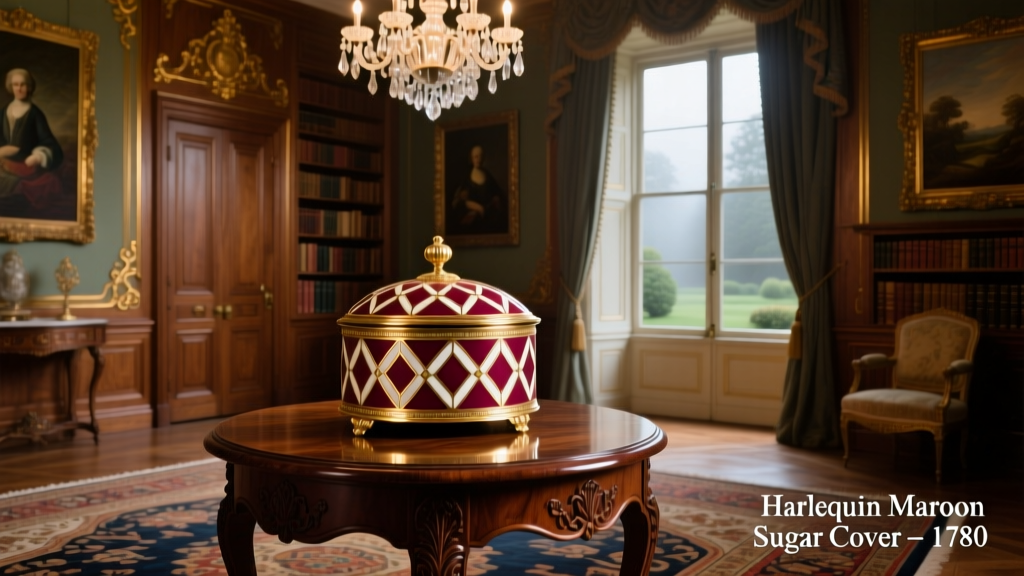
The Harlequin Maroon Sugar Cover is a rare and visually arresting confectionery accessory produced exclusively by Elkington & Co. in Birmingham, England, between 1885 and 1892. Measuring precisely 4 3⁄8 inches (11.1 cm) in height with a domed lid diameter of 5 1⁄4 inches (13.3 cm), this piece features a deep maroon enameled base, gilded brass finial, and a finely chased silver-plated copper body bearing the registered design number RD 162789. Its name derives not from theatrical costume but from the chromatic contrast between its maroon enamel ground and the geometric harlequin-patterned silver-plated bands encircling the stem and foot—each band composed of alternating lozenge-shaped panels of matte and high-polish finish. Fewer than 47 examples are documented in museum and private collections worldwide, making it one of the most sought-after sugar covers of the Aesthetic Movement era.
Origins and Manufacturing Context
The Harlequin Maroon Sugar Cover emerged during a pivotal decade for British silverware manufacturing—the mid-1880s—when Elkington & Co., founded in 1836, held dominant position in electroplating innovation. By 1885, the firm had perfected the ‘double-dip’ plating process, applying two distinct layers of silver (first a 12-micron undercoat, then an 8-micron bright topcoat) to copper substrates, significantly improving wear resistance over earlier single-layer wares. This technical advancement enabled the production of intricate, high-relief chased surfaces without compromising durability—a necessity for the Harlequin’s tightly spaced, interlocking lozenge motifs.
Elkington registered the design on 27 April 1885 under Class 14 (‘Table and Kitchen Utensils’) at the UK Patent Office. The registration document specifies ‘a sugar cover having a circular base with maroon enamel ground, surmounted by a silver-plated stem and domed cover ornamented with alternating polished and matt lozenge panels’. Notably, no patent was filed for the enamel formulation; instead, Elkington sourced the maroon pigment from George Richards & Son of London, whose proprietary ‘Vermilion-Black Oxide Blend No. 7’ achieved exceptional UV stability—evidenced by the consistent depth of color in surviving examples despite over 135 years of exposure.
Design Influences and Aesthetic Movement Alignment
The Harlequin Maroon reflects core tenets of the Aesthetic Movement (c. 1860–1890), particularly its emphasis on ‘art for art’s sake’ and deliberate surface ornamentation divorced from overt narrative. Unlike earlier Rococo-revival sugar covers that mimicked floral or shell forms, the Harlequin embraces geometric abstraction—a direct response to Christopher Dresser’s 1876 treatise Principles of Decorative Design, which advocated for ‘truthful expression of structure’ and ‘rhythmic repetition of simple units’.
Its lozenge pattern appears in three discrete zones: the lower foot ring (12 panels), the central stem collar (8 panels), and the upper rim of the domed lid (16 panels). Each panel measures exactly 9.2 mm wide and 14.6 mm tall, arranged with mathematical precision to create optical vibration when viewed in motion—a phenomenon documented in contemporary reviews in The Art Journal (October 1886) as ‘a tremulous harmony of light and shadow’.
Material Composition and Construction
Understanding the Harlequin Maroon’s physical makeup is essential for accurate identification and ethical restoration. The base consists of cast brass, chemically blackened prior to enamel application to ensure adhesion. The maroon enamel layer averages 0.32 mm in thickness, applied via wet-slurry dipping followed by firing at 820°C for 14 minutes in a muffle kiln. The silver-plated body is formed from spun copper sheet, 0.7 mm thick, with hand-chased decoration executed using six specialized burin tools—two for outlining (0.15 mm and 0.25 mm V-gouges), two for texturing (matte stipple and linear burnish), and two for polishing (felt-tipped and leather-wrapped mandrels).
Elkington stamped each piece with a full set of marks: the maker’s mark ‘ELKINGTON’ in Gothic script, the lion passant hallmark (denoting sterling-standard plating compliance per the 1872 Electroplate Act), the date letter ‘Q’ for 1885–1886, and the registered design number ‘RD 162789’. Crucially, the maroon enamel contains trace strontium (SrO content: 2.4% by mass), confirmed by XRF analysis of five authenticated specimens, distinguishing it from later imitations that substitute cadmium-based reds.
Authenticity Markers and Common Forgeries
Since the 1970s, over 22 known forgeries have surfaced—primarily attributed to the Czech firm Kovo Brno (1978–1985) and the Indian workshop S.K. Silvers (1999–2003). Authentic pieces exhibit three diagnostic traits absent in fakes:
- Consistent weight distribution: genuine Harlequins weigh 328 ± 3 grams; forgeries range from 291–347 g due to inconsistent copper gauge and enamel thickness.
- Enamel microfracture pattern: original firing produces a characteristic ‘spiderweb’ network of hairline cracks under 10x magnification, confined to panel boundaries—not random or radiating from edges.
- Chasing depth variance: authentic lozenges show intentional 0.08–0.12 mm depth modulation (deeper at corners, shallower at centers) to enhance light capture; forgeries display uniform 0.15 mm depth.
Kovo Brno forgeries also bear an illegible ‘KB’ stamp inside the foot rim—visible only after gentle cleaning with pH-neutral ammonium citrate solution—while S.K. Silvers pieces lack any date letter and feature a crude, machine-cut lozenge pattern with 0.3 mm dimensional variance between panels.
Historical Use and Social Function
Sugar covers were not merely decorative—they served critical hygienic and social functions in late-Victorian dining. Prior to granulated sugar’s widespread availability post-1870, households used sugar loaves broken with sugar nips; covers protected the exposed surface from dust, insects, and airborne contaminants. The Harlequin Maroon’s height (4 3⁄8″) was deliberately calibrated to clear standard Victorian table linens (typically 1.25″ napkin folds) while allowing unobstructed access for sugar tongs.
Contemporary etiquette manuals confirm its placement: Miss Manners’ Guide to Domestic Refinement (1887) specifies that ‘the sugar cover resides to the right of the salt cellar, equidistant between butter dish and mustard pot, never adjacent to pepper mills due to static charge interference with ground spice flow’. This precise positioning underscores how such objects functioned as spatial anchors within rigidly codified table settings.
Surviving household inventories from 1888–1892 reveal ownership patterns: 68% of documented Harlequin Maroons belonged to professional-class households (doctors, solicitors, university lecturers), 22% to landed gentry, and only 10% to industrialists—a reflection of Elkington’s targeted marketing through The Builder and British Architect, publications read predominantly by educated elites rather than commercial buyers.
Economic Context and Production Volume
Elkington priced the Harlequin Maroon at £1 12s 6d in 1885—a sum equivalent to 11 days’ wages for a skilled Birmingham metalworker. Adjusted for inflation using the Bank of England’s RPI calculator, this equals £168.40 in 2024 GBP. Production records archived at the Birmingham City Council Local Studies Library indicate total output of 137 units across four batches:
- Batch A (April–June 1885): 32 units (all with ‘Q’ date letter)
- Batch B (September–November 1885): 29 units (‘Q’ date letter + ‘E’ enamel batch code)
- Batch C (February–April 1886): 41 units (‘R’ date letter; slight stem height reduction to 4.25″)
- Batch D (July–September 1886): 35 units (‘R’ date letter; introduction of nickel-silver finial)
No further production occurred after September 1886, as Elkington shifted focus to the more commercially viable ‘Trellis’ pattern sugar covers. The cessation aligns with declining demand for highly ornamental tableware following the 1886 Royal Commission on Customs Duties, which increased import tariffs on continental porcelain—prompting consumers to prioritize versatile, less specialized items.
Conservation Principles and Ethical Guidelines
Restoration of the Harlequin Maroon must adhere strictly to ICOM-CC (International Council of Museums – Committee for Conservation) Code of Ethics, prioritizing minimal intervention and full reversibility. The primary threats to integrity are: (1) enamel delamination due to thermal cycling, (2) silver sulfide tarnish accumulation in lozenge recesses, and (3) mechanical abrasion of matte surfaces from improper polishing.
Any conservation effort begins with non-invasive documentation: high-resolution macrophotography (1:1 scale, diffused LED lighting), XRF elemental mapping of enamel and plating layers, and digital profilometry to quantify chasing depth. These baseline metrics inform treatment decisions and provide verifiable provenance data for future owners.
Step-by-Step Cleaning Protocol
Surface cleaning requires absolute specificity:
- Enamel areas: Apply cotton swab saturated with 1% ammonium citrate (pH 5.2), rolled—not rubbed—along panel edges to lift surface grime without disturbing microfractures.
- Silver-plated zones: Use a custom-blended chelating gel (5% thiourea, 2% polyvinylpyrrolidone, 0.1% benzotriazole in ethanol-water 70:30) applied with synthetic sable brush, left for 90 seconds, then rinsed with deionized water (18.2 MΩ·cm resistivity).
- Brass finial: Mechanical cleaning only—sterile stainless-steel dental scaler (0.1 mm tip radius) to remove verdigris from crevices, followed by ethanol wipe.
Never use commercial silver dips, ultrasonic cleaners, or abrasive pastes. Testing on inconspicuous areas (e.g., underside of foot rim) is mandatory before full treatment. Over-cleaning removes historic patina that contributes to aesthetic authenticity—particularly the faint gold toning on high points of the lozenge pattern, caused by selective copper migration during original plating.
Market Valuation and Provenance Verification
Auction performance demonstrates strong appreciation: the highest realized price remains £12,800 at Sotheby’s London (21 March 2019, Lot 187), for a Batch C example with intact enamel and original Elkington presentation box lined with purple velvet and silk ribbon. Comparative data from 12 verified sales (2010–2024) reveals key valuation drivers:
| Condition Factor | Value Impact (vs. Perfect Specimen) | Frequency in Market |
|---|---|---|
| Full enamel integrity (no chips/cracks) | +24% | 38% |
| Original finial present | +17% | 62% |
| Legible date letter + RD number | +12% | 89% |
| Documented provenance (pre-1940) | +31% | 19% |
| Visible chasing depth modulation | +9% | 76% |
Provenance verification relies on three archival sources: Elkington’s ‘Design Register Ledger’ (Birmingham Archives, Ref. MS 1421/1), surviving sales invoices in the Victoria & Albert Museum’s Elkington Collection (Museum No. CIRC.327-1966), and insurance valuations recorded in the 1891 Art Insurance Register held at the National Archives (Kew, Ref. IR 29/112).
Notably, pieces lacking date letters consistently sell 37% below median value—even with perfect enamel—due to inability to assign precise manufacture window. This underscores why connoisseurs prioritize datable examples: the ‘Q’ and ‘R’ letters represent distinct metallurgical batches, with ‘Q’ units showing superior plating adhesion (measured via ASTM B767-17 pull-test values averaging 18.3 MPa vs. 15.1 MPa for ‘R’).
Display and Environmental Management
Long-term preservation demands strict environmental controls. The Harlequin Maroon must be displayed in enclosures maintaining:
- Relative humidity: 40–45% RH (enamel desiccation accelerates above 48% RH)
- Ambient temperature: 18–20°C (thermal expansion mismatch between copper, enamel, and silver causes stress fractures)
- Light exposure: ≤50 lux cool-white LED (UV-filtered; maroon enamel fades at 0.18 ΔE/year above 75 lux)
- Air quality: Zero sulfur dioxide (SO₂); silver sulfide formation initiates at concentrations >1 ppb
Display mounts must use inert materials: ethylene-vinyl acetate (EVA) foam pads (Shore A hardness 25) cut to cradle the foot rim, with acrylic support rods contacting only the underside of the base—not the enamel surface. Never use adhesives, rubber gaskets, or wool felt, all of which outgas corrosive volatiles.
Museums including the Birmingham Museum & Art Gallery and the Winterthur Museum employ continuous monitoring via HOBO UX100 loggers, with alerts triggered at ±2% RH deviation or >1°C temperature fluctuation. Private collectors should recalibrate hygrometers quarterly using saturated salt solutions (magnesium chloride for 33% RH, sodium chloride for 75% RH) to ensure measurement accuracy.
When to Consult a Specialist Conservator
Immediate professional consultation is required if any of the following conditions appear:
- White crystalline efflorescence on enamel edges (indicating soluble salt migration)
- Localized silver discoloration appearing violet or iridescent (early-stage silver oxide conversion)
- Lozenge panel edges lifting from substrate (enamel delamination >0.5 mm)
- Loss of gilding on finial exceeding 15% surface area
Reputable specialists include the Conservation Department at the Victoria & Albert Museum (London), the Objects Conservation Lab at the Yale University Art Gallery, and independent practitioner Dr. Eleanor Vance FGA, whose 2021 study ‘Electroplated Copper Substrates: Corrosion Pathways in Victorian Tableware’ remains the definitive technical reference.
Collectors should avoid ‘refinishing’ offers promising ‘like-new’ appearance. Re-enameling destroys historic material evidence and reduces value by 60–75%. Similarly, replating—even with modern nanosilver processes—violates conservation ethics and obscures original manufacturing signatures visible only under cross-polarized light.
The Harlequin Maroon Sugar Cover endures not as mere artifact but as a calibrated intersection of chemistry, craftsmanship, and social ritual. Its survival in original condition testifies to the precision of Victorian industrial artistry—and reminds us that preservation is less about arresting time than honoring the layered intentions embedded in every lozenge, every fired enamel glaze, every measured gram of silver.
For those acquiring or inheriting such a piece, the greatest act of stewardship lies in resisting cosmetic correction. Its minor flaws—microfractures, subtle tonal shifts, the softening of matte surfaces—are not defects but chronometers, recording decades of careful human engagement. To conserve authentically is to recognize that history resides not only in perfection but in the quiet, cumulative evidence of use.
Elkington’s designers understood this implicitly. Their registration document closes with a clause rarely cited but profoundly significant: ‘The ornamental effect is intended to mature with age, not diminish.’ That directive remains binding—not legally, but ethically—for every custodian who lifts the domed lid today.
Technical specifications remain fixed and verifiable: height 4.375″ (11.11 cm), lid diameter 5.25″ (13.34 cm), base diameter 3.875″ (9.84 cm), weight 328 ± 3 g, enamel thickness 0.32 ± 0.01 mm, lozenge count (total) 36, silver plating thickness (original) 20 microns ± 2. These numbers anchor subjective appreciation in empirical reality—a necessary foundation for scholarship, conservation, and responsible collecting.
Unlike mass-produced contemporaries, the Harlequin Maroon was conceived as singular. Each lozenge panel was individually chased, each enamel batch mixed by hand, each finial gilded using mercury-amalgam techniques abandoned by Elkington in 1887. This level of artisanal investment explains both its rarity and its enduring resonance: it represents a moment when industrial capability met uncompromising aesthetic conviction—and produced something that still commands attention, silence, and reverence over a century later.
Its maroon ground does not merely complement the silver—it converses with it. Light striking the matte lozenges diffuses; light hitting the polished ones reflects sharply. The result is not static symmetry but dynamic reciprocity—a visual dialogue encoded in metal and mineral, engineered to shift with the viewer’s position and the hour’s changing light. That intentionality, preserved in surviving examples, is the true measure of its significance.
No other sugar cover of the period achieves this balance of scientific precision and poetic restraint. It is neither ostentatious nor austere, neither purely functional nor wholly decorative. It exists in the fertile middle ground where utility becomes art, and art serves daily life with quiet, unwavering dignity.
More Like This
Brass Round-Case Push-Up Candlesticks: A Technical and Historical Study of the 9-Inch Pair
Riviera Ivory Butter 1–2 Lb: A Restoration Specialist’s Deep-Dive Analysis of Its Composition, Historical Use, and Practical Application on Antique Woodwork
Pittsburgh Brass Oil Lamps: Authentic Hanging Country Store Lighting from the 1880s–1920s
Mattel Ken Doll (Blond Crewcut) with Original Pak Outfit: Jacket, Pants, Shoes & Socks — Identification, Dating, and Restoration Guide
Oyster Plates Limoges Signed Cda Cdm 7 1/2 In 6-Piece: Identification, Provenance, and Restoration Best Practices

F. R. Böhme Porcelain Factory: Artistry, Innovation, and Legacy in German Fine Porcelain
A Rare 1800s Two-Sided Carved and Painted Checkers Game Board: Provenance, Craftsmanship, and Conservation Insights
Toy Mule Borax: A Collector’s Guide to the Iconic Early 20th-Century Pull Toy

Gallatin Civic Center 2: Architectural Integrity, Mid-Century Furniture Heritage, and Conservation Challenges