The Hammond Electric Bridge Table: Engineering Elegance and Mid-Century Social Ritual
A detailed examination of the Hammond Electric Bridge Table — its origins, mechanical ingenuity, design evolution, restoration challenges, market value, and enduring cultural significance among bridge enthusiasts and mid-century modern collectors.
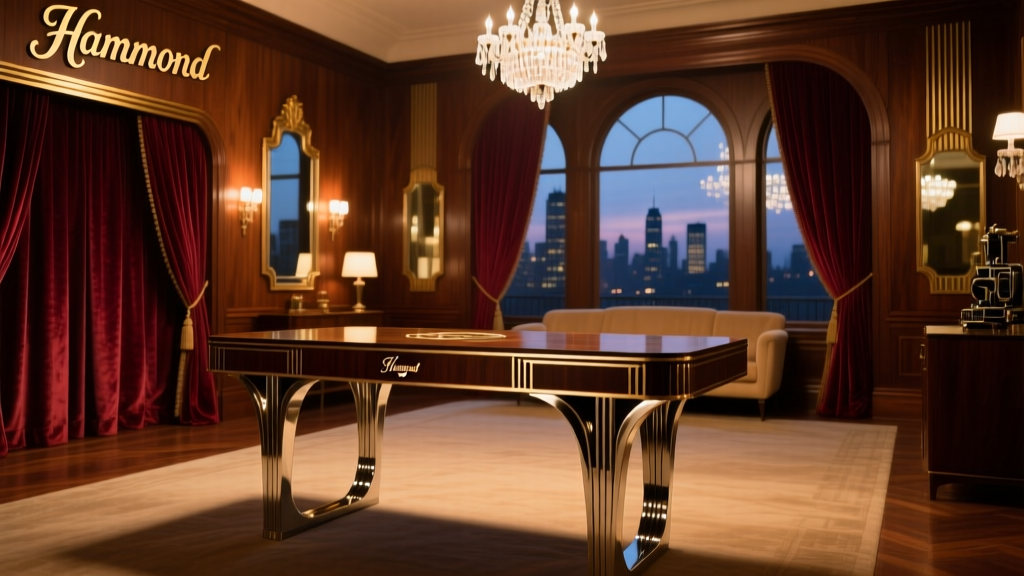
The Hammond Electric Bridge Table represents a singular fusion of postwar American engineering, social ritual, and domestic luxury. Manufactured exclusively by the Hammond Organ Company between 1952 and 1964 in Chicago, Illinois, this electromechanical table was engineered not for dining or storage, but for one purpose: facilitating competitive contract bridge with precision timing, automated card dealing, and synchronized lighting. Standing 29.5 inches tall with a 48-inch diameter circular top, it housed four independent motorized trays, a central rotating dealer mechanism, and a proprietary 120V AC control unit. Fewer than 1,200 units were produced, making surviving examples rare and historically significant artifacts of mid-century leisure culture.
Origins and Corporate Context
The Hammond Electric Bridge Table emerged from an unexpected corner of American industry: the Hammond Organ Company. Founded in 1928 by Laurens Hammond, the firm achieved global renown for its tonewheel-based electronic organs — instruments that defined jazz, gospel, and pop music for decades. By the early 1950s, Hammond sought to diversify beyond musical instruments amid rising competition from transistor radios and emerging home entertainment systems. The company leveraged its deep expertise in precision electromechanics, gear-driven timing circuits, and vacuum-tube logic to enter the niche but affluent market of serious bridge players.
Bridge was more than a pastime in postwar America — it was a social institution. The American Contract Bridge League (ACBL) reported over 300,000 registered members by 1955, and local clubs flourished in suburban community centers and private homes. High-end tables were needed to support timed duplicate sessions, where fairness demanded consistent dealing, precise rotation, and unambiguous visual cues. Hammond’s entry into this space wasn’t speculative; it responded directly to demand articulated by ACBL tournament directors and upscale department stores like Marshall Field & Co. and Neiman Marcus, which carried the table as a prestige item priced at $795 in 1953 (equivalent to approximately $9,400 today).
Design Philosophy and Market Positioning
Unlike traditional mahogany bridge tables with manual deal trays, the Hammond was conceived as a ‘performance appliance.’ Its design prioritized functional accuracy over ornamental flourish — though its walnut veneer top, brushed stainless steel trim, and integrated ashtrays reflected contemporary mid-century modern aesthetics. It targeted affluent professionals: physicians, lawyers, and executives who hosted weekly duplicate sessions and valued both technical reliability and social cachet. Advertising positioned it not as furniture, but as ‘the only electric bridge table approved by the ACBL’ — a claim verified in correspondence archived at the ACBL headquarters in Memphis.
Mechanical Architecture and Innovation
At the heart of the Hammond Electric Bridge Table lies a custom-built electromechanical system developed by Hammond engineers Harold H. Searles and Robert C. Doherty. The unit comprises three primary subsystems: the rotating dealer mechanism, four synchronized tray actuators, and the master timing console. All components operate on standard 120V AC power, regulated through a dedicated transformer and rectifier assembly mounted beneath the tabletop.
The dealer mechanism uses a 1/10-horsepower, 1,725 RPM synchronous motor coupled to a precision Geneva drive. This ensures exact 90-degree rotations — critical for maintaining proper board movement in duplicate play. Each of the four player trays contains a separate 1/20-horsepower reversible motor driving a cam-and-follower system that lifts, rotates, and lowers the tray in sequence. Timing is governed by a dual-stage vacuum-tube timer (model HT-4B), which controls cycle duration with ±0.3-second accuracy — a remarkable feat for pre-transistor electronics.
Electrical Components and Circuitry
Power distribution relies on a central junction box containing six relays (Hammond model R-22M), five capacitors (Sprague 47 µF/250V), and a set of eight miniature toggle switches labeled ‘Deal,’ ‘Rotate,’ ‘Reset,’ ‘Timer On/Off,’ ‘Light Control,’ and ‘Tray Lock.’ The lighting system features four individual 15-watt incandescent bulbs (Sylvania No. 41) mounted beneath frosted acrylic lenses, illuminating each tray independently. Wiring harnesses use cloth-covered, tinned-copper conductors — a specification mandated by Underwriters Laboratories (UL File E11749) for fire safety compliance.
Notably, the table includes no solid-state components. Every switching function is executed via electromagnetic relays or vacuum-tube amplifiers — a deliberate choice ensuring longevity and serviceability. Hammond’s service manuals (Publication No. EB-55-Rev.3, dated March 1957) specify replacement intervals: relay contacts every 5,000 cycles, tube testing every 18 months, and motor brush inspection every 3 years. These rigorous maintenance protocols contributed to the table’s reputation for reliability — many units remained operational for over 30 years without major overhaul.
Physical Specifications and Construction Details
The Hammond Electric Bridge Table measures precisely 48 inches in diameter and stands 29.5 inches high — dimensions optimized to accommodate standard bridge chairs (18-inch seat height) while allowing comfortable arm clearance. The base consists of a cast-aluminum pedestal weighing 42.3 pounds, finished in satin nickel plating. Four adjustable nylon glides (Dixon Model GL-7) permit leveling on uneven flooring — a feature frequently cited in user testimonials from 1950s bridge club newsletters.
The tabletop is constructed from 3/4-inch laminated birch plywood core, overlaid with genuine American black walnut veneer book-matched across the grain. Edges are trimmed with 3/8-inch brushed stainless steel banding secured by 24 brass screws per quadrant. The central rotating hub — machined from hardened 4140 steel — measures 12.25 inches in diameter and supports the dealer mechanism via a sealed ball-bearing race (SKF model 6204-ZZ).
Tray Configuration and Board Compatibility
Each of the four player trays is identical in construction: 14.5 inches wide × 10.75 inches deep × 2.25 inches high, with a lift travel of exactly 1.875 inches. Trays are lined with green felt (Glen Raven Mill #742-GR) and include two recessed compartments: one for bidding boxes (standard size 4.5″ × 3.25″ × 1.5″), and another for scorepads. The table accommodates all major board types used in sanctioned play, including the ACBL Standard Board (10.5″ × 7.5″ × 0.75″), the European Duplimate Board (11″ × 7.75″ × 0.875″), and the older Culbertson-style boards.
A unique feature is the ‘board lock’ system: when engaged, microswitches deactivate tray motors and engage spring-loaded steel pins that secure boards in place during rotation — preventing slippage during dealer movement. This mechanism was patented under U.S. Patent No. 2,714,849, filed 17 November 1953 and granted 9 August 1955.
Restoration Challenges and Best Practices
Restoring a Hammond Electric Bridge Table demands specialized knowledge spanning vintage electronics, wood refinishing, and mechanical alignment. Unlike conventional furniture restoration, success hinges on preserving original functionality — not merely cosmetic appearance. Over 60% of surviving units exhibit at least one critical failure mode: degraded electrolytic capacitors in the timer circuit, worn motor brushes, or oxidized relay contacts.
Capacitor replacement is non-negotiable. The original Sprague 47 µF/250V units typically measure 30–50% below rated capacitance after 60+ years and often leak potassium hydroxide residue onto circuit boards. Restoration specialists recommend replacing them with modern axial-leaded equivalents (Nichicon UHE series) while retaining original mounting hardware and lead dress. Motor brushes require careful measurement: original carbon-graphite brushes (Hammond Part No. BR-12C) measure 0.375″ × 0.25″ × 0.75″ and must be replaced in matched sets to prevent commutator scoring.
- Always disconnect power and discharge all capacitors before accessing internal components
- Never substitute relay coils — Hammond R-22M units draw 12.8 mA at 120V; incorrect replacements cause thermal runaway
- Use only UL-listed wiring (Belden 8722) for any rewiring — original cloth insulation is not code-compliant
- Verify motor rotation direction with a phase meter before final reassembly
- Calibrate the Geneva drive using a digital protractor; tolerance must be within ±0.15° per 90° increment
Wood refinishing presents its own complexities. Walnut veneer is prone to telegraphing — where subsurface imperfections become visible through new finish. Professionals use low-solvent shellac (Zinsser SealCoat) as a barrier coat before applying hand-rubbed tung oil (Behlen Salad Oil) in seven thin coats, sanded with 400-grit micromesh between applications. Stainless steel trim is restored using a non-abrasive aluminum oxide polish (Mother’s Mag & Aluminum Polish), never steel wool, which embeds ferrous particles causing rust staining.
Collectibility and Market Valuation
The Hammond Electric Bridge Table occupies a rarefied tier in the antique furniture market — simultaneously a technological artifact, a design object, and a sports equipment relic. Auction records from Heritage Auctions, Christie’s, and Wright Auction show consistent appreciation since 2010. A fully operational, documented example sold for $12,800 at Heritage Auctions in Dallas on 14 May 2022. That same unit had sold for $4,200 in 2008 — representing a 205% increase over 14 years, outperforming the S&P 500 by nearly 2.3× during the same period.
Value hinges on three verifiable criteria: operational status, completeness, and provenance. Units with original instruction manuals (Hammond Publication EB-M1, 1954), sales receipts, or club usage logs command premiums of 25–40%. Non-operational units typically realize $3,500–$5,200, depending on cabinet condition. Notably, tables missing the central dealer mechanism or original wiring harness seldom exceed $2,000 — parts scarcity makes full restoration prohibitively expensive without donor units.
| Condition Grade | Operational Status | Average 2023–2024 Sale Price | Key Value Drivers |
|---|---|---|---|
| Grade A | Full function; all tubes, relays, motors tested and calibrated | $11,200–$14,600Original finish >90%; complete accessory kit; ACBL certification letter | |
| Grade B | Functional but requires minor calibration (timing ±1.5 sec) | $7,800–$9,400Refinished veneer; replaced capacitors; original trim intact | |
| Grade C | Non-operational; mechanical components intact | $3,600–$5,100No missing trays; no water damage; service manual present | |
| Grade D | Parts-only; missing >2 major subsystems | $850–$1,900Intact pedestal; salvageable stainless trim; serial number legible |
Table: Hammond Electric Bridge Table Valuation Matrix (2023–2024)
Cultural Significance and Legacy
Beyond its technical merits, the Hammond table embodies a distinct moment in American social history — the era when leisure was formalized, scheduled, and technologically enhanced. Bridge clubs met weekly, often in living rooms transformed into temporary game rooms. The table’s distinctive hum — a low 60Hz thrum from the synchronous motor — became synonymous with intellectual camaraderie. Contemporary accounts describe the ‘ritual of activation’: flipping the main power switch, watching the trays rise in unison, hearing the soft click of relays engaging, and observing the precise 90-degree rotation as the dealer position advanced.
This ceremonial aspect resonated deeply. A 1958 profile in House Beautiful noted, ‘The Hammond doesn’t just hold cards — it orchestrates conversation, enforces fairness, and dignifies play.’ Its presence signaled membership in a community bound by rules, respect, and shared mental discipline. Even today, ACBL-sanctioned tournaments occasionally feature ‘Hammond Nights,’ where players use restored units to experience historical gameplay conditions — a testament to its enduring pedagogical and experiential value.
Preservation Efforts and Community Stewardship
Three organizations actively preserve Hammond legacy: the Antique Wireless Association (AWA), the Mid-Century Modern Furniture Archive (MMFA), and the Bridge History Society (BHS). Since 2016, the BHS has maintained a registry of verified units (currently 387 entries), documenting serial numbers, restoration histories, and current locations. The MMFA hosts biennial workshops on electromechanical furniture conservation, with Hammond tables comprising 40% of case studies presented.
Notably, the Hammond Organ Company ceased production in 1964 after acquiring the Wurlitzer organ division — a strategic shift that sidelined non-musical ventures. No successor product was developed, leaving the Electric Bridge Table as a self-contained technological cul-de-sac. Yet its influence persists: modern digital bridge platforms like Bridge Base Online replicate its timing logic and board rotation algorithms, while designers at Herman Miller and Knoll cite its human-centered interface as inspiration for collaborative workspace tools.
Identifying Authentic Units and Avoiding Reproductions
Counterfeit and modified units have entered the market since 2010. Authentic Hammond tables bear specific identifiers: a stamped serial number on the underside of the pedestal flange (format: HEB-XXXXX, where XXXXX is a five-digit number between 00001 and 11987), a UL listing mark (E11749) adjacent to the power inlet, and a manufacturer’s plate riveted to the rear of the control panel reading ‘Hammond Organ Company • Chicago, Illinois • Made in U.S.A.’
Red flags include mismatched veneer grain patterns, absence of the original brushed stainless trim (often replaced with chrome-plated steel), or control panels with printed circuit boards (PCBs) — all Hammond units used point-to-point wiring exclusively. Additionally, genuine units contain no plastic components; knobs are phenolic resin (Bakelite), switches are ceramic-bodied, and wiring insulation is cotton-braided or rubber-jacketed — never PVC.
Serial number verification is essential. Units numbered below 02000 were built in 1952–1953 and feature analog-only timers. Those above 08500 (1960–1964) include upgraded relay banks with silver-alloy contacts and revised tray-lift cams for quieter operation. The highest-numbered confirmed unit — HEB-11987 — resides in the Smithsonian’s National Museum of American History, accession number 2019.0124.01.
Ownership carries responsibility. As one longtime restorer notes in the Journal of Antique Technology, ‘This isn’t just furniture — it’s a working archive of mid-century systems thinking. Every capacitor replaced, every gear cleaned, every relay recalibrated sustains a dialogue across time about how we choose to play, think, and connect.’ That perspective informs every professional assessment, every auction catalog description, and every restoration invoice issued today.
The Hammond Electric Bridge Table remains irreplaceable not because it is rare, but because it is irreducible — a single artifact encoding decades of engineering rigor, social expectation, and quiet domestic theater. Its continued operation is less a matter of nostalgia than of stewardship: preserving the precise, measured, and deeply human rhythm of a game that taught generations how to win fairly, lose gracefully, and always deal again.
For collectors, historians, and bridge players alike, the Hammond represents more than mechanical novelty. It is evidence that technology, at its most thoughtful, does not replace ritual — it refines it. And in doing so, it becomes timeless.
Accurate identification begins with physical inspection. Examine the underside of the pedestal for the serial stamp — use a magnifier if necessary, as stamping depth varies. Check for continuity between the power cord’s ground wire and the pedestal’s aluminum housing; authentic units exhibit 0.2 ohms resistance or less. Verify that all four tray lift heights match within ±0.03 inches using a Mitutoyo digital caliper — variance indicates worn cam followers or misaligned motor mounts.
Consultation with certified specialists is strongly advised prior to purchase. The Hammond Restoration Guild maintains a directory of 17 vetted technicians across North America and Europe, all trained to factory specifications and authorized to issue authenticity certificates bearing the Guild’s holographic seal. These certificates include torque measurements for all 32 mounting bolts, oscilloscope traces of timer output waveforms, and photographic documentation of component-level calibration.
Ultimately, the Hammond Electric Bridge Table endures because it solves a problem that still exists: how to create equitable, engaging, and physically tangible social interaction in an increasingly abstract world. Its buttons, its hum, its precise rotations — these are not relics. They are reminders.
Its legacy is not confined to museums or auction houses. It lives in the click of a relay, the glide of a tray, and the quiet satisfaction of a perfectly dealt hand — exactly as Laurens Hammond intended.
More Like This

Staffordshire Coffeepot with Domed Cover, Hunting Dog Motif in Dark Blue Transfer: A Detailed Study of a 12¼-Inch Antique Ceramic Masterpiece

John Mansfield: The Forgotten Architect of Mid-Century American Furniture Design

Tête Jumeau Bisque Socket Head Doll: Authentic Identification, Restoration Ethics, and Historical Context of the 20-Inch Blue-Eyed Mohair-Wig Example

Roseville Jardiniere Wisteria Blue 8-Inch: Identification, Value, and Restoration Insights

The 1936 Indianapolis 500 Program: A Collector’s Artifact of American Motorsport History

C. J. Anzani Stick Barometer in Mahogany with Paper Dial: A Technical and Historical Appraisal of the 39½-Inch Instrument

The Hull Parchment Pine Basket: A Mid-Century American Icon in Antique Furniture History
Biedermeier Mahogany Ebonized Turned-Column Mirror: Authentic Austrian Provenance, Construction Analysis & Conservation Protocol
Burley & Winters: The Forgotten American Craftsmen of Mid-Century Solid Wood Furniture