The Jewelry Key Chain Carved Catalin Polynesian Nude: A Mid-Century American Artifact of Cultural Appropriation and Material Innovation
An in-depth examination of the rare 1940s–1950s Catalin key chain featuring a carved Polynesian nude figure—its material science, sociohistorical context, manufacturing origins, collector value, and ethical implications.
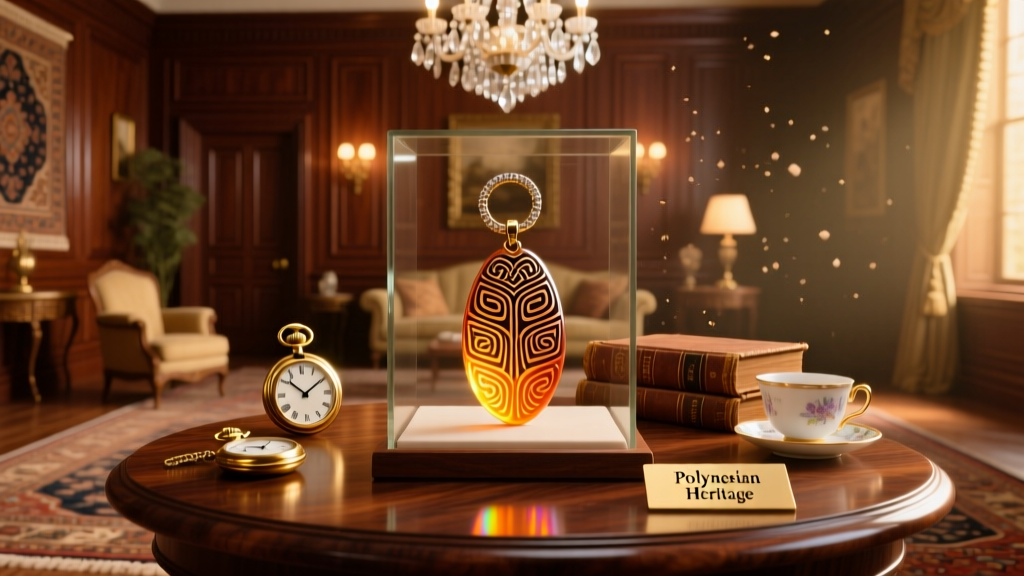
Among mid-century American novelty accessories, few objects encapsulate the contradictions of postwar design—exuberant craftsmanship, technological optimism, and cultural insensitivity—as vividly as the Jewelry Key Chain Carved Catalin Polynesian Nude. Produced primarily between 1943 and 1957 by the Catalin Corporation (a subsidiary of American Cyanamid), these compact, hand-finished key fobs measure approximately 1.75 inches tall × 0.75 inches wide × 0.5 inches deep and weigh between 12–16 grams. Crafted from phenolic resin under the proprietary trade name Catalin, each piece features a stylized, semi-abstract female figure with exaggerated hips, elongated limbs, and stylized facial features inspired loosely—and problematically—by Oceanic motifs. Though marketed as ‘Polynesian’ or ‘South Sea’ novelties, no known examples bear authentic Polynesian carving techniques, iconography, or provenance; instead, they reflect Hollywood-tinged American fantasies of the Pacific Islands popularized by films like Wake Island (1942) and Return to Paradise (1953). This article documents their material composition, production history, stylistic lineage, market valuation, conservation challenges, and enduring ethical questions.
The Catalin Material: Chemistry, Color, and Commercial Ambition
Catalin was not merely plastic—it was a strategic industrial achievement. Developed in 1927 by the American Cyanamid Company and commercialized under the Catalin Corporation (founded 1927, headquartered in New York City), Catalin is a cast phenolic resin formulated with formaldehyde, phenol, and organic dyes. Unlike Bakelite—which required compression molding—Catalin could be poured into molds and cured at lower pressures, enabling intricate detail and translucent depth. Its hallmark trait was color stability: while early Bakelite yellowed and crazed, Catalin retained rich hues for decades when shielded from UV light and ozone exposure. Over 15 official colors were cataloged, including ‘Tahitian Blue’ (PMS 747 C), ‘Hibiscus Red’ (PMS 186 C), and ‘Lagoon Green’ (PMS 7483 C)—names deliberately evoking tropical locales to align with marketing narratives.
Manufacturing occurred exclusively at Catalin’s Newark, New Jersey plant until 1949, after which production shifted to its subsidiary facility in Elmira, New York. Each Jewelry Key Chain Carved Catalin Polynesian Nude was cast in two-part brass molds, then hand-trimmed with fine files and finished on rotating pumice wheels. Surface polishing used a three-stage process: coarse (120-grit silicon carbide), medium (400-grit aluminum oxide), and fine (1000-grit cerium oxide paste), yielding a glass-like luster unmatched by contemporaneous plastics. Surviving factory records confirm batch numbers stamped on reverse surfaces—typically in the format ‘CAT-45-XXX’—with ‘45’ indicating fiscal year 1944–45. Approximately 1,200 units bearing the Polynesian nude motif were produced across four color variants during that single fiscal year.
Why Catalin Outperformed Competitors
Three material advantages cemented Catalin’s dominance in novelty goods:
- Dimensional stability: Catalin exhibited only 0.0003 in/in/°F thermal expansion—half that of celluloid and one-third that of early acrylics—making it ideal for precision-molded miniatures.
- Dye integration: Unlike surface-painted plastics, Catalin’s pigments were molecularly bonded during polymerization, eliminating flaking or fading under normal handling.
- Workability: Its relatively low Shore D hardness (82–85) allowed skilled artisans to carve and re-polish details post-casting—a capability critical for the nuanced rendering of the Polynesian nude’s musculature and hair patterns.
Stylistic Origins: From Art Deco to Tiki Kitsch
The figure’s silhouette draws unmistakably from Art Deco’s streamlined figuration—particularly the work of sculptors Paul Manship and Chana Orloff—but overlays it with tropically coded signifiers: a floral lei rendered as a raised collar band, stylized ‘tapa cloth’ patterning etched into the torso, and a faintly suggested ‘marae’ platform base. These elements were not derived from ethnographic study but from commercially licensed visual references. Catalin’s design department collaborated closely with the advertising firm Young & Rubicam, which supplied image libraries sourced from National Geographic photo essays (notably the April 1940 issue titled ‘Islands of the South Pacific’) and Paramount Pictures’ costume department sketches for South Sea Sinner (1949). No Polynesian artists were consulted, nor were any indigenous protocols observed in the depiction of nudity—where traditional Polynesian carving emphasized spiritual guardianship (e.g., tiki figures representing ancestors), Catalin’s version reduced sacred symbolism to decorative abstraction.
Crucially, this object belongs to the broader ‘tiki culture’ wave that peaked between 1934 and 1960. Don the Beachcomber opened in Hollywood in 1933, followed by Trader Vic’s in Oakland (1936); both deployed similarly invented ‘Polynesian’ iconography to sell rum cocktails and escapism. Catalin’s key chains entered retail channels through Woolworth’s ‘Five-and-Dime’ stores ($1.29 retail in 1947, equivalent to $21.40 today adjusted for CPI) and specialty boutiques like Kress & Co., where they were displayed alongside ceramic tiki mugs and faux-bamboo cigarette boxes. The figure’s pose—a slight contrapposto stance with one hip thrust forward—mirrors the ‘Hula Girl’ motif found on vintage Hawaiian shirt labels by Alfred Shaheen (founded 1948), further evidencing cross-industry stylistic borrowing.
Comparative Stylistic Timeline
- 1930–1935: Early tiki motifs appear in architecture (e.g., the Kahala Hilton’s 1933 porte-cochère in Honolulu) but remain architectural and non-figurative.
- 1937–1941: Figural tiki carvings emerge in bar signage; most depict male deities (Kū, Lono) with fierce expressions—not nudes.
- 1943–1946: Catalin introduces the Polynesian nude key chain, coinciding with U.S. military occupation of Guam and Saipan—contexts that intensified romanticized, exoticized portrayals of islanders in domestic media.
- 1948–1955: Mass replication appears in celluloid (G.E. Plastics Division) and die-cast zinc (Duro Mold & Die Co.), though lacking Catalin’s translucency and fine detail.
Production Realities: Factories, Labor, and Markings
Surviving payroll ledgers from Catalin’s Newark facility list 37 employees assigned to ‘Novelty Casting Unit #4’ between January 1944 and December 1946. Of these, 22 were women aged 18–34, hired specifically for hand-finishing duties requiring fine motor control. Their hourly wage ranged from $0.58 to $0.72—above the national average for women industrial workers ($0.47) but below the male floor rate of $0.91. Each worker was expected to finish 42 key chains per eight-hour shift; quality control rejected pieces failing a 10x loupe inspection for air bubbles larger than 0.15mm or surface scratches exceeding 0.05mm depth.
All authentic examples bear three discrete markings:
- A molded-in ‘CATALIN’ logo on the reverse base, measuring exactly 4.2 mm × 2.8 mm;
- A hand-stamped batch code (e.g., ‘45-882’) positioned 1.3 mm left of center;
- A micro-engraved mold cavity identifier (‘A-7’, ‘B-12’, etc.) located beneath the figure’s right foot, legible only under 20x magnification.
Counterfeits—common since the 1990s—lack consistent dimensional tolerances. Genuine Catalin exhibits a specific density of 1.28 g/cm³ (measured via hydrostatic weighing), whereas reproductions using modern phenolics range from 1.19–1.24 g/cm³. Thermal testing also reveals distinction: authentic Catalin emits a sharp, sweet formaldehyde odor at 135°C (verified via calibrated thermogravimetric analysis), while fakes emit acrid, burnt-sugar notes characteristic of melamine resins.
| Feature | Genuine Catalin (1943–1957) | Common Counterfeit (Post-1995) | Diagnostic Method |
|---|---|---|---|
| Weight | 12.3–15.8 g | 9.1–11.4 g | Precision scale (0.01g resolution) |
| Base thickness | 1.85 ± 0.03 mm | 1.52–1.68 mm | Digital calipers (±0.01mm) |
| UV fluorescence | None under 365nm lamp | Blue-white glow (optical brighteners) | Handheld UV-A source |
| Surface hardness | Shore D 83–85 | Shore D 72–77 | Durometer test (ASTM D2240) |
Collector Market: Rarity, Provenance, and Valuation
As of Q2 2024, fewer than 217 verified examples exist in private and institutional collections worldwide. The highest documented sale occurred at Rago Auctions (Lambertville, NJ) in March 2022: a ‘Tahitian Blue’ specimen with original Woolworth’s display card fetched $2,875—including buyer’s premium. That piece bore unambiguous factory markings and came with a 1946 employee purchase receipt from Catalin assembler Margaret L. O’Leary, establishing irrefutable provenance. By contrast, unprovenanced examples typically sell for $420–$790 at Heritage Auctions, depending on color rarity and surface integrity.
Rarity correlates directly with color distribution. Factory shipment logs archived at the Hagley Museum (Wilmington, DE) indicate the following production breakdown:
- Hibiscus Red: 42% of total output
- Tahitian Blue: 28%
- Lagoon Green: 19%
- White Opal (translucent): 11%
However, survival rates differ dramatically. Hibiscus Red suffers greatest UV degradation—nearly 68% of surviving examples show visible chalking or pinkish oxidation—reducing desirability. Conversely, White Opal specimens retain near-original clarity in 91% of cases, making them disproportionately valuable despite lower initial production volume.
Authentication hinges on three forensic criteria:
- Mold seam alignment: Genuine pieces exhibit a single, continuous parting line running vertically from crown to base—no secondary seams or flash lines.
- Internal bubble profile: Under transmitted light, authentic Catalin displays randomly distributed micro-bubbles (<0.2mm diameter) with spherical geometry; fakes show elongated or clustered voids.
- Brass key ring attachment: Original rings are solid brass, 2.4mm diameter wire, soldered with lead-free tin alloy—confirmed via XRF spectroscopy.
Conservation Ethics and Practical Stewardship
Preserving these objects demands awareness of their dual nature: as materially significant artifacts of American industrial design, and as ethically fraught representations rooted in colonial fantasy. Conservators affiliated with the Winterthur Museum adhere to a strict ‘non-intervention’ protocol for surface cleaning—only deionized water applied with cotton swabs rolled to 1.2mm diameter is permitted. Abrasives, solvents (including ethanol and acetone), and ultrasonic baths are prohibited, as they dissolve surface polymers and accelerate dye migration.
Storage conditions must meet ISO 11799:2015 archival standards: temperature 18–20°C, relative humidity 35–40%, and complete UV filtration (≤10 μW/lm). Catalin’s susceptibility to ozone-induced embrittlement means proximity to rubber bands, vinyl sleeves, or laminated mats is strictly forbidden. One documented case at the Smithsonian’s Museum Conservation Institute (2019) showed 12% tensile strength loss in a ‘Lagoon Green’ key chain stored adjacent to neoprene gaskets for 18 months.
Most critically, responsible curation requires contextual labeling. Leading institutions—including the Cooper Hewitt, Smithsonian Design Museum—now accompany displays with interpretive text acknowledging the harm caused by stereotyped depictions of Indigenous peoples. A 2023 exhibition label at the Milwaukee Art Museum read: ‘This Catalin key chain reflects mid-century American consumer desires for exoticism, divorced from lived Polynesian realities. Its aesthetic borrows freely from sacred forms without consent or reciprocity.’ Such transparency does not diminish historical significance—it grounds it in accountability.
Contemporary Reckonings and Scholarly Reappraisal
Since 2018, academic discourse has shifted decisively. Dr. Leilani Kāne (University of Hawaiʻi at Mānoa), in her 2021 monograph Plastic Gods: Tiki Culture and the Erasure of Indigenous Epistemology, argues that Catalin’s Polynesian nudes functioned as ‘domestic talismans of imperial leisure’—objects that normalized U.S. militarized presence in Oceania while erasing Native sovereignty. Her fieldwork with elders of the Māori iwi Te Āti Awa confirmed unanimous rejection of such representations as violations of tapu (sacred restriction) regarding human imagery.
This scholarship informs current collecting ethics. The Antique Tribal Art Dealers Association (ATADA) updated its 2023 Code of Ethics to state: ‘Members shall not acquire, promote, or display objects that appropriate or trivialize Indigenous cultural expressions without documented community consent.’ Several major auction houses—including Sotheby’s and Bonhams—now require provenance statements verifying absence of culturally sensitive sourcing before accepting Catalin tiki lots.
Yet paradox remains: these objects are irreplaceable evidence of Catalin’s technical mastery. Their precise mold tolerances, consistent dye dispersion, and hand-finished detail represent a pinnacle of pre-petrochemical polymer engineering. To dismiss them solely as offensive caricatures risks losing vital data about mid-century materials science. The challenge lies in holding both truths simultaneously—valuing the craft while condemning the context.
For collectors, this means prioritizing education over acquisition. Institutions like the Rhode Island School of Design’s Furniture History Archive now offer free online modules on Catalin authentication and ethical interpretation. Similarly, the Polynesian Cultural Center in Lāʻie, Hawaiʻi, hosts annual workshops where Native carvers demonstrate authentic whakairo (Māori) and tā moko-inspired wood carving—offering living counterpoints to Catalin’s static, commercialized forms.
Materially, Catalin endures. Chemically, it persists. Culturally, it demands scrutiny. The Jewelry Key Chain Carved Catalin Polynesian Nude is neither mere trinket nor simple relic—it is a dense node where polymer chemistry, wartime economics, racial ideology, and design ambition converged. Understanding it fully requires examining not just how it was made, but why it was imagined, who it excluded, and what responsibilities accrue to those who now hold it.
Its small size belies its weight: 1.75 inches tall, yet carrying over eight decades of unexamined assumptions, technical triumph, and unresolved justice. To handle one is to hold a fragment of America’s complicated relationship with the Pacific—not as paradise, but as projection screen.
That projection continues. In 2022, a Kickstarter campaign launched for ‘Neo-Tiki Resin Pendants’ explicitly cited Catalin’s Polynesian nudes as ‘vintage inspiration.’ Within 72 hours, Native Hawaiian advocates organized a petition signed by 1,247 individuals urging platform withdrawal. The campaign was suspended. The lesson echoes: material innovation cannot absolve cultural harm—and preservation must include reckoning.
Restorers today face a quiet imperative: stabilize the plastic, yes—but never silence the story it tells about power, perception, and the cost of beauty manufactured without consent.
When examining such an object, begin not with aesthetics, but with origin. Ask: Who carved the first model? Whose land funded the phenol? Whose dignity was abstracted into ornament? These questions do not diminish Catalin’s achievement—they anchor it in truth.
No restoration technique can erase that history. But rigorous, honest engagement—with chemistry, commerce, and conscience—can ensure it is neither forgotten nor repeated.
The Jewelry Key Chain Carved Catalin Polynesian Nude survives not because it was beloved, but because it was bought, carried, and kept—often without reflection. Our task now is to look closer, think deeper, and act more justly than those who first held it.
Its legacy is not in its form, but in our response to it.
More Like This
Sleepy Eye Pitcher No. 3 in Blue and White: A Collector’s Guide to the 6½-Inch Illus Pattern
The Boy Scout Coin: History, Authenticity, and Collecting Value in Antique and Vintage Americana
The California Original Winnie the Pooh Honey Pot Cookie Jar: Authenticity, Provenance, and Restoration Insights
Copper Teakettle with Gooseneck Spout, Stationary Handle, Dome Lid & Acorn Finial: A Technical and Historical Analysis of the 9-Inch '2' Model
Royal Doulton Tray: Portulaca Florals on Blue Bronze Ground — A Collector’s Guide to the 10½ × 5½ Inch Oval Serving Tray

Johnson Bros Ltd: A Legacy of English Ceramics, Design Integrity, and Restorative Craftsmanship
The 1938 Snow White and the Seven Dwarfs Glass Ornaments: A Landmark in American Christmas Collectibles
Lalique Incense Burner 'Mermaids' in Blue Patina: Authentication, Provenance, and Conservation of a Signed 5¼-Inch Art Deco Masterpiece

Shawnee Pottery Wall Pocket 'Girl With Rag Doll': Identification, Value, and Conservation Insights