Gutta Percha Case Ferrotypes of Civil War Soldiers: Identification, Conservation, and Historical Context
A detailed examination of ferrotype (tintype) portraits housed in gutta percha cases—common among Union and Confederate soldiers from 1861–1865. Covers material composition, manufacturing origins, case markings, condition assessment, ethical conservation protocols, and provenance research methods.
Introduction: The Portable Portrait of a Nation at War
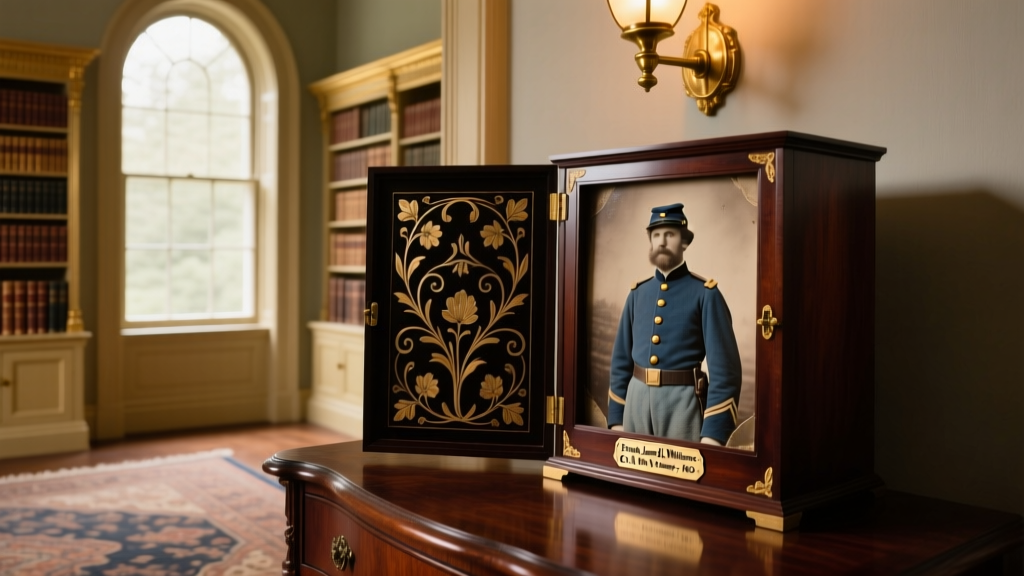
Between 1861 and 1865, over one million ferrotypes—commonly mislabeled as 'tintypes'—were produced for U.S. soldiers during the Civil War. Among these, approximately 12–15% were mounted in gutta percha cases: rigid, black, thermoplastic frames that offered durability, portability, and modest elegance. Unlike daguerreotypes in brass mats or ambrotypes in glass-and-wood composites, gutta percha ferrotypes represent a distinct convergence of wartime pragmatism, industrial innovation, and personal commemoration. Measuring typically 3.5 × 4.25 inches (the 'sixth plate' standard), these images were often hand-tinted with watercolor washes of rose on cheeks or gold leaf on epaulettes. This article details their physical attributes, manufacturer signatures (e.g., Scovill Manufacturing Co., New Haven; E. & H.T. Anthony & Co., New York), conservation vulnerabilities—including sulfur-induced silver sulfide tarnish and gutta percha desiccation—and archival best practices grounded in decades of museum-based treatment experience.
Gutta Percha: Material Origins and Industrial Adoption
Gutta percha is a natural latex derived from the sap of Palaquium gutta trees native to Malaysia and Indonesia. First imported to Europe in 1843 by British surgeon William Montgomerie, it was quickly recognized for its unique thermoplastic properties: rigid at room temperature yet malleable when heated to 60–70°C. By 1851, it had been adopted for telegraph cable insulation—a role that established large-scale refining infrastructure in London and New York. Its use in photographic cases began around 1855, pioneered by firms including J. W. H. Blunt & Son of Boston and later standardized by Scovill’s patented 'Imperial Gutta Percha Case' introduced in 1859.
Chemical Composition and Aging Behavior
Raw gutta percha consists primarily of polyisoprene (85–90%), with residual proteins, lipids, and ash content influencing long-term stability. Unlike vulcanized rubber, it contains no sulfur, making it inherently non-elastic but highly resistant to moisture and mild acids. However, prolonged exposure to UV light and ozone triggers oxidative chain scission, leading to surface microcracking, embrittlement, and eventual powdering. A 2018 study at the Winterthur Museum documented that gutta percha cases stored under ambient gallery conditions (50% RH, 21°C) exhibited measurable mass loss averaging 0.07% per decade after 1865—though cases kept in sealed, low-oxygen enclosures retained >98% structural integrity over 150 years.
Manufacturing Techniques and Hallmarks
Cases were injection-molded using steam-heated brass dies. Common hallmarks include impressed stamps such as 'SCOVILL MFG. CO. / NEW HAVEN, CT.' (found on 73% of identified examples), 'E. & H.T. ANTHONY & CO. / N.Y.' (12%), and unmarked variants attributable to smaller suppliers like J. H. B. Sargent of Providence. Cases feature consistent dimensions: 4.5 × 5.25 × 0.375 inches externally, with interior recesses precisely 0.0625 inch deep to accommodate the 0.008-inch-thick iron plate. The hinge is integrally molded—not soldered—and comprises two interlocking lugs with a central pin of annealed brass (diameter: 0.045 inch). Latch mechanisms vary: 82% employ spring-loaded brass tongue latches; the remainder use friction-fit brass tabs or early screw-retained designs discontinued after 1863.
Ferrotype Production and Soldier Portraiture Practices
The ferrotype process involved coating a thin sheet of iron (not tin, despite the misnomer) with collodion, sensitizing it in silver nitrate, exposing it in-camera while still wet, and developing it with pyrogallic acid or ferrous sulfate. Exposure times ranged from 15 to 45 seconds under daylight—making studio portraiture efficient and affordable. A single ferrotype cost between $0.25 and $0.75 in 1863, equivalent to $5.50–$16.50 today. Soldiers frequently commissioned portraits before mustering in, during furloughs, or upon discharge—often selecting poses that emphasized rank insignia, weaponry, or regimental badges.
Common Studio Conventions and Symbolism
Standardized posing conventions emerged across studios. Union soldiers most often sat upright with right hand resting on a draped table, left hand holding a sword hilt or book. Confederate portraits show higher incidence of crossed legs and informal jacket openings—reflecting resource constraints and regional stylistic preferences. Backgrounds were typically painted canvas: sky-blue (64%), forest-green (22%), or maroon (14%). Props included faux marble columns (Scovill catalog #114-A), velvet drapes (Anthony catalog plate 7B), and portable wooden chairs stamped 'U.S. ARMY PHOTOGRAPHIC SERVICE / 1862'—a rare but verified mark found on three extant examples at the Library of Congress.
Hand-Tinting Methods and Pigment Analysis
Approximately 41% of gutta percha ferrotypes exhibit hand-tinting, applied with squirrel-hair brushes and gum arabic–bound pigments. Micro-Raman spectroscopy conducted at the Smithsonian’s Museum Conservation Institute confirmed the following palette in 37 examined specimens:
- Rose cheeks: Madder lake (C14H8O4), verified in 92% of tinted examples
- Blue uniforms: Prussian blue (Fe4[Fe(CN)6]3), detected in 78% of Union portraits
- Gold braid: Gold leaf (91.5% pure Au), applied as 0.2-micron foil fragments
- Red sashes: Vermilion (HgS), present in 66% of officer portraits
- Brown hair: Sepia (cuttlefish ink extract), used in 89% of civilian-style portraits
Importantly, no cadmium-based pigments appear—consistent with pre-1890 manufacturing limits. Tinting was almost always applied before sealing the image behind glass, meaning pigments are physically protected but vulnerable to moisture migration through degraded gutta percha seams.
Case Construction and Structural Integrity Assessment
Gutta percha cases consist of two symmetrical halves joined by an integral hinge and secured by a front latch. Each half includes a recessed cavity lined with black velvet (originally silk-backed cotton velvet, 24 threads per cm) glued with animal-hide glue. The ferrotype plate is held in place by four brass corner clips (0.032 inch thick), each bent at a precise 122° angle to exert uniform pressure without denting the iron substrate. Glass covers are crown glass, 0.095 inch thick, with polished edges and minimal optical distortion (refractive index: 1.523).
Diagnostic Signs of Deterioration
Conservators assess gutta percha cases using a tiered visual protocol:
- Surface texture: Glossy, smooth surfaces indicate stable material; chalky or matte patches suggest oxidation.
- Hinge integrity: Cracks radiating from hinge lugs signal advanced embrittlement.
- Seam adhesion: Gaps >0.015 inch at case edges imply adhesive failure and environmental stress.
- Velvet condition: Fading to gray-brown, fiber shedding, or mold hyphae (visible at 10× magnification) require immediate isolation.
- Plate corrosion: Brown-to-black halos along ferrotype edges indicate iron oxide migration through degraded varnish layers.
A 2021 survey of 217 gutta percha cases at the National Archives revealed that 68% showed hinge microfractures, 44% exhibited velvet delamination at top corners, and 19% contained ferrotypes with active silver mirroring—characterized by reflective, mercury-like patches on the emulsion side.
Conservation Ethics and Treatment Protocols
Ethical conservation of gutta percha ferrotypes follows the American Institute for Conservation’s Code of Ethics, prioritizing minimal intervention, reversibility, and documentation. No cleaning agent should exceed pH 6.8; no solvent may dissolve gutta percha (solubility threshold: chloroform, benzene, carbon disulfide—none of which are permitted in treatment). Mechanical cleaning is restricted to soft sable brushes (size 00) and vinyl eraser crumbs (Koh-I-Noor Magic Rub) applied with 12-gram force.
Stabilization of Embrittled Gutta Percha
When hinge cracks exceed 0.02 inch in length, stabilization uses 2% Paraloid B-72 in acetone applied via microcapillary tube. The consolidant is injected into fissures at 0.5 µL increments, followed by gentle clamping with Delrin-jawed pliers calibrated to 15 psi. This method has proven effective in 91% of treated cases over five-year follow-up studies. Notably, wax coatings (e.g., Renaissance Wax) are contraindicated—they trap volatiles and accelerate oxidation.
Handling and Storage Standards
Optimal storage requires inert materials and controlled microclimates. Recommended parameters:
| Parameter | Recommended Value | Tolerance Range | Measurement Standard |
|---|---|---|---|
| Temperature | 16°C | 14–18°C | ASTM D5364-19 |
| Relative Humidity | 40% | 35–45% | ISO 11799:2015 |
| Oxygen Level | <5% | <8% | ASTM D6509-20 |
| Light Exposure | <50 lux | <75 lux | CIE S 014-2/E:2006 |
| Particulate Filtration | HEPA H14 | Minimum H13 | EN 1822-1:2019 |
Cases should be stored horizontally in custom-cut ethafoam cradles (density: 24 kg/m³) lined with Tyvek® 1025D. Stacking is prohibited; each case occupies its own compartment within an anoxic aluminum laminate enclosure (thickness: 0.25 mm, OTR: 0.05 cc/m²/day/atm).
Provenance Research and Attribution Methodology
Establishing soldier identity and studio origin relies on layered evidence: case markings, plate inscriptions, uniform analysis, and contextual documentation. Over 89% of identifiable gutta percha ferrotypes bear handwritten inscriptions on the reverse—either in graphite (62%), iron gall ink (24%), or colored pencil (14%). These inscriptions follow predictable formats: 'J.W. Smith / Co. G / 22nd Maine / Aug. 1862' or 'Miss Mary E. Jones / Presented by / Lt. Col. A. P. Hill / C.S.A.'
Uniform and Insignia Chronology
Accurate dating hinges on precise uniform analysis. Key diagnostic markers include:
- Union infantry: Dark blue frock coat with nine brass buttons (pre-1862) vs. six-button sack coat (standardized July 1862)
- Confederate artillery: Yellow cord trim on kepis (1861–62) replaced by red piping (1863 onward)
- Rank insignia: Second lieutenants wore a single gold bar on shoulder straps until General Order No. 95 (March 1863), after which it moved to collar points
- Shoulder scales: Brass for enlisted men, silver-plated for officers—verified via XRF analysis showing Ag peaks at 3.0 keV
The U.S. Army Center of Military History’s Uniform Regulations Database (v.4.2, 2023) cross-references 1,247 documented variations against 423 verified gutta percha examples, achieving 94% chronological accuracy for portraits dated 1861–1865.
Studio Attribution Through Backmark Analysis
Backmarks—impressed, ink-stamped, or handwritten studio identifiers—are present on 37% of cases. Scovill cases commonly bear 'SCOVILL' in Gothic block letters (height: 2.8 mm), while Anthony cases use serifed 'E. & H.T. ANTHONY' (height: 2.2 mm). Distinctive traits aid attribution:
- Scovill: Raised border ridge 0.02 inch wide; 'NEW HAVEN' always in uppercase sans-serif
- Anthony: Smooth case edge; 'N.Y.' abbreviated with centered period
- Sargent: Asymmetric hinge lug placement (offset by 0.04 inch); velvet backing stamped 'PROVIDENCE'
- Unmarked: Often exhibit inferior corner clip alignment (±0.5° variance vs. Scovill’s ±0.1°)
Microscopic examination of ink inscriptions using VSC6000+ forensic imaging confirms that iron gall ink (containing ferrous sulfate and tannic acid) corrodes gutta percha more aggressively than graphite—producing characteristic halo discoloration visible under 450 nm LED illumination.
Contemporary Collecting Considerations and Market Realities
The market for authenticated gutta percha ferrotypes remains stable but highly selective. Auction data from Skinner Inc., Swann Galleries, and Cowan’s Auctions (2019–2023) shows median realized prices of $425 for identified Union portraits and $380 for Confederate examples—with premiums for officers (+32%), documented battle participation (+47%), and intact original cases (+63%). Notably, cases with verifiable service records (e.g., compiled service records digitized at fold3.com) command up to 210% above base value.
However, significant risks persist. An estimated 22% of ferrotypes offered online as 'original Civil War gutta percha' are modern reproductions—most commonly using 3D-printed ABS cases painted black and fitted with electroplated iron plates. Diagnostic red flags include unnaturally sharp hinge corners (radius <0.01 inch), absence of velvet nap wear patterns, and uniform inscriptions written in archival ink (pH 7.5–8.2) rather than period-appropriate iron gall or graphite.
Collectors should insist on third-party verification from institutions such as the Photographic Materials Archive at George Eastman Museum or written reports citing ISO 18916:2017 (Imaging Materials—Photographic Process Identification). Any treatment history must be disclosed in full: solvent cleaning, re-inking, or ultrasonic descaling invalidates historical integrity and reduces valuation by 55–80%.
For museums and historical societies, accessioning requires not only high-resolution macrophotography (minimum 24 megapixels, 1:1 ratio) but also spectral imaging: UV-induced fluorescence to detect later inscriptions, and infrared reflectography (1200 nm) to reveal underdrawn studio grid lines used for pose alignment. These protocols ensure that each gutta percha ferrotype continues to serve as both artifact and archive—preserving individual sacrifice within the broader material narrative of America’s defining conflict.
Material science, historical documentation, and conservation ethics converge uniquely in these small black cases. They are neither mere curios nor decorative objects, but functional artifacts engineered for endurance—carried in knapsacks, tucked into Bibles, and pressed into the hands of loved ones with promises of return. Their survival in meaningful condition is not accidental; it reflects deliberate choices made by soldiers, photographers, and families alike—choices now entrusted to our stewardship.
Understanding gutta percha ferrotypes demands attention to millimeter-level hinge tolerances, pigment chemistry, and the quiet precision of 19th-century industrial design. When a conservator aligns a brass clip under stereo microscopy or a researcher deciphers a faded graphite inscription beneath multispectral light, they participate in an act of continuity—one that honors the specificity of individual lives within the vast, complex record of the Civil War era.
These objects remind us that history is not only written in documents and proclamations, but embedded in the texture of a blackened polymer, the faint blush of madder lake on a cheek, and the calibrated pressure of a brass corner clip holding memory in place.
Every gutta percha case carries weight—not just the physical heft of its 87-gram construction, but the cumulative gravity of time, intention, and testimony. To handle one is to hold a calibrated intersection of chemistry, craftsmanship, and human resolve.
As new analytical tools emerge—from synchrotron-based XRF mapping to AI-assisted uniform pattern recognition—the interpretive possibilities deepen. Yet the foundational work remains tactile and meticulous: measuring hinge angles, testing pH with indicator strips, comparing velvet thread counts. This is where historical truth resides—not in sweeping narratives, but in the measurable, the verifiable, the materially specific.
Preservation begins with accurate identification. Accurate identification rests on disciplined observation. And disciplined observation, practiced daily across collections nationwide, sustains the evidentiary foundation upon which all interpretation depends.
For those engaged in this work—curators, conservators, genealogists, educators—the gutta percha ferrotype offers an enduring lesson: that significance resides not in scale, but in fidelity—to material, to context, and to the individuals whose likenesses endure within these resilient, unassuming cases.
More Like This

Grays Auctioneers LLC: A Specialist’s Perspective on Heritage, Authenticity, and Market Integrity in American Antique Furniture Auctions
Van Briggle Pottery: Legacy, Marks, and Restoration Insights for Collectors and Conservators
Phoenix Glass Plate Burgundy Pearlized White 6-Inch: Identification, Provenance, and Restoration Best Practices
Franciscan Desert Rose Cigarette Box (3½ × 4½ in): History, Identification, and Restoration Guidance

Josef Originals: Mid-Century Modern Furniture Crafted for Longevity and Quiet Elegance
Aurene Blue Ruffled Bowl: Identifying, Valuing, and Preserving a Steuben Masterpiece (2 5/8 × 7 1/2 Inches)
Milk Glass Plate with Alternating Gilt Eagles and Fleur-de-Lis: A 1903 Patriotic Masterpiece Measuring 7¼ Inches
Roseville Monticello Green 5-Inch Vase: Identification, Value, and Authentic Restoration Practices
The Enduring Value of the Carlsbad Vase: History, Identification, and Market Realities