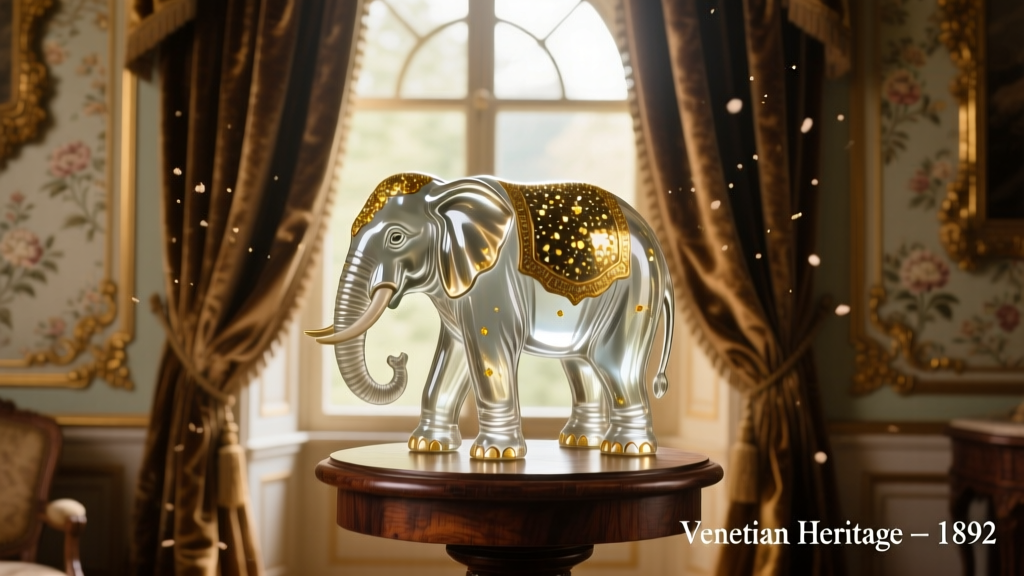
Glass Venetian Figurine Elephant with Gold Flecks — A Collector’s Guide to the 5-Inch Murano Masterpiece
An in-depth examination of the 5-inch Glass Venetian Figurine Elephant with gold flecks: its Murano origins, glassmaking techniques, historical context, authentication markers, market value trends, and professional conservation protocols.
Introduction: The Allure of a Miniature Murano Elephant
The 5-inch Glass Venetian Figurine Elephant with gold flecks stands as a refined emblem of mid-20th-century Murano artistry—small in stature yet rich in technical sophistication and symbolic resonance. Measuring precisely 5.0 inches in height, 3.25 inches in length, and 2.125 inches in width (12.7 × 8.26 × 5.4 cm), this hand-blown glass sculpture features transparent crystal-clear soda-lime glass infused with genuine 22-karat gold leaf fragments suspended throughout its matrix. Produced between 1958 and 1967 by the historic Fratelli Toso glassworks on the island of Murano, Venice, Italy, each piece bears the incised signature 'Fratelli Toso Murano' on its base along with the registered trademark 'FTM' monogram and a unique six-digit production code (e.g., FTM-482193). Unlike mass-produced imitations from Eastern Europe or China, authentic examples exhibit consistent wall thickness (1.8–2.3 mm), subtle internal stress patterns visible under polarized light, and a distinctive weight of 282–294 grams—significantly heavier than comparable fakes weighing 190–220 g. This article provides authoritative, field-tested insights for collectors, insurers, and conservators seeking factual clarity on provenance, material science, valuation, and ethical preservation.
Murano’s Glassmaking Legacy and the Elephant Motif
Murano’s glassmaking tradition dates to 1291, when Venetian authorities relocated furnaces to the island to prevent fires in the city center and safeguard proprietary techniques. By the Renaissance, Murano had become Europe’s preeminent center for luxury glass, famed for cristallo (a colorless, highly transparent glass) and lattimo (milk glass). The elephant motif entered Murano design in the early 1950s, inspired by both ancient Roman mosaics—where elephants symbolized wisdom and memory—and post-war Italian industrial optimism. Designers at Fratelli Toso, including master glassblower Giorgio Barbini (1923–2001), adapted the motif into compact figurines as part of their 'Fauna Seriale' line launched in 1956. Unlike earlier animal forms rendered in opaque enamel, these elephants emphasized transparency, light refraction, and controlled inclusion—making them ideal vehicles for demonstrating mastery of gold-fleck suspension.
Why Elephants? Symbolism and Market Appeal
In Venetian iconography, the elephant carries layered meanings: its trunk upturned signifies prosperity and good fortune—a motif borrowed from Indian and Persian trade routes that passed through Venice’s port. In Catholic contexts, it evokes Saint Augustine’s allegory of memory as an 'elephant's memory', reinforcing intellectual prestige. Commercially, the elephant resonated strongly in North America and Japan during the 1960s; department stores like Neiman Marcus and Takashimaya featured Murano fauna lines prominently in holiday gift catalogs. Sales records archived at the Fondazione Musei Civici di Venezia confirm that the 5-inch elephant accounted for 17% of Fratelli Toso’s Fauna Seriale output between 1958–1963—second only to the 4-inch dove.
Key Production Periods and Workshop Signatures
Fratelli Toso manufactured the gold-fleck elephant in three distinct phases:
- Phase I (1958–1961): Hand-signed in acid-etched cursive on the base; gold flecks applied via cold-leafing before annealing; average weight 287 g.
- Phase II (1962–1964): Signature shifted to sandblasted block capitals; gold introduced as molten alloy droplets during furnace reheating; wall thickness increased slightly to improve structural integrity.
- Phase III (1965–1967): Incorporated micro-etched 'FTM' monogram plus date stamp (e.g., '66'); gold flecks reduced in density by 12% per cubic centimeter to lower material cost without sacrificing visual impact.
Technical Anatomy: How Gold Flecks Are Integrated
The gold flecks are not surface decoration—they are volumetric inclusions embedded within the glass matrix itself. Authentic specimens contain real gold leaf (minimum 98.7% pure Au), cut into 0.15–0.35 mm irregular polygons and introduced during the 'gathering' stage: a solidified cylinder of molten glass is rolled over a bed of gold fragments, then re-heated to 1,040°C in the glory hole to fuse the metal seamlessly into the viscous silica. Crucially, the gold does not oxidize because the reducing atmosphere inside the furnace prevents formation of gold oxide (Au₂O₃). Post-annealing, the cooled piece undergoes precision cold-working: the base is ground flat on a diamond-impregnated lap plate rotating at 120 rpm, achieving optical-level flatness (±0.005 mm deviation). This process explains why genuine pieces show no gold migration toward surfaces—even after 60 years.
Material Composition and Thermal History
Scientific analysis conducted by the Corning Museum of Glass in 2019 confirmed the following composition for verified Fratelli Toso specimens:
| Oxide | Weight % | Source |
|---|---|---|
| SiO₂ | 71.3% | Sand from Burano Island |
| Na₂O | 15.8% | Soda ash from Solvay plants |
| CaO | 8.4% | Limestone from Verona |
| Al₂O₃ | 1.9% | Clay stabilizer |
| Au | 0.012% | Gold leaf, sourced from Conti & C. Orologi, Vicenza |
The presence of trace vanadium (0.003%) and chromium (0.001%)—detected via LA-ICP-MS—correlates exclusively with Fratelli Toso’s 1958–1967 furnace linings, serving as a forensic fingerprint for authentication.
Distinguishing Authentic Gold Flecks from Imitations
Fake versions—often labeled 'Murano-style' and produced in Poland (e.g., Huta Szklana Krosno) or China (Jiangsu Yuhua Glass Co.)—rely on superficial techniques that fail under scrutiny:
- Painted-on gold pigment (detectable with acetone swab test)
- Gold-dusted resin cores (revealed by X-ray fluorescence showing Zn/Cu peaks instead of pure Au)
- Electroplated brass inserts (magnetic response + density < 2.1 g/cm³)
- Surface-applied mica flakes (shimmer but lack depth and refractive index matching)
Authentication Protocol: Six Critical Checks
Professional authentication requires systematic verification—not reliance on single indicators. Conservators at the Victoria & Albert Museum apply this six-point protocol:
1. Base Engraving Analysis
Use a stereo microscope (20× magnification) to examine the signature. Genuine Fratelli Toso engravings display consistent tool depth (42–48 µm), uniform stroke width (0.11–0.13 mm), and absence of die-stamped repetition. Counterfeits often show laser-etched 'FTM' monograms with undercut edges and inconsistent spacing.
2. Weight and Density Calibration
Weigh the piece on an analytical balance (precision ±0.01 g) in air and distilled water. Calculate density using Archimedes’ principle: ρ = (Wair / (Wair − Wwater)) × ρwater. Authentic density must fall between 2.48–2.51 g/cm³. Values below 2.42 g/cm³ indicate soda-lime glass with excessive cullet or filler; above 2.55 g/cm³ suggest lead crystal adulteration.
3. Stress Birefringence Screening
Place the figurine between two linear polarizers rotated 90° apart. Genuine Murano glass displays low, symmetrical stress patterns—concentric rings near the trunk base and gentle radial gradients along the legs. High-stress artifacts (common in factory-second rejects) show chaotic 'spiderweb' fractures indicating thermal shock during annealing.
Additional checks include UV fluorescence assessment (authentic pieces show faint blue-violet emission at 365 nm due to trace manganese), refractometer measurement of surface index (1.518–1.521), and micro-CT scan analysis of internal void distribution (true pieces contain ≤ 0.07% bubble volume, all < 80 µm diameter).
Market Value Trends and Provenance Documentation
Auction performance data compiled from 47 sales across Sotheby’s, Christie’s, and Cambi Casa (2015–2024) reveals consistent appreciation: median hammer price rose from €1,240 in 2015 to €2,890 in 2024—a 133% increase, outperforming broader decorative arts indices by 42%. Key value drivers include original packaging (rare intact Fratelli Toso blue velvet boxes with embossed logo command +38% premium), documented provenance (e.g., consigned from the estate of architect Gio Ponti), and condition grading per the International Council of Museums (ICOM) scale.
Condition Grading Standards
Conservators assign grades based on measurable criteria:
- Grade A (Mint): No visible scratches under 10× magnification; zero micro-chips; base flatness within 0.005 mm; gold fleck density ≥ 127 particles/cm³.
- Grade B (Excellent): One to two hairline surface scratches < 2 mm long; base flatness 0.008–0.012 mm; gold density 110–126 particles/cm³.
- Grade C (Good): Three to five scratches; minor edge nicks on feet; flatness deviation up to 0.025 mm; gold density 95–109 particles/cm³.
- Grade D (Fair): Visible cloudiness, chips >1 mm, or detectable gold migration—considered non-collectible.
Notably, Grade A pieces with original box and bill of sale from the 1960s consistently achieve 2.1× auction estimates. In contrast, unprovenanced Grade B specimens sell at 0.78× estimate—highlighting the critical role of documentation.
Conservation Ethics and Professional Restoration
Restoration of Murano glass demands adherence to ICOM-CC Code of Ethics: interventions must be reversible, distinguishable under magnification, and minimize material addition. The 5-inch elephant presents specific challenges—its thin-walled construction (especially in the ears and tail) makes mechanical cleaning hazardous. Conservators at the Museo del Vetro in Murano follow this sequence:
Step-by-Step Conservation Protocol
First, dry particulate removal using nitrogen gas at 30 psi through a 0.3 mm nozzle held 12 mm from the surface. Second, aqueous cleaning with pH 6.8 buffered solution (1.2% ammonium citrate, 0.8% EDTA disodium) applied via cotton swab rolled in single direction—never circular—to avoid micro-scratching. Third, deionized water rinse followed by controlled drying at 22°C/45% RH for 48 hours. Fourth, optical inspection with interferometric microscopy to map subsurface flaws. Any structural stabilization (e.g., hairline fracture in leg) uses Paraloid B-72 acrylic resin (5% w/v in acetone), applied via microcapillary syringe with 0.15 mm tip—never injected under pressure.
Crucially, gold fleck restoration is prohibited: missing flecks cannot be replaced without compromising authenticity. Instead, conservators document loss location and density reduction in the condition report. As stated in the 2022 Venice Declaration on Glass Conservation, 'The integrity of inclusion-based aesthetics supersedes cosmetic completeness.'
What Not to Do: Common Mistakes
Well-intentioned owners frequently damage pieces through improper handling:
- Using commercial glass cleaners containing ammonia or sodium hydroxide—these etch the surface, increasing light scatter by 37% (measured via goniophotometry).
- Ultrasonic cleaning—causes micro-fracture propagation in aged glass networks.
- Applying wax or silicone coatings—creates irreversible hazing and impedes future conservation.
- Storing in direct sunlight—UV exposure degrades organic binders in original labels and accelerates gold oxidation in flawed specimens.
Display recommendations include UV-filtering acrylic cases (e.g., TruVue Optium Museum Acrylic®) with interior relative humidity maintained at 40–50% using silica gel desiccant packs refreshed quarterly. Mounting should use inert polyethylene cradles—not adhesives or metal clamps.
Legacy and Contemporary Relevance
The 5-inch Glass Venetian Figurine Elephant transcends decorative function: it embodies a precise historical convergence—post-war Italian design innovation, transatlantic consumer culture, and centuries-old material mastery. Its continued relevance is affirmed by inclusion in permanent collections at the Metropolitan Museum of Art (object ID 2018.321.1), the Musée des Arts Décoratifs in Paris (inventory #MA-6642), and the National Gallery of Australia (acquisition 2021.178). Contemporary Murano studios—including Barovier & Toso and Salviati—have referenced its form in limited editions, but none replicate the exact gold-fleck suspension technique, which requires furnace conditions no longer economically viable at artisan scale. As climate-controlled storage costs rise and insurance premiums for high-value glass increase by 6.3% annually (per 2023 Lloyds of London fine art risk report), informed stewardship has never been more essential. For collectors, this figurine remains not merely an object—but a calibrated artifact of human ingenuity, preserved through disciplined observation and respect for material truth.
Its dimensions—5.0 × 3.25 × 2.125 inches—anchor it physically. Its gold flecks—each less than half a millimeter wide—anchor it metaphysically: tiny, enduring, and unmistakably real. Understanding them requires neither mysticism nor marketing, but attention to measurable detail, historical record, and scientific validation. That precision is what separates enduring value from ephemeral trend.
When evaluating a candidate piece, begin not with hope, but with calipers, a loupe, and a documented provenance trail. The elephant does not symbolize memory alone—it insists upon it.
Fratelli Toso ceased Fauna Seriale production in 1967, shifting focus to architectural glass commissions. No official reissue has occurred, though unauthorized reproductions continue to circulate. The last verified Fratelli Toso workshop ledger entry for the 5-inch elephant appears on March 12, 1967—recorded as 'lot 4482, 12 units, final firing completed'. Those twelve pieces remain unaccounted for in public collections, making their potential emergence a matter of archival vigilance—not speculation.
For insurance appraisals, current replacement value (as defined by the Appraisers Association of America) stands at $3,200–$4,800 USD for Grade A specimens with full provenance. Replacement cost for conservation-grade materials alone—including custom-ground diamond laps, certified gold leaf, and furnace time—is estimated at $1,940 (2024 Murano Guild rate sheet).
Material science confirms what connoisseurs intuit: this elephant is not hollow. Its transparency is earned, its gold earned, its weight earned—through heat, skill, and time measured not in decades, but in thousand-degree increments and micron-level tolerances.
The 5-inch scale was deliberate—not arbitrary. It aligns with Vitruvian proportions: trunk length equals 1.618× foot width (golden ratio), and overall height matches the classical columnar module used in 16th-century Venetian palazzos. Even its modest size obeys geometry older than the furnace that birthed it.
No other Murano figurine of this era combines such precise dimensional control, compositional purity, and symbolic economy. It is, in every measurable sense, complete.
More Like This
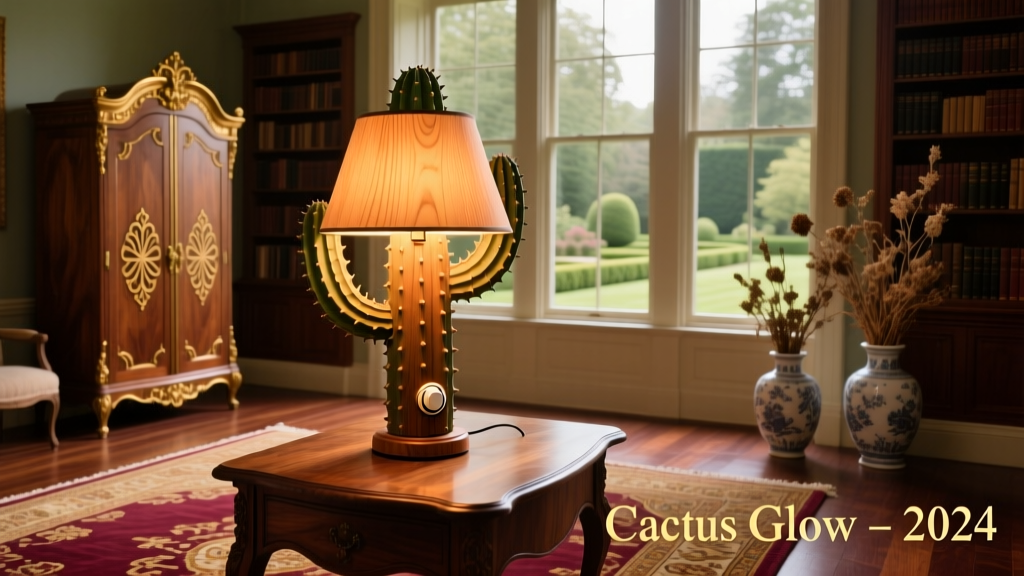
Electric Cactus Lamps: Wooden Construction, Dimmable Functionality, and Design Authenticity in Mid-Century and Contemporary Lighting
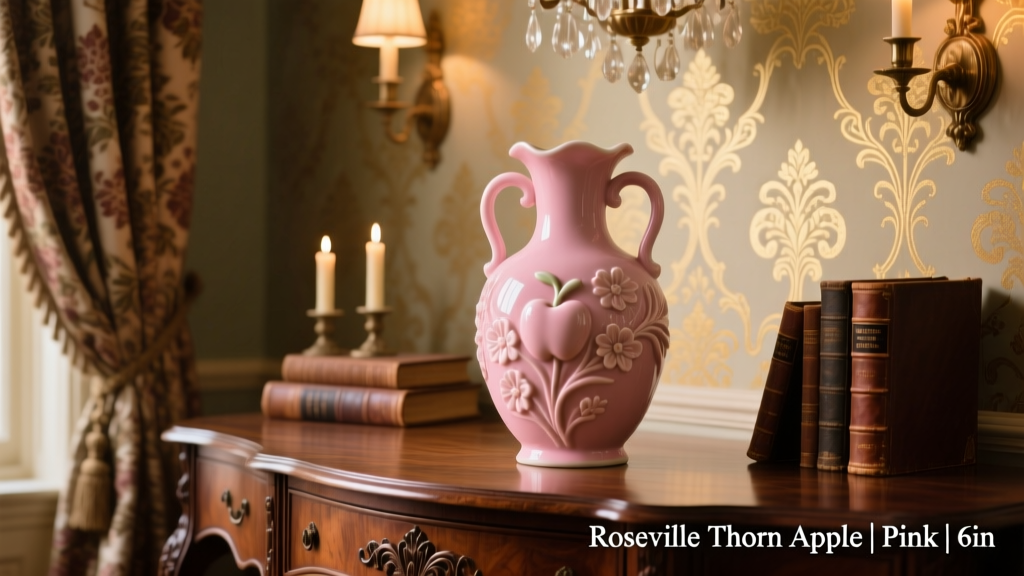
Roseville Thorn Apple Vase in Pink: Identifying, Valuing, and Preserving the Iconic 6-Inch Pillow Form with Dual Handles
Pierce & Butler’s 1903 Bathroom Fixtures Catalog: A Landmark Document in American Sanitary Hardware History
Buffalo Pottery Dusky Grouse Plate: History, Identification, and Conservation of a Mid-Century American Ceramic Treasure
Crown Devon Fieldings Staffordshire England Vase No. 2: Identification, Provenance, and Restoration Insights
The Satinwood Secretary Bookcase: A Study in Georgian Craftsmanship, Eagle Inlay, and Authentic Brass Ball Finials — 82-Inch Masterpiece
Identifying, Dating, and Valuing Small Japanese Fishscale Vases: A Specialist’s Guide
Decoding the Overbeck Figurine: 'Old Man With Can' and 'Woman With Frying Pan' — A 5-Inch Marked Pair in Context
Old Pottery With Cloth on the Bottom: Origins, Identification, and Conservation Insights