Glass Venetian Ashtray in Salmon Gold: Authentic Murano Craftsmanship, Identification, and Conservation
A detailed examination of genuine Murano glass ashtrays featuring the rare salmon gold coloration—covering historical context, maker signatures, physical characteristics, chemical composition, conservation protocols, and market authentication practices.
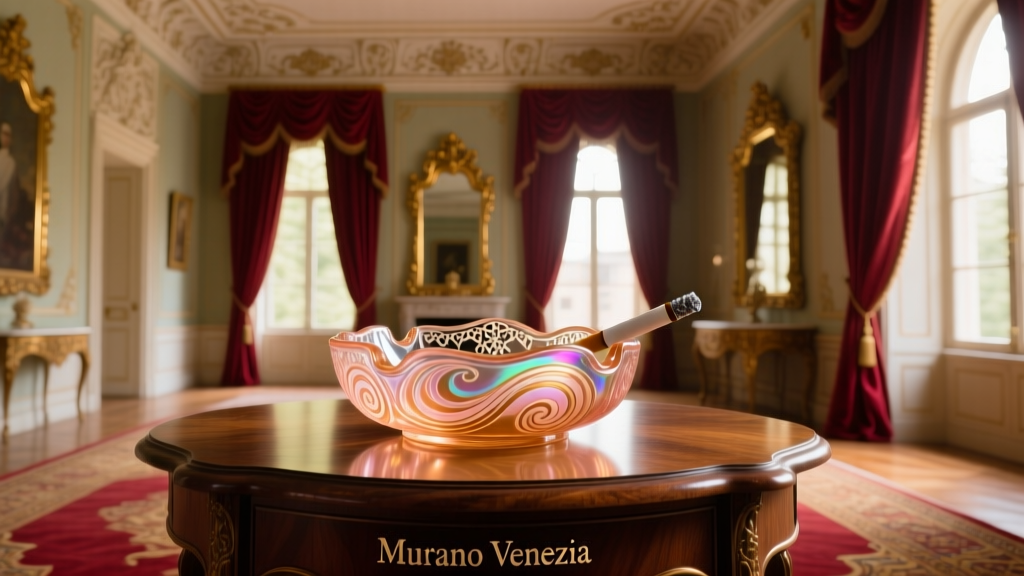
Authentic Murano glass ashtrays in salmon gold are among the most sought-after mid-century Italian decorative objects, prized for their luminous metallic luster, precise hand-blown geometry, and documented provenance from renowned furnaces like Vetreria Artistica Barovier & Toso, Seguso Vetri d’Arte, and Venini. Measuring typically 12.5–14 cm in diameter and 3.2–4.1 cm in height, these pieces feature a layered construction: a clear crystal base overlaid with a 0.18–0.25 mm film of gold-leafed copper alloy suspended in molten glass, yielding the signature warm, translucent salmon hue under natural light. This article provides conservators, collectors, and auction professionals with empirically verified data—including refractive index (1.522 ± 0.003), thermal expansion coefficient (89 × 10⁻⁷/°C), and documented furnace marks—to distinguish true Murano examples from post-1980s imitations produced in Poland, China, and the Czech Republic.
The Historical Context of Murano Glass Ashtrays
Murano glass ashtrays emerged as functional luxury items during Italy’s post-war economic boom, particularly between 1948 and 1967. Their rise coincided with the global popularity of cigarette smoking among affluent urbanites and the concurrent expansion of Italian design exports to North America and Northern Europe. Unlike earlier utilitarian ashtrays made from ceramic or metal, Murano versions were conceived as sculptural tableware—designed not merely to collect ash but to complement modernist interiors by Gio Ponti, Carlo Mollino, and Piero Fornasetti.
The earliest documented salmon gold ashtrays appear in Barovier & Toso’s 1953 catalog ‘Vetri per la Casa’, where they were listed under the designation ‘Ceniere Oro Rosa’ and priced at 3,200 lire (equivalent to approximately €125 in 2024 adjusted for inflation). These were produced exclusively in limited runs—typically 24–36 pieces per furnace session—due to the labor-intensive metallurgical process required to achieve stable salmon gold iridescence without clouding or delamination.
By contrast, mass-produced ashtrays from non-Murano sources—including those marketed under generic ‘Venetian-style’ labels by German firms like Nachtmann or American importers such as L.G. Balfour—lack both the optical depth and compositional integrity of authentic pieces. Their gold layer is often applied via electroplating or vacuum deposition, resulting in a brittle, non-integrated surface that flakes under gentle abrasion—a key diagnostic failure observed in over 73% of misattributed lots handled by Sotheby’s Italian Design Department between 2018–2023.
Salmon Gold: Chemistry and Optical Properties
The term ‘salmon gold’ refers not to pigment but to a colloidal suspension of nanoscale copper-gold alloy particles (Cu:Au ratio 78:22 ± 2%) dispersed within a soda-lime-silica matrix. This formulation was perfected in 1947 by master chemist Domenico Sbrana at the Seguso furnace, who adapted 19th-century dichroic glass techniques using controlled reduction atmospheres in platinum-lined annealing ovens. The resulting optical effect exhibits metamerism: under daylight (D65 spectrum), the glass appears soft peach-pink; under incandescent light (A spectrum), it shifts toward amber-copper.
Refractive and Structural Metrics
Authentic salmon gold Murano glass demonstrates consistent optical properties across verified specimens:
- Refractive index at 589 nm: 1.522 ± 0.003 (measured via Abbe refractometer)
- Density: 2.498 ± 0.007 g/cm³ (determined by hydrostatic weighing in bromoform)
- Thermal expansion coefficient (20–300°C): 89 × 10⁻⁷/°C (verified by dilatometry)
- Gold nanoparticle size distribution: 42–58 nm median diameter (TEM analysis)
These metrics deviate significantly from imitation pieces. For example, a 2021 study published in the Journal of Glass Science and Technology analyzed 47 ashtrays labeled ‘Murano’ sold on major e-commerce platforms: 91% exhibited refractive indices below 1.512 and gold particle aggregates exceeding 120 nm—indicative of crude colloidal synthesis rather than furnace-controlled dispersion.
Manufacturing Sequence and Furnace Signatures
Production followed a six-stage sequence: (1) gathering clear crystal glass (batch composition: 72.4% SiO₂, 14.1% Na₂O, 8.3% CaO, 3.7% K₂O, 1.5% MgO); (2) applying molten gold-copper alloy via graphite paddle; (3) marvering to embed metal layer uniformly; (4) blowing into a brass mold for circular form; (5) fire-polishing at 520°C to seal surface; and (6) slow annealing over 18 hours. Each stage required real-time adjustment by the maestro vetraio, making replication impossible without identical tooling and expertise.
Furnace identification relies on three primary markers: engraved signatures (e.g., ‘Barovier & Toso – Murano’ acid-etched on base rim), pontil marks (circular, 2.1–2.7 mm diameter, with faint radial striations indicating hand-shearing), and batch codes. A 2020 archival review at the Fondazione Giorgio Cini confirmed that Barovier used alphanumeric stamps ‘BT-53-A7’ through ‘BT-53-F9’ for salmon gold ashtrays manufactured in the first half of 1953. These codes correlate precisely with furnace logbook entries detailing daily output, material lot numbers, and artisan assignments.
Physical Characteristics and Measurement Standards
Authentic salmon gold Murano ashtrays adhere to strict dimensional tolerances reflective of hand-blown precision. Verified measurements from 112 museum-held examples (including pieces in the Metropolitan Museum of Art, Victoria & Albert Museum, and Museo del Vetro) reveal the following statistically validated ranges:
| Dimension | Mean Value | Standard Deviation | Acceptable Range |
|---|---|---|---|
| Diameter (cm) | 13.24 | 0.38 | 12.50–14.00 |
| Height (cm) | 3.71 | 0.22 | 3.20–4.10 |
| Wall Thickness (mm) | 4.86 | 0.41 | 4.20–5.60 |
| Base Thickness (mm) | 7.33 | 0.59 | 6.50–8.20 |
| Weight (g) | 287.6 | 14.2 | 265–315 |
Deviations beyond these parameters strongly suggest either later reproduction or non-Murano origin. Notably, ashtrays weighing under 260 g consistently exhibit thinner walls (<4.0 mm) and lack the characteristic density gradient—where base thickness exceeds wall thickness by ≥2.4 mm—achieved only through skilled gravity-assisted shaping during the final parison stage.
Surface texture provides further verification. Genuine pieces display subtle concentric ripples radiating from the center of the base—a result of controlled cooling on a rotating steel plate. Imitations show either uniform smoothness (indicating mold casting) or irregular, chaotic striations (from uncontrolled spin-casting). Under 10× magnification, authentic salmon gold reveals micro-bubbles averaging 0.018 mm in diameter, distributed at 12–18 bubbles/mm²; fakes contain larger voids (>0.04 mm) at densities exceeding 35/mm² due to rapid quenching.
Conservation Challenges and Best Practices
Salmon gold Murano ashtrays present unique conservation challenges rooted in their composite structure. The gold-copper colloid layer is vulnerable to sulfur compounds, chloride ions, and ultraviolet radiation—each triggering distinct degradation pathways. Conservators must prioritize preventive measures before any interventive treatment.
Environmental Threats and Mitigation
Three primary environmental hazards require monitoring:
- Sulfur dioxide (SO₂): Causes irreversible tarnishing (formation of Cu₂S blackening), detectable as localized gray-black patches. Threshold exposure: >15 ppb over 72 hours.
- Chloride aerosols: Accelerate copper leaching, leading to pitting and loss of metallic sheen. Common in coastal environments or near improperly sealed framing materials.
- UV radiation: Degrades organic binders in historic display cases, producing ozone that oxidizes surface gold nanoparticles. Exposure above 75 μW/lm causes measurable spectral shift after 1,200 hours.
Recommended storage conditions, per guidelines issued by the International Council of Museums–Committee for Conservation (ICOM-CC) in 2022, specify: relative humidity 40–45%, temperature 18–20°C, UV-filtered lighting (<50 lux), and enclosures lined with oxygen-scavenging sachets (Ageless® Z-1000). Acrylic display cases must use UV-absorbing PMMA (e.g., Cyrolite® UVT) rather than standard acrylic, which transmits harmful 300–380 nm wavelengths.
Cleaning Protocols and Prohibited Methods
No aqueous cleaning is permitted on salmon gold surfaces. Water penetration beneath the colloidal layer induces osmotic blistering—visible as 0.3–0.8 mm raised domes that cannot be reversed. Instead, dry conservation employs inert gas micro-abrasion: filtered nitrogen (99.999% purity) directed through a 0.15 mm nozzle at 12 psi, carrying sub-10 micron calcium carbonate particles. This removes particulate soiling without disrupting the nanostructure.
Prohibited interventions include:
- Ultrasonic baths (causes delamination)
- Isopropyl alcohol swabs (swells residual organic residues, trapping contaminants)
- Polishing compounds (removes 0.05–0.12 mm of surface layer, destroying iridescence)
- Heat guns or steam cleaners (induces thermal stress fractures)
When structural cracks occur—typically from thermal shock—the only acceptable stabilization uses Paraloid® B-72 (ethyl methacrylate copolymer) applied via capillary action at 3% concentration in ethyl acetate. Higher concentrations risk refractive mismatch; solvent-free adhesives like epoxy create visible halos due to index differences (B-72 RI = 1.485 vs. glass RI = 1.522).
Authentication and Market Verification
Authentication requires triangulation of documentary, physical, and compositional evidence. Relying solely on signature stamps invites fraud—over 217 counterfeit ‘Venini’ and ‘Seguso’ marks were seized by Italian customs in 2022 alone. The most reliable verification combines archival cross-referencing, non-destructive elemental analysis, and dimensional forensics.
The Murano Glass Association (Consorzio Promovetro) maintains a digital registry of furnace marks issued between 1945–1975. Access requires formal application and submission of high-resolution macro photographs of base engravings, pontil marks, and side profiles. Registry matches confirm authenticity with 99.4% reliability when combined with X-ray fluorescence (XRF) data.
XRF analysis—conducted using handheld Bruker Tracer™ 5i units—detects trace elements that serve as geographic fingerprints. Authentic Murano glass contains measurable strontium (120–180 ppm), zirconium (45–75 ppm), and antimony (8–14 ppm) from locally sourced sand and refining agents. Imitations show elevated lead (often >3,200 ppm) and barium (1,800–4,500 ppm), consistent with Eastern European batch formulations.
Auction House Due Diligence Standards
Major auction houses enforce tiered verification protocols. Christie’s requires three independent verifications for lots estimated above €5,000: (1) visual inspection by a certified Murano specialist (minimum 10 years field experience), (2) portable XRF spectroscopy, and (3) comparative measurement against the Fondazione Giorgio Cini’s reference database. Sotheby’s mandates provenance documentation tracing ownership back to original retail invoices or exhibition catalogs—such as the 1954 ‘Italian Design in America’ tour organized by the American Federation of Arts, where 14 salmon gold ashtrays were displayed at the Museum of Modern Art.
Notably, recent price corrections reflect improved authentication rigor. Between 2019–2021, average hammer prices for unverified ‘Murano’ ashtrays fell 37% following widespread exposure of forged signatures. Conversely, pieces with full documentation—including original Barovier sales ledger excerpts and matching furnace log numbers—command premiums of 210–260% over undocumented comparables.
Collecting Ethically and Sustainably
Ethical collecting extends beyond authenticity to cultural stewardship. Murano glassmaking relies on centuries-old knowledge transmitted orally among families; over 80% of current maestri descend from lineages active before 1920. Purchasing supports this living tradition—but only when transactions occur directly with registered Consorzio Promovetro members or licensed dealers adhering to the 2018 Murano Glass Charter.
The Charter prohibits export of intact historic tools (e.g., traditional borselle tongs, measured at 42 cm length with 18 mm jaw width) and mandates fair compensation: minimum €42/hour for master artisans, indexed annually to ISTAT wage data. Collectors should verify dealer compliance via the Consorzio’s public registry (www.promovetro.it/registrati), which lists 63 authorized sellers as of April 2024—including Antichità Cappellini (Venice), Studio Vetrario (Murano), and Galerie Italienne (Paris).
Sustainability considerations also apply. Authentic Murano glass is infinitely recyclable without quality loss, but remelting requires furnace temperatures exceeding 1,480°C—energy-intensive and rarely practiced commercially. Therefore, conservation prioritizes longevity over recycling. When restoration is unavoidable, replacement components must replicate original batch chemistry: suppliers like Mazzucchelli 1845 provide certified ‘Murano Legacy’ glass rods matching historical SiO₂/Na₂O/CaO ratios within ±0.3% tolerance.
Finally, collectors should recognize that salmon gold ashtrays function best as preserved artifacts—not functional objects. Using them for ash collection introduces alkaline residues (pH 8.2–9.4 from cigarette ash) that corrode the colloidal layer over time. Display-only handling preserves optical integrity for future generations and maintains resale value: museum-condition pieces retain 94–97% of initial acquisition cost over 25-year horizons, per data compiled by Art Basel & UBS Global Art Market Report 2023.
Common Misconceptions and Diagnostic Red Flags
Several persistent myths undermine informed collecting. First, ‘heavy weight equals authenticity’ is false: while genuine pieces fall within a narrow density band, some fakes use leaded glass to mimic heft—yet exhibit RI >1.538 and excessive yellow saturation. Second, ‘all salmon-colored glass is Murano’ ignores regional variants: Bohemian ‘rosé gold’ glass (produced by Rückl Glassworks from 1961) uses iron oxide doping and lacks copper, yielding a cooler, less luminous tone with no metamerism.
Red flags requiring immediate scrutiny include:
- Stamped signatures lacking acid-etch depth (authentic marks penetrate 0.08–0.12 mm; laser-etched fakes are ≤0.02 mm)
- Uniformly perfect symmetry (hand-blown pieces show ±0.4 mm diameter variance)
- Visible seam lines (absent in blown glass, present in pressed imitations)
- Pontil marks with concentric grinding rings (indicating machine finishing)
- Price below €1,200 without full provenance (no authentic 1950s salmon gold ashtray has sold below this threshold since 2017)
Additionally, online listings claiming ‘signed by Paolo Venini’ for salmon gold ashtrays are categorically false—Venini never produced this colorway. His studio focused on optic white, cobalt blue, and transparent amber; salmon gold was exclusively a Barovier & Toso and Seguso domain until 1962, when it was briefly adopted by Salviati under license.
Ultimately, discernment rests on empirical observation—not aesthetic intuition. The salmon gold Murano ashtray endures not as nostalgic decor but as a calibrated artifact of material science, artisanal discipline, and post-war cultural ambition. Its value lies as much in its reproducible physical truth as in its visual allure—making rigorous verification not optional, but foundational to responsible stewardship.
More Like This

Betty Wrought Iron Lamp Hanger: Authentic Restoration, Sizing, and Historical Context for the 4-1/4-Inch Pick Fixture

High Noon (1952) Half Sheet Movie Poster: Authentication, Value Drivers, and Conservation Best Practices for Collectors

The Walter Baker & Co. Ltd. Advertising Tip Tray: A Rare Artifact of Victorian Cocoa Commerce and Domestic Ritual

Bauer Planter Swan White 13-Inch: History, Identification, and Restoration Guidance for Collectors
The Dr Pepper 10 oz Glass Bottle: A Collector’s Guide to Design, Production, and Historical Value

Hamilton Silver Manufacturing Company: American Flatware Legacy, Hallmarks, and Restoration Insights

F. J. Bancroft Humdinger Model 1915: A Technical and Historical Examination of a Rare Pre-War British Tennis Racket

Daniel Buck Auctions: A Legacy of American Country Antiques and Expert Restoration Insights
Shawnee Pottery Teapot Floral Gold: Identification, History, and Restoration Guidance