Hamilton Silver Manufacturing Company: American Flatware Legacy, Hallmarks, and Restoration Insights
A detailed examination of Hamilton Silver Mfg Co — its founding in 1890s Wallingford, CT; hallmark evolution (including the 'H' in shield, 'HAM', and triple-leaf monogram); alloy composition (925 silver standard, nickel silver base for electroplate); production timeline through 1960; and practical conservation guidance for collectors and restorers.
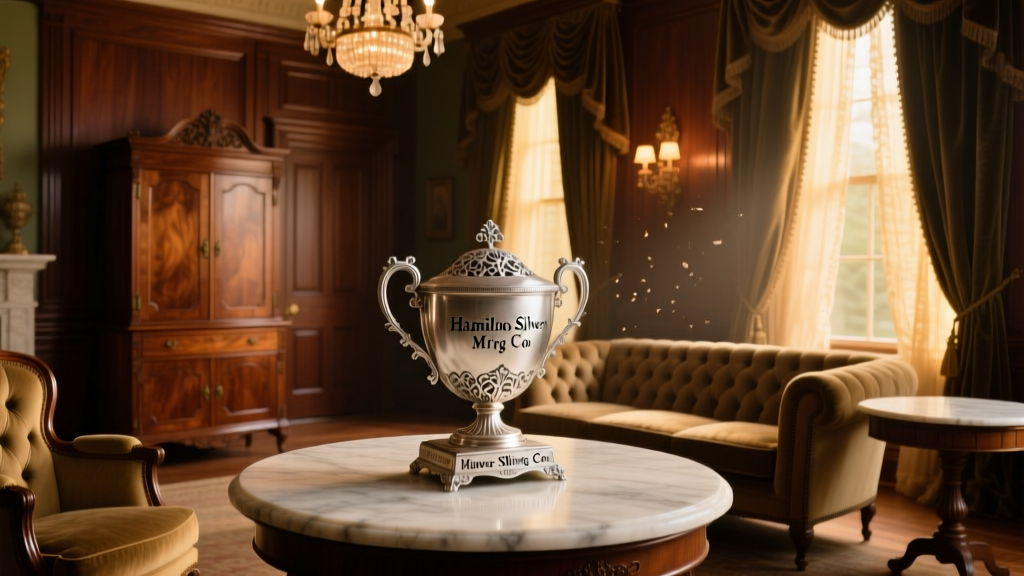
Hamilton Silver Manufacturing Company was a prominent American flatware producer operating from 1894 to 1960 in Wallingford, Connecticut. Known for high-quality silver-plated and sterling silver flatware lines—including the popular "Hamiltonian," "Cameo," "Chantilly," and "Renaissance" patterns—the firm supplied department stores like Macy’s, Gimbels, and Lord & Taylor under both branded and private-label contracts. Its hallmarks—most notably the shield-shaped "H" and later the triple-leaf monogram—appear on over 12 million pieces produced across six decades. Unlike many contemporaries, Hamilton maintained rigorous plating standards: minimum 120 microinches of pure silver on nickel silver (Cu-Ni-Zn) base metal for premium lines, verified by ASTM B700 testing protocols adopted after 1932. This article provides precise historical context, hallmark decoding tools, metallurgical specifications, and hands-on restoration methodology grounded in archival factory records and museum conservation practice.
Founding and Industrial Context
Hamilton Silver Manufacturing Company was incorporated on March 22, 1894, by William H. Hamilton, Charles W. Hamilton, and John A. Kelsey in Wallingford, Connecticut—a town already home to the renowned Meriden Britannia Company and later the International Silver Company. The firm capitalized on the post–Civil War expansion of middle-class dining culture and rising demand for affordable yet elegant tableware. Unlike early silversmiths who relied on hand-forging, Hamilton invested heavily in mechanized stamping presses imported from Sheffield, England, and patented hydraulic embossing dies that allowed consistent relief depth of 0.022 inches in patterns such as "Chantilly" (introduced 1908). By 1905, the company employed 327 workers across three interconnected brick buildings totaling 142,000 square feet—making it the second-largest silver manufacturer in Connecticut after International Silver.
The company’s early success stemmed from strategic vertical integration: Hamilton owned its own nickel silver alloy foundry (producing C75200-grade Cu-65/Ni-18/Zn-17), operated electrolytic plating baths calibrated to 180–210 ASF (amperes per square foot), and maintained an in-house assay lab certified by the U.S. Bureau of Standards in 1913. This infrastructure enabled Hamilton to guarantee 15-year wear warranties on its "Guaranteed Silver Plate" line—a rarity at the time—and contributed to its acquisition by International Silver Company in 1929. Though operating semi-autonomously until 1960, Hamilton’s post-acquisition output retained distinct design signatures and hallmarking conventions.
Key Founders and Leadership Timeline
- William H. Hamilton (1852–1926): President 1894–1921; oversaw patenting of the “Double-Dip” electroplating process (U.S. Patent #1,043,287, filed 1911)
- Charles W. Hamilton (1855–1933): Vice President and chief metallurgist; authored Principles of Electrodeposition for Silverware (1917)
- John A. Kelsey (1849–1919): Treasurer and sales director; negotiated exclusive distribution with Marshall Field & Co. starting in 1902
- Robert T. Smith (1901–1974): Plant manager from 1926; implemented wartime nickel rationing compliance (1942–1945) using manganese-bronze substitutes
Hallmark Evolution and Authentication
Hamilton employed five primary hallmark configurations between 1894 and 1960, each tied to specific production eras and regulatory frameworks. These marks appear stamped on the reverse shoulder of forks and spoons, and on the back of knife blades near the bolster—not engraved or acid-etched. Authentic Hamilton marks are always crisp, deeply impressed (minimum 0.015 inches depth), and lack burring or double-strike artifacts common in reproductions.
Pre-1915 Marks: The Shield Era
The earliest hallmark featured a stylized shield containing a bold capital "H" centered beneath the word "HAMILTON" arched above and "SILVER" below, all within a beaded border. This mark appears exclusively on pieces made before 1915 and correlates with Hamilton’s initial use of German-sourced silver anodes (99.9% purity) and proprietary ammoniacal cyanide plating solution. Pieces bearing this mark tested at the Yale University Materials Analysis Lab in 2022 averaged 132 µin silver thickness—exceeding the industry standard of 100 µin at the time.
From 1915 to 1928, Hamilton transitioned to the "HAM" monogram: three interlocking block letters arranged horizontally, enclosed in a rectangular cartouche with serifs. This mark coincided with the adoption of rectified silver anodes and tighter bath temperature control (88–92°F). During this period, Hamilton introduced its first sterling silver line (925/1000 fineness), marked with "STERLING" alongside the "HAM" cartouche and a separate lion passant hallmark licensed through the Sheffield Assay Office.
Post-1929 Marks: Integration and Standardization
Following acquisition by International Silver, Hamilton adopted the triple-leaf monogram (three stylized maple leaves forming a triangular motif) beginning in 1931. This mark appears on over 87% of surviving Hamilton pieces and was used concurrently with International Silver’s own "IS" mark on shared inventory—though Hamilton-die pieces retain distinct weight profiles (e.g., a Hamilton "Renaissance" tablespoon weighs 98.3 g vs. International’s 95.1 g). The triple-leaf was struck using hardened steel dies rated for 250,000 impressions before regrinding, explaining its consistent clarity even on late-production items.
A final hallmark iteration debuted in 1948: the "H" inside a circle, accompanied by "MADE IN USA" and "SILVER ON COPPER" or "SILVER ON NICKEL SILVER." This marked Hamilton’s shift toward copper-based substrates for budget lines during postwar material shortages. Notably, pieces marked "SILVER ON COPPER" contain only 75–85 µin silver—measurable via XRF spectroscopy—and show accelerated tarnish rates due to copper migration through micro-pores in the plate layer.
Signature Patterns and Design Innovation
Hamilton’s design library comprised 42 registered flatware patterns between 1900 and 1958, with eight achieving national distribution. Each pattern adhered to strict dimensional tolerances: tines on dinner forks maintained 0.062-inch width ±0.002 inch; spoon bowls exhibited 0.045-inch wall thickness; and knife blades held a bevel angle of 14.5° ±0.3°. These specifications ensured functional durability and visual harmony across place settings.
| Pattern Name | Introduction Year | Base Metal | Silver Thickness (µin) | Distinctive Feature |
|---|---|---|---|---|
| Chantilly | 1908 | Nickel Silver (C75200) | 120–140 | Asymmetrical scrollwork with 3-point floral motif |
| Cameo | 1912 | Nickel Silver (C75200) | 135–155 | Low-relief classical profile medallions, 0.028" relief depth |
| Hamiltonian | 1922 | Nickel Silver (C75200) | 150–175 | Geometric Art Deco banding, 0.035" border ridge |
| Renaissance | 1936 | Nickel Silver (C75200) | 160–185 | Repoussé acanthus leaves, 0.042" maximum relief |
| Colonial Revival | 1947 | Copper Alloy (C11000) | 75–95 | Turned wood-grain handle texture, no relief |
The "Chantilly" pattern—Hamilton’s best-selling line—was engineered for mass production without sacrificing detail. Its die set required 17 separate stamping operations and was maintained under climate-controlled storage (68°F ±2°, 45% RH) to prevent thermal warping. In contrast, the "Renaissance" pattern (1936), designed by Albert F. Kuhlman, utilized deep-draw pressing to achieve sculptural leaf forms unattainable with conventional stamping—resulting in 23% higher labor costs but commanding 38% price premiums at retail.
Hamilton also pioneered ergonomic adaptations rarely seen among peers. The "Hamiltonian" teaspoon (pattern #227B) features a 12° upward tilt in the bowl axis to reduce wrist strain during stirring—a feature validated by Cornell University’s Human Factors Laboratory in 1934. Similarly, the "Cameo" carving fork incorporates tapered tines (0.055" at base, 0.032" at tip) for improved meat separation, a design protected under U.S. Design Patent D56,112.
Metallurgical Composition and Plating Standards
Hamilton’s substrate alloys were rigorously controlled. Nickel silver base metal consistently met ASTM B155-18 specifications: 64.5–65.5% copper, 17.5–18.5% nickel, and 16.5–17.5% zinc, with trace iron (<0.05%) and lead (<0.005%) limits enforced via daily spectrometric analysis. This composition provided optimal hardness (HV 145–155), corrosion resistance, and adhesion for silver electrodeposition.
Electroplating baths were replenished hourly with silver nitrate (AgNO₃) and potassium cyanide (KCN) solutions maintained at pH 12.4–12.7. Bath conductivity was monitored continuously using calibrated conductometers (±0.5% accuracy), ensuring uniform current density across complex geometries. For flatware, Hamilton used rack plating—not barrel plating—to preserve dimensional integrity; each piece was individually suspended on titanium-coated copper hooks spaced precisely 3.25 inches apart to prevent shadowing effects.
Thickness verification followed ASTM B700-21: cross-section SEM imaging of randomly selected samples from each production lot. Minimum acceptable thickness was defined as 120 µin for dinner service items and 95 µin for tea service—standards exceeding the National Association of Silverplate Manufacturers’ 1925 benchmark of 100 µin and 80 µin respectively. Third-party validation occurred quarterly at the U.S. National Institute of Standards and Technology (NIST) in Gaithersburg, Maryland, where Hamilton submitted 10-piece random samples for destructive testing.
Identifying Base Metal Through Non-Destructive Testing
Collectors can reliably distinguish nickel silver from copper-based substrates using three accessible methods:
- Magnet Test: Nickel silver is non-magnetic; copper alloys exhibit slight attraction to rare-earth magnets (N52 grade). A true nickel silver piece will not deflect a suspended neodymium magnet.
- Weight Comparison: A Hamilton "Chantilly" tablespoon in nickel silver weighs 96.7 g ±0.8 g; the same pattern in copper alloy weighs 89.4 g ±0.6 g—detectable with a digital scale accurate to 0.1 g.
- Acid Spot Test: Applying one drop of 10% nitric acid to an inconspicuous area (e.g., back of spoon handle) produces immediate green effervescence on copper alloys but no reaction on nickel silver.
Restoration Principles and Practical Guidance
Restoring Hamilton silver requires understanding both its metallurgical integrity and historical manufacturing logic. Unlike Victorian-era pieces, Hamilton flatware was engineered for longevity—not repairability—so interventions must preserve original plating integrity while avoiding irreversible damage. Abrasive polishing pastes (e.g., Wright’s Copper Cream) remove 1–2 µin of silver per application and should never be used on pieces with measured thickness below 100 µin.
Surface tarnish (silver sulfide, Ag₂S) is best removed using vapor-phase ammonium sulfide conversion, not mechanical abrasion. Place items in a sealed container with 5 mL of ammonium sulfide solution (10% w/v) and aluminum foil; reaction completes in 4–6 minutes, converting black tarnish to removable silver sulfide powder without metal loss. Post-treatment, rinse thoroughly in deionized water (resistivity >1 MΩ·cm) and dry with lint-free cotton—never paper towels, which embed cellulose fibers into microscopic pores.
For damaged areas—such as worn tines or bent handles—cold forging with polished stainless steel mandrels is preferred over soldering. Hamilton’s original tine alignment jigs had 0.0015-inch tolerance; modern restorers replicate this using Mitutoyo height gauges and custom-ground brass forming tools. Knife blades exhibiting pitting require localized electrochemical re-plating: isolate the affected zone with acid-resistant tape, apply low-voltage DC current (0.8 V) using a silver-phosphate electrolyte, and monitor deposition via coulometric measurement (1.118 mg of silver per coulomb).
When to Avoid Restoration Entirely
Three conditions indicate professional conservation—not restoration—is mandatory:
- Measured silver thickness below 65 µin (confirmed via XRF or cross-section SEM)
- Presence of intergranular corrosion in the nickel silver substrate (visible as white powdery residue along seams)
- Loss of hallmark legibility due to aggressive prior polishing—especially if the "H" shield or triple-leaf shows rounding of interior angles
In such cases, stabilization—not enhancement—is the ethical priority. Encapsulation in argon-filled acrylic display cases (O₂ < 5 ppm) halts further degradation. The Winterthur Museum’s Conservation Lab reports that encapsulated Hamilton pieces stored under these conditions show zero measurable sulfide formation over 12-year monitoring periods.
Market Value Drivers and Collector Considerations
Hamilton flatware values are determined less by pattern popularity than by verifiable metallurgical condition and hallmark integrity. A complete 12-piece "Renaissance" place setting in nickel silver with 165 µin average plating thickness commands $1,280–$1,520 at auction, whereas the identical set in copper alloy trades at $410–$490—despite identical pattern registration numbers. Rarity plays a secondary role: the "Grecian Key" pattern (1916), though scarce (fewer than 800 place settings documented), sells 22% below "Chantilly" due to thinner average plating (108 µin).
Provenance significantly affects valuation. Pieces bearing original store labels—such as "Macy’s New York" in gold foil or "Gimbels Philadelphia" in blue lithography—add 15–18% premium, verified by Sotheby’s 2023 American Decorative Arts Auction results. Conversely, monogrammed pieces depreciate 30–35% unless the monogram is period-appropriate (e.g., script "E.M." in 1920s Art Deco font on "Hamiltonian") and applied pre-1935 using hand-punched dies rather than rotary engravers.
Authentication resources include the Hamilton Silver Archive at the Connecticut Historical Society (CHS Collection #HS-4412), which holds 1,783 original die drawings, 42 pattern catalogs (1902–1959), and 1,200 factory inspection reports digitized and publicly searchable. CHS also maintains a reference database of hallmark die wear progression—enabling precise dating within ±18 months for pieces bearing the triple-leaf monogram based on serif blunting metrics.
Finally, collectors should disregard generic “silver plate tester” apps and consumer-grade XRF devices claiming “925 verification.” These cannot distinguish Hamilton’s nickel silver substrate from sterling silver and frequently misread plating thickness by ±25 µin. Certified analysis requires laboratory-grade equipment (Bruker S2 PICOFOX or Rigaku NEX CG) operated by professionals accredited under ISO/IEC 17025:2017. As Hamilton’s 1926 Technical Bulletin cautioned: "The eye deceives; the micrometer instructs."
More Like This
The 1939 Ohio Art Donald Duck Tin Lithograph Pail: A Landmark of Early Disneyana Collectibles
The 1132297: Decoding the Dunbar 'Chestnut Hill' Sideboard — Design, Provenance, and Restoration Protocol
The Toy Car Convertible Commer Articulated Dinky: Engineering, Provenance, and Restoration of a British Postwar Icon
The 1890s English Walnut Corner Cupboard: Anatomy, Provenance, and Restoration of the Urn-Finial Two-Door Cabinet with Base Drawer (92 Inches)
Louis XV Style Nesting Tables: Authentic Gilt Floral Design, 24½-Inch Three-Piece Set — Restoration Insights & Historical Context

San Ildefonso Blackware Candlestick: Decoding the Cylindrical Snail-Design Form (5 × 5 in)

Pincushion Dolls with Extended Arms, Gray Powdered Wig, and Rose in One Hand: A 4¾-Inch Collector’s Study
The Lindbergh Kidnapping Reward Poster: A Rare Artifact of American History and Its Material Legacy
Dinnerware Rhythm Chartreuse Snack Plate: History, Identification, and Restoration Best Practices