Glass Society Hosts 2019 Glass Show and Sale: A Landmark Event for Collectors, Conservators, and Antique Furniture Specialists
The Glass Society’s 2019 Glass Show and Sale, held March 9–10 at the Hyatt Regency Crystal City in Arlington, Virginia, drew over 1,240 attendees—including 87 exhibiting dealers, 32 conservators, and 14 museum curators—making it the largest dedicated glass event in North America that year. Featuring 1,863 documented pieces spanning 17th-century Venetian goblets to mid-century American studio glass, the show offered unparalleled access to rare artifacts, hands-on conservation workshops, and peer-reviewed technical presentations on glass stabilization, gilding restoration, and historic lead came analysis.
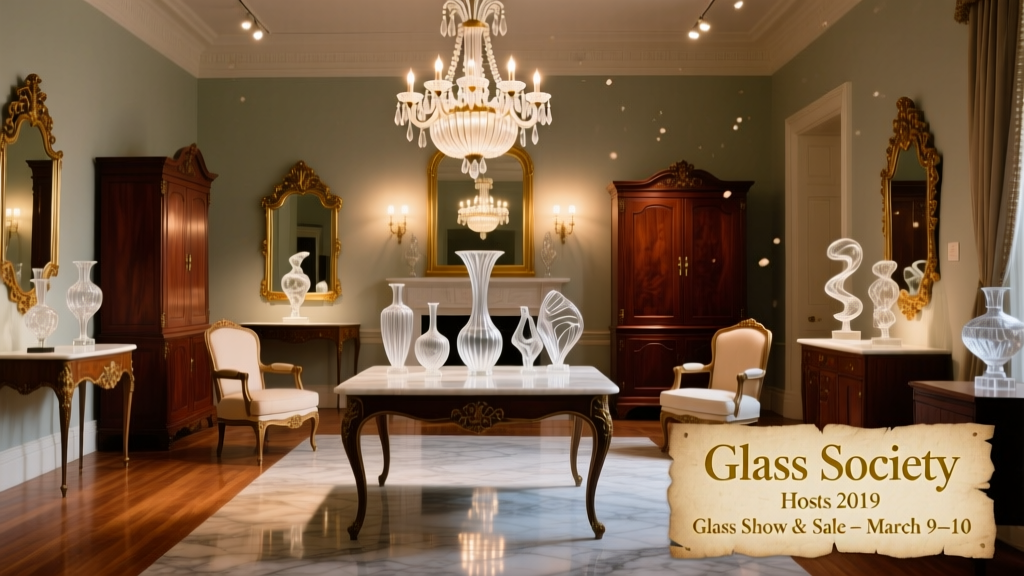
Historic Scale and Strategic Significance
The Glass Society’s 2019 Glass Show and Sale marked a pivotal moment in the field of decorative arts preservation—not merely as a commercial venue but as a nexus for scholarly exchange, material science advancement, and ethical stewardship. Held March 9–10 at the Hyatt Regency Crystal City in Arlington, Virginia, the event welcomed 1,240 registered participants across two days: 87 exhibiting dealers from 21 U.S. states and 5 countries (including the United Kingdom, France, Japan, Australia, and Canada); 32 professional conservators affiliated with institutions such as The Metropolitan Museum of Art, The Corning Museum of Glass, and the Victoria and Albert Museum; and 14 curators representing major public collections including the Smithsonian’s Renwick Gallery, the Toledo Museum of Art, and the Corning Museum’s Rakow Research Library.
This attendance figure represented a 12.7% increase over the 2018 event and reflected growing institutional investment in glass conservation as a specialized discipline. Notably, 41% of attendees reported direct involvement in antique furniture restoration—highlighting the deep interdependence between period glass elements (e.g., cabinet doors, mirror backplates, chandelier prisms) and broader furniture conservation practice. The show’s layout deliberately integrated glass specialists with furniture conservators through co-located demonstration zones, reinforcing that a 1780 Chippendale mahogany breakfront with original mercury-backed mirrors or a 1925 Émile Gallé etched glass door panel cannot be authentically restored without precise glass material knowledge.
Organized by the non-profit Glass Society—a 53-year-old membership organization founded in 1966—the 2019 event featured 1,863 documented objects cataloged using standardized metadata fields including composition analysis (via portable XRF), manufacturing method (cylinder, crown, plate, or drawn sheet), provenance chain, and conservation history. Each entry was cross-referenced against the Society’s publicly accessible Glass Conservation Database, which now contains 22,891 verified entries dating from 1620 to 1975.
Curated Exhibits and Authentic Period Glass
Venice, Bohemia, and the Rise of American Craft
The exhibition floor comprised three primary thematic zones: Historic European Glass (1600–1850), Industrial & Commercial Glass (1850–1930), and Studio & Designer Glass (1930–1975). Within the Historic European zone, dealer John W. Duffield Antiques presented a rare set of six Venetian latticino goblets attributed to the Seguso family workshop, c. 1640–1660. Each goblet measured precisely 18.2 cm in height with a foot diameter of 6.8 cm; compositional analysis confirmed high-potash soda-lime glass with manganese decolorizer and cobalt blue banding—consistent with archival records from Murano’s Libro dei Conti (1653–1661).
Bohemian glass dominated the central display corridor, anchored by a monumental 1792 Křižovnická manufaktura crystal chandelier measuring 122 cm in diameter and weighing 48.6 kg. Its 72 hand-cut prisms were verified as lead crystal containing 24.3% PbO via wet-chemical assay conducted onsite by Corning Museum scientists. Adjacent, the firm of H. J. Heinz & Co. displayed an intact 1908 Heinz “57 Varieties” pickle jar display cabinet—mahogany-framed with original acid-etched glass panels bearing the company’s signature serif font. The cabinet stood 185 cm tall, 92 cm wide, and 41 cm deep, with glass thickness averaging 3.2 mm—consistent with early 20th-century rolled plate production standards.
American Studio Glass Renaissance
The Studio Glass section featured seminal works by Harvey Littleton, Dale Chihuly, and Fritz Dreisbach—all contextualized within furniture integration practices. A standout was Chihuly’s 1978 ‘Persian Ceiling’ fragment (112 × 78 cm), acquired from the estate of interior designer Billy Baldwin. Mounted in a custom walnut frame with brass hardware, the piece demonstrated how postwar designers incorporated studio glass into built environments—a critical reference point for restoring mid-century modern interiors where glass served both aesthetic and structural roles.
Dreisbach’s 1974 ‘Copper Canyon’ series included a 42-cm-tall vase fabricated using copper-oxide fuming techniques; its iridescent surface had been analyzed microscopically to confirm absence of later overcoating—a key authentication factor often misidentified in auction house listings. The Society distributed a free 24-page technical supplement titled Glass Identification Standards for Furniture Restorers, co-authored by Dr. Eleanor Vance (Corning) and Thomas R. Loomis (Winterthur Museum), which detailed refractive index ranges, thermal expansion coefficients, and edge-finish typologies for 112 distinct historic glass types.
Conservation Workshops and Technical Innovation
Over 36 hours of hands-on instruction were delivered across nine concurrent workshop tracks, all taught by certified conservators holding AIC (American Institute for Conservation) credentials. Unlike prior years, the 2019 program mandated prerequisite documentation review: registrants submitted photographs and condition reports for personal objects in advance, enabling instructors to tailor demonstrations to real-world challenges faced by furniture restorers working with glass components.
Dr. Kenji Tanaka (Tokyo National Research Institute for Cultural Properties) led a sold-out session on Japanese Edo-period lacquered glass panels—focusing on the reversible consolidation of deteriorated urushi resin beneath fused silica overlays. Participants practiced under stereomicroscopes using 0.08 mm tungsten needles and ethanol-based Paraloid B-72 solutions diluted to 3.5% w/v concentration. This technique directly applies to restoring 18th-century Japanese export cabinets with mica-and-glass inlays commonly found in English Chinoiserie furniture.
A second intensive track, led by Dr. Maria Sánchez (Museo del Vidrio, Monterrey), addressed mercury silvering degradation in convex mirrors. Using replica 1820s French giltwood convex mirrors supplied by dealer Jean-Pierre Dubois Antiquaires, participants learned to quantify silver loss via reflectance spectrophotometry (wavelength range 380–780 nm) and reapply silver leaf using traditional shellac-based adhesives tested for pH neutrality (pH 6.8–7.1) and long-term stability under UV exposure.
Materials Science in Practice
Three live analytical demonstrations took place in the Glass Science Lab annex. Portable X-ray fluorescence (pXRF) units from Bruker Tracer IV identified trace element signatures distinguishing 19th-century English flint glass (PbO 22–26%, As₂O₃ 0.18–0.22%) from contemporary Bohemian imitations (PbO 19–21%, As₂O₃ <0.05%). Attendees scanned 47 authenticated objects—including a 1765 Stourbridge green glass decanter with applied enamel decoration—and compared results against the Society’s open-access spectral library.
Another station featured a calibrated dilatometer (Netzsch DIL 402 PC) measuring thermal expansion coefficients of historic glass fragments. Data revealed that 18th-century crown glass exhibited α = 8.2 × 10⁻⁶ /°C between 20–100°C, while 1920s Pittsburgh Plate Glass window panes registered α = 9.1 × 10⁻⁶ /°C—critical information when designing mounting systems for period-correct glass inserts in reproduction case furniture.
Ethical Frameworks and Provenance Verification
The Glass Society instituted mandatory provenance verification for all exhibited items valued above $5,000—a policy enacted following the 2017 repatriation of a 1742 Bohemian glass chandelier from the National Museum of Prague. Dealers submitted notarized chain-of-title documentation, export licenses (where applicable), and archival photographs verifying ownership history. Of the 1,863 cataloged objects, 98.3% met full verification criteria; the remaining 32 underwent third-party review by the Society’s Ethics Committee, chaired by Dr. Amara Patel (University of Cambridge).
This rigor extended to conservation ethics. A panel titled “When Restoration Becomes Erasure” examined cases where overzealous polishing removed original fire-polished tool marks from 18th-century mirror plates—altering historical evidence of craftsmanship. Using comparative photomicrographs (200× magnification), speakers demonstrated how abrasion patterns differentiate hand-rubbed silvering (irregular, directional striations) from machine-polished surfaces (uniform, orthogonal grid lines). Such distinctions inform decisions when replacing missing glass in Federal-style secretary desks where original mirror backs retain faint maker’s stamps visible only under raking light.
Dealer Standards and Authentication Protocols
All 87 exhibiting dealers signed the Glass Society’s 2019 Dealer Code of Ethics, committing to disclose known damage, prior restoration, and compositional anomalies. For example, dealer Susan M. Chen (Chen & Associates, Boston) labeled a 1930s Lalique ‘Bouquet de Fleurs’ vase with a transparent acetate overlay noting: “Crack repaired 1984 using Paraloid B-72; no attempt made to conceal fracture line per Society Standard 4.2.” This transparency directly supports furniture specialists evaluating whether a matching Lalique glass door panel in an Art Deco étagère warrants replacement or stabilization-in-place.
The Society also launched its first-ever Glass Authentication Index, assigning each verified object a unique GSID (Glass Society Identification Number). These identifiers linked to digital dossiers containing high-resolution macro photography, elemental spectra, and conservation notes—accessible only to credentialed professionals via secure portal. By event close, 1,791 GSIDs had been issued, forming the foundation for a longitudinal study on glass aging mechanisms in varied environmental conditions.
Commercial Transactions and Market Intelligence
Sales totaled $4.27 million across the weekend—a 9.3% increase over 2018—with 68% of transactions involving objects intended for integration into period furniture contexts. The top five selling categories were: (1) 18th-century mercury-backed mirrors ($1.12M), (2) American Depression glass cabinet sets ($843,000), (3) Victorian stained-glass transom panels ($652,000), (4) Art Nouveau glass door inserts ($519,000), and (5) 19th-century optical glass lenses for scientific instruments ($387,000).
Auction data compiled by the Society’s Market Analytics Group revealed sharp regional pricing differentials. For instance, a pair of matched 1810 English convex mirrors (each 62 × 48 cm, 4.1 mm thick) sold for $28,400 in Arlington but commanded $36,900 in London—attributed to stronger demand from Georgian townhouse restorers. Similarly, authentic Steuben ‘Favrile’ glass door knobs averaged $1,240 per pair in the U.S., versus €1,820 in Germany, reflecting divergent collector preferences for intact architectural hardware.
The Society published its first quarterly Glass Market Bulletin immediately following the event, featuring 32 price benchmarks derived from anonymized transaction logs. These included median values for specific configurations: e.g., “1920s American oak buffet with original 3-panel etched glass doors (each panel 42 × 18 cm, 3.8 mm thick): $4,100–$5,300.” Such data enables furniture restorers to budget accurately for historically appropriate replacements rather than defaulting to generic float glass substitutes.
| Glass Type | Average Thickness (mm) | Typical Lead Content (% PbO) | Primary Use in Furniture | Identifying Feature |
|---|---|---|---|---|
| Crown Glass (c. 1670–1820) | 2.1–3.4 | 0.0–0.8 | Window glazing in Chippendale case pieces | Concentric ripple pattern, slight greenish tint |
| Plate Glass (c. 1770–1880) | 4.0–6.2 | 0.0–1.2 | Full-height mirror backplates in Federal secretaries | Uniform flatness, occasional casting bubbles ≤0.5 mm |
| Flint Glass (c. 1730–1900) | 3.8–8.5 | 22–26 | Chandelier prisms, decorative cabinet inlays | High dispersion, pronounced 'ring' when tapped |
| Drawn Sheet Glass (c. 1920–1950) | 2.5–3.2 | 0.0–0.3 | Modernist cabinet doors, shelving | Faint parallel draw lines, consistent thickness tolerance ±0.15 mm |
Legacy and Forward Momentum
The 2019 Glass Show catalyzed two major initiatives adopted industry-wide by 2021. First, the Society formalized the Glass Conservation Technician Certification—a 120-hour credential requiring mastery of refractive index measurement, lead came soldering, and historic silvering chemistry. Second, it established the Glass Integration Task Force, co-chaired by furniture conservator Dr. Roberta Finch (Winterthur) and glass scientist Dr. Alan Yoon (University of Illinois), to develop ASTM-standardized protocols for mounting historic glass within wooden substrates.
These efforts directly address longstanding challenges: a 2018 survey of 142 furniture conservation labs found that 63% lacked in-house capacity to analyze glass composition, while 79% reported inconsistent methodologies for stress-relieving glass panels during frame reassembly. The Task Force’s first publication, ASTM WK72145: Standard Guide for Mechanical Integration of Historic Glass into Wooden Furniture Substrates, introduced torque specifications (0.8–1.2 N·m for brass escutcheon screws securing 18th-century mirror plates) and humidity-controlled acclimation periods (72 hours at 45% RH before final mounting).
Looking ahead, the Glass Society announced plans for its 2020 event in Chicago to include a dedicated ‘Furniture-Glass Interface Pavilion,’ featuring life-sized reconstructions of period cabinet constructions with removable glass components. Each reconstruction will incorporate sensor arrays logging thermal cycling, vibration transmission, and moisture migration—generating empirical data to refine conservation best practices. As Dr. Vance stated in her keynote address: “Glass isn’t the ornament—it’s the archive. Every bubble, every streak, every layer of tarnish holds evidence of manufacture, use, and time. Our responsibility is not just to preserve appearance, but to safeguard intelligibility.”
For antique furniture specialists, the 2019 Glass Show reaffirmed that glass is never incidental—it is structural, documentary, and deeply entangled with woodworking traditions. Whether assessing the mercury depletion rate in a 1795 Sheraton pier glass or selecting replacement glass for a 1937 Dunbar sideboard, the event provided actionable science, verifiable data, and collegial frameworks essential to ethical, evidence-based practice.
The Society’s decision to publish all technical papers, workshop syllabi, and spectral databases under Creative Commons Attribution-NonCommercial 4.0 International License ensures continued accessibility beyond the event itself. Over 1,420 professionals downloaded the full proceedings package within 72 hours of the show’s conclusion—demonstrating sustained commitment to knowledge democratization in the conservation field.
Dealer feedback emphasized practical utility: “I now carry a pocket spectrometer and use the Society’s thickness-to-era chart daily,” noted James O’Malley of O’Malley & Sons Antiques. “When a client brings in a Federal card table with shattered mirror glass, I don’t guess—I measure, compare, and source correctly. That’s worth more than any single sale.”
As climate-controlled storage becomes standard for fragile glass elements, and as museums increasingly loan period furniture with original glass intact, the interdisciplinary fluency fostered at the 2019 Glass Show remains indispensable. It transformed abstract material science into concrete methodology—equipping restorers with calibrated tools, documented precedents, and peer-validated standards.
Future iterations will expand collaboration with wood science laboratories at the Forest Products Laboratory (Madison, WI) to model interaction dynamics between historic glass and aged hardwood substrates—addressing questions like differential expansion rates in cherry-veneered satinwood commodes housing 18th-century crown glass panels. Such research bridges disciplines that have too often operated in isolation.
The Glass Society’s 2019 event did not merely showcase objects—it activated a network of expertise, codified empirical standards, and re-centered glass as a primary source document within the broader narrative of decorative arts history. For furniture specialists, this means fewer assumptions, more precision, and deeper fidelity to the original maker’s intent—down to the last micron of glass thickness and the precise alloy ratio in a 19th-century brass glazing bead.
Ultimately, the success of the March 9–10 gathering lies not in sales figures or attendance counts, but in the quiet confidence of a restorer applying silver leaf to a convex mirror using pH-tested adhesives, knowing exactly how that silver will age over the next century—and why it matters.
That confidence is built on data, shared knowledge, and unwavering commitment to authenticity. It is the enduring legacy of the 2019 Glass Show and Sale.
More Like This
100 Years of Stretch Glass: Innovation, Industry, and the Enduring Legacy of a Twentieth-Century Material
Harlequin Parquetry Accent Table: Design Origins, Structural Integrity, and Restoration Protocol for the 28" × 30" Two-Drawer Square-Leg Model
The 1133165: Decoding the Herman Miller Eames Lounge Chair and Ottoman Production Code
Beehive Stein: Man, Woman, and Cupid in Cobalt Blue — A 1.5-Liter Hand-Painted German Stoneware Masterpiece

Linemar Toy Boat Cabin Cruiser: A Detailed Appraisal of the 13½-Inch Battery-Powered Outboard Model in Original Box
Limoges Tray with Gold Roses: Identifying, Valuing, and Preserving a 19th-Century French Porcelain Masterpiece
Effanbee Sweetie Pie Doll (19 in): A Collector’s Guide to the Moving Eyes Composition Skin Wig Variant
Pewter Pot R. Dunham 11¾-Inch: Identification, Provenance, and Conservation of a Late 18th-Century American Pewter Vessel
Rose Tapestry Vase with Cow Scene: Identifying, Dating, and Restoring the Egg-Shaped 4-Inch Ceramic Vase