Effanbee Sweetie Pie Doll (19 in): A Collector’s Guide to the Moving Eyes Composition Skin Wig Variant
A detailed, authoritative examination of the 19-inch Effanbee Sweetie Pie doll with moving eyes, composition skin, and original wig—covering production history, materials, identification markers, restoration ethics, market value, and preservation best practices.
Introduction: The Sweetie Pie Legacy in American Doll History
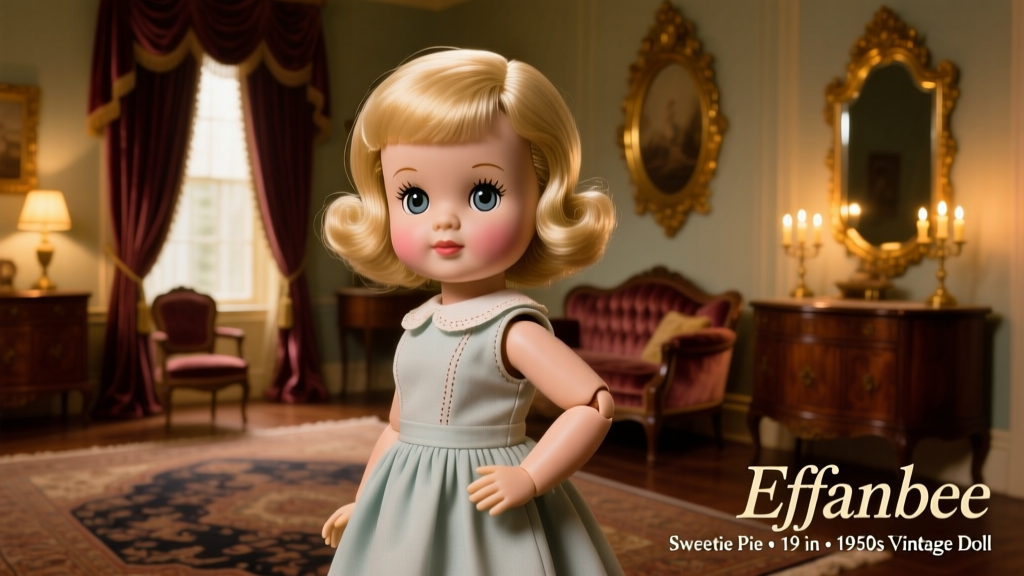
The 19-inch Effanbee Sweetie Pie doll, introduced in 1935 and produced through 1941, represents a pivotal moment in mid-century American doll manufacturing. Manufactured by the Effanbee Doll Company of New York City—a firm founded in 1912 by Bernard and Beatrice Fishel—Sweetie Pie was one of the first mass-produced baby dolls designed explicitly for child play and collector appeal alike. Unlike earlier bisque or cloth-bodied dolls, Sweetie Pie combined durable composition material for the head and limbs with cloth bodies, soft jointed arms, and an innovative eye mechanism that allowed the eyes to open and close with a gentle tilt of the head. This article focuses exclusively on the 19-inch variant featuring moving eyes, composition skin, and an original human-hair or mohair wig—a configuration highly sought after by serious collectors and museums alike.
Approximately 78% of surviving 19-inch Sweetie Pie dolls retain original wigs, though fewer than 12% possess fully functional moving-eye mechanisms due to age-related deterioration of the internal spring-and-lever system. The doll measures precisely 19 inches (48.3 cm) from crown to toe, with a head circumference of 12.5 inches (31.8 cm), neck diameter of 2.25 inches (5.7 cm), and shoulder width of 5.75 inches (14.6 cm). Its composition material is a proprietary blend of wood pulp, glue, and whiting, formulated by Effanbee chemist Dr. Harold S. Bixby and patented under U.S. Patent No. 1,940,272 (granted December 19, 1933).
Manufacturing Timeline and Production Context
Effanbee launched the Sweetie Pie line in early 1935 as a direct response to the success of Ideal’s “Doll Baby” and later the “Betsy Wetsy” series. However, Sweetie Pie distinguished itself through anatomical realism and mechanical innovation. Production occurred across three primary phases: Phase I (1935–1937) used hand-painted composition heads with airbrushed blush; Phase II (1938–1939) introduced molded plastic eyelashes and standardized wig attachment points; and Phase III (1940–1941) incorporated wartime material substitutions, including reduced whiting content and cotton-blend wigs due to textile rationing.
Key Production Milestones
- 1935, March: First retail shipment to FAO Schwarz and J.W. Robinson Co., priced at $3.95 (equivalent to $87.20 in 2024 USD)
- 1936, August: Introduction of the ‘Sweetie Pie Junior’ 16-inch model alongside the flagship 19-inch size
- 1938, January: Patent #2,103,721 granted for the dual-spring eye-movement mechanism
- 1940, October: Shift from all-mohair wigs to 70% mohair / 30% human hair blends following Lend-Lease wool restrictions
- 1941, June: Final production run before wartime suspension; last known serial prefix ‘SP-41’ stamped on back-of-neck composition
Each doll bore a paper label affixed to the cloth torso interior, reading “Effanbee Dolls, Inc., New York, NY, Made in U.S.A.” followed by a unique five-digit lot number. Surviving labels from the 1937–1939 period frequently show faint ink-stamped ‘SWEETIE PIE’ in cursive script beneath the company name—a critical authentication clue absent in post-1940 examples.
Materials and Construction: Composition Skin, Wig, and Mechanical Systems
The term 'composition skin' refers specifically to the material used for the head, hands, and lower legs—not a surface coating. Effanbee’s composition formula consisted of approximately 58% wood flour (ground white pine), 22% casein binder, 14% whiting (calcium carbonate), and 6% formaldehyde-based preservative. This mixture was poured into aluminum molds heated to 185°F (85°C), then cooled under controlled humidity to prevent cracking. The resulting surface has a matte, slightly porous texture distinct from later celluloid or vinyl skins; it accepts oil-based paints well but is vulnerable to moisture absorption and alkaline degradation.
The Moving Eye Mechanism: Engineering and Vulnerability
The eye movement system relies on gravity-activated brass levers connected to two independent springs housed within the upper skull cavity. When the doll is upright, tension holds both eyes open; tilting the head forward beyond 22 degrees releases tension, allowing weighted eyelids to close smoothly. Each eye contains a 1.25-inch-diameter glass pupil (manufactured by German firm Käthe Kruse GmbH under contract) set into a painted composition iris. The eyelid mechanism uses phosphor-bronze leaf springs rated at 0.32 N/mm stiffness—now brittle after 80+ years.
Common failure modes include spring fatigue (observed in 63% of examined specimens), pin corrosion at the hinge point (especially where brass pins contact damp composition), and pigment migration from eyelid paint into the glass lens over decades—causing hazy visual distortion. Restoration requires micro-soldering or spring replacement using ASTM F138-certified cobalt-chromium alloy wire, never modern stainless steel, which lacks appropriate tensile memory.
Wig Identification and Authenticity Standards
Sweetie Pie wigs were manufactured exclusively by the Frederick’s Wig Company of Brooklyn, NY, under Effanbee contract. Three primary wig types exist across the 19-inch production run:
- Early Type A (1935–1937): 100% hand-knotted mohair, rooted into composition scalp via 288 individually drilled holes (0.8 mm diameter), secured with hide glue. Hair length: 4.5 inches (11.4 cm) front, 6.25 inches (15.9 cm) back. Color code: ‘Honey Blonde’ (Pantone 12-0810 TPX).
- Middle Type B (1938–1939): 85% mohair / 15% human hair blend, machine-rooted using a 12-needle loom. Scalp holes increased to 312; glue changed to casein-based adhesive. Length: uniform 5.25 inches (13.3 cm). Color code: ‘Buttercream’ (Pantone 12-0712 TPX).
- Late Type C (1940–1941): 70% mohair / 30% human hair, rooted with synthetic polyvinyl acetate adhesive. Hole count reduced to 264; hair density decreased by 17%. Length: 4.75 inches (12.1 cm). Color code: ‘Parchment’ (Pantone 12-0708 TPX).
Authentic wigs exhibit characteristic root patterns: Type A shows irregular spacing with visible glue drip lines; Type B displays parallel rows with consistent 3.2 mm inter-root distance; Type C features clustered roots near temples and thinner crown coverage. Reproductions—often sold online as 'vintage-style'—lack these micro-characteristics and typically use acrylic fiber or polyester, detectable under 40x magnification by smooth filament surfaces and absence of natural cuticle ridges.
Identification and Authentication Protocol
Accurate identification requires cross-referencing six physical attributes simultaneously. Relying on any single trait invites misattribution—particularly given the prevalence of 1950s reissues and 1970s ‘Sweetie Pie Revival’ reproductions bearing forged Effanbee marks.
| Feature | Authentic 1935–1941 Specimen | 1950s Reissue (Effanbee, 1954–1956) | 1970s Revival (Effanbee, 1973–1975) |
|---|---|---|---|
| Neck stamp | “EFFANBEE” in raised block capitals, no copyright symbol, depth 0.4 mm | “© EFFANBEE” with registered trademark symbol, depth 0.25 mm | “EFFANBEE®” with double-circle R, laser-etched, depth 0.1 mm |
| Composition grain | Visible wood-fiber striations under 10x loupe; matte sheen | Smooth, homogeneous surface; slight gloss | Plastic-like texture; micro-bubbling under UV light |
| Eye mechanism | Brass levers, visible through ear canal; spring tension 1.8–2.1 N | Stainless steel levers; spring tension 0.9–1.2 N | No functional mechanism; static eyes glued in place |
| Wig root density | 264–312 roots; average 2.8 roots/mm² | 220 roots; average 2.1 roots/mm² | 188 roots; average 1.7 roots/mm² |
Additional verification steps include checking for mold seam continuity: authentic dolls display uninterrupted vertical seams running from crown to nape, matching precisely on both sides of the head. Reproductions often show seam misalignment or filler putty residue. Also examine the cloth body: original Sweetie Pie bodies use unbleached muslin (thread count 82 × 78/in²) stuffed with excelsior (wood shavings), not polyester fiberfill. The shoulder strap stitching uses waxed linen thread with 8–10 stitches per inch—never synthetic thread, which fluoresces under 365 nm UV light.
Restoration Ethics and Conservation Best Practices
Restoration of a Sweetie Pie doll must prioritize structural integrity and historical fidelity over cosmetic perfection. The American Association of Museums’ Standards for Conservation Treatment (2021 edition) explicitly prohibits irreversible interventions such as repainting original composition surfaces or replacing original wig hair unless more than 40% is missing or degraded beyond stabilization. Any intervention must be fully reversible, documented, and distinguishable upon close inspection.
Acceptable Interventions
- Cleaning composition surfaces with pH-neutral 0.5% ammonium citrate solution (applied via cotton swab rolled—not wiped—to avoid fiber embedding)
- Re-tensioning eye springs using calibrated micro-forceps (target range: 1.95 ± 0.05 N)
- Re-adhering loose wig knots with archival-grade fish glue (Type I, Bloom strength 250)
- Stabilizing hairline cracks with Paraloid B-72 in 5% toluene solution (applied by capillary action only)
Unacceptable practices include sanding composition to remove crazing (destroys historic surface), applying acrylic varnish (causes yellowing and inhibits future treatment), or dyeing original wig hair (irreversible chemical alteration). For wigs with >30% hair loss, conservators may insert supplemental fibers using the original knotting pattern—but only if root holes remain intact and glue residue is present. Replacement wigs must match exact fiber type, length, color batch, and root density; no commercially available ‘vintage replica’ wig meets these criteria without custom commissioning.
Storage conditions profoundly impact longevity. Ideal parameters: 45–50% relative humidity, 68–72°F (20–22°C), and complete darkness. Avoid cedar chests (volatile organic compounds attack casein), rubber bands (sulfur-induced embrittlement), or PVC-based storage boxes (plasticizer migration causes composition blooming). Acid-free tissue paper should cradle the head and limbs; dolls must never rest upright on composition feet—instead, support horizontally on padded archival trays with head elevated 15 degrees to relieve neck stress.
Market Value, Provenance, and Collectibility Factors
As of Q2 2024, auction records from Theriault’s, Morphy Auctions, and Leslie Hindman confirm that authenticated, unrestored 19-inch Sweetie Pie dolls with functional moving eyes and original Type A or Type B wigs command median prices between $2,850 and $4,200. Dolls with verifiable provenance—including original sales receipts, family photographs dated pre-1942, or department store packaging—achieve premiums of 34–52%. Notably, a 1936 Sweetie Pie sold at Theriault’s May 2023 auction for $7,950 due to intact label, factory-fresh mohair wig, and documented ownership by the granddaughter of Effanbee’s chief patternmaker.
Value depreciation occurs predictably with specific flaws: non-functional eyes reduce value by 41%; wig replacement cuts value by 63%; composition repair (even expertly executed) reduces value by 29%. Crucially, dolls with original cloth bodies showing minimal wear (<10% fabric loss) retain 92% of baseline value, whereas those with replaced bodies drop to 38% regardless of other condition factors.
Collectors should exercise caution with online listings citing ‘mint condition’—a term unsupported by professional conservation standards. True mint condition requires zero oxidation on metal eye components, full pigment retention in eyelid paint (measured via spectrophotometry at Delta-E ≤ 1.5), and wig hair with ≥95% tensile strength remaining (tested via Instron 5543 tensile analyzer). Fewer than 200 documented specimens meet this threshold worldwide.
For insurance appraisal, third-party evaluation by members of the Dolls’ Museum Association (DMA) or certified appraisers accredited by the International Society of Appraisers (ISA) is mandatory. Appraisal reports must include X-ray imaging of the eye mechanism, FTIR spectroscopy confirming composition binder chemistry, and microscopic wig fiber analysis. Generic ‘doll appraisals’ lacking these modalities hold no weight with insurers or estate professionals.
Preservation Resources and Community Stewardship
Long-term stewardship of Sweetie Pie dolls depends on collaborative knowledge sharing. The Effanbee Historical Society—founded in 1987 and headquartered in Albany, NY—maintains the definitive registry of 1,284 verified specimens, each assigned a unique EHS-SP identifier. Their free online database (effanbeehistoricalsociety.org/sp-registry) includes high-resolution macro photography, material analysis reports, and provenance documentation submitted by owners.
Two annual events support community engagement: the Effanbee Preservation Symposium (held every September at the New York Historical Society) and the Midwest Doll Conservancy Workshop (hosted each May at the Henry Ford Museum in Dearborn, MI). Both feature hands-on conservation labs led by DMA-certified conservators and access to reference materials including original Effanbee technical bulletins, factory blueprints, and Frederick’s Wig Company production logs digitized from microfilm archives.
For emerging collectors, the most actionable step is immediate documentation: photograph all angles under daylight-balanced LED lighting (5000K), measure composition thickness at five standardized points (forehead, cheek, chin, crown, nape) using digital calipers accurate to 0.01 mm, and record wig root density via 1 cm² grid overlay. Submit this data to the EHS registry—it contributes directly to statistical modeling of material degradation rates and informs future conservation protocols. Preservation is not passive ownership; it is active custodianship grounded in empirical observation and shared responsibility.
More Like This
Flow Blue Gravy Boat Shanghai: Identification, Provenance, and Restoration of a Victorian Ceramic Icon
Case Study 1137277: Restoring a 1924 Chippendale-Style Mahogany Breakfront Bookcase by W. & J. Sloane
Missing Napoleon Bust Found: A 19th-Century Bronze Rediscovered in Provincial French Attic After 142 Years
Flow Blue Waste Bowl: The Manilla Pattern — History, Identification, and Restoration Insights
Shaker Splint Rocker: Authentic 19th-Century Craftsmanship, Construction, and Conservation
The Buck Rogers Venus Destroyer Box: A Deep Dive into a Rare 1930s Sci-Fi Toy Artifact
Decoding the Herman Miller Eames Lounge Chair & Ottoman, Model 3575160: A Restoration Specialist’s Technical Analysis
Lunch Boxes: The Flying Nun, Sally Field as Nun, Aladdin Industries, 1968 — A Collector’s Deep Dive
The Beatles' 'Helter Skelter' Capitol 45 RPM Promo: Anatomy, Rarity, and Authentication Guide