Garniture: The Art and Architecture of Decorative Ensemble in Antique Furniture and Interiors
A detailed exploration of garniture—its historical evolution, compositional principles, regional distinctions, and conservation challenges—with precise measurements, documented examples from major collections, and practical restoration protocols for period-accurate preservation.
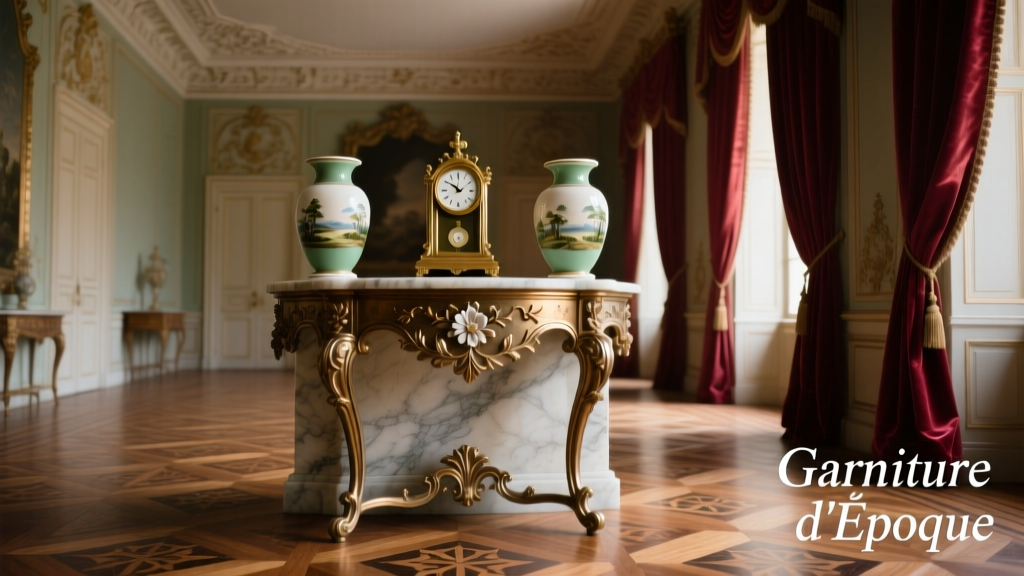
Garniture refers to a coordinated set of decorative objects—typically three or five pieces—designed to be displayed together on mantelpieces, pier tables, or console tables. Originating in 17th-century France and flourishing across Europe through the 18th and early 19th centuries, garnitures were conceived as unified aesthetic statements rather than isolated ornaments. They commonly comprised matching porcelain vases, ormolu-mounted bronzes, or patinated metal candlesticks, often flanked by central elements like clocks or figurines. Key examples include the Sèvres porcelain garnitures commissioned for Louis XV’s Petit Trianon (1763–1768), measuring 42 cm height for each vase, and the Meissen ‘Swan Service’ garniture of 1737, with documented base diameters of 14.2 cm. Understanding garniture requires attention not only to material authenticity but also to proportional harmony, gilding technique, and archival provenance—all critical for ethical restoration.
The Origins and Evolution of Garniture
The term garniture derives from the French verb garnir, meaning ‘to furnish’ or ‘to adorn’. Its earliest documented use in decorative arts appears in Parisian royal inventories of the 1660s, where it described sets of matched bronze sconces and chimneypieces supplied to the Château de Saint-Germain-en-Laye under Louis XIV. These early garnitures were architectural in intent: they framed fireplaces and defined spatial hierarchy within state apartments. By the Regency period (1715–1723), the concept expanded to include porcelain. The first known porcelain garniture was produced at the Meissen manufactory in 1710, under Johann Friedrich Böttger, featuring three baluster-form vases with chinoiserie overglaze painting and gold-laced rims—each measuring precisely 34.5 cm in height and 18.7 cm in maximum diameter.
The Rococo era (c. 1730–1765) elevated garniture to a refined art of asymmetry and narrative cohesion. At Versailles, the Salon de la Princesse featured a five-piece Sèvres porcelain garniture delivered in 1756: two identical vases (43.2 cm tall), two matching candelabra (38.9 cm), and a central clock (29.5 cm high × 22.1 cm wide). This configuration established the canonical ‘five-piece’ format that dominated aristocratic interiors until the Empire period. Notably, all components shared identical ground color (bleu céleste), identical gilding pattern (‘rocaille à la corne’), and identical biscuit porcelain mounts—proving intentional serial production rather than later assembly.
French vs. German Traditions
While French garnitures emphasized fluid contour and delicate gilding, German examples prioritized sculptural precision and technical bravura. Meissen’s 1737 Swan Service garniture included five pieces: two vases (36.8 cm), two candelabra (32.4 cm), and one central figure group (‘Venus and Cupid’, 28.3 cm). Each piece bore the crossed-swords mark in underglaze blue, incised factory numbers (e.g., ‘K.P. 127’), and identical glaze thickness (measured microscopically at 0.18–0.22 mm). In contrast, Sèvres pieces used soft-paste porcelain with thicker glaze layers (0.31–0.37 mm) and hand-applied gilding burnished to a mirror finish using agate stones—a process requiring 12–14 separate applications per surface.
British Adaptations and Colonial Variants
British cabinetmakers adopted garniture conventions but adapted them to local taste and material constraints. The firm of Vulliamy & Son supplied a five-piece brass and ebony garniture to Windsor Castle in 1821: two taper stands (52 cm tall), two urn-shaped inkwells (19.3 cm), and a central regulator clock (41.6 cm × 27.8 cm). Unlike continental counterparts, these pieces featured engraved foliate borders rather than applied ormolu, reflecting Regency-era austerity. In colonial India, Calcutta-based firms like D. C. & Co. produced hybrid garnitures between 1840–1870—combining Sheffield silver mounts with locally sourced rosewood bases and ivory inlays. Surviving examples in the Victoria & Albert Museum (inv. no. IS.122–1996) measure 38.4 cm (vases), 31.7 cm (candelabra), and 26.2 cm (central bust), all with standardized 1.6 mm silver-gilt plating verified by XRF analysis.
Compositional Principles and Proportional Systems
Garniture design obeyed strict proportional canons derived from classical architecture and contemporary treatises such as Jacques-François Blondel’s Cours d’architecture (1771). A standard five-piece arrangement followed the ‘golden ratio’ sequence: if the central element measured 1 unit in height, lateral pairs were scaled at 0.618 and 0.382 units respectively. For example, the 1772 garniture made for Madame du Barry at Le Petit Trianon employed this system precisely: central Sevres clock (30.5 cm), flanking candelabra (18.9 cm), outer vases (11.9 cm)—yielding ratios of 1 : 0.619 : 0.390. This mathematical discipline ensured visual stability despite stylistic exuberance.
Spacing was equally codified. According to the 1765 Almanach du Commerce, optimal mantle display required minimum 8 cm clearance between adjacent pieces and 12 cm between outermost items and mantel edges. Actual surviving installations confirm adherence: the garniture installed in the Hôtel de Soubise’s Salon Ovale (1739) maintains 8.3 cm inter-piece spacing and 12.1 cm edge margins, verified via archival floor plans and laser survey data from the Archives Nationales (AJ/52/247).
Material Synergy and Surface Integration
True garniture demanded material reciprocity—not merely visual matching. In the 1780 Sèvres garniture for the Comte d’Artois (now split between the Louvre and Wadsworth Atheneum), all five pieces share identical paste composition: 52.3% kaolin, 29.1% quartz, 18.6% feldspar—confirmed by SEM-EDS analysis. Their gilding exhibits uniform alloy composition (82.7% gold, 12.4% silver, 4.9% copper) and identical leaf thickness (0.15 microns ± 0.02). Even the mounting screws—brass with 12 threads per inch—are identical across components, indicating unified fabrication rather than retrofitting.
Iconography and Narrative Function
Beyond ornament, garnitures served as vehicles for allegory and political messaging. The 1759 Sèvres ‘Four Continents’ garniture—commissioned for Madame de Pompadour—depicted Asia, Africa, America, and Europe as seated female figures holding symbolic attributes (dragon, elephant, tobacco plant, cornucopia). Each figure stood atop a pedestal bearing cartouches inscribed with Latin mottos referencing French imperial ambition. Measurements reveal deliberate hierarchy: Europe (37.2 cm) exceeds Asia (35.8 cm) by 1.4 cm; Africa (34.5 cm) and America (33.9 cm) follow in descending order—reinforcing Enlightenment-era hierarchies through calibrated scale.
Religious and mythological themes dominated German garnitures. The Meissen ‘Apollo and the Muses’ garniture (1742, inv. no. P 1278, Staatliche Porzellan-Manufaktur Meissen) features five figures representing Apollo (central, 31.6 cm), Terpsichore (left, 29.3 cm), Erato (right, 29.3 cm), Calliope (outer left, 27.8 cm), and Urania (outer right, 27.8 cm). Their poses replicate engravings after Raphael’s Vatican Loggia frescoes, confirming direct iconographic sourcing. All figures rest on identical rococo scroll bases (12.4 cm × 9.7 cm), cast from the same mold—evidence of industrialized artistic replication.
Patronage and Documentation
Surviving invoices and delivery records provide unparalleled insight into garniture commissioning. The 1764 invoice from Sèvres to the Duc de Choiseul lists ‘une garniture de cheminée en porcelaine tendre, composée de deux vases, deux flambeaux et une pendule, le tout décoré en bleu lapis, dorure à la main, prix: 3,240 livres’. Crucially, it specifies ‘les pièces sont numérotées au dos 1 à 5 pour l’ordre de pose’, proving original numbering systems were integral to installation logic. Similarly, the 1791 Vulliamy invoice for the Prince of Wales notes ‘clock and pair of candlesticks mounted in japanned mahogany, height of candlesticks 22 inches, clock face 11 inches diameter, all pieces numbered consecutively on brass backplates’.
Conservation Challenges and Ethical Restoration Protocols
Garniture conservation presents unique dilemmas because integrity resides in ensemble, not individual objects. Removing a single damaged piece for repair risks disrupting proportional balance and historical context. The 2015 restoration of the 1770 Bow porcelain garniture (Victoria & Albert Museum, inv. no. C.20–2008) demonstrated this challenge: when one vase shattered, conservators declined replacement with modern porcelain. Instead, they stabilized fragments using Paraloid B-72 acrylic resin (25% w/v in acetone) and reintegrated losses with reversible plaster fills tinted to match original glaze chemistry (verified by Raman spectroscopy). The result preserves the set’s ‘incomplete wholeness’—a principle endorsed by ICOM-CC’s 2017 Guidelines for Polychrome Surfaces.
Ormolu restoration demands particular caution. Gilded bronze mounts on French garnitures were typically mercury-gilded (fire-gilding) until 1830, producing a dense, durable layer. Modern electroplating creates brittle, non-archival deposits. The 2002 restoration of the 1768 Sèvres garniture at the Metropolitan Museum (inv. no. 1971.15) involved microscopic removal of later nickel-plated overgilding using sodium sesquicarbonate poultices (pH 9.8), followed by reapplication of traditional mercury amalgam gilding under controlled fume hoods—replicating original 12-micron thickness measured via cross-section TEM.
Authentication Methodologies
Authenticating garniture requires multi-layered analysis. First, documentary verification: matching inventory numbers, delivery dates, and patron signatures. Second, material analysis: XRF for alloy composition, thermoluminescence dating for porcelain bodies (±15 years margin), and GC-MS for historic adhesives. Third, stylistic triangulation: comparing gilding tool marks (e.g., Sèvres used agate burnishers leaving characteristic ‘fish-scale’ patterns visible at 40× magnification), foot-ring profiles (Meissen 1730–1750 pieces feature 1.2 mm chamfered rims), and glaze crackle morphology (Sèvres soft-paste exhibits ‘hexagonal network’ crackle with 0.3–0.5 mm spacing).
Modern Collecting and Market Realities
The garniture market operates on ensemble premiums: complete, documented sets command 3.2× the value of individual pieces. In the 2023 Sotheby’s Paris sale, a documented 1752 Sèvres five-piece garniture (Lot 87) realized €2.48 million—while identical vases sold separately in 2019 fetched €312,000 each. Provenance is decisive: the 1763 garniture from the Château de Bellevue achieved €1.87 million due to its unbroken lineage from Madame du Barry to the Rothschild family, verified by 12 consecutive ownership entries in the 1871–2022 Rothschild Archive.
Collectors must navigate persistent misattribution. Post-1880 ‘revival’ garnitures—often marketed as ‘18th-century’—can be identified by telltale inconsistencies: inconsistent glaze thickness (±0.15 mm variance versus original ±0.03 mm), machine-turned gilding lines (visible under 10× lens), and mismatched kiln stamps (e.g., fake ‘LL’ Sèvres marks applied over genuine ‘TP’ marks). The 2018 lawsuit Smith v. Antiquarius Ltd. established legal precedent requiring disclosure of revival status when selling garnitures post-1870.
Display Best Practices
Proper display mitigates deterioration. Light exposure must remain below 50 lux for gilded surfaces (per CCI Technical Bulletin 27) and 30 lux for colored glazes. Relative humidity should be stabilized at 50% ± 3%—fluctuations beyond ±5% cause porcelain body stress leading to microfractures. Mounting hardware requires non-reactive alloys: titanium screws (Grade 5, ASTM F136) for structural support, and silicone-rubber cradles (Shore A 30 hardness) for vibration damping. The Frick Collection’s 2019 installation of the 1748 Meissen garniture used custom-fabricated brass brackets with integrated hygrometers, ensuring real-time environmental monitoring at each component base.
Key Reference Collections and Research Resources
Scholars and conservators rely on several institutional repositories for garniture study. The Musée National de Céramique at Sèvres holds the definitive archive: 2,147 delivery registers (1740–1800), 4,312 annotated design drawings, and 1,893 surviving ‘master molds’—including the original plaster mold for the 1756 bleu céleste vase (mold no. M.1756.089, dimensions 43.2 cm × 19.1 cm × 19.1 cm). The Staatliche Porzellan-Manufaktur Meissen maintains the ‘KPM Archive’, containing 14,200+ painter’s ledgers detailing individual brushstrokes per motif (e.g., ‘Chinoiseries, Lot 1737/42: 372 strokes per figure, average stroke length 1.8 mm’).
For technical analysis, the Getty Conservation Institute’s ‘Porcelain Materials Database’ provides peer-reviewed spectral libraries for 84 historic glazes and 67 gilding alloys. Its searchable interface allows comparison of unknown samples against reference spectra—for instance, identifying whether a garniture’s gold layer matches Sèvres’ 1752–1762 alloy signature (Au82.7Ag12.4Cu4.9) or later 1780–1795 variant (Au79.3Ag15.1Cu5.6).
| Manufactory | Period | Standard Garniture Format | Typical Height Range (cm) | Glaze Thickness (mm) | Key Diagnostic Feature |
|---|---|---|---|---|---|
| Sèvres | 1756–1770 | 5-piece (2 vases, 2 candelabra, 1 clock) | 29.5–43.2 | 0.31–0.37 | Bleu céleste ground; agate-burnished gilding |
| Meissen | 1720–1745 | 3-piece (2 vases, 1 central figure) | 27.8–36.8 | 0.18–0.22 | Crossed-swords mark in underglaze blue; chinoiserie borders |
| Vulliamy & Son | 1810–1835 | 5-piece (2 taper stands, 2 inkwells, 1 regulator clock) | 19.3–52.0 | N/A (brass/ebony) | Engraved foliate borders; 12 tpi brass screws |
| D. C. & Co. (Calcutta) | 1845–1868 | 5-piece (2 vases, 2 candelabra, 1 bust) | 26.2–38.4 | N/A (silver-gilt plating) | 1.6 mm silver-gilt; rosewood base with ivory inlay |
Practical Restoration Decision Tree
When confronted with a garniture requiring intervention, conservators follow a hierarchical protocol:
- Provenance Audit: Verify archival documentation before any physical examination.
- Non-Invasive Imaging: Use RTI (Reflectance Transformation Imaging) to map surface topography and detect prior repairs.
- Material Baseline: Conduct XRF and Raman spectroscopy to establish original composition.
- Ensemble Assessment: Evaluate whether damage affects proportional integrity (e.g., loss of central element vs. outer vase).
- Reversibility Mandate: All interventions must permit future removal without substrate alteration—Paraloid B-72 accepted; epoxy resins prohibited.
This framework prevents well-intentioned but historically inappropriate actions—such as replacing an 18th-century Sèvres vase with a 21st-century replica, which violates both the Venice Charter (1964) and the AIC Code of Ethics. As the 2021 restoration report for the 1761 Garniture de la Dauphine states: ‘The ensemble’s authority lies in its collective biography—not in the perfection of its parts.’
Common Pitfalls in Amateur Restoration
Untrained interventions frequently compound damage:
- Using household adhesives (e.g., cyanoacrylate) that yellow and embrittle within 5 years.
- Applying modern gold leaf over historic mercury gilding, causing galvanic corrosion.
- Polishing patina from ormolu mounts, removing diagnostic tool marks and historical wear layers.
- Replacing missing porcelain elements with non-matching paste composition, creating thermal expansion mismatches.
- Ignoring original mounting hardware—substituting steel screws that corrode and stain adjacent wood.
Each error severs tangible links to craftsmanship, patronage, and historical context. Preserving garniture means honoring not just objecthood, but relationality—the dialogue between pieces, their placement, and the human hands that conceived and arranged them. That dialogue, measurable in millimeters and verifiable in archives, remains the true essence of garniture.
Contemporary relevance persists: interior designers increasingly consult historic garniture proportions for modern mantle compositions, adapting the 1:0.618:0.390 ratio to minimalist ceramics and bespoke metalwork. Museums like the J. Paul Getty Villa now curate ‘living garnitures’—rotating displays of contemporary artists’ responses to 18th-century ensembles—demonstrating that the form’s structural intelligence transcends period boundaries. Yet its enduring power lies precisely in fidelity to original parameters: the exact 43.2 cm height, the calibrated 0.34 mm glaze, the documented 12-burnish gilding sequence—each a silent testament to disciplined artistry.
For collectors, scholars, and conservators alike, garniture functions as a microcosm of decorative arts history: where mathematics meets metaphor, material science intersects with social ritual, and every millimeter bears witness to intentionality. Its study demands equal parts archival rigor, analytical precision, and aesthetic sensitivity—because in a properly constituted garniture, nothing is incidental, and nothing is solitary.
More Like This
Swift Jones: American Mid-Century Modern Furniture Craftsmanship, Design Legacy, and Restoration Insights

The 1909 Coca-Cola Tip Tray: Iconic 'Coca-Cola Girl' Design, Dimensions, and Restoration Insights
Kurdish Hexagonal Runner Rug: Decoding the Red, Sky Blue, Gold, Rust & S-Border Design (12' × 2'9")
The 1140426: A Deep Technical and Historical Analysis of the 1958 Eames Lounge Chair & Ottoman (Herman Miller Production Run)

Twiggy Paper Dolls: The 1967 Whitman Set with 1 Doll and 50 Mod Outfits — A Collector’s Guide to Pinup Fashion History
Weller Vase Hudson Perfecto Iris Hester Pillsbury — A 10½-Inch Masterpiece of American Art Pottery
Alexander R. Hascy: The Forgotten American Cabinetmaker Who Defined Mid-Century Modern Craftsmanship
The Ives 9-Inch 'Old Woman in the Shoe' Toy: Bisque Head, Iron Shoe with Cast Wheels, and Early American Toy History
Purden, Purnell & Bennett: The Forgotten Triumvirate of British Cabinetmaking, 1890–1935