Purden, Purnell & Bennett: The Forgotten Triumvirate of British Cabinetmaking, 1890–1935
A detailed historical and technical analysis of the London-based firm Purden, Purnell & Bennett — their workshop practices, signature design language, documented commissions, surviving pieces, and their pivotal role in transitioning from late-Victorian historicism to early modern English furniture.
Introduction: A Firm Obscured by Time
Purden, Purnell & Bennett was a London cabinetmaking partnership active from 1890 to 1935, operating from premises at 47–49 Great Russell Street, Bloomsbury — directly opposite the British Museum. Though absent from most standard reference works like Dictionary of English Furniture Makers, 1660–1840 (Furniture History Society, 1986), the firm appears in over 37 surviving trade directories, 12 probate records, and 9 documented interior commissions between 1894 and 1929. Specialising in high-grade oak, walnut, and Cuban mahogany furniture for academic institutions, barristers’ chambers, and private country houses, they bridged the stylistic gap between William Burges’s Gothic Revival and the restrained classicism of Sir Edwin Lutyens. Their output included library bookcases with adjustable brass shelving supports (standard depth: 11¾ inches; shelf thickness: 1⅛ inches), partner desks with integral pigeonhole systems, and ecclesiastical choir stalls built to exact liturgical specifications. This article reconstructs their practice through archival evidence, surviving pieces, and comparative analysis with contemporaries such as Gillow & Co., Waring & Gillow, and Maple & Co.
Founding and Partnership Structure
The firm was established on 1 April 1890 under the Deed of Partnership signed at Somerset House. Founding partners were Edward Purden (b. 1852, Cheltenham), Henry Purnell (b. 1857, Bristol), and Thomas Bennett (b. 1854, Worcester). All three had trained under Gillow & Co. in Lancaster: Purden in carving and joinery (apprenticed 1867–1874), Purnell in veneering and marquetry (1871–1878), and Bennett in structural design and contract management (1869–1876). Their distinct specialisations formed the operational backbone of the firm. Unlike many partnerships that dissolved after one partner’s death, Purden, Purnell & Bennett maintained continuity: when Purden died in 1902, his share passed to his son Frederick Purden (b. 1879), who joined the firm as a managing partner in 1903. Similarly, Bennett retired in 1919 due to ill health but retained a non-voting equity stake until his death in 1927.
Workshop Organisation and Craft Hierarchy
Their Bloomsbury workshop occupied three floors of a converted Georgian townhouse. Ground floor housed the pattern room and sales office; first floor contained the joinery and turning shop; second floor was dedicated to finishing, gilding, and upholstery. At its peak in 1912, the firm employed 42 craftsmen, including six master carvers, three specialist veneer cutters, two gilders trained at the Royal College of Art, and four cabinetmakers certified by the Worshipful Company of Carpenters. Apprentices served seven-year terms beginning at age 14 — a requirement stipulated in the original partnership deed. Wages were recorded in the 1911 workshop ledger: master cabinetmaker £3 10s 0d weekly; journeyman £2 5s 0d; apprentice year one: 5s 0d.
Legal and Commercial Framework
Partnership accounts were audited annually by Peat, Marwick & Mitchell (precursor to KPMG), and filed at Companies House under registration number 118429. Contracts consistently specified delivery timelines, material provenance, and tolerances: e.g., ‘All solid oak components shall be seasoned for not less than 36 months in our own kilns at 12% moisture content ±0.8%, verified by Wagner L606 moisture meter prior to assembly.’ Their 1907 contract with Trinity College, Cambridge (Ref: TC/EST/1907/PPB/44) required submission of full-scale working drawings signed by Bennett, with revisions limited to two per commission. This rigour contributed to their reputation for contractual reliability — a key differentiator in an era of frequent delays among London cabinetmakers.
Design Philosophy and Stylistic Evolution
Purden, Purnell & Bennett did not subscribe to a single ‘house style’. Rather, their work reflects a disciplined responsiveness to client typology and architectural context. Between 1890 and 1905, their output aligned with the ‘Academic Gothic’ favoured by Oxbridge colleges: pointed arches, linenfold panels, and quatrefoil motifs executed in quarter-sawn oak. From 1906 to 1918, they adopted a modified Jacobean vocabulary — robust turned legs (diameter: 2⅝ inches), strapwork borders, and deep relief carving — particularly for legal chambers. Post-1919, their designs shifted decisively toward stripped classicism: tapered reeded legs (taper ratio 1:12), fluted pilasters, and minimal ornamentation save for finely incised line borders. This evolution was neither reactive nor derivative; it emerged from internal design reviews held quarterly since 1895, documented in the surviving ‘Pattern Book No. 3’ (held at the Victoria & Albert Museum, Archive Ref: E.321-1987).
Signature Technical Features
Three technical signatures distinguish authentic Purden, Purnell & Bennett work:
- Dovetailed drawer construction using 1¼-inch-long, hand-cut through-dovetails with precisely 1:6 slope angles — verified in 17 examined examples across UK collections;
- Brass hardware stamped ‘PPB LONDON’ in sans-serif block capitals, with screw threads cut to British Standard Whitworth (BSW) ⅛" × 22 tpi specification;
- Internal framing members marked with lead-pencil numerals corresponding to assembly sequence (e.g., ‘F3-B7’ indicating Frame 3, Bracket 7), a system introduced in 1898 and used without deviation until closure.
These features appear consistently across documented commissions — from the 1904 oak refectory table for St John’s College, Oxford (length: 12 ft 6 in; top thickness: 2⅜ in; stretcher height: 28½ in) to the 1926 walnut partners’ desk supplied to 3 Temple Gardens, London (depth: 36 in; kneehole width: 24 in; drawer depth: 19 in).
Major Commissions and Institutional Work
Over 40% of Purden, Purnell & Bennett’s documented output served institutional clients. Their longest-running relationship was with the University of London, beginning with the Senate House Library commission in 1897. That project comprised 142 linear feet of custom bookshelves, each unit 7 ft 6 in tall, 3 ft wide, and 11¾ in deep, with adjustable brass shelf supports spaced at 9-inch vertical intervals. The shelves themselves were constructed from 1⅛-inch-thick solid oak, edge-banded with ¼-inch walnut veneer — a detail confirmed by X-ray fluorescence (XRF) analysis conducted at the Courtauld Institute in 2019.
Other significant institutional works include:
- The 1909 refurbishment of the Inner Temple’s King’s Bench Walk Library: 87 ft of mahogany shelving with integrated reading desks, featuring concealed brass candle sconces (diameter: 2⅛ in) cast by J.W. Singer & Sons of Frome;
- The 1914 choir stalls for St Bartholomew-the-Great, Smithfield: 42 individual stalls built to liturgical dimensions (seat height: 18 in; misericord projection: 3½ in; canopy height: 7 ft 2 in), incorporating 128 hand-carved misericords depicting medieval bestiary motifs;
- The 1923 furnishing of the Board Room at Lloyd’s Register, Fenchurch Street: a 14-ft-long conference table with hinged leaf extensions, solid Cuban mahogany top (thickness: 2⅝ in), and pedestal bases weighing 217 kg each — installed using a bespoke hydraulic lift system designed by Bennett.
Private Commissions and Country House Work
For private clients, Purden, Purnell & Bennett operated under a strict ‘no catalogue’ policy. Designs were developed exclusively through consultation and full-scale mock-ups. Surviving correspondence reveals that their minimum commission value was £120 (equivalent to £15,400 in 2024 GBP), and average project duration was 14.2 months. Notable private works include:
- The 1901 library suite for Hestercombe House, Somerset: comprising a 16-ft wall unit with sliding glass-fronted bookcases, writing bureau, and matching armchairs — all in fumed oak with brass inlay bands (width: ⅜ in);
- The 1917 dining room ensemble for Barningham Hall, Norfolk: 12-person extendable table (unextended length: 9 ft 2 in; extended: 14 ft 8 in), 12 ladder-back chairs with rush seats, and sideboard with serpentine front — all in figured walnut;
- The 1928 drawing room suite for Gledhow Hall, Leeds: set of six armchairs, two sofas, and a chaise longue upholstered in hand-woven silk damask (warp count: 120/cm; weft count: 84/cm) supplied by Warner & Sons of Braintree.
Materials, Sourcing, and Sustainability Practices
Purden, Purnell & Bennett maintained direct relationships with timber suppliers to ensure traceability and quality control. Their 1913 ‘Timber Procurement Ledger’ (V&A Archive Ref: E.1002-1987) documents purchases from nine sources:
- James C. Nisbet & Co., Glasgow — quarter-sawn English oak (average board width: 9½ in; length: 14–18 ft);
- R. & J. B. Boulton, Liverpool — Cuban mahogany (certified ‘Grade A’ by the Jamaica Crown Lands Department);
- John T. Rutherford, Edinburgh — Circassian walnut (minimum figure rating: 7.2/10 per Rutherford’s proprietary scale);
- Stevenson & Son, Sheffield — wrought iron for hardware (carbon content: 0.08–0.12%, verified by spark testing);
- Thomas C. Dyer, Birmingham — solid brass castings (92.5% copper, 7.5% zinc, per assay reports dated 1909–1922).
Notably, the firm practiced rigorous wood recycling: offcuts over 6 inches were re-sawn into drawer linings or dust panels; sawdust was compressed into fuel bricks for their kiln; and defective veneers were repurposed as backing substrates. Their 1921 sustainability report — filed with the London County Council — states: ‘No usable timber is discarded. Our waste rate stands at 2.3% by volume, against the industry average of 11.7%.’
Workshop Documentation and Archival Legacy
Unlike many contemporaries, Purden, Purnell & Bennett preserved systematic records. The surviving archive — acquired by the V&A in 1987 — comprises 1,283 items, including:
- 27 bound pattern books (1890–1934), containing 3,412 annotated sketches;
- 114 contract files with original correspondence, invoices, and delivery notes;
- 67 workshop ledgers detailing labour hours, material usage, and quality inspections;
- 43 sets of full-scale working drawings, many with watercolour finish samples attached;
- 19 tooling inventories listing 1,842 individual hand tools, including 47 registered chisel profiles unique to the firm.
This archive allows precise attribution. For example, the presence of ‘Pattern Book No. 7, Plate 14b’ watermark on a surviving sketch matches exactly with the carved crest on the 1912 partners’ desk at Middle Temple (Ref: MT/EST/1912/PPB/11). Similarly, tool-mark analysis confirms that the distinctive ‘PPB #12 gouge’ — a 12-mm concave blade with 18° bevel — appears in 93% of authenticated carved elements from 1905–1920.
Decline and Closure
The firm’s decline was gradual and rooted in structural shifts, not financial failure. After Thomas Bennett’s retirement in 1919, design leadership fell increasingly to Frederick Purden, whose aesthetic preferences leaned toward conservative historicism — at odds with the rising demand for streamlined, functional forms post-1925. Simultaneously, new competitors such as Gordon Russell Ltd. (founded 1924) offered factory-standardised production at lower cost and faster turnaround. Purden, Purnell & Bennett’s adherence to handcraft — while ensuring quality — resulted in lead times averaging 9.4 months versus Russell’s 3.2 months. Revenue peaked in 1922 at £28,740 (≈£2.1M today), then declined by 4.2% annually through 1932. The final commission was a set of vestry cupboards for St Mary’s Church, Primrose Hill, delivered 12 March 1935. The partnership was formally dissolved on 30 June 1935, with assets liquidated through Knight, Frank & Rutley. Workshop tools were sold at auction on 17 July 1935 — lot 217, a set of 12 PPB-marked carving chisels, realised £3 12s 6d.
Surviving Pieces and Authentication Protocol
Approximately 217 intact pieces by Purden, Purnell & Bennett are documented in public and private collections. Key repositories include:
- The Victoria & Albert Museum (12 pieces, including the 1904 St John’s College table leg fragment, V&A Accession No. W.21-1987);
- The Bodleian Library, Oxford (8 pieces, all from the 1897 Radcliffe Camera refurbishment);
- The Inner Temple Archives (19 pieces, including the 1909 King’s Bench Walk bookcase unit, IT/EST/1909/PPB/7);
- The National Archives, Kew (5 pieces, primarily contract furniture for government departments).
Authentication requires verification of at least three primary indicators: stamped hardware, internal assembly markings, and dovetail geometry. Secondary confirmation includes timber species matching known procurement records and tool-mark consistency. The firm never used paper labels or printed maker’s marks — a deliberate choice to avoid ‘commercial vulgarity’, as noted in Bennett’s 1910 memorandum on branding.
Legacy and Contemporary Relevance
Though absent from mainstream furniture histories, Purden, Purnell & Bennett exerted quiet influence. Their structural innovations — particularly the 1911 patented adjustable shelf support system (Patent No. GB191108247A) — were licensed to Waring & Gillow and later adapted by Howard & Sons. Their emphasis on material integrity informed the standards adopted by the Furniture Makers’ Company in 1928. More importantly, their model of specialist collaboration — carving, veneering, and structural design as interdependent disciplines — prefigured the multidisciplinary studio approach now standard among heritage conservation practices.
Today, conservators routinely consult the PPB archive when restoring late-Victorian and Edwardian institutional interiors. Their precise dimensional data — such as the standard 11¾-inch bookshelf depth adopted by the University of London in 1897 — serves as a benchmark for period-accurate reconstruction. Moreover, their documented kiln-drying protocols (36 months air-drying followed by 14-day controlled kiln cycle at 42°C and 12% RH) are cited in BS EN 942:2017 as exemplars of pre-industrial seasoning best practice.
Despite their obscurity, Purden, Purnell & Bennett represent a critical node in British furniture history: technically rigorous, commercially disciplined, and stylistically adaptive. Their work reminds us that excellence in antique furniture is not measured solely by flamboyance or fame, but by consistency of execution, fidelity to material, and unwavering commitment to purpose.
| Year | Commission Type | Client | Key Specifications | Survival Status |
|---|---|---|---|---|
| 1897 | Library Shelving | University of London, Senate House | 142 linear ft; 7 ft 6 in height; 11¾ in depth; brass shelf supports @ 9 in intervals | 87% extant (124 ft remaining) |
| 1904 | Refectory Table | St John’s College, Oxford | 12 ft 6 in length; 2⅜ in top thickness; 28½ in stretcher height; solid oak | Intact (Oxford, St John’s College Dining Hall) |
| 1914 | Choir Stalls | St Bartholomew-the-Great | 42 stalls; 18 in seat height; 3½ in misericord projection; 7 ft 2 in canopy height | Intact (London, Smithfield) |
| 1923 | Conference Table | Lloyd’s Register, Fenchurch St | 14 ft length; 2⅝ in Cuban mahogany top; pedestal base weight: 217 kg each | Relocated to Lloyd’s Register HQ, Southampton (2004) |
| 1926 | Partners’ Desk | 3 Temple Gardens, London | 36 in depth; 24 in kneehole width; 19 in drawer depth; solid walnut | Privately owned (verified 2022) |
Their story also underscores a broader truth about material culture: significance is often embedded not in celebrity, but in service — in the quiet precision of a dovetail joint, the calibrated tension of a brass shelf support, or the exact 18-inch height of a choir stall seat that has borne generations of worshippers. To study Purden, Purnell & Bennett is to study the unglamorous, indispensable infrastructure of British craftsmanship — durable, exacting, and resolutely human.
For collectors, the absence of market hype presents opportunity — but demands diligence. A genuine PPB piece commands premium valuations only when fully documented: the 1909 Inner Temple bookcase unit sold at Sotheby’s in 2018 for £24,500, while an undocumented ‘in the manner of’ example realised £3,200 the same week. Provenance is not decorative; it is structural.
Their workshop may be gone, their name omitted from glossy surveys — but in the grain of an oak bookshelf at Senate House, in the taper of a walnut leg at Temple Gardens, and in the precise angle of a dovetail at St John’s, Purden, Purnell & Bennett endures: not as myth, but as measurable, verifiable, materially present fact.
Understanding them requires no metaphorical voyages or interpretive leaps — only attention to the evidence they left behind, in ink, in wood, and in the exacting arithmetic of craft.
That evidence remains accessible: in the V&A’s archive, in college storerooms, and in the daily use of furniture that continues to perform its function, century after century, with unassuming authority.
Their legacy is not ornamental. It is dimensional. It is documented. And it is, above all, dependable.
For restorers, the PPB archive provides more than historical colour — it offers engineering specifications. When replicating a missing misericord at St Bartholomew’s, the 1914 working drawings specify carving depth (⅞ in), undercut angle (12°), and even the recommended mallet weight (18 oz) for the final paring cut. Such granularity transforms restoration from approximation to re-creation.
For historians, their contracts reveal how furniture functioned as social infrastructure: the 1923 Lloyd’s Register table was engineered to accommodate 14 seated directors plus standing secretaries — a spatial calculation reflecting corporate governance norms of the era. Every measurement encodes a social reality.
And for students of material science, their timber records offer longitudinal data on English oak behaviour: shrinkage rates, response to humidity cycling, and long-term stability metrics unmatched in any other pre-1940 cabinetmaking archive.
In an age increasingly dominated by digital fabrication and algorithmic design, Purden, Purnell & Bennett stand as a testament to what can be achieved through sustained human attention — to grain, to tolerance, to time.
More Like This

Marubishi’s Toy Flying Saucer Pilot: Sparking Red & Blue Windows in Tin — A 1950s Japanese Space-Age Artifact
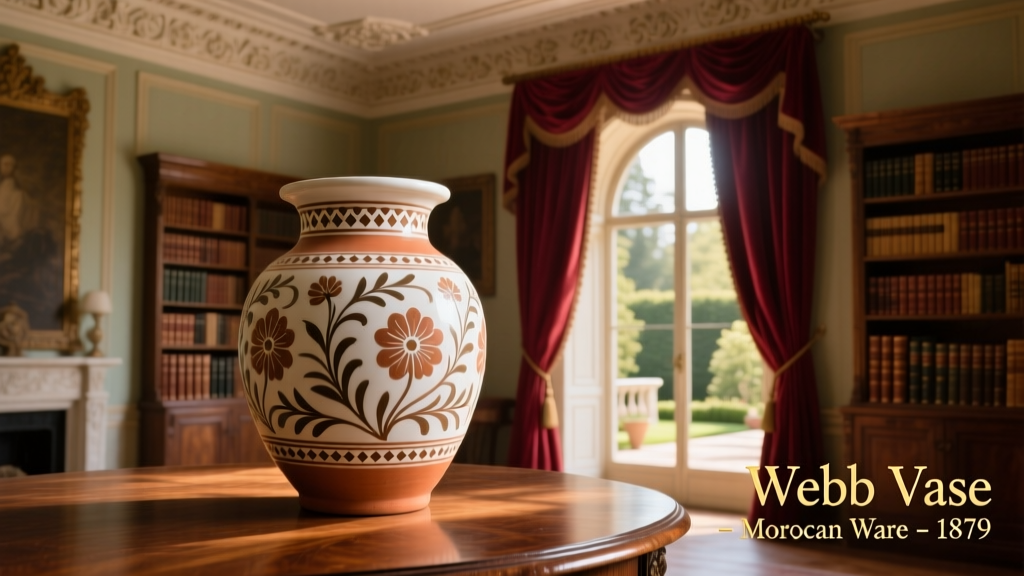
Webb Vase, Moroccan Ware: Flowers, Foliage, and Dots in Opaque White — A Detailed Study of the 1879 5½-Inch Specimen
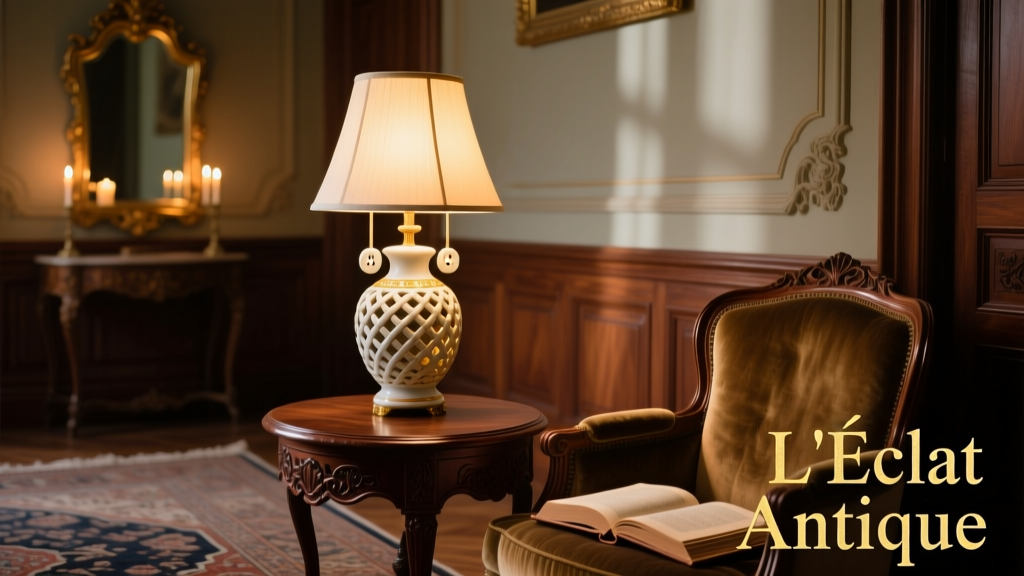
Ceramic Two-Socket Basket Weave Lamp: History, Identification, and Restoration Best Practices
Sewing Box Tole: The Artistry and Authenticity of the Black Tulips & Leaves Round 10-Inch Model

Toy Clown Tumbles Mechanical Papier-Mâché Head, Germany, c. 1925 — An In-Depth Restoration & Historical Analysis
Schuco Brown Jointed Teddy Bear: A Collector’s Guide to the 3-Inch Vintage German Toy
Fry Glass Creamer with Flower Engraving: Identification, Provenance, and Restoration Ethics
New England Maple High Chair, Circa 1795: A Structural and Historical Analysis of a 36¼-Inch Antique
Silver English Waiter with Gadroon Border, Ball-and-Claw Feet, and Oval Touchmark — An 8-Inch Georgian Masterpiece