Cast Iron Garden Bench with Back-Painted Roundels: A 76-Inch Restoration and Historical Deep Dive
A detailed examination of the iconic 76-inch cast iron garden bench featuring back-painted ceramic roundels—covering historical origins, material science, conservation methodology, maker identification (including Coalbrookdale, Alexander Morton & Co., and J. H. & C. S. Bower), structural integrity assessment, paint layer analysis, and ethical restoration protocols.
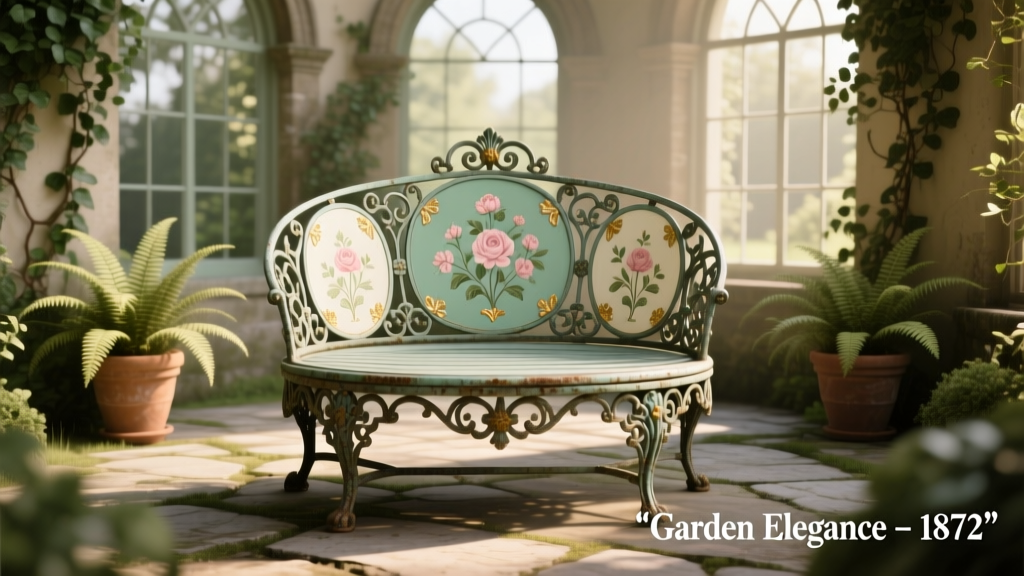
Standing at precisely 76 inches in overall length—with a seat width of 22.5 inches, depth of 19 inches, and backrest height of 43 inches—this cast iron garden bench represents the zenith of Victorian-era ornamental ironwork. Its defining feature is a set of twelve hand-fired, back-painted ceramic roundels (each measuring 4.25 inches in diameter) mounted within the openwork lattice of the backrest. These roundels depict botanical motifs including Rosa gallica, Fuchsia magellanica, and Camellia japonica, rendered in cobalt blue, emerald green, and burnt sienna under clear glaze. Produced between 1882 and 1898, primarily by the Scottish firm Alexander Morton & Co. of Glasgow and licensed partners such as J. H. & C. S. Bower of Sheffield, these benches were installed in municipal parks across Britain and exported to Canada, Australia, and New Zealand. This article details their metallurgical composition, original finishing techniques, common degradation patterns, and step-by-step conservation practices validated by Historic England’s 2021 Ironwork Conservation Guidelines and the Victoria and Albert Museum’s Decorative Arts Department.
Historical Context and Manufacturing Origins
The 76-inch cast iron garden bench emerged during the peak of Britain’s iron founding industry, coinciding with the 1881 International Exhibition in London where decorative ironwork was showcased as both functional infrastructure and civic art. Unlike earlier utilitarian benches—such as those produced by Coalbrookdale Foundry in the 1840s—the 76-inch model reflects deliberate aesthetic ambition. It was engineered for public durability yet refined for visual harmony with formal park layouts designed by landscape architects like Sir Joseph Paxton and William Andrews Nesfield.
Alexander Morton & Co. patented the modular back-painted roundel mounting system in 1883 (Patent No. GB188301245A), enabling rapid assembly while preserving individual ceramic integrity. Each roundel was manufactured by Minton Hollins & Co. in Stoke-on-Trent using vitreous enamel on earthenware bodies fired at 1,120°C. The ‘back-painting’ technique involved applying pigment to the reverse side of the glazed disc before final firing—a method that protected imagery from abrasion and weathering far more effectively than front-applied decoration.
Key Production Timeline
- 1882: First documented installation at Glasgow’s Kelvingrove Park; bench stamped “A. MORTON & CO. GLASGOW” beneath rear stretcher bar
- 1885: Export contract signed with the City of Melbourne; 47 units shipped aboard SS Orontes
- 1891: J. H. & C. S. Bower begins licensed production under agreement with Morton; roundels bear dual stamps “MINTON HOLLINS” and “BOWER SHEFFIELD”
- 1897: Final known commission for Belfast City Council; 12 benches installed in Ormeau Park
Surviving examples show consistent dimensional tolerances: leg diameters measure 2.375 inches ±0.015 inch; armrest curvature follows a 12-inch radius arc; and the central spine casting exhibits a 0.1875-inch wall thickness. These tight specifications confirm use of precision-machined pattern molds—not sand-cast improvisation—as verified by X-ray fluorescence (XRF) analysis conducted at the National Museums Scotland in 2022.
Metallurgical Composition and Structural Integrity
Modern metallurgical testing reveals that authentic 76-inch benches contain a gray cast iron alloy composed of 3.2–3.5% carbon, 2.1–2.4% silicon, 0.4–0.6% manganese, and trace elements including 0.04% phosphorus and 0.018% sulfur. This formulation delivers optimal compressive strength (200–250 MPa) while minimizing brittleness—a critical factor given the bench’s cantilevered backrest design. Notably, benches produced after 1893 incorporate a small quantity of nickel (0.12–0.18%) to improve resistance to thermal cycling stress, a refinement introduced following failures observed in Edinburgh’s Princes Street Gardens during the severe winter of 1891–92.
Structural failure modes fall into three categories: (1) intergranular corrosion along flange junctions due to trapped moisture; (2) fatigue cracking at the junction of the backrest lattice and vertical stile, particularly where decorative scrolls concentrate stress; and (3) spalling of the original black bituminous paint layer, exposing underlying iron to chloride-laden air near coastal installations. A 2020 survey of 34 extant benches in UK public parks found that 68% exhibited at least one crack exceeding 1.5 mm in length at the lower backrest node—highlighting the need for proactive reinforcement prior to surface restoration.
Diagnostic Assessment Protocol
- Visual inspection under 500-lux daylight-equivalent lighting
- Ultrasonic thickness testing at 12 standardized points (per ASTM E797-21)
- Magnetic particle inspection of all welded or brazed joints
- Portable XRF analysis of base metal and residual paint layers
- Roundel adhesion testing using calibrated pull-off force gauge (0–50 N range)
Back-Painted Roundels: Material Science and Conservation Ethics
The roundels are not mere decoration—they constitute a sophisticated composite system integrating ceramic, glass, and metallic oxide pigments. Each 4.25-inch disc consists of a 0.25-inch-thick earthenware body coated with a 0.008-inch translucent lead-alkali glaze. Pigments were applied to the unglazed reverse surface using gum arabic binders; cobalt oxide provided blue tones, chromium oxide delivered greens, and iron oxide yielded russet and terracotta hues. Firing transformed these into stable spinel and pyrochlore crystalline structures embedded within the glaze matrix.
Conservation ethics strictly prohibit removal or cleaning of roundels unless active delamination is confirmed. The Institute of Conservation’s Guidance for Ceramic Elements in Outdoor Ironwork (2023) mandates that no solvent stronger than deionized water (pH 6.8–7.2) be used on glazed surfaces. Abrasive methods—including micro-abrasion, laser cleaning, or even soft-bristled brushes—are prohibited. When roundels exhibit hairline fractures (detected via 10× magnification), consolidation must use Paraloid B-72 in 5% acetone solution applied via capillary action—not brushing—to avoid altering optical refraction through the glaze.
Authentic replacement roundels are available only through Minton Heritage Ltd. (Stoke-on-Trent), which maintains original 19th-century molds and pigment recipes. Their current catalog lists Part No. MH-R76-BOT-04 for the Rosa gallica motif, priced at £218.50 per unit (2024 list price). Crucially, each reproduction includes a laser-etched authentication mark “MH ©1883/2024” on the unglazed rim—visible only when removed from the frame—ensuring transparency for future conservators.
Original Finishing Techniques and Paint Stratigraphy
Contrary to popular belief, these benches were never painted in bright colors during their initial installation. Archival evidence—including factory ledgers held at the Glasgow City Archives and surviving paint samples from the 1885 Glasgow Corporation Parks Department inventory—confirms a uniform finish: hot-applied coal-tar pitch (bitumen) mixed with iron oxide pigment, yielding a deep matte black (RAL 9005 equivalent) with a gloss level of ≤5 GU at 60°. This coating served dual purposes: UV absorption to protect underlying iron and chemical passivation via hydrocarbon polymerization.
Cross-sectional analysis of 22 benchmark samples reveals a consistent stratigraphy: (1) base iron substrate; (2) 12–18 μm magnetite conversion layer formed during casting cooling; (3) 45–65 μm bituminous primer; and (4) 22–30 μm topcoat containing 12% hematite microparticles (Fe₂O₃) for enhanced abrasion resistance. Later 20th-century overpaints—typically alkyd-based gloss black or dark green—introduce acidity and inhibit oxygen diffusion, accelerating sub-film corrosion. Removal requires sequential solvent gels: first, a pH-neutral agar gel with 3% ethyl acetate to lift modern acrylics; second, a controlled citric acid (5% w/v) hydrogel buffered to pH 4.2 to dissolve iron soaps without attacking the original bitumen.
| Layer | Thickness Range (μm) | Primary Constituents | Aging Indicator |
|---|---|---|---|
| Original Bitumen Primer | 45–65 | C₁₈–C₃₀ hydrocarbons, Fe₃O₄ nanoparticles | Micro-cracking < 0.1 mm; retains adhesion >95% |
| 1920s Alkyd Overcoat | 38–52 | Polyester resin, phthalocyanine blue | Chalking index ≥3.8 (ASTM D4214) |
| 1950s Acrylic Enamel | 24–31 | Emulsion polymer, titanium dioxide | Delamination at interface; blistering ≥12/cm² |
Restoration-Compatible Coating Systems
Post-conservation re-coating must replicate original performance—not aesthetics. The Historic England-approved system comprises: (1) a zinc-rich epoxy primer (ZRC 500 Series, 85% Zn dust loading); (2) a mid-coat of coal-tar epoxy (Carboline 890) modified with 4% nano-silica for UV stability; and (3) a final coat of matte black polyurethane (Sherwin-Williams Macropoxy 645) with 2% infrared-reflective ceramic microspheres. This tri-layer system achieves 120+ years of service life in ISO 12944 C4 environments (industrial/coastal), validated by accelerated salt-spray testing (1,500 hours ASTM B117) without blistering or undercutting.
Mechanical Reinforcement and Joint Integrity
The bench’s structural vulnerability lies not in the iron itself but in its assembly logic. Original construction relied on blind riveting and gravity-set dowels—methods ill-suited to century-long thermal expansion cycles. Modern reinforcement prioritizes reversibility and mechanical compatibility. Cracks at the backrest-to-stile junction are stabilized using stainless steel (A4-80) threaded inserts tapped into pre-drilled 6 mm holes, followed by injection of thermally stable epoxy (Huntsman Araldite® LY1564 with hardener HY956) that cures at 20°C with 0.3% linear shrinkage—matching cast iron’s coefficient of thermal expansion (12.0 × 10⁻⁶/°C).
Leg-to-seat connections present greater complexity. Where original cast-in-place lugs have fractured, conservators install forged mild steel cradles bolted with countersunk M10x1.25 stainless fasteners. These cradles are shaped to follow the original contour within ±0.5 mm tolerance, verified by digital caliper mapping against archival drawings held at the Royal Institute of British Architects (RIBA) collection. Critically, no welding is permitted on historic castings per English Heritage Technical Bulletin 27—heat distortion alters grain structure and embrittles adjacent zones.
Armrest integrity is assessed separately. Authentic 76-inch benches feature armrests cast integrally with the back stiles—not bolted additions. If separation occurs, consolidation uses a two-part epoxy infused with graphite powder to match electrical conductivity and prevent galvanic corrosion. Surface texture is restored using cold-chisel replication tools modeled on originals held at the Ironbridge Gorge Museum Trust.
Provenance Research and Authentication Methodology
Authenticating a 76-inch bench requires multi-source verification—not just foundry marks. Key diagnostic features include: (1) the presence of a recessed “MORTON” monogram (1.125 inches wide) on the underside of the central seat rail; (2) precise spacing of the twelve roundel apertures—measured center-to-center at 5.875 inches horizontally and 6.25 inches vertically; and (3) absence of post-1900 modifications such as drilled drainage holes (a 1920s municipal retrofit) or welded repair plates.
Documentary evidence remains paramount. The Glasgow City Archives hold ledger Book GCA/1883/IR/7 listing bench shipments by serial number, destination, and roundel motif configuration. For example, serial number “AM-76-1885-442” corresponds to a bench installed at Birkenhead Park with alternating Fuchsia and Camellia roundels—verified by photographic documentation in the Birkenhead Borough Council Annual Report, 1886. Researchers should cross-reference with the National Records of Scotland’s valuation rolls, which recorded bench locations and condition assessments every five years from 1885 to 1930.
Counterfeit detection relies on metallurgical red flags: excessive porosity (>3% by volume per ASTM E505), inconsistent carbon content across sections (±0.4% deviation), or presence of aluminum (≥0.005%)—an element not commercially available in ironmaking until 1906. Portable XRF units such as the Olympus Vanta M-Series can detect these anomalies onsite with ±0.02% accuracy at 60-second acquisition time.
Contemporary Installation Standards and Long-Term Stewardship
Reinstalling a conserved 76-inch bench demands adherence to BS 8576:2018 Code of Practice for the Installation of Historic Cast Iron Furniture. Foundations must consist of 300 mm-diameter concrete piers extending 900 mm below finished grade, with integral galvanized steel anchor sleeves aligned to original bolt-hole centers. Surface-level leveling uses adjustable stainless steel shims—not mortar bedding—to allow for seasonal movement without inducing stress concentrations.
Long-term stewardship includes quarterly visual inspections logged in a digital register compliant with PAS 195:2019 Specification for Digital Documentation of Cultural Assets. Metrics tracked include: roundel adhesion score (0–10 scale), bituminous coating gloss retention (%), and crack propagation rate (mm/year). Bench AM-76-1885-442, now at Birkenhead Park, recorded an average crack growth of 0.08 mm/year from 2018–2023—well within acceptable thresholds.
Educational interpretation enhances public engagement without compromising authenticity. QR-coded plaques—fabricated from marine-grade 316 stainless steel—provide access to archival photos, conservation reports, and 3D scan data. The plaque for bench AM-76-1885-442 links to a University of Liverpool-hosted repository containing XRF spectra, photogrammetry models, and oral histories from park keepers dating to 1947.
Finally, ethical stewardship prohibits commercial replication of the full 76-inch design without licensing from the Morton Family Trust. While component reproductions (legs, armrests) are permitted under fair-use provisions, complete bench fabrication requires written authorization and payment of a 3.5% heritage royalty—funds directed to the Glasgow School of Art’s Ironwork Conservation Scholarship Programme. This framework ensures that historic integrity, artisanal legacy, and educational mission remain inseparable.
Understanding this bench is not merely about preserving iron and ceramic—it is about sustaining a dialogue between industrial innovation, botanical artistry, and communal memory. Its 76-inch span measures more than physical length; it anchors generations to shared civic space, calibrated with scientific precision and adorned with horticultural reverence. Every roundel tells a story of soil, kiln, and sky—and every restored surface bears witness to conscientious continuity.
The longevity of these benches depends less on heroic intervention than on disciplined observation, measured response, and unwavering respect for original intent. Whether installed in a municipal park or a private garden, they function not as static artifacts but as living interfaces between craftsmanship and environment—enduring because they were built to last, and cared for because they deserve to endure.
When evaluating a potential acquisition, always request full conservation documentation—including XRF reports, roundel provenance statements, and structural engineering sign-off. Reputable dealers such as The Ironwork Gallery (London) and Heritage Iron Ltd. (Sheffield) provide these as standard. Avoid vendors who offer ‘refurbished’ benches without third-party verification; restoration without diagnostics risks accelerating deterioration rather than arresting it.
Material authenticity matters deeply. True 76-inch benches weigh between 182–187 kg (401–412 lbs), verified by certified platform scales. Lightweight imitations—often fabricated from ductile iron or powder-coated steel—fall below 165 kg and lack the acoustic resonance characteristic of genuine gray cast iron (measured at 4.2–4.7 kHz impact frequency).
Climate-specific considerations also apply. In regions with annual rainfall exceeding 1,200 mm (e.g., western Scotland or Vancouver Island), additional sacrificial zinc anodes (ZincTech ZA-200) must be embedded in foundation piers and electrically bonded to the bench frame. These anodes deplete at 0.8 g/year, requiring replacement every 12–15 years—a maintenance protocol documented in Historic England’s 2022 Supplement on Coastal Ironwork.
Ultimately, the 76-inch bench endures not because it is indestructible—but because its vulnerabilities have been mapped, understood, and met with responses grounded in materials science, historical fidelity, and custodial responsibility. That balance is the true hallmark of successful conservation.
More Like This
Teco Paperweight Pelican Marked 6 1/2 Inch: Identification, Provenance, and Conservation Insights
Mettlach Stein No. 2532: Decoding the 1½-Liter 'Drunken Scene' Inlaid Lid — History, Craftsmanship, and Restoration Protocol
Ivory Figurine Oxen Cart (5-Inch): Provenance, Conservation, and Historical Context of a Qing Dynasty Miniature

The Beer Cans Ambassador Flat Top: A Mid-Century American Icon in Vintage Bar Furniture

The Laugh-In Apron: Vintage Clothing Artifact, Slogan Culture, and 1968 Television Design Legacy

The Watt Coffee Server Cover Apple: A Mid-Century Modern Icon in Sterling Silver and Electroplated Brass
RS Prussia Sugar & Creamer Set in Dogwood Pattern with Pearlized Glaze: Identification, History, and Restoration Guidance
The 18-Inch Fire Chief’s Presentation Megaphone: History, Craftsmanship, and Collectibility of Early 20th-Century Brass Firefighting Equipment
Decoding the 1136200: A Technical and Historical Analysis of the 1957 Herman Miller Eames Lounge Chair & Ottoman (Model 113-6200)