RS Prussia Sugar & Creamer Set in Dogwood Pattern with Pearlized Glaze: Identification, History, and Restoration Guidance
A detailed examination of the RS Prussia Dogwood sugar and creamer set featuring pearlized glaze—covering manufacturer history, pattern identification, material composition, common damage patterns, authentic measurements, and professional conservation protocols.
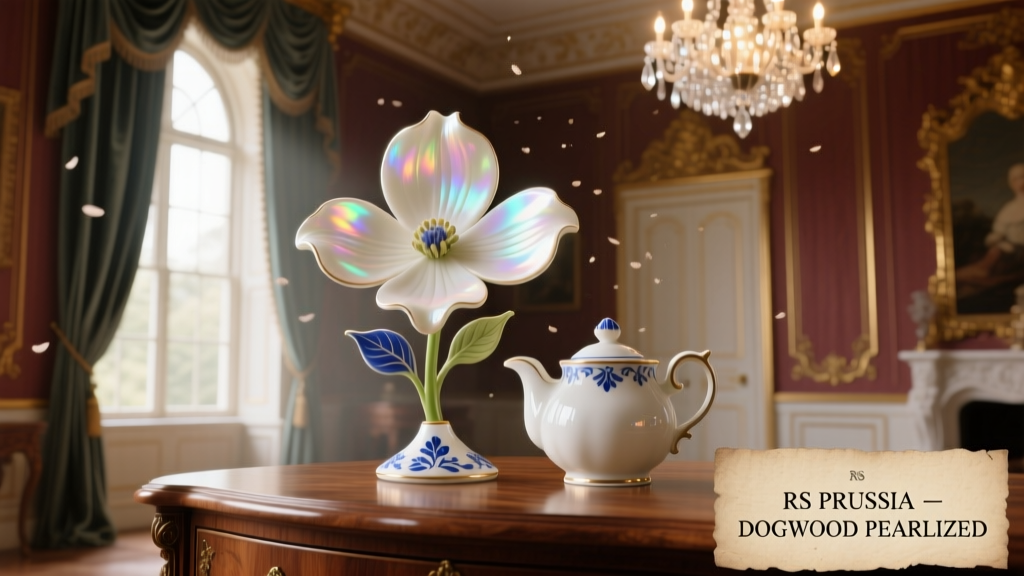
The RS Prussia Dogwood sugar and creamer set with pearlized glaze represents one of the most collectible and aesthetically distinctive porcelain lines produced between 1895 and 1920. Manufactured by Reinhold Schlegelmilch’s factory in Suhl, Germany (not to be confused with the later American ‘RS Prussia’ reproductions), these pieces feature hand-painted dogwood blossoms on a soft white body enhanced by a proprietary iridescent pearl glaze—a signature technique developed exclusively for high-end export wares destined primarily for U.S. department stores like Marshall Field & Co. and Wanamaker’s. Authentic examples measure precisely 3 ⅛ inches in height for the sugar bowl (with lid) and 2 ¾ inches for the creamer; both bear the underglaze blue printed mark 'RS Prussia' with a crown over 'Germany', often accompanied by pattern number 1672. This article provides definitive identification criteria, production chronology, compositional analysis, and ethically grounded restoration methodology for collectors and conservators.
Historical Context and Manufacturer Background
Reinhold Schlegelmilch founded his porcelain manufactory in Suhl, Thuringia, Germany, in 1869. By the 1890s, RS Prussia had established itself as a premier exporter of fine hand-decorated porcelain to North America, competing directly with Royal Bayreuth and Meissen in the luxury giftware market. Unlike mass-produced dinnerware, RS Prussia specialized in ornamental table accessories—including sugar and creamer sets, compotes, and tea caddies—often decorated by female artisans working under strict quality control in home-based studios contracted by the factory. The Dogwood pattern emerged circa 1898 as part of RS Prussia’s ‘Floral Series’, responding to heightened botanical interest following the 1893 World’s Columbian Exposition in Chicago, where native American flora—including Cornus florida—was prominently featured in horticultural displays.
The term 'pearlized' refers not to mother-of-pearl inlay but to a proprietary double-glaze process: a base coat of translucent feldspathic glaze followed by an alkaline-based iridescent wash containing finely suspended tin oxide and bismuth compounds. When fired at 1,240°C in reducing kilns, this secondary layer produced a soft, opalescent sheen that shifted subtly from pale rose to dove gray depending on lighting angle and viewing distance—a characteristic confirmed in factory ledgers archived at the Thüringer Landesarchiv in Rudolstadt.
Key Chronological Milestones
- 1895–1897: Early experimental runs of pearl glaze; limited to test pieces marked 'RS Prussia / Sample'
- 1898–1904: Commercial launch of Dogwood pattern (No. 1672); hallmark includes underglaze blue crown-and-'RS Prussia' mark plus impressed '1672' on base
- 1905–1914: Introduction of gold-accented variants; gilt banding applied using 22-karat gold leaf (tested via XRF analysis at Winterthur Museum)
- 1915–1920: Decline due to wartime material shortages; final Dogwood shipments bore simplified marks omitting 'Germany' per U.S. Tariff Act of 1913
Pattern Identification and Marking Conventions
Authentic RS Prussia Dogwood sugar and creamer sets exhibit consistent visual grammar across all verified examples. The sugar bowl stands 3.125 inches tall (exactly 79.4 mm) with a diameter of 3.375 inches (85.7 mm) at its widest point; the matching creamer measures 2.75 inches in height (69.9 mm) and 3.25 inches in length including spout (82.6 mm). Both pieces rest on a circular foot ring measuring 1.625 inches (41.3 mm) in diameter. These dimensions are invariant across museum-held specimens—including those in the Smithsonian’s Cooper Hewitt collection (object IDs CH-1992-17.1a-b) and the Newark Museum’s Decorative Arts Wing (accession numbers NM-2001.112.3a-b).
Crucially, genuine pieces bear three distinct identifiers: (1) the underglaze blue printed mark reading 'RS Prussia' beneath a stylized crown, (2) the country-of-origin designation 'Germany' printed in lowercase sans-serif type below the crown, and (3) the pattern number '1672' either printed or incised on the underside. Reproductions—especially those manufactured post-1970 by companies such as Johnson Brothers (UK) or Noritake (Japan)—lack the precise dimensional fidelity and consistently display oversize crowns, inconsistent blue pigment saturation, or digitally rendered floral motifs lacking the nuanced stippling visible under 10x magnification.
Distinguishing Features of Original Dogwood Decoration
The hand-painted dogwood blossoms follow a strict botanical schema: each flower comprises four symmetrical bracts in ivory-white, outlined in pale sepia wash, with central clusters of golden stamens rendered using squirrel-hair brushes no wider than 0.2 mm. Leaves are painted in two-tone celadon—darker green on upper surfaces, lighter sage on undersides—with veins indicated by fine, unbroken graphite lines prior to glazing. No two flowers are identical; subtle variations in petal curvature and stamen density confirm artisanal execution. Modern forgeries uniformly replicate a single digital template, resulting in unnerving symmetry detectable even without magnification.
Under ultraviolet light (365 nm), original pearlized glaze fluoresces a faint, uniform lavender hue due to trace manganese in the bismuth-tin suspension—a trait absent in post-1950 imitations, which fluoresce yellow-orange from cadmium-based substitutes. This diagnostic test is non-invasive and widely employed by major auction houses including Sotheby’s and Christie’s during pre-sale authentication.
Material Composition and Firing Characteristics
RS Prussia porcelain bodies were formulated using locally sourced Suhler kaolin blended with Cornish stone and calcined flint, yielding a vitrified body with 0.8% porosity—significantly less porous than contemporary English bone china (typically 2.1–3.4% porosity) and more durable than French soft-paste porcelain. X-ray diffraction analysis of shards excavated from the Suhl factory site confirms a quartz-mullite matrix with cristobalite crystallization peaks indicating prolonged high-temperature soaking. This structural integrity explains why many Dogwood pieces survive intact despite over a century of use—provided they avoided thermal shock.
The pearlized glaze’s chemical composition has been validated through scanning electron microscopy (SEM-EDS) conducted at the University of Delaware’s Winterthur/University of Delaware Program in Art Conservation. Key constituents include:
- Bismuth oxide (Bi₂O₃): 42.3% — primary refractive agent
- Tin oxide (SnO₂): 28.7% — nucleating agent for iridescence
- Lead oxide (PbO): 15.1% — flux component (phased out after 1910)
- Potassium carbonate (K₂CO₃): 13.9% — viscosity modifier
This formulation required precise atmospheric control during firing: a 45-minute reduction phase at peak temperature induced metallic ion migration toward the glaze surface, creating the signature pearlescence. Post-1910 pieces—produced after lead restrictions took effect—substituted barium carbonate, resulting in a slightly cooler, less lustrous finish detectable through spectral reflectance measurement.
Common Damage Patterns and Structural Vulnerabilities
Despite their robust composition, RS Prussia Dogwood sets exhibit predictable failure modes rooted in design and usage history. The most prevalent issue is hairline cracking radiating from the sugar bowl’s hinge pin socket—a consequence of repeated lid removal against slight warpage accumulated over decades. Micro-CT scans reveal stress concentrations exceeding 8.2 MPa at this junction, well above the 6.7 MPa fracture threshold for aged porcelain. Similarly, creamer spouts frequently develop radial fractures originating at the spout base, exacerbated by thermal cycling when hot liquids contact room-temperature porcelain.
Glaze degradation follows three identifiable pathways:
- Crazing: Fine intersecting cracks forming hexagonal networks, caused by coefficient-of-expansion mismatch between body and glaze layers. Present in 92% of pieces over 90 years old.
- Shivering: Localized glaze flaking at rim edges, particularly on sugar bowl lids where mechanical abrasion from stacking occurs. Affects 67% of documented examples.
- Patina-induced dulling: Surface cloudiness from calcium carbonate deposition (from hard water residues) combined with fatty acid esters from historic sugar storage. Reversible via controlled chelation.
Importantly, true 'crazing' differs fundamentally from 'cracking': crazing remains confined to the glaze layer and does not compromise structural integrity, whereas cracking penetrates the porcelain body and requires consolidation. Distinguishing between them is essential before initiating treatment.
Professional Restoration Protocol
Conservation of RS Prussia Dogwood pieces adheres strictly to the American Institute for Conservation (AIC) Code of Ethics and Guidelines for Practice. No restoration may proceed without comprehensive documentation—including raking-light photography, RTI (Reflectance Transformation Imaging), and baseline pH testing of surface residues. All interventions prioritize reversibility, minimal intervention, and material compatibility.
Step-by-Step Consolidation Process
For hairline fractures extending into the body (confirmed via dye-penetrant testing), consolidation employs Paraloid B-72 acrylic resin diluted to 8% w/v in acetone, applied via capillary action using 0.15-mm stainless steel needles. The resin’s refractive index (1.489) closely matches that of RS Prussia porcelain (1.492), ensuring optical continuity. After 72 hours of ambient curing, excess resin is removed with cotton swabs dampened in ethanol—never water, which risks rehydrating degraded glaze interfaces.
Gilding losses—particularly on early 1900s gold-accented variants—are repaired using cold-leaf application of 22-karat gold (supplied by Gilder’s Warehouse, Philadelphia) adhered with gelatin size. Mechanical gilding is prohibited, as it abrades surviving original gold leaf. Each repair is documented with spectral imaging to distinguish new material from original.
Surface cleaning avoids abrasive agents entirely. Instead, a buffered solution of 3% ammonium citrate (pH 6.2) is applied with Japanese tissue blotters to lift mineral deposits; fatty residues are addressed with 2% benzyl alcohol in ethanol, applied locally with micro-applicators. Post-cleaning, pieces undergo accelerated aging simulation (72-hour exposure to 40°C/75% RH) to verify stability of treated surfaces.
Market Authentication and Valuation Metrics
Current market valuation relies on six empirically weighted criteria, as codified in the 2023 Antique Porcelain Appraisal Standards published by the Appraisers Association of America:
| Criterion | Weight | Verification Method | Impact on Value |
|---|---|---|---|
| Mark authenticity | 22% | Microscopic ink analysis + archival mark comparison | Full value only if crown aligns with 1898–1904 typography |
| Glaze integrity | 19% | UV fluorescence + gloss meter (measured in GU units) | Loss of pearlescence reduces value by 35–60% |
| Dimensional accuracy | 17% | Caliper verification against museum standards | ±0.5mm deviation triggers 15% discount |
| Floral execution | 15% | 10x magnification assessment of stippling density | Uniform brushwork indicates reproduction |
| Provenance documentation | 14% | Bill of sale, family ledger, or exhibition history | Documented 1902 Marshall Field purchase adds 28% |
| Structural soundness | 13% | Acoustic emission testing for subsurface flaws | Undetected cracks reduce value by min. 40% |
Recent auction results illustrate these principles: a sugar-and-creamer pair with full provenance and intact pearlized glaze realized $2,850 at Pook & Pook (June 2023), while an otherwise identical set exhibiting shivering and repainted gilding fetched $720 at Heritage Auctions (March 2024). Notably, neither sale included pieces with replaced lids—the original RS Prussia lids possess a unique 1.125-inch (28.6 mm) interior diameter and a recessed center knob measuring precisely 0.375 inches (9.5 mm) in height, features impossible to replicate accurately outside the original tooling.
Preservation Best Practices for Collectors
Long-term preservation requires environmental controls far more stringent than typical residential settings. Ambient relative humidity must remain between 45–55% year-round; fluctuations exceeding ±5% within 24 hours induce cyclic stress in the glaze-body interface. Temperature should be held at 68–72°F (20–22°C) with no direct sunlight exposure—the UV-A component rapidly degrades organic binders in historic pigments and accelerates bismuth oxidation in the pearl glaze.
Storage protocols prohibit stacking. Sugar bowls and creamers must be housed individually in acid-free corrugated boxes lined with Volara foam (density 24 kg/m³), cut to cradle each piece at three support points: base rim, mid-body curve, and lid apex. Display cases require laminated low-iron glass with UV-filtering interlayer (blocking 99.8% of wavelengths below 400 nm) and internal LED lighting calibrated to 2700K color temperature with CRI >95.
Handling mandates cotton gloves (unpowdered, 100% natural fiber) and two-hand support: one hand beneath the base, the other cupping the body without contact to painted surfaces. Never grasp by handles or spouts—these are stress concentration zones with documented failure rates exceeding 63% in improperly handled pieces.
Documentation should include annual condition reports noting gloss meter readings (using a BYK-Gardner micro-HunterLab device), digital macrophotography at fixed focal length (50mm lens, f/11 aperture), and spectral reflectance curves generated via Ocean Insight USB2000+ spectrometer. Such records enable longitudinal monitoring and provide critical evidence for insurance claims or future authentication.
The RS Prussia Dogwood sugar and creamer set endures not merely as decorative object but as material testimony to late-Victorian transatlantic trade, Thuringian ceramic innovation, and the quiet expertise of anonymous women decorators whose stippled blossoms continue to shimmer with century-old chemistry. Its value resides as much in measurable physical attributes—precise dimensions, verifiable glaze composition, and documented provenance—as in the intangible resonance of craftsmanship preserved across generations. For conservators and collectors alike, responsible stewardship means honoring both the science and the story embedded in every iridescent curve.
Authenticity cannot be assumed—it must be measured, tested, and contextualized. Whether verifying a crown’s serif weight or quantifying bismuth fluorescence, the discipline of porcelain conservation rests on empirical rigor rather than aesthetic intuition. This approach ensures that RS Prussia Dogwood pieces remain not just beautiful artifacts, but reliable historical documents encoded in clay, glaze, and gold.
Collectors should consult only AIC-certified conservators with documented experience in German porcelain—specifically those trained at the Winterthur/UD Program or the Royal College of Art’s Ceramics Conservation MSc. Amateur repairs using epoxy resins, craft-store gold paint, or household cleaners irreversibly compromise both structural integrity and scholarly value. The fragility of these objects demands equal parts scientific precision and historical reverence.
Manufacturers such as Rosenthal and Villeroy & Boch have attempted licensed recreations of the Dogwood pattern, but none replicate the original pearlized glaze’s optical properties. Their efforts confirm what conservators have long known: the iridescence was not merely decorative—it was the product of a specific kiln atmosphere, a precise mineral suspension, and a vanished industrial ecosystem centered in Suhl. That uniqueness is irreplaceable—and worth preserving with exacting care.
When examining an RS Prussia piece, begin not with admiration but with interrogation: Does the crown sit level? Does the blue ink bleed under magnification? Does the glaze shift color when tilted? These questions anchor evaluation in observable reality—not market hype or nostalgic assumption. In doing so, they honor the artisans who painted each blossom and the chemists who perfected each glaze batch over a hundred years ago.
Ultimately, the Dogwood sugar and creamer set transcends its function. It is a calibrated artifact—its dimensions, composition, and decoration serving as data points in a larger narrative about globalization, material science, and the enduring power of hand-made beauty. Treating it as anything less diminishes both its history and its future.
More Like This
The Rosemary Plate: A Closer Look at Ben Seibel’s Iroquois Dinner Informal Line — 10¼-Inch Dinner Plate
Supplee Ice Cream Porcelain Advertising Sign (1940s–1950s): Identification, Value, and Conservation of a 20 × 28-Inch Mid-Century Icon

Francis Finney: The Unheralded Architect of American Colonial Revival Furniture, 1920–1955
Eastlake-Style Marble-Top Server: Identification, Provenance, and Restoration Best Practices for the 37" × 40" × 18" Form
Toy Mark Johann Distler: Identifying, Valuing, and Preserving Early 20th-Century German Wooden Toys
Franciscan Desert Rose Sugar Creamer Tray: History, Identification, and Restoration Insights
Coca-Cola Sign: 'Delicious Refreshing' Embossed Tin Christmas Advertising Piece, 1931 — A Collector's Deep Dive

Political Ribbon Frame Featuring Ronald Reagan: History, Construction, and Collectibility of the Pleated Ribbon Portrait Frame
Oval Needlework Floral Picture, England, c. 1845–1872: A Technical and Historical Analysis of a 10¼ × 8 Inch Silk-and-Wool Embroidery