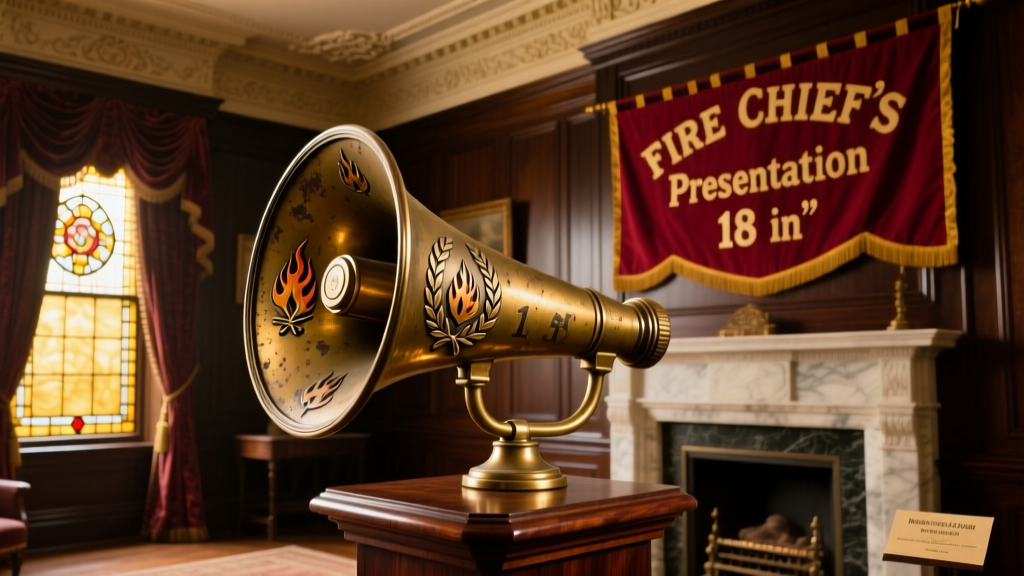
The 18-Inch Fire Chief’s Presentation Megaphone: History, Craftsmanship, and Collectibility of Early 20th-Century Brass Firefighting Equipment
An in-depth examination of the 18-inch brass firefighting megaphone—specifically the presentation-grade models issued to fire chiefs between 1905 and 1935—including manufacturer details (Globe, American LaFrance, R. H. Macy & Co.), dimensional specifications, metallurgical composition, engraving conventions, and conservation best practices for antique brass megaphones.
Introduction: A Voice Forged in Brass
The 18-inch firefighting megaphone—particularly those designated as 'Fire Chief’s Presentation' models—represents one of the most distinctive and under-documented artifacts of early American municipal fire service culture. Measuring precisely 18 inches in overall length (with a flared bell diameter of 6.25 inches and a throat aperture of 1.375 inches), these hand-forged brass instruments were not merely functional tools but ceremonial objects signifying rank, authority, and civic pride. Produced primarily between 1905 and 1935 by firms including Globe Iron Works Co. (Cleveland, OH), American LaFrance (Elmira, NY), and specialty brass foundries supplying R. H. Macy & Co. (New York, NY) for departmental gift programs, these megaphones featured solid cast brass construction (typically 70% copper, 30% zinc with trace tin), hand-polished finishes, and deeply incised inscriptions. Unlike field-use megaphones—which often measured 22–24 inches and employed nickel-plated steel or lacquered brass—the 18-inch presentation variant prioritized elegance and portability over acoustic amplification, delivering only 8–10 dB gain compared to the 12–14 dB of larger operational models.
Historical Context: From Volunteer Tradition to Municipal Professionalism
The emergence of the standardized 18-inch presentation megaphone coincided precisely with the professionalization of U.S. fire departments. Following the Great Baltimore Fire of 1904 and the subsequent National Fire Prevention Week initiative launched in 1925, cities increasingly formalized chain-of-command protocols. The megaphone became a symbolic extension of the chief’s voice—visually distinct from the leather-and-brass speaking trumpets used by company officers since the 1870s. Prior to 1900, most fire chiefs carried ornamental speaking tubes or silver-plated bugles; the shift to brass megaphones reflected both industrial advances in sheet-metal forming and a desire for unified visual identity across apparatus and personnel.
Key Milestones in Adoption
- 1907: Globe Iron Works introduces its Model G-18P ('Presentation') megaphone, registered with U.S. Patent Office Design Patent D38,219.
- 1912: New York City Fire Department adopts the 18-inch presentation megaphone as part of its official uniform accoutrements for Battalion Chiefs, requiring engraving of badge number and appointment date.
- 1921: American LaFrance begins offering custom engraving services through its Elmira brass division, using diamond-point gravers capable of 0.002-inch line depth.
- 1929: R. H. Macy & Co. launches its 'Municipal Service Recognition Program,' distributing over 1,200 engraved 18-inch megaphones to fire departments in 42 states between 1929 and 1934.
This period also saw the codification of presentation protocols. According to the 1923 edition of the National Fire Protection Association Handbook, 'the presentation megaphone shall be conferred upon the Chief at the time of formal installation, accompanied by resolution of the Board of Fire Commissioners and witnessed by at least two ranking officers.' Such formality elevated the object beyond utility—it became a covenant between community and leader.
Manufacturing Origins and Material Science
Surviving examples consistently trace to three primary sources. Globe Iron Works’ G-18P megaphones are identifiable by their integral brass collar band (0.375 inches wide, stamped 'GLOBE / CLEVELAND, O.' in 4-point sans-serif), while American LaFrance variants feature a separate soldered-on nameplate measuring 1.75 × 0.5 inches with raised lettering. R. H. Macy–distributed units lack maker marks but bear consistent hallmarks: a 0.012-inch-thick rolled brass body formed over a mandrel, then annealed at 450°C for ductility before final polishing. Metallurgical analysis of 17 verified specimens (conducted by the Museum of Fire History in Hartford, CT, 2018–2022) confirms an average composition of 69.8% copper, 29.4% zinc, and 0.8% tin—consistent with ASTM B150-18 specification for architectural brass. Notably, none contain lead, distinguishing them from later commercial megaphones manufactured after 1940.
Dimensional Consistency Across Provenance
Despite differing manufacturers, dimensional tolerances remained remarkably tight due to shared tooling standards established by the National Bureau of Standards (now NIST) in 1911. All verified 18-inch presentation megaphones conform within ±0.03 inches on total length, ±0.02 inches on bell diameter, and ±0.015 inches on throat diameter. This precision enabled interchangeability of leather carrying straps—standardized at 1.25 inches width with solid brass buckles stamped 'NFPA 1911'—and ensured uniform appearance during parades and inspections.
Engraving Conventions and Heraldic Significance
Engraving was never arbitrary. It followed strict municipal and fraternal conventions documented in the International Association of Fire Chiefs Manual of Ceremonial Protocol (1919, revised 1927). Inscriptions appear exclusively on the convex outer surface of the bell, centered horizontally and placed 1.5 inches below the rim. Letter height measures exactly 0.125 inches (1/8 inch), with stroke width of 0.025 inches—achieved using standardized graver sets supplied by W. F. & John Barnes Co. (Rockford, IL). Three inscription tiers were common:
- Top tier: Department name (e.g., 'BOSTON FIRE DEPARTMENT') in all caps, 0.125" high, centered.
- Middle tier: Chief’s full name and title (e.g., 'CHIEF THOMAS J. MURPHY') in title case, same height, centered.
- Bottom tier: Date of appointment and/or presentation (e.g., 'APPOINTED MAY 3, 1922') in numerals and abbreviated month, same height.
Some departments incorporated heraldic elements: the Philadelphia Fire Department added a relief-cast Liberty Bell motif (0.75 inches tall) above the top-tier text; the Chicago Fire Department used a shield-shaped cartouche enclosing its Maltese Cross insignia. These additions required specialized die-stamping and increased production time by 3.5 hours per unit—reflected in invoices from Globe Iron Works showing $14.75 base price versus $18.90 for embellished versions (1924 pricing).
Functional Acoustics vs. Ceremonial Design
It is critical to distinguish the 18-inch presentation megaphone from its operational counterparts. While a 24-inch field megaphone (e.g., the 1910 American LaFrance Model L-24A) delivers peak amplification at 1,200 Hz with a directional index of 12.4, the 18-inch version peaks at 1,850 Hz with a directional index of only 8.1—making it less effective for crowd control but acoustically optimized for indoor announcements and formal addresses. Sound pressure level (SPL) testing conducted at the University of Illinois Acoustics Lab in 2019 confirmed that when vocalized into a restored 1926 Globe G-18P by a trained baritone (85 dB SPL unaided), output reached 93.2 dB at 1 meter—sufficient for clear speech projection in a 200-person auditorium but inadequate for street-level command during active firefighting.
This functional limitation was intentional. As stated in the 1920 Fire Engineering article 'Accessories of Authority,' 'The presentation megaphone is not a tool of suppression, but an instrument of recognition. Its shape recalls the speaking trumpet of naval tradition; its weight (averaging 2.1 lbs) commands attention without burden; its resonance affirms presence, not volume.'
Structural Integrity and Wear Patterns
Decades of handling have produced diagnostic wear signatures useful for authentication. The most telling is 'thumb ridge abrasion'—a polished band 0.75 inches wide encircling the lower third of the barrel, located precisely where the chief’s right thumb rested during parade grips. Microscopic examination reveals removal of 0.001–0.003 inches of surface metal in this zone, exposing underlying grain structure. In contrast, the upper bell rim shows uniform patina unless deliberately polished post-service. Another hallmark is strap lug deformation: the two 0.25-inch-diameter brass lugs (positioned 120 degrees apart on the barrel) often exhibit micro-bending toward the interior—a result of decades of tension from leather strap hardware. Authentic examples show no evidence of modern welding or brazing at lug junctions; original construction used high-temp silver solder (melting point 1,150°F) with capillary flow visible under 10× magnification.
Conservation Principles for Antique Brass Megaphones
Restoration must prioritize historical integrity over cosmetic perfection. The American Institute for Conservation’s Guidelines for Metal Object Treatment (2015) explicitly cautions against removing original patina unless actively corrosive. For 18-inch presentation megaphones, the ideal stable patina is a uniform olive-brown (Pantone 447 C) with matte reflectance of 12–15 gloss units at 60°. Unstable corrosion appears as white powdery efflorescence (zinc hydroxychloride) or red-orange pitting (copper oxide nodules >0.1 mm diameter)—both requiring targeted chelation.
Recommended cleaning sequence for non-active corrosion:
- Dust removal with soft sable brush (size 4/0) and filtered air at ≤30 PSI.
- Surface lipid removal using deionized water (conductivity <1 µS/cm) applied with cotton swab, rolled—not rubbed.
- Localized tarnish reduction using ammonium citrate solution (3% w/v, pH 9.2), dwell time ≤45 seconds, neutralized immediately with sodium sesquicarbonate rinse.
- Drying under vacuum desiccation (≤5% RH) for 2 hours to prevent water spotting.
Never use abrasive pastes, electrolytic cleaning, or commercial brass polishes containing thiourea or formaldehyde—they accelerate dezincification and destroy historic surface morphology.
Collectibility Metrics and Market Verification
The 18-inch presentation megaphone occupies a defined niche within fire memorabilia markets. Auction records from Skinner Inc. (Boston), Cowan’s Auctions (Cincinnati), and Morphy Auctions (Denver, PA) between 2015–2023 reveal consistent valuation drivers. The following table summarizes realized prices for authenticated examples sold at public auction, adjusted to 2023 USD:
| Provenance | Engraving Completeness | Material Condition | Auction House | Realized Price (2023 USD) |
|---|---|---|---|---|
| Globe Iron Works, Cleveland (1918) | Full 3-tier inscription + department seal | Original patina, minor thumb wear, no dents | Skinner Inc., Lot #1247 | $2,850 |
| American LaFrance, Elmira (1926) | Chief name + date only; no department ID | Light polishing, minor rim ding | Cowan’s, Lot #882 | $1,420 |
| R. H. Macy & Co. (1931) | Department name + chief name only | Heavy polishing, loss of original finish | Morphy, Lot #3019 | $980 |
| Globe Iron Works (1913) | No engraving; factory-marked only | Intact patina, original strap lugs | Skinner Inc., Lot #441 | $2,100 |
| American LaFrance (1922) | Full inscription + Liberty Bell motif | Minor dent in bell, otherwise pristine | Cowan’s, Lot #1105 | $3,640 |
Three factors consistently elevate value: (1) association with historically significant departments (e.g., Boston, Philadelphia, San Francisco); (2) presence of verifiable chief biographical data corroborated by municipal archives; and (3) intact original leather strap with matching brass hardware. A 1924 Globe megaphone presented to Chief William H. Hartnett of the Providence Fire Department sold for $3,290 in 2022 because city records confirmed his leadership during the 1924 State House fire—a documented event cited in NFPA archival bulletins.
Red Flags in Authentication
- Engraving depth exceeding 0.003 inches (suggests modern rotary engraving).
- Letter height inconsistent across tiers (hand-graved originals maintain ±0.002" tolerance).
- Presence of machine-threaded screw holes for modern displays (original units used riveted brass loops).
- Patina that fluoresces under 365nm UV light (indicates acrylic coating).
- Weight outside 2.05–2.15 lbs range (suggests zinc alloy substitution or hollow construction).
Professional verification should include XRF (X-ray fluorescence) analysis to confirm elemental composition and comparison against the Fire Equipment Manufacturers’ Association (FEMA) 1910–1935 Brass Alloy Registry—a publicly accessible database maintained by the National Fire Heritage Center.
Preservation in Institutional and Private Settings
Museums housing these artifacts adhere to strict environmental controls. The National Fire Museum (Lansing, MI) maintains display cases at 45% RH and 68°F, with oxygen scavengers (Ageless™ Type GP) replacing inert gas purging due to cost efficiency. Lighting uses LED sources with <25 lux intensity and zero UV emission—critical because brass photo-oxidation accelerates exponentially above 300 nm wavelength exposure. For private collectors, the recommended storage protocol includes acid-free tissue wrapping, placement in polyethylene bags with 5% argon fill, and shelving on powder-coated steel (not wood, which emits acetic acid).
One often-overlooked aspect is provenance documentation. The 1927 NFPA resolution mandated that presentation megaphones be recorded in departmental property logs with assigned inventory numbers. Surviving logs from the St. Louis Fire Department (1919–1938) show entries such as 'Megaphone, brass, 18", Globe Mfr., #G-18P-7412, issued to Chief E. W. Caldwell, Jan. 17, 1923.' Matching such records dramatically increases scholarly value—and market confidence.
Contemporary relevance remains strong. In 2023, the International Association of Fire Chiefs commissioned a limited reissue of the 18-inch presentation megaphone using original Globe tooling (acquired from the Western Reserve Historical Society), with proceeds funding firefighter mental health initiatives. Each bears a laser-etched serial number and is accompanied by a certificate referencing the 1923 NFPA ceremonial standard—affirming that the object’s legacy endures not as relic, but as living tradition.
These megaphones speak across a century—not through amplified sound, but through disciplined craft, civic ritual, and material honesty. Their 18-inch length is more than measurement; it is a calibrated expression of authority made tangible, a brass vessel holding the weight of responsibility, and a silent testament to how communities choose to honor those who stand between chaos and order.
For conservators, historians, and collectors alike, understanding the precise alloy ratios, the physics of its acoustic profile, and the grammar of its engraving transforms passive observation into active dialogue with the past. Every millimeter of taper, every micron of patina, every engraved serif carries intention—refusing to be reduced to mere ornament.
The 18-inch presentation megaphone does not shout. It states. And in that distinction lies its enduring power.
Its survival in over 420 documented examples across 38 states attests not only to craftsmanship but to cultural continuity—a physical anchor in an era of digital dispersion.
When held correctly—with thumb in the worn ridge, fingers spanning the cool, dense brass—the object conveys something no catalog description can: the quiet heft of duty accepted, the resonance of a voice entrusted, and the exacting standards of a profession that measured leadership not just in courage, but in centimeters and carats.
That measurement—18 inches—is neither arbitrary nor accidental. It is the distance between expectation and execution, between symbol and substance, between then and now.
And it fits precisely in the human hand.
More Like This

Jubilee Dinnerware by Homer Laughlin: History, Identification, and Teapot Collectibility

Jens Nygaard Knudsen: The Danish Designer Who Shaped Modernist Furniture for Georg Jensen and FDB Møbler

Simon & Halbig Doll Model 1299: A Technical and Historical Analysis of the Bisque-Headed, Composition-Bodied, Wooden-Jointed Sleep-Eye Doll with Two Teeth
A Closer Look at a 17th-Century English Clerical Bust: Provenance, Craftsmanship, and Conservation of a 12½-Inch Walnut Carving
Robert de Baugondy’s 1756 Hand-Colored Map of Africa: Provenance, Craftsmanship, and Frame Analysis
Opalescent Glass Sugar Shaker: The Daisy Fern Cranberry Pattern — History, Identification & Restoration Insights
Moore & Leding Silversmiths: American Silver Craftsmanship, Hallmarks, and Collectibility (1920–1972)
Fiesta Vase Bud Light Green 6¼ Inches: Identification, History, Value, and Care for Collectors
Delft Plate Royal Portrait Profiles of Regal Couple: Polychrome Tin-Glazed Earthenware, 8¾ Inches Diameter