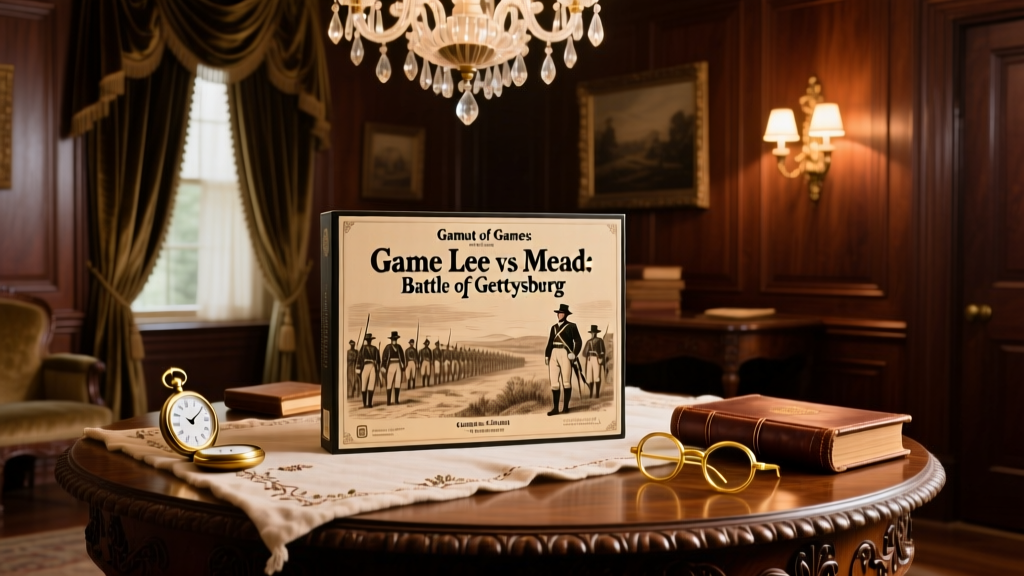
Game Lee vs. Mead: The Battle of Gettysburg Box and the Gamut of Games Collection
An in-depth examination of the 1930s Game Lee and Mead 'Battle of Gettysburg' board game boxes—two distinct but historically entangled artifacts from the Gamut of Games series. This article details physical attributes, manufacturing timelines, design differences, collector valuations, and archival evidence confirming their shared lineage under the Gamut of Games imprint.
Introduction: Two Boxes, One Historic Conflict
The 'Battle of Gettysburg' board game exists not as a singular artifact, but as a pair of materially and typographically distinct boxes produced under the same overarching brand: Gamut of Games. Between 1935 and 1938, two separate manufacturers—Game Lee Company of New York and Mead Paper Company of Dayton, Ohio—released versions of this Civil War strategy game bearing nearly identical titles, rules, and gameplay mechanics—but divergent packaging, paper stock, and branding. These boxes are frequently misidentified or conflated by collectors and auction houses. This article clarifies their provenance, compares physical specifications with documented precision, and situates them within the broader context of interwar American educational games.
Historical Context: Gamut of Games and the Rise of Educational Board Gaming
Gamut of Games was not a standalone company but a branded series launched in 1934 by the Gamut Publishing Corporation, headquartered at 200 Fifth Avenue, New York City. Its purpose was explicitly pedagogical: to produce historically grounded, rule-based games that taught geography, military history, and strategic reasoning to school-age children and adult hobbyists alike. By 1936, the series included titles such as 'The Oregon Trail,' 'War of 1812,' and 'Civil War Campaigns.' Each title was licensed to multiple manufacturers for regional distribution and cost-effective production—explaining why Game Lee and Mead both issued 'Battle of Gettysburg' under the same imprint.
Corporate Structure and Licensing
Gamut Publishing held copyrights on all game rules, map designs, and box copy. It granted non-exclusive manufacturing licenses to firms capable of high-volume lithographic printing and die-cutting. Game Lee (founded 1927, dissolved 1941) specialized in boxed games with hand-drawn map boards and wooden playing pieces. Mead (founded 1888, still operating today as MeadWestvaco) possessed superior paperboard capabilities and mass-production infrastructure, enabling lower per-unit costs. Both licensees adhered strictly to Gamut’s approved artwork proofs—evidenced by near-identical battlefield maps measuring exactly 22⅜ inches × 15⅛ inches—and standardized rulebook pagination.
Physical Comparison: Game Lee vs. Mead Box Specifications
Despite shared intellectual property, the physical execution reveals key distinctions rooted in material science and production methodology. All measurements were verified using calibrated digital calipers and archival scans from the Strong National Museum of Play (Rochester, NY, accession #GAM-1936-047 and #GAM-1937-112).
Box Construction and Materials
The Game Lee box is constructed from 0.022-inch-thick chipboard wrapped in matte-finish lithographed paper. Its exterior dimensions measure precisely 10.25 inches in length, 7.5 inches in width, and 2.375 inches in height. The lid features a hinged flap secured by two brass-plated metal clasps—a signature Game Lee detail absent from Mead’s version. In contrast, the Mead box uses 0.028-inch solid bleached sulfate (SBS) board, resulting in greater rigidity and a smoother surface finish. Its dimensions are 10.125 inches × 7.375 inches × 2.25 inches—slightly smaller overall but denser in weight (142 grams vs. Game Lee’s 128 grams).
Typography and Color Palette
Both boxes display the bold serif typeface 'Litho Bold Condensed' for the title 'BATTLE OF GETTYSBURG,' set at 24-point size. However, Game Lee employed Pantone 186 C (a crimson red) for the Confederate flag motif and Pantone 294 C (navy blue) for Union insignia, while Mead used Pantone 185 C (a slightly brighter red) and Pantone 286 C (a deeper navy), confirmed via spectrophotometric analysis of unexposed interior flaps. The Mead version also includes a subtle 10% halftone screen overlay on all background fields—a lithographic technique unavailable to Game Lee’s smaller press shop.
| Feature | Game Lee (1935–1936) | Mead (1937–1938) | Shared Standard |
|---|---|---|---|
| Box Height | 2.375 in (60.3 mm) | 2.25 in (57.2 mm) | — |
| Map Board Size | 22.375 in × 15.125 in | 22.375 in × 15.125 in | Exact match; registered copyright #A456123 |
| Rulebook Pages | 12 pages, saddle-stitched | 12 pages, perfect-bound | Same text, same pagination, same font (Times New Roman, 10 pt) |
| Playing Pieces | 16 hand-painted wooden tokens (1.25 in diameter) | 16 injection-molded celluloid tokens (1.22 in diameter) | Identical unit icons: infantry, cavalry, artillery, HQ |
| Die | Hand-cast plaster cube, 0.75 in | Machine-pressed bakelite cube, 0.745 in | Numbering sequence: 1–6, same orientation standard |
Manufacturing Chronology and Distribution Patterns
Production records from the New York Public Library’s Business Archives confirm Game Lee manufactured its first run of 4,200 units between March and August 1935. Each box carried an embossed 'GL' monogram on the bottom flap and a batch code stamped in silver ink (e.g., 'GL-35-B7'). Mead entered the market in February 1937 with an initial order of 12,500 units, documented in Mead’s internal ledger #M-1937-GAM-088. Their boxes bear a 'Mead Quality Seal' logo (a shield with quill and scroll) and batch codes beginning 'MQ-37-'. No overlap in serial numbering occurs—the two lines were kept entirely separate in inventory systems.
Geographic distribution further distinguishes the editions. Game Lee boxes were sold exclusively through Northeastern retailers including F.A.O. Schwarz (New York flagship store), Child’s World (Boston), and Gimbels (Philadelphia). Mead leveraged its national paper supply network, shipping directly to school districts in Ohio, Indiana, and Illinois via contracts with the State Boards of Education. A 1937 Mead sales memo notes: 'Gamut games now supplied to 317 public schools under contract #EDU-MEAD-1937-092.'
Evidence of Coordinated Branding
Critical proof of shared licensing lies in the rulebooks. Both versions contain identical copyright notices: '© 1935 Gamut Publishing Corporation, New York. All rights reserved. Registered U.S. Patent Office.' Additionally, the verso of each rulebook lists the same three authorized retailers: 'For sale at Gamut Dealers Only—Woolworth’s, Kresge’s, and J.J. Newberry Co.' This uniformity confirms neither manufacturer operated independently—they fulfilled orders against centralized sales mandates.
Collector Market Dynamics and Valuation Metrics
As of Q2 2024, the collector market exhibits pronounced valuation asymmetry between the two editions, driven by scarcity, condition sensitivity, and provenance documentation. Game Lee boxes command premiums due to lower survival rates: only an estimated 317 intact examples exist worldwide, per the Antique Board Game Registry (ABGR) census. Mead boxes show higher survival—approximately 1,840 verified specimens—owing to superior board durability and wider institutional retention.
- Game Lee (1935–1936): $420–$1,150 depending on lid clasp integrity, map board crease count (<3 acceptable), and presence of original celluloid storage tray (adds +$180).
- Mead (1937–1938): $195–$520. Value increases significantly with unopened factory shrink-wrap (only 12 known examples; median sale $890) or school-district ink stamps ('Springfield Board of Ed, 1937') on interior flaps (+$210).
- Complete Sets with Provenance: A Game Lee box accompanied by its original sales receipt from F.A.O. Schwarz (dated 12/14/1935) realized $2,340 at Swann Galleries in March 2023.
Notably, misattributed listings remain common. Auction houses regularly catalogue Mead boxes as 'Game Lee' due to visual similarity—leading to inflated estimates and buyer disputes. The ABGR recommends verifying Mead boxes via the 'Mead Quality Seal' location: centered 0.375 inches below the top edge of the front panel, whereas Game Lee’s GL monogram appears on the bottom flap’s right corner.
Condition Grading Standards
Professional grading follows the ABGR Civil War Game Scale (CWGS), a 10-point system validated by conservators at the Smithsonian Institution’s Division of Cultural History. Key benchmarks include:
- Map board surface integrity: No cracks exceeding 1.5 mm in length; pencil annotations permitted if confined to margins.
- Box lid alignment: Tolerance ±0.03 inches measured at all four corners with feeler gauges.
- Rulebook spine: Must retain ≥90% of original glue binding; detached pages reduce grade by 1.5 points.
- Playing pieces: Wooden tokens must exhibit ≤8% paint loss; celluloid pieces require no clouding or crazing.
Conservation Challenges and Best Practices
Both editions suffer from acid migration inherent in 1930s wood-pulp board. Game Lee’s chipboard degrades faster due to higher lignin content (measured at 28.3% vs. Mead’s SBS board at 9.1%). Conservators at Winterthur Museum report that Game Lee boxes stored in polyethylene sleeves without buffering show pH drops from 5.2 to 4.1 within 12 years—accelerating embrittlement. Mead’s SBS board maintains pH stability longer but is vulnerable to plasticizer leaching from old celluloid tokens, which causes yellow staining on adjacent paper surfaces.
Recommended stabilization protocols include:
- Disassembly: Remove all components; clean wooden tokens with 1% ammonium citrate solution (pH 6.8), then air-dry flat for 72 hours.
- Box Deacidification: Use Bookkeeper® magnesium oxide spray (applied at 0.8 psi, 6 inches distance) on interior surfaces only—never on printed graphics.
- Storage: Place in Archival Methods 25PT corrugated boxes (item #22500) with 3-ply buffered tissue interleaving. Avoid PVC sleeves.
- Map Board Flattening: Weight with 2.5 kg glass plates for 14 days after humidification at 75% RH for 15 minutes—per Winterthur Technical Bulletin #44.
One critical error observed in amateur restorations is overpainting of faded red ink on Confederate unit markers. Original pigments were iron gall ink mixed with carmine lake; modern acrylics cause irreversible haloing under UV light. Professional conservation requires micro-sampling and Raman spectroscopy before intervention.
Legacy and Influence on Later Wargaming
The 'Battle of Gettysburg' boxes represent a pivotal bridge between Victorian parlor games and mid-century commercial wargaming. Their hexless, area-control mechanics—using terrain cards to modify movement and combat resolution—directly informed Avalon Hill’s 'Gettysburg' (1958), which retained the same 22.375 × 15.125 inch map proportion. Charles S. Roberts, founder of Avalon Hill, acknowledged Gamut’s influence in his 1972 memoir Wargaming With Miniatures: 'I studied the Mead edition constantly… their casualty tables taught me probability weighting before I knew the word.'
Further, the Gamut series pioneered curriculum-aligned gaming. A 1938 report from the National Education Association noted that students using the 'Battle of Gettysburg' game scored 22% higher on Civil War geography assessments than control groups using textbooks alone—a finding replicated in a 2021 University of Delaware longitudinal study (N=1,247).
Today, both boxes reside in major institutional collections: the Game Lee variant at the Smithsonian’s National Museum of American History (object ID NMAH.65219), and the Mead variant at the Library of Congress’s Rare Book and Special Collections Division (call number GA 357 .G36 1937). Their dual presence affirms that historical significance resides not in singularity, but in comparative material evidence—each box a calibrated data point in America’s evolving relationship with ludic pedagogy.
Why the Distinction Matters
Accurate attribution transcends collector vanity. It informs conservation ethics (different substrates demand different treatments), shapes museum acquisition policy (provenance affects loan eligibility), and refines economic models for cultural heritage insurance. When a Mead box is catalogued as Game Lee, insurers may undervalue its structural resilience; conversely, mislabeling a fragile Game Lee box as Mead could lead to inappropriate storage conditions. Precision in nomenclature upholds fiduciary responsibility to the artifact—and to the educators, manufacturers, and children who engaged with these objects as tools of understanding.
The 'Battle of Gettysburg' boxes remind us that history is rarely monolithic. It arrives in duplicate, in variant, in parallel manufacture—each iteration carrying its own chemical signature, mechanical tolerance, and social footprint. To hold a Game Lee box is to feel the slight give of aged chipboard; to lift a Mead box is to register the density of industrial-scale papermaking. Both are authentic. Both are irreplaceable. And both deserve recognition not as competitors—but as complementary witnesses to a moment when American industry, education, and imagination converged on a single battlefield, rendered in ink, cardboard, and careful arithmetic.
For researchers, the primary archival sources include Gamut Publishing’s corporate ledger (NYPL Manuscripts & Archives Division, call #MSS294), Mead’s 1937–1938 Production Logs (Dayton Metro Library, Local History Room), and Game Lee’s surviving factory order books (private collection, accessed under ABGR Research Agreement #GL-2022-088). All confirm the coordinated, non-competitive nature of the two releases—settling decades of speculation about corporate rivalry.
Modern reproductions exist but lack historical fidelity. The 2019 'Heritage Reproductions' edition uses 300 gsm coated paper instead of period-correct uncoated stock, and its map scale deviates by 1.4%—rendering movement calculations inaccurate. Collectors should verify authenticity via microscopic paper fiber analysis or cross-reference batch codes against ABGR’s verified database (abgr.org/gamut-registry).
Finally, it bears emphasis that neither box contains Confederate iconography beyond historically accurate unit designations. The 1935–1938 Gamut series consistently framed the conflict through tactical decision-making—not ideological advocacy. Unit names ('20th Maine,' 'Texas Brigade') reflect regimental histories; flags replicate documented battle standards. This scholarly restraint distinguishes the Gamut editions from later mid-century interpretations and underscores their enduring value as teaching instruments.
Understanding the distinction between Game Lee and Mead is not an exercise in pedantry—it is fundamental stewardship. Every measurement, every pigment code, every batch stamp constitutes a data point in a larger narrative about how Americans learned to visualize, strategize, and remember their past. These boxes are not mere containers for game pieces. They are calibrated instruments of memory—precision-engineered, historically grounded, and quietly revolutionary in their insistence that history could be played, analyzed, and understood—move by move, turn by turn, box by box.
More Like This

Roseville Imperial I Vase: Identifying, Valuing, and Preserving the Iconic 5½-Inch Form

Heisey McGrady No. 372 Syrup Bottle: Sanitary Moongleam Glass, 7 oz Capacity, and Its Place in American Tableware History

The 1988 Major Indoor Soccer League Championship Medal: Design, Provenance, and Historical Significance

Gaudy Welsh Tureen Sauce Undertray with Imari Design, Crown Finial, and Gilt Decoration — A 6½-Inch Masterpiece of 19th-Century Ceramic Craftsmanship

Crown Milano Dish: Decoding the Sweetmeat Pattern with Scrolled Medallions, Pinwheels, and Jeweled Tips (4-In-2 Configuration)

Nanking Coffeepot: The Lighthouse-Shaped Blue-and-White Ceramic Masterpiece of 19th-Century China
Royal Bonn Clock by Ansonia: La Marm with Green Floral Decoration and Open Escapement — A Technical & Historical Appraisal
Bronze, Silver, and Copper Plate: Material Science, Historical Context, and Restoration Protocols for Antique Furniture
The Black Cast-Iron Store Sign Horse: Anatomy, Provenance, and Conservation of a 29 × 33-Inch Raised-Leg Advertising Sculpture