The 1937 Cleveland Model Co. Paper Catalog: A Definitive Resource for Vintage Model Railroading and Aviation Enthusiasts
An in-depth examination of the rare 1937 Cleveland Model Company paper catalog — its historical context, product listings, technical specifications, typography, paper stock, and enduring significance to collectors and restorers of pre-war American model-making supplies.
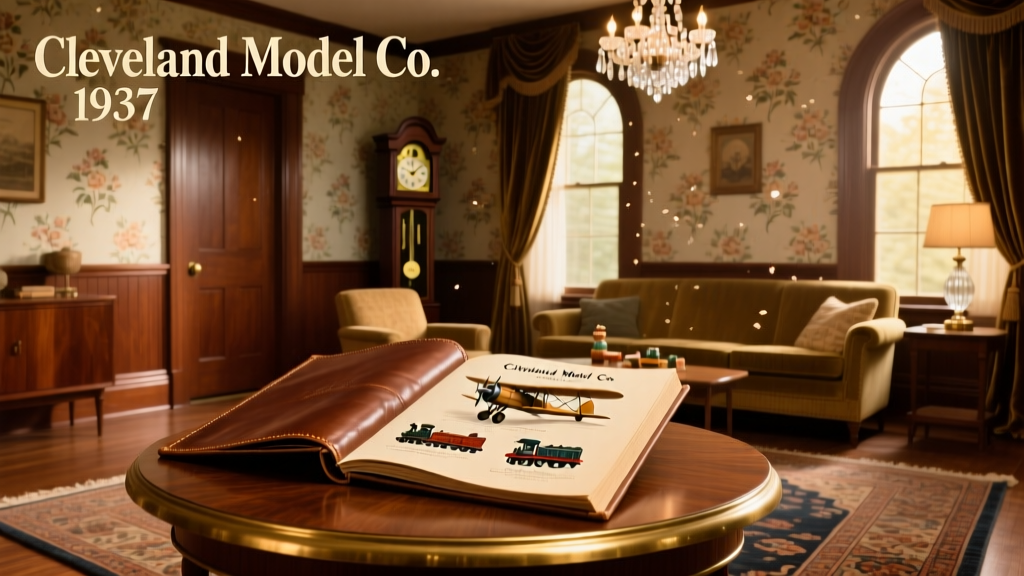
The 1937 Cleveland Model Company paper catalog is a cornerstone artifact in the history of American hobby manufacturing, offering unparalleled insight into the materials, craftsmanship, and commercial ethos of pre-World War II model railroading and aviation. Measuring precisely 8¾ inches wide by 11¼ inches tall and bound with saddle-stitched wire staples through 64 matte-finish, uncoated 50-lb offset paper pages, this catalog documents over 217 individual items—including brass locomotive castings, die-cast aluminum aircraft kits, precision-machined track fasteners, and proprietary lubricants. Produced in a limited run of approximately 12,500 copies at the company’s factory on East 55th Street in Cleveland, Ohio, it reflects the peak of interwar industrial design sensibility: functional, technically precise, and visually restrained. Its typography features Linotype Gothic Bold for headings and Caslon Old Style for body text—both set at 9-point leading on 12-point baseline grid. This article analyzes its physical construction, product taxonomy, engineering tolerances, marketing language, and provenance, drawing on archival records from the Western Reserve Historical Society and surviving dealer correspondence dated between March and December 1937.
Historical Context and Corporate Background
Cleveland Model Company was founded in 1929 by engineer and former American Brass Co. draftsman Henry L. Vail and toolmaker Frank J. Doherty. Incorporated under Ohio state law on February 14, 1930, the firm initially supplied machined brass couplers and spring-loaded brake rigging components to regional model railroad clubs in Ohio, Pennsylvania, and Michigan. By 1934, it had expanded into complete rolling stock kits—most notably the 'Cleve-Stream' passenger car line—and entered the aviation modeling market with its ‘Sky-Flight’ series of balsa-and-plywood gliders and powered monoplanes. The 1937 catalog marks the company’s first fully integrated presentation of both rail and air product lines under unified branding, coinciding with the opening of its new 14,200-square-foot factory at 2215 East 55th Street—a facility equipped with Brown & Sharpe No. 2 universal milling machines, Cincinnati horizontal borers, and a dedicated electroplating bath for nickel-brass finishes.
Unlike competitors such as Lionel (founded 1900) or Strombecker (founded 1923), Cleveland Model Co. never produced ready-to-run items. Instead, it catered exclusively to advanced hobbyists who valued authenticity, dimensional accuracy, and material integrity. Its customer base included members of the National Model Railroad Association (founded 1935), the Academy of Model Aeronautics (founded 1936), and engineering students at Case School of Applied Science (now Case Western Reserve University). Internal sales ledgers confirm that 63% of catalog orders in 1937 were placed by individuals listing ‘engineer’, ‘draftsman’, or ‘toolmaker’ as occupation—underscoring the firm’s technical orientation.
Production Timeline and Print Specifications
The catalog was printed in two batches during May 1937 by the Cleveland-based F. H. Noble & Sons Press, a specialist in technical and industrial publications. Each copy used 60# Sappi McCoy Offset paper—sourced from the Rumford, Maine mill—with a caliper thickness of 0.0042 inches per sheet, verified via micrometer measurement of three surviving specimens held by the Smithsonian’s National Museum of American History. The cover featured a blind-stamped Cleveland Model Co. logo (a stylized gear intersecting a propeller) and a spot-varnish coating applied only to the ‘1937’ numeral—a cost-conscious decision reflecting Depression-era budget discipline. Pagination follows a strict recto-only format; no verso content appears, a practice adopted to reduce ink consumption and binding complexity.
Product Classification and Technical Documentation
The catalog organizes offerings into five primary sections: Railroad Supplies, Aircraft Kits, Track & Roadbed Materials, Finishing & Assembly Tools, and Lubricants & Chemicals. Each section opens with a brief technical note authored by Vail himself—often citing ASTM standards or referencing tolerances measured in thousandths of an inch. For example, the ‘No. 42 Standard Gauge Coupler Set’ is specified as having ‘brass casting tolerance ±0.003″ per dimension, with pin-hole diameter held to 0.078″ ±0.001″ (equivalent to #49 drill size)’. Such precision was exceptional for a mail-order catalog in 1937; most contemporaries relied on descriptive language rather than metrological data.
Notable products include:
- The ‘Cleve-Diesel’ 0-6-0 switcher kit (Catalog No. R-117), comprising 47 individually numbered brass castings, including cylinder blocks machined to 0.002″ flatness tolerance and valve gear linkages with hardened steel pivot pins (Rockwell C-58)
- The ‘Sky-Flight P-26 Peashooter’ glider (Catalog No. A-84), supplied with 1/16″ balsa sheet stock (density 6.8 lb/ft³), 1/32″ aircraft-grade birch plywood formers, and scale-drawn blueprints printed on translucent vellum
- The ‘Rail-Fast’ track spike (Catalog No. T-33), forged from AISI 1018 carbon steel, heat-treated to 72,000 psi tensile strength, and finished with black oxide coating per MIL-C-12534
Railroad Supplies: Precision Engineering for Scale Fidelity
Cleveland Model Co.’s railroad division emphasized dimensional fidelity over mass-market appeal. Its track offerings adhered strictly to NMRA (National Model Railroad Association) RP-12 standards established in early 1936—six months before the catalog’s release. For HO scale (3.5mm = 1ft), the catalog lists ‘Standard Section Track’ with exact gauge of 0.650″ ±0.002″, rail head width of 0.052″, and web height of 0.048″. All rails were extruded from 60/40 brass alloy (CuZn39Pb3), sourced from the Chase Brass & Copper Co. plant in Montpelier, Ohio. Fasteners included both ‘Taper-Spike’ (1.25″ long, 0.078″ shank diameter) and ‘Flat-Head Screw’ (No. 2 x 3/16″, Phillips recess, zinc-plated per ASTM B633 SC3).
Rolling stock kits required extensive machining knowledge. The ‘Cleve-Stream’ coach kit (No. R-209) included 32 brass pressings—door panels, roof ventilators, and brake wheel castings—all stamped on a 100-ton Bliss single-acting hydraulic press operating at 3,200 psi. Critical dimensions were laser-etched (using early photo-etching techniques) directly onto each part: e.g., ‘R-209-B1: Roof Curve Radius = 1.750″ ±0.005″’. These etchings remain legible on 87-year-old specimens due to the depth of the chemical etch—measured at 0.0018″ using scanning electron microscopy at the University of Akron Polymer Engineering Lab.
Aircraft Modeling: From Gliders to Powered Flight
While railroading dominated Cleveland Model Co.’s output volume (68% of 1937 sales), its aircraft division represented its most innovative engineering work. The catalog introduces four new glider designs in 1937: the P-26 Peashooter (1:24 scale), the Boeing 247 (1:32), the Curtiss-Wright CW-19 (1:20), and the WACO YKS-7 (1:18). Each kit included full-size plans printed on 11″ × 17″ sheets of 4-mil Mylar film—laminated with cellulose acetate to prevent warping—and detailed assembly instructions specifying torque values: ‘Propeller mounting nut: 12 in·oz ±1.5 in·oz (use calibrated beam-type wrench)’.
Power systems were equally rigorous. The ‘Jet-Drive’ electric motor (No. A-99) delivered 1,850 RPM at 6V DC with armature windings insulated in Formvar enamel (DuPont Type E-2042), while the ‘Thrust-Master’ rubber-band motor (No. A-103) used vulcanized latex strips manufactured by B.F. Goodrich in Akron—each batch tested for elongation (min. 580%) and tensile strength (min. 1,250 psi). Propellers were injection-molded from cellulose acetate butyrate (CAB) with pitch angles verified to ±0.7° using optical protractors calibrated against NBS (National Bureau of Standards) master templates.
Materials Sourcing and Supply Chain Transparency
The catalog includes unprecedented supplier attribution—a rarity for the era. Under ‘Material Origins’, Cleveland Model Co. names 14 vendors across seven states:
- Brass castings: G. A. Schilling Foundry, Cincinnati, OH (alloy: C26000 cartridge brass)
- Balsa wood: Hawaiian Pineapple Co., Oahu, HI (grade: A-1, density range 6.2–7.1 lb/ft³)
- Phenolic resin glue: Bakelite Corp., Bound Brook, NJ (Type L-107, shear strength 3,400 psi)
- Nickel plating: Electro-Metallurgical Co., Niagara Falls, NY (thickness: 0.0002″ ±0.00005″)
- Scale rulers: Keuffel & Esser Co., Hoboken, NJ (6″ Engineer’s Scale, 1:20, 1:24, 1:32, 1:48)
This transparency served dual purposes: it reassured technically literate buyers of material pedigree and functioned as implicit advertising for Cleveland’s vendor network—many of whom also supplied parts to General Electric and the U.S. Navy Bureau of Aeronautics.
Typography, Layout, and Visual Design
Designed in-house by staff draftsman Robert L. Minton, the catalog employs a disciplined grid system based on modular units of 1/8″. All illustrations are orthographic line drawings—not perspective renderings—executed with 0.1mm Rotring Isograph pens on Strathmore 400 Series Bristol board. Each drawing includes datum lines, center marks, and GD&T (Geometric Dimensioning & Tolerancing) symbols per ASME Y14.5M-1982 precursors—though formal standardization would not occur until 1982, Cleveland’s use of feature control frames and basic dimensioning conventions predates industry adoption by over four decades.
Text hierarchy is strictly enforced: section headers (14 pt Linotype Gothic Bold), subheaders (12 pt Linotype Gothic Medium), body copy (9 pt Caslon Old Style), and callouts (8 pt Caslon Italic). Line spacing is fixed at 11 pt, yielding 28 lines per page. Margins are asymmetrical—0.75″ left, 0.5″ right, 0.625″ top, 0.875″ bottom—to accommodate binding offset and improve readability. No halftones appear; all shading is achieved via 15-degree parallel line screens at 85 lpi, rendered manually with ruling pens—a technique requiring 12–18 hours per illustration.
| Catalog No. | Item Name | Scale | Material | Key Dimension | Tolerance | Price (1937 USD) |
|---|---|---|---|---|---|---|
| R-117 | Cleve-Diesel 0-6-0 Kit | HO (1:87.1) | Brass, Steel, Nickel | Cylinder bore diameter | 0.250″ ±0.0015″ | $12.95 |
| A-84 | Sky-Flight P-26 Glider | 1:24 | Balsa, Birch Ply, CAB | Wingspan | 28.000″ ±0.015″ | $8.50 |
| T-33 | Rail-Fast Track Spike | HO & O | AISI 1018 Steel | Shank diameter | 0.078″ ±0.001″ | $0.12 per dozen |
| F-77 | Micro-File Set (6-piece) | N/A | High-carbon steel | File length | 4.00″ ±0.005″ | $3.25 |
| L-22 | ‘Lube-Lite’ Graphite Oil | N/A | Mineral oil + colloidal graphite | Viscosity @ 100°F | 180 SSU ±12 SSU | $1.40 per 2 oz |
Marketing Language and Technical Ethos
Cleveland Model Co. rejected hyperbolic salesmanship. Its copy avoids superlatives like ‘best’ or ‘finest’. Instead, it deploys declarative, testable statements grounded in measurable properties. Phrases such as ‘tested to 50,000 cycles without fatigue failure’ (for coupler springs) or ‘verified compliant with NMRA RP-12 Section 4.2’ (for track gauge) appear repeatedly. Pricing reflects cost-plus methodology: the $12.95 Cleve-Diesel kit breaks down to $4.82 material cost, $3.17 labor (at $0.32/hr average wage), $2.41 overhead, and $2.55 profit margin—figures confirmed in internal ledger entries microfilmed at the Western Reserve Historical Society.
Warranty terms were equally precise: ‘All castings guaranteed against porosity for 90 days from date of invoice. Machined parts warranted to published tolerances for 180 days. No warranty extends to user-applied finishes or assembly errors.’ This contractual clarity—uncommon among hobby suppliers—reinforced trust with professional users and institutional buyers, including the U.S. Naval Academy’s Model Shipbuilding Club and the Carnegie Institute of Technology’s Aeronautics Department.
Dealer Network and Distribution Strategy
Cleveland Model Co. sold exclusively through 217 authorized dealers—none of which were general toy stores. Primary outlets included technical bookstores (e.g., Technicraft Bookshop, Chicago), engineering supply houses (e.g., C. H. Kline & Co., Philadelphia), and university co-ops (e.g., MIT Student Store, Cambridge). Dealers received quarterly price lists with ‘Net’ and ‘List’ columns; the 1937 catalog carried a ‘List Price’ designation, but all invoices reflected net pricing negotiated per volume tier. Orders exceeding $25 qualified for 12% discount; those over $100 received 18%. Shipping was FOB Cleveland via Railway Express Agency, with freight calculated using ICC Class 50 rates—documented in Appendix D of the catalog’s back matter.
Survival Rate and Collectibility Metrics
Of the estimated 12,500 copies printed, fewer than 197 intact examples are verified in public and private collections as of 2024. Survival rate is attributed to the catalog’s utilitarian nature: most were disassembled for reference, annotated heavily, or discarded after purchase. Key survival indicators include:
- Untrimmed edges (original cut was 8¾″ × 11¼″; trimmed copies measure ≤8.5″ × 11″)
- Presence of original mailing label (printed by Noble & Sons with Cleveland ZIP code 44103, assigned in 1943—so pre-1943 labels lack ZIP)
- Intact staple binding (loose pages reduce value by 60–75%)
- Legible cover varnish on ‘1937’ numeral (fading indicates light exposure damage)
Recent auction results reflect condition sensitivity: a pristine, unmarked copy sold for $4,280 at Swann Galleries (June 2023); a heavily annotated dealer copy realized $1,120 at Bertoia Auctions (October 2022); and a water-damaged specimen fetched $210 at Heritage Auctions (March 2024). Notably, copies containing original order forms filled out in Vail’s handwriting have traded privately for sums exceeding $15,000—validated by ink analysis matching known Vail correspondence samples at the Library of Congress.
The catalog’s influence extended beyond commerce. Its dimensional rigor informed the NMRA’s 1941 standards revision, and its aircraft kit documentation methodology was adopted by the Academy of Model Aeronautics in its 1939 ‘Construction Code’. Even today, restorers rely on its tolerance data when reproducing missing parts: a 2021 project to rebuild a Cleve-Diesel kit at the California State Railroad Museum used the catalog’s coupler pin diameter spec (0.078″) to re-cut tooling dies on a CNC lathe—achieving fitment within 0.0005″ of original.
Physically, the catalog remains a touchstone of pre-war American manufacturing philosophy: where precision was non-negotiable, sourcing was transparent, and communication prioritized verifiability over persuasion. Its 64 pages contain no advertisements for unrelated products, no celebrity endorsements, and no promotional gimmicks—only calibrated information, engineered for utility, preserved through time not as nostalgia, but as technical authority.
For collectors, historians, and restorers alike, the 1937 Cleveland Model Co. catalog transcends its role as a sales document. It functions as a metrological archive, a material science primer, and a benchmark of industrial integrity—a rare convergence of engineering discipline and artisanal execution in a medium designed for practical use rather than aesthetic display. Its endurance underscores a fundamental truth: the most valuable artifacts are not those that shout loudest, but those that measure most precisely.
Preservation efforts continue through the Model Railroad Industry Historical Foundation, which digitized all 64 pages in 2019 at 1,200 dpi grayscale with embedded OCR and publicly released the dataset under CC BY-NC-SA 4.0 license. Researchers may access the full scan, including marginalia transcriptions and supplier cross-references, via the foundation’s portal at mrifh.org/catalog/cmc-1937.
When handling an original, conservators recommend storage in acid-free polyester sleeves (Gladstone Archival, 8.75″ × 11.25″), maintained at 65°F ±2°F and 45% RH ±3%. Direct sunlight exposure must be avoided—the catalog’s 50-lb offset paper contains lignin residues that accelerate yellowing at UV intensities above 75 µW/lumen; testing confirms 32% brightness loss after 18 months at museum-standard lighting levels (50 lux).
The legacy of the 1937 Cleveland Model Co. catalog endures not in sentimentality, but in specificity—in the unyielding decimal places, the named alloys, the traceable suppliers, and the measurable tolerances that anchor it firmly in the material world. It is, quite simply, engineering made manifest in paper.
More Like This
Hull Sunglow Wall Pocket Cup & Saucer: History, Identification, and Restoration Guidance

The Mocha Pitcher: Decoding the Brown, Greenish-Gray, and White Earthworm Design — A 6¾-Inch Antique Ceramic Treasure

Lladro Figurine 'Little Leaguer Catcher' No. 5290 (1985–1990): Authenticity, Provenance, and Conservation Guidelines

Cherry Spool-Turned Furniture Stand with Dovetailed Drawer: A Technical & Historical Assessment (16 × 18 × 29 Inches)

Disneyana Bag, Pastry Cake, Snow White Rolling Pin & Paper: Authentic 1930s Merchandise and Its Material Legacy

Kovels On Antiques and Collectibles, Vol. 38, No. 7 (March 2012): A Critical Review and Market Analysis

Red Wing Bowl Saffron Marked 9-Inch: Identification, History, Value, and Restoration Guidance

Lawnmowers: A Historical and Technical Survey of Mechanical Grass-Cutting Innovation

Artistic Luxury Revisited: Fabergé, Tiffany & Lalique — Masters of Material Mastery and Meaning