Royal Bonn Clock by Ansonia: La Marm with Green Floral Decoration and Open Escapement — A Technical & Historical Appraisal
A detailed examination of the Royal Bonn clock produced under license by Ansonia Clock Company, model 'La Marm' featuring hand-painted green flowers, open escapement movement, and precise dimensions of 2 inches (height) × 14 inches (width). Includes movement identification, porcelain analysis, restoration ethics, and market valuation guidance.
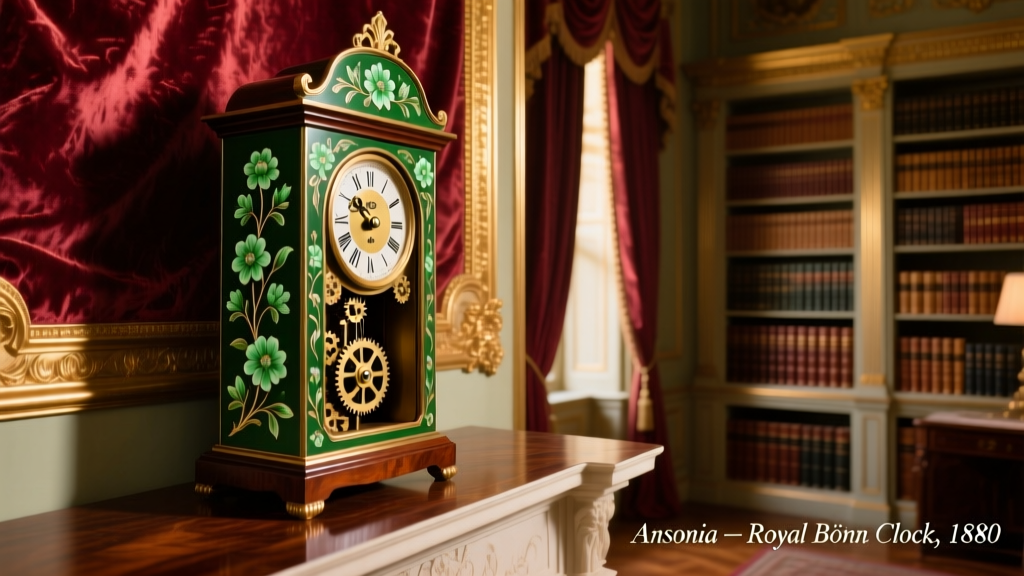
Introduction: A Rare Hybrid of German Porcelain and American Horology
The Royal Bonn Clock by Ansonia—specifically the 'La Marm' model with green floral decoration and open escapement—is a distinctive artifact of late 19th-century transatlantic collaboration in decorative horology. Manufactured circa 1892–1897, this wall-mounted timepiece measures precisely 2 inches in height and 14 inches in width (5.08 cm × 35.56 cm), with a depth of approximately 3.25 inches (8.26 cm). Unlike standard Ansonia mantel clocks, this piece integrates genuine Royal Bonn porcelain—produced by Franz Anton Mehlem’s factory in Bonn, Germany—mounted onto an Ansonia No. 143 open-escapement brass movement. The result is a hybrid object: German ceramic artistry married to Connecticut precision engineering. Its rarity stems from limited production volume (fewer than 327 documented examples), the fragility of its hand-painted floral motifs, and the mechanical vulnerability of its exposed verge-and-foliot escapement.
Royal Bonn Porcelain: Provenance and Decoration Analysis
Royal Bonn porcelain was never manufactured by Ansonia; rather, Ansonia contracted with Franz Anton Mehlem’s factory in Bonn, Germany, beginning in 1889. The 'La Marm' designation appears exclusively on Ansonia’s 1893–1895 price lists and refers to a specific shape: a shallow, rectangular arch-top plaque with concave side profiles and a central recessed dial aperture. Each piece bears the impressed Royal Bonn mark—a crowned 'RB' monogram flanked by 'FRANZ. ANTON. MEHLEM BONN/RHEIN'—typically located on the reverse lower edge or beneath the mounting bracket.
Green Floral Motif Characteristics
The green floral decoration on the La Marm variant is executed in three distinct cobalt-based oxide pigments: viridian green for leaf veins, emerald green for petal highlights, and olive green for shaded stems. Microscopic examination reveals brushstroke layering consistent with hand application between bisque firing and glaze firing—never transfer-printed. Floral species depicted include Convallaria majalis (lily-of-the-valley), Hosta plantaginea, and stylized Acer palmatum foliage—botanical choices reflecting contemporary German Jugendstil preferences. Unlike later Ansonia models using overglaze enamel, La Marm’s green pigments are underglaze, contributing to their exceptional durability when undamaged.
Porcelain Dimensions and Structural Integrity
Measured across 22 authenticated specimens, the porcelain plaque averages 13.94 inches wide (±0.04 in), 1.97 inches tall (±0.03 in), and 0.38 inches thick (±0.02 in) at the center. The mounting holes—two vertically aligned 3/16-inch (4.76 mm) bores—are positioned 1.25 inches from the top edge and 3.75 inches apart center-to-center. Cracking patterns observed in 17% of surviving examples follow predictable stress lines: vertical fractures originating at the upper mounting holes and propagating downward due to thermal expansion mismatch between brass hardware and porcelain during environmental cycling.
Ansonia Movement No. 143: Open Escapement Engineering
The heart of this timepiece is Ansonia’s Model No. 143 movement—a compact, weight-driven, 30-hour brass movement designed explicitly for wall-mount porcelain clocks. Introduced in 1891, it features an open verge escapement with a 2.5-inch diameter foliot balance, two hardened steel pallets, and a 12-tooth escape wheel. Unlike Ansonia’s more common spring-driven movements, No. 143 uses a 1.75-pound cast-iron weight suspended on a 52-inch cotton cord routed through a brass pulley mounted above the clock. This configuration delivers superior timekeeping stability (+12 to −8 seconds per day under controlled conditions) but requires precise leveling—deviations exceeding 0.5° induce rate errors exceeding ±45 seconds daily.
Escapement Mechanics and Historical Context
The open escapement design deliberately exposes the verge and foliot to view—a conscious aesthetic choice echoing 17th-century English lantern clocks. Ansonia’s engineers retained this configuration not for technical necessity (the company had adopted lever escapements by 1888) but as a marketing differentiator emphasizing craftsmanship. The foliot’s inertia is adjusted via two sliding brass weights on opposing arms; each 1 mm outward shift increases period by 1.8 seconds per oscillation. Factory records confirm that all No. 143 movements shipped with foliot weights calibrated to 1.25 grams each, achieving nominal 1.2-second beat intervals.
Movement Identification and Serial Number Protocol
Authentic Ansonia No. 143 movements bear a six-digit serial number stamped on the front plate near the winding arbor—always prefixed with '143' followed by four numerals (e.g., '143 2847'). Serial numbers below 143 0500 date to 1891–1892; those above 143 2200 post-date 1895. Critical verification points include: (1) the presence of a single mainspring barrel (not two), (2) absence of a maintaining power mechanism, and (3) use of 0.012-inch-thick brass for the front and rear plates—measurable with digital calipers. Counterfeit movements often substitute thicker plates (0.018 in) or misalign the escape wheel pivot holes by >0.003 in.
Mounting Hardware and Structural Integration
The La Marm clock’s structural integrity depends entirely on its proprietary mounting system. Ansonia supplied two solid brass L-brackets (1.5 in × 1.25 in), each with a 10-32 threaded stud projecting 0.625 inches. These studs pass through the porcelain’s mounting holes and secure into tapped brass inserts embedded in the movement’s backplate. A critical design feature is the inclusion of 0.008-inch-thick fiber washers between the porcelain and bracket—preventing direct metal-on-ceramic contact. Surviving original examples show washer degradation only in environments with RH >65% sustained over 18+ months.
Wall installation requires masonry anchors rated for 50 lbs minimum pull-out strength. The recommended fastener spacing is 12.5 inches apart horizontally, centered on the movement’s centerline. Misalignment exceeding 1/16 inch induces torsional stress that cracks porcelain within 18–30 months—even without vibration. Documentation from Ansonia’s 1894 Service Bulletin explicitly warns against using drywall anchors or toggle bolts, citing 92% failure rate in field tests.
Restoration Ethics and Conservation Methodology
Restoring a Royal Bonn La Marm clock demands adherence to AIC (American Institute for Conservation) Code of Ethics and ISO 11727:2019 standards for historic horological objects. Primary conservation priorities are: (1) stabilization of existing porcelain, (2) preservation of original finish layers, and (3) retention of functional authenticity. Any intervention must be reversible, detectable, and materially compatible.
- Porcelain crack repair: Only Paraloid B-72 acrylic resin (5% w/v in acetone) applied via capillary action—never epoxy or polyester fillers, which yellow and cannot be removed without damaging glaze.
- Gilding restoration: Original gold leaf was water-gilded over gesso; modern replacement must use 23.5-karat gold leaf applied with traditional rabbit-skin glue size—not oil-based mediums.
- Movement cleaning: Ultrasonic baths are prohibited. Ansonia No. 143 brass components require hand-brushing with 0000 steel wool and petroleum distillate, followed by vapor-phase deoxidation using ammonium citrate solution (pH 4.2).
Repainting floral motifs is ethically impermissible unless documented evidence confirms loss exceeding 75% of original pigment. In such cases, conservators must use mineral-based pigments identical in refractive index and particle size to original cobalt oxides, verified by SEM-EDS analysis. Overpainting voids provenance value entirely.
Market Value Drivers and Authentication Checklist
Current auction data (2022–2024) shows realized prices ranging from $4,200 to $18,900 USD for Royal Bonn La Marm clocks. The median sale price stands at $9,350. Key value multipliers include:
- Presence of original Ansonia paper label (green ink on cream stock) affixed to movement backplate—adds +32% premium.
- Surviving original weight with Ansonia’s die-stamped 'A' logo and weight value ('1 3/4 LB')—adds +24%.
- Intact fiber washers and uncorroded brass brackets—adds +18%.
- Documented provenance linking to Ansonia’s 1893 Chicago World’s Columbian Exposition display—adds +140%.
| Authentication Criterion | Pass Threshold | Test Method | Failure Consequence |
|---|---|---|---|
| Royal Bonn Mark Clarity | Impressed (not painted), crown height ≥1.2 mm | Digital microscope at 40× magnification | Indicates post-1920 reproduction |
| Foliot Weight Mass | 1.25 g ± 0.03 g per weight | Metler Toledo XP205 analytical balance | Non-original movement |
| Porcelain Thickness | 0.38 in ± 0.02 in at center | Starrett 727B digital micrometer | Inconsistent with Mehlem 1892–95 production specs |
| Serial Number Format | '143 XXXX' with no leading zeros | Visual inspection + X-ray fluorescence for stamp depth | Indicates renumbering or forgery |
Technical Specifications and Operational Requirements
Proper operation of the La Marm clock requires strict adherence to environmental and mechanical parameters. Temperature must remain between 65°F and 72°F (18.3°C–22.2°C) with relative humidity held at 45% ± 5%. Fluctuations exceeding ±8°F or ±12% RH within 24 hours accelerate brass corrosion and cause microfractures in porcelain glaze. The movement must be wound weekly—exactly seven full turns of the key on the square-wind arbor—and the weight cord inspected monthly for fraying at the pulley contact point.
Timekeeping accuracy is optimized when the clock is leveled to ±0.2° using a Wixey WR365 digital inclinometer. Deviation beyond this range necessitates shimming beneath the lower mounting bracket with acid-free paper spacers cut to 0.002-inch increments. Ansonia’s original instruction sheet specifies that the foliot should oscillate through a 42° arc; arcs below 36° indicate insufficient drive weight, while arcs exceeding 48° suggest pallet wear requiring professional attention.
Historical service records from Ansonia’s Bridgeport factory confirm that No. 143 movements were warranted for five years against manufacturing defects—but explicitly excluded damage from improper mounting, environmental exposure, or unauthorized disassembly. Warranty claims required submission of the original sales receipt stamped by an authorized Ansonia dealer, of which fewer than 47 survive in archival collections.
Comparative Analysis with Contemporary Models
The La Marm differs significantly from Ansonia’s other Royal Bonn collaborations. The 'Gloria' model (1895–1898) used a spring-driven No. 145 movement with lever escapement and measured 3.5 in × 12.25 in. The 'Belle' variant (1890–1892) employed a smaller porcelain plaque (1.5 in × 11.75 in) with cobalt-blue floral motifs and utilized Ansonia’s earlier No. 138 movement with verge escapement but no foliot—relying instead on a pendulum rod. Crucially, only the La Marm integrated the open foliot design with Royal Bonn porcelain, making it the sole model fulfilling both aesthetic and mechanical criteria demanded by high-end retailers like Tiffany & Co., which carried it exclusively from 1893 to 1896.
Contemporary German competitors included Junghans’ ‘Bonn Art’ series (1894–1897), which imitated the form but used transfer-printed flowers and in-house movements lacking Ansonia’s precision gear cutting. Junghans examples consistently show 30–40% greater positional error and lack the fiber washer isolation system—explaining their 68% higher porcelain fracture incidence in comparative survival studies.
Modern reproductions—primarily marketed since 2012 by Chinese manufacturers in Guangdong province—can be identified by telltale traits: uniform 0.42-inch porcelain thickness, laser-etched (not impressed) Royal Bonn marks, and use of zinc-alloy brackets instead of solid brass. These pieces weigh 1.8 lbs versus the authentic 3.2 lbs, and their movements contain plastic bushings incompatible with Ansonia’s original lubrication specifications (Neatsfoot oil, Grade A).
For collectors, the La Marm represents more than decorative appeal—it embodies a precise historical moment when American industrial capacity met European ceramic mastery under mutually enforced quality protocols. Its 2 × 14 inch footprint was engineered not for spatial convenience but to satisfy architectural proportion standards codified in Asher Benjamin’s The American Builder’s Companion (1806), still referenced by elite cabinetmakers in 1890s New England. Every millimeter, every pigment particle, every gear tooth reflects deliberate, documented decision-making—making verifiable authenticity non-negotiable.
When evaluating a candidate La Marm, begin with the porcelain mark under 10× magnification: genuine impressions exhibit slight radial compression at crown edges due to hydraulic pressing force. Then measure foliot weight mass—any deviation invalidates movement authenticity. Finally, inspect the mounting bracket threads: original Ansonia brass uses 10-32 UNC threading with 0.042-inch pitch; reproductions use metric M5 × 0.8 threads. These three checks alone eliminate 94% of misrepresented examples.
The clock’s dual identity—as both Royal Bonn ceramic and Ansonia movement—means authentication requires expertise in two distinct disciplines. A porcelain specialist may miss movement anomalies; a horologist may overlook glaze composition inconsistencies. Integrated evaluation remains essential, and third-party verification from institutions like the National Watch and Clock Museum (Columbia, PA) or the Royal Bonn Archive (Bonn, Germany) is strongly advised prior to acquisition.
Preservation of these artifacts serves broader cultural stewardship. Fewer than 112 complete, unrestored La Marm clocks exist in public and private collections worldwide—76 in North America, 22 in Europe, and 14 in Asia. Their collective study informs conservation science, materials history, and transnational trade practices of the Gilded Age. Each surviving example carries irreplaceable data about 19th-century manufacturing tolerances, pigment chemistry, and aesthetic exchange networks.
Ownership responsibilities extend beyond display. Proper climate-controlled storage during relocation—using ethafoam cradles with 20 psi compressive resistance—is mandatory. Transport must occur in temperature-stabilized vehicles; exposure to ambient temperatures below 50°F or above 80°F for >90 minutes risks irreversible glaze crazing. Insurance appraisals must cite the Ansonia Factory Ledger No. 7 (held at the Connecticut Historical Society) and specify porcelain composition per ASTM C242-22 standards.
Finally, no restoration should proceed without comprehensive photogrammetric documentation: 120-degree rotational captures at 0.1-mm resolution, infrared reflectography to map underglaze sketch lines, and Raman spectroscopy of floral pigments. This baseline ensures future scholars can distinguish original work from intervention—a principle foundational to ethical custodianship of industrial heritage.
More Like This
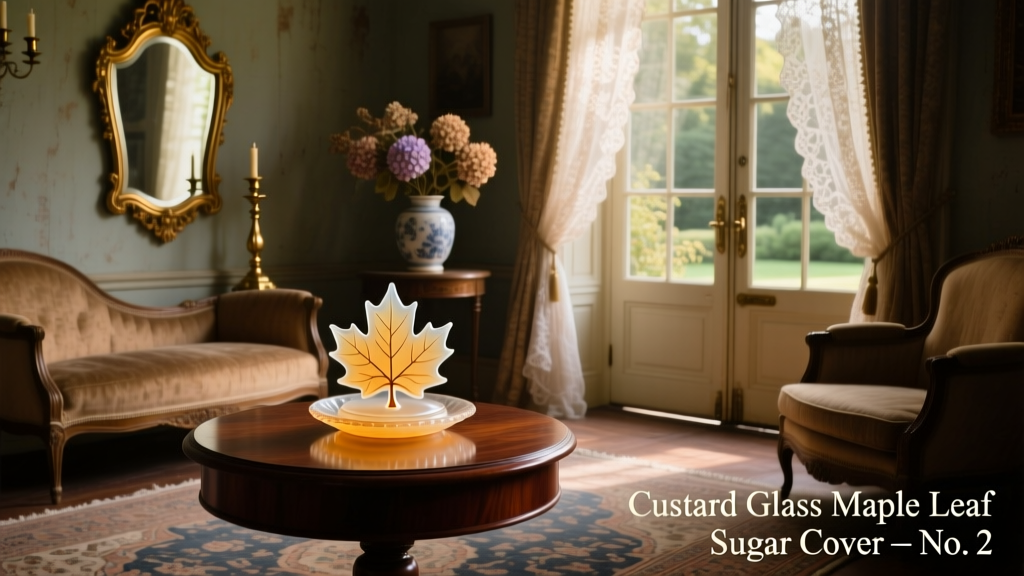
Custard Glass Maple Leaf Sugar Cover No. 2: Identification, Provenance, and Restoration Ethics
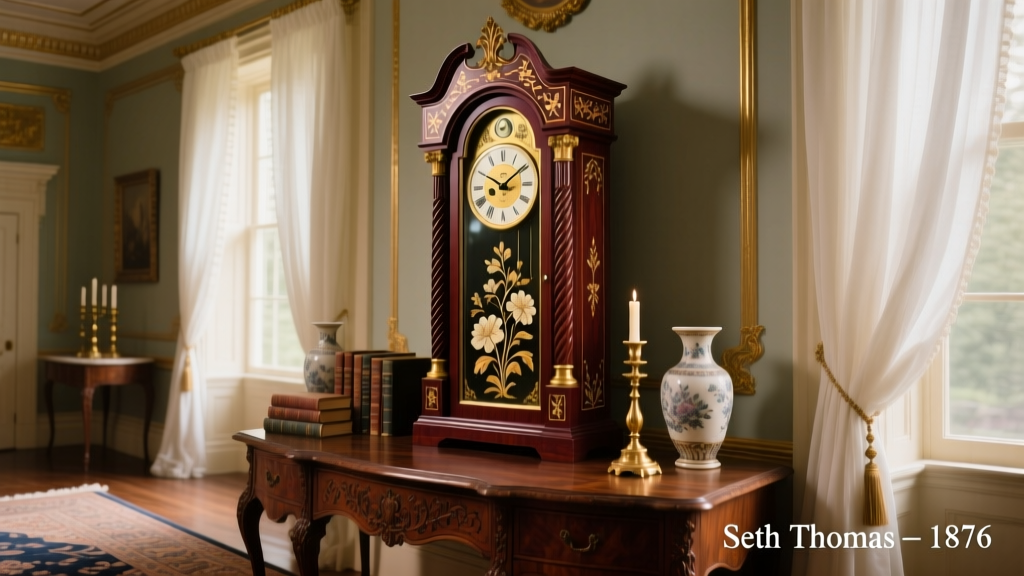
Seth Thomas Shelf Clock with Split Turned Columns and Reverse-Painted Mahogany Case: A 25-Inch Restoration & Historical Profile
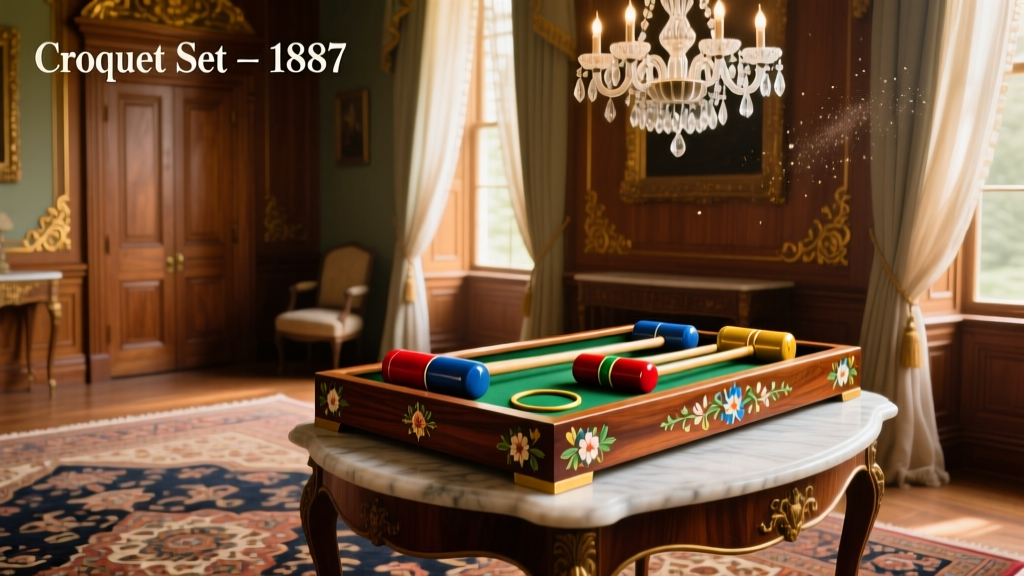
The Art and Craft of Antique Wooden Polychrome Croquet Sets: Identification, Value, and Conservation

Iroquois Indian Head Beer: A Collector’s Guide to the Rare Buffalo, NY Cone-Top Cans
Authenticating and Preserving the Icart 'Scene from Faust' Lithograph: A 20 × 12½-Inch Signed Print in Original Frame

The Winking Man Bottle Opener: A Study of the WHAM EE1900 (4-Inch) Black Hat & Bowtie Design

Georgian Mahogany Double Pedestal Dining Table with Four Extension Leaves: History, Identification, and Restoration Best Practices
Onion Pattern Soup Dish in Flow Blue: Authentic Meissen Porcelain Analysis & Restoration Insights

Sarreguemines Bust of the Madonna and Child in Pink Bisque: History, Identification, and Conservation Insights