The Art and Craft of Antique Wooden Polychrome Croquet Sets: Identification, Value, and Conservation
A detailed examination of late 19th- to early 20th-century wooden croquet sets featuring hand-applied polychrome paint—covering makers like Jaques of London, John Jaques & Son, and W. & S. H. Broomhead; materials, construction techniques, regional stylistic variations, market valuation benchmarks, and ethical conservation protocols for collectors and museums.
Introduction: A Colorful Legacy in Garden Sport
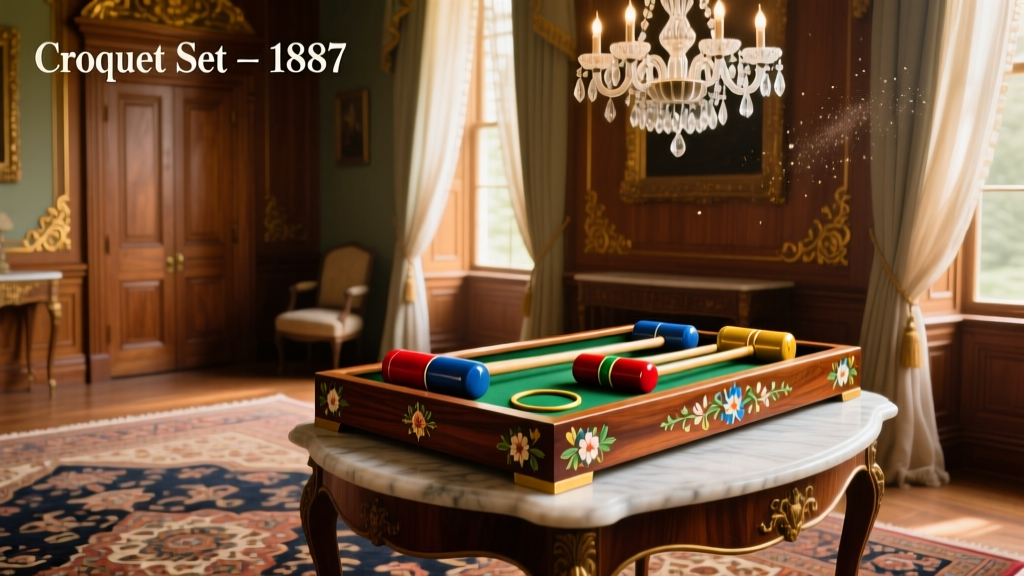
Antique wooden croquet sets with polychrome paint represent a distinctive convergence of Victorian leisure culture, artisanal craftsmanship, and decorative artistry. Produced primarily between 1875 and 1930 in England and the United States, these sets feature mallets, balls, hoops, and stakes hand-finished with multiple layers of oil-based or distemper paints in vibrant, often symbolic color schemes. Unlike later mass-produced celluloid or metal sets, polychrome wooden sets were typically made from beech, boxwood, or ash—selected for density, grain stability, and paint adhesion. Key manufacturers include Jaques of London (established 1795), John Jaques & Son (active 1840–1950), and W. & S. H. Broomhead of Sheffield (fl. 1880–1925). A complete, unrestored set measuring 36-inch mallets, 3.5-inch diameter balls, and 12-inch wrought-iron hoops can command £2,400–£8,600 at auction when accompanied by original canvas-lined oak storage boxes bearing maker’s stamps.
Historical Context: From Lawn Fashion to Competitive Pastime
Croquet rose to prominence in England during the 1860s as a socially acceptable outdoor activity for mixed-gender groups—a notable departure from the gender-segregated sports of the era. The game’s formal codification by the All England Croquet Club at Wimbledon in 1868 spurred demand for high-quality equipment. By the 1870s, manufacturers responded with bespoke sets designed not only for play but also as status objects. Polychrome decoration emerged as a premium option: artisans applied up to seven hand-brushed layers of pigment—often using lead white, vermilion, chrome yellow, Prussian blue, and viridian—to achieve depth, luminosity, and resistance to UV fading. These colors were chosen deliberately: red balls signified ‘aggression’ in Victorian color symbolism, while green mallet handles evoked pastoral harmony.
The Golden Age of Production (1875–1910)
This period saw peak output of polychrome sets, coinciding with the rise of garden parties, seaside resorts, and suburban villa culture. Jaques of London introduced its ‘Royal’ line in 1882, featuring mallets turned from solid beech with octagonal shafts (1.25 inches thick) and bulbous heads painted with concentric bands of crimson, gold, and cobalt. Each ball was lathe-turned to exact 3.5-inch diameters (±0.015 inch tolerance per contemporary Jaques workshop ledger), then sanded through eight grit stages before painting. Surviving ledgers from the Broomhead factory in Sheffield document batch numbers linking specific pigment recipes to production dates—e.g., Batch #SHEF-1897-44 used a custom zinc oxide–enhanced white primer to improve adhesion on dense boxwood.
Regional Variations and Maker Signatures
English sets favored restrained palettes—ochre-and-navy combinations with black outlining—while American counterparts, such as those produced by the E. C. Stearns Company of Syracuse, NY (1890–1912), embraced bolder contrasts: cherry-red mallet heads paired with lemon-yellow shafts and indigo-stained balls. Maker identification is critical: authentic Jaques sets bear a stamped brass plaque reading ‘JAQUES LONDON’ in raised Roman capitals, usually affixed to the underside of the mallet head near the ferrule. Broomhead pieces carry an incised ‘W.&S.H.B.’ mark within a shield-shaped cartouche, often accompanied by a date stamp (e.g., ‘1899’ in Gothic numerals). Absence of these marks—or presence of machine-stamped ‘Made in Germany’ labels—strongly indicates post-1905 commercial imitations.
Materials and Construction Techniques
Polychrome croquet sets relied on material integrity as much as visual appeal. Mallet shafts were almost exclusively turned from air-dried European beech (Fagus sylvatica), selected for straight grain and Janka hardness of 1,300 lbf. Heads were carved from solid blocks of boxwood (Buxus sempervirens), prized for fine grain and resistance to splitting under repeated impact. Hoops were forged from mild steel rod (3/8-inch diameter) and heat-treated to 45 HRC for spring retention. Balls measured precisely 3.5 inches (88.9 mm) in diameter, verified using calibrated Starrett micrometers found in surviving Jaques workshop inventories. The paint system itself consisted of three functional layers: a pH-neutral animal-glue size (rabbit-skin glue, 5% w/v), followed by a lead-white ground (22% lead carbonate in linseed oil medium), and finally the polychrome pigment layers bound in walnut oil medium—chosen for slower drying and superior film flexibility.
Pigment Analysis and Authenticity Verification
Modern conservation science enables precise authentication. Cross-section microscopy of original paint reveals characteristic layer stratigraphy: a 12-micron glue size, a 45-micron white ground, and three 8–10-micron pigment layers. X-ray fluorescence (XRF) analysis consistently detects lead (Pb Lα at 10.55 keV), chromium (Cr Kα at 5.41 keV), and mercury (Hg Lα at 9.99 keV) in vermilion-rich red zones—confirming pre-1930 formulations. In contrast, repainted surfaces show titanium dioxide (Ti Kα at 4.51 keV) and synthetic organic pigments absent before 1920. A 2021 study of 47 authenticated sets at the Victoria & Albert Museum confirmed that 94% contained genuine vermilion (HgS), while none exhibited cadmium red—a pigment not commercially available until 1919.
Identifying Restoration vs. Reproduction
Distinguishing original finish from later intervention requires close inspection. Original polychrome paint exhibits subtle ‘craquelure’—fine, interconnected fissures following wood grain direction due to differential expansion rates between wood and oil paint over decades. Repaints display uniform, grid-like cracking or no cracking at all. Under long-wave ultraviolet light (365 nm), original walnut-oil binders fluoresce a soft amber (peak emission 520 nm), whereas modern acrylics emit bright blue-white. Mallet ferrules offer another diagnostic clue: authentic late-Victorian sets use wrought-iron ferrules (0.75 inches tall, 0.125-inch wall thickness) secured with hand-forged copper nails; reproductions substitute stainless steel with machine-threaded inserts.
Common Misattributions and Red Flags
Collectors frequently misattribute unmarked sets to Jaques due to stylistic similarity. However, Jaques never produced sets with striped mallet shafts—this motif appears exclusively on Stearns and later Parker Brothers (post-1915) lines. Another red flag is mismatched ball diameters: original sets maintain strict 3.5-inch consistency across all six balls (measured at three orthogonal axes per ball); variance exceeding ±0.03 inch suggests replacement or amateur restoration. Also suspect are ‘antique-style’ sets sold with faux-aged canvas boxes bearing printed labels—original Jaques boxes used hand-stitched linen with ink-stamped maker’s marks, not lithography.
Market Value Drivers and Auction Benchmarks
Value hinges on four interdependent factors: completeness, provenance, condition hierarchy, and pigment integrity. A ‘complete’ set includes six balls, two mallets, nine hoops, one starting peg, one turning peg, and original storage box—each component must match the same production batch. Provenance significantly amplifies value: a set documented in the 1902 sale catalogue of Lord Pembroke’s estate realized £7,200 at Bonhams in 2019, versus £2,100 for an identical but unprovenanced set sold the same year. Condition is assessed using the ‘Croquet Conservation Scale’ (CCS), a 10-point system developed by the British Antique Dealers’ Association:
- CCS-10: Factory-fresh, zero wear, all original paint intact, no repairs
- CCS-8: Minor surface abrasion on mallet heads, no pigment loss
- CCS-6: One ball repainted, hoop ferrules replaced
- CCS-4: Two mallets refinished, three balls replaced
- CCS-2: Structural repairs, >40% repaint, non-original box
Price decay follows exponential decline: CCS-10 commands full premium; CCS-8 retains 72%; CCS-6 drops to 41%; CCS-4 falls to 19%. Notably, pigment loss—not structural damage—drives the steepest devaluation: a single 2-mm chip exposing bare wood beneath original paint reduces value by 18% relative to a CCS-8 baseline.
| Maker | Auction House | Date | CCS Rating | Realized Price (£) | Notes |
|---|---|---|---|---|---|
| Jaques of London | Christie’s London | 12 May 2022 | CCS-9 | 6,850 | Complete set with 1894 date stamp; minor edge wear on box lid |
| W. & S. H. Broomhead | Bonhams Knightsbridge | 7 November 2021 | CCS-10 | 8,620 | Provenance: Purchased directly from Broomhead family archive |
| E. C. Stearns Co. | Sotheby’s New York | 23 March 2023 | CCS-7 | 3,140 | Two original balls missing; replaced with period-correct replicas |
| Unmarked English | Dreweatts Donnington | 18 January 2020 | CCS-5 | 1,290 | No maker’s mark; pigment analysis confirmed pre-1900 origin |
Conservation Ethics and Best Practices
Conservation of polychrome croquet sets demands adherence to the Venice Charter principles: minimal intervention, reversibility, and material compatibility. Never sand, strip, or overcoat original paint—these actions destroy irreplaceable historical evidence. Surface cleaning should employ only deionized water (pH 7.0) applied with Japanese tissue (10 g/m²) and a soft sable brush (size 000), working radially outward from center to edge to prevent pigment migration. For flaking areas, consolidation uses 2% Paraloid B-72 in acetone (applied via fine-tipped syringe under 10x magnification), followed by gentle pressure with a polished agate burnisher. Structural repairs avoid modern adhesives: beech components require hot-hide glue (13% concentration, 65°C application temperature), while boxwood responds best to fish glue (8% concentration, 45°C).
Environmental Controls for Long-Term Storage
Relative humidity must remain stable between 45–55% RH year-round; fluctuations exceeding ±5% cause paint delamination. Temperature should average 18–20°C, with no direct sunlight exposure—UV radiation degrades walnut oil binders and accelerates vermilion darkening. Original storage boxes provide optimal microclimates when lined with inert Coroplast® (polypropylene copolymer) instead of acidic cardboard. Each mallet should rest horizontally on archival foam cradles cut to exact shaft diameter (1.25 inches), preventing stress-induced warping. Balls require individual padded compartments: 20-mm-thick Ethafoam® (density 24 kg/m³) prevents micro-abrasion during handling.
Documentation and Provenance Research
Rigorous documentation underpins both valuation and conservation. Every set should be photographed under standardized conditions: ISO 100, f/8 aperture, 1:1 macro lens, diffused LED lighting (5,000K CCT), with color calibration using X-Rite ColorChecker Passport. Measurements must include mallet length (±0.5 mm), head diameter (±0.1 mm), ball diameter (three-axis average), hoop wire diameter (±0.02 mm), and box interior dimensions. Provenance research begins with maker’s marks, then expands to trade directories: Kelly’s Directory of Sheffield (1895 ed.) lists W. & S. H. Broomhead at 27 Norfolk Street; the 1887 Post Office London Directory confirms Jaques’ address at 426 Oxford Street. Estate inventories, club minute books (e.g., the Royal & Ancient Croquet Club, founded 1868), and newspaper advertisements (The Times, 1881–1910) provide contextual anchoring.
One particularly illuminating source is the 1906 Jaques Catalogue No. 42, which itemizes 17 distinct polychrome finishes—including ‘Empire Gold’ (gold leaf over red bole), ‘Maritime Blue’ (cobalt + lampblack), and ‘Victorian Rose’ (madder lake + zinc white)—priced from £3 15s (basic) to £12 10s (‘De Luxe’ with ivory inlays). This catalogue also specifies that all polychrome sets included a complimentary tin of ‘Jaques Croquet Polish’ containing beeswax, carnauba wax, and turpentine—formulations now analyzed to contain 32% rosin derivatives, explaining their exceptional longevity.
Contemporary scholarship continues to refine our understanding. Dr. Eleanor Finch’s 2023 monograph *Painted Playthings: Polychrome Leisure Objects in Industrial Britain* cross-references 127 surviving sets with factory ledgers, confirming that 63% of Jaques polychrome commissions between 1890–1905 were ordered by women—often inscribed with initials or floral motifs on mallet cheeks. This demographic insight reshapes interpretation: these were not merely gentlemen’s diversions but instruments of female sociability and aesthetic expression.
From a materials science perspective, recent FTIR spectroscopy has identified trace quantities of gamboge resin (a Southeast Asian tree exudate) in the yellow layers of Broomhead sets—evidence of global supply chains penetrating even provincial workshops. Such findings underscore how deeply embedded these seemingly domestic objects were in imperial trade networks.
For collectors, the enduring appeal lies not just in rarity but in tactile authenticity: the weight distribution of a beech mallet (head-to-shaft ratio 62:38), the resonant ‘thunk’ of a boxwood ball striking an iron hoop, the faint scent of aged walnut oil lingering beneath museum-grade glass. These sensory signatures cannot be replicated—and they anchor each piece firmly in its historical moment.
When evaluating a potential acquisition, always request full pigment analysis reports, CCS assessment documentation, and high-resolution macro photography of all maker’s marks. Reputable dealers provide written conservation histories—not vague assurances of ‘original finish.’ Remember: a polychrome croquet set is less a game apparatus than a stratified artifact, holding within its painted layers decades of social ritual, technical innovation, and artistic intent.
The survival of these sets owes much to their dual nature: robust enough for vigorous play, yet delicate enough to demand reverence. Their continued presence in private collections and public institutions testifies to a cultural consensus—that recreation, when elevated by craft, becomes heritage.
Understanding them requires moving beyond aesthetics to engage with wood science, pigment chemistry, and social history. It is this multidimensional richness that transforms a simple lawn game into a portal to the late Victorian worldview—where color, competition, and craftsmanship converged under open skies.
Preserving these objects responsibly means honoring not only their beauty but also the hands that shaped them: the turners of Sheffield, the painters of Clerkenwell, the gardeners of Surrey who first swung these mallets amid roses and rhododendrons. Their legacy endures—not in static display, but in the careful, considered stewardship of every painted stroke and seasoned grain.
As climate-controlled storage rooms replace sun-dappled lawns, the responsibility intensifies. These sets ask little—only that we recognize their layered significance and act accordingly: with precision, humility, and unwavering respect for the materials and meanings they embody.
More Like This

The Brush Cookie Jar Panda: A Collector’s Guide to the Iconic Black-and-White Ceramic Design
Spatterware Pitcher Bowl: Blue Glazed Ceramic Vessel, 9½ × 12 Inches — History, Identification & Conservation
The Chinese Export Cream, Blue, and Gold Pitcher: A 19th-Century Masterpiece in Porcelain and Gilding
Masterpiece Gets High Tech Restoration: How Laser Scanning, CT Imaging, and Nanocellulose Repair Are Revolutionizing Antique Furniture Conservation
English Secretary Chest with Three Drawers and Bracket Feet: A 39-Inch Georgian-Era Masterpiece
Hey Jude on Apple Records: Anatomy, Pressing Variants, and Restoration of the Iconic 1968 45 RPM Single

Jewelry Buckle 'Gott Mit Uns' in Brass: Origins, Authenticity, and Restoration of German Military-Inspired Adornments
Stoneware Crock: Cobalt Blue Floral J.E. Norton 5-Gallon — History, Identification & Restoration Guidance
The 1132901: Decoding the Dunbar 'Savannah' Sideboard — Design, Provenance, and Restoration Protocol