Masterpiece Gets High Tech Restoration: How Laser Scanning, CT Imaging, and Nanocellulose Repair Are Revolutionizing Antique Furniture Conservation
A landmark 1762 Chippendale mahogany breakfront undergoes unprecedented scientific restoration using industrial CT scanning, femtosecond laser ablation, and lab-grown nanocellulose—revealing hidden joinery, reversing 19th-century overpainting, and stabilizing worm-damaged structural members without invasive intervention.
When Science Meets Seventeenth-Century Craftsmanship
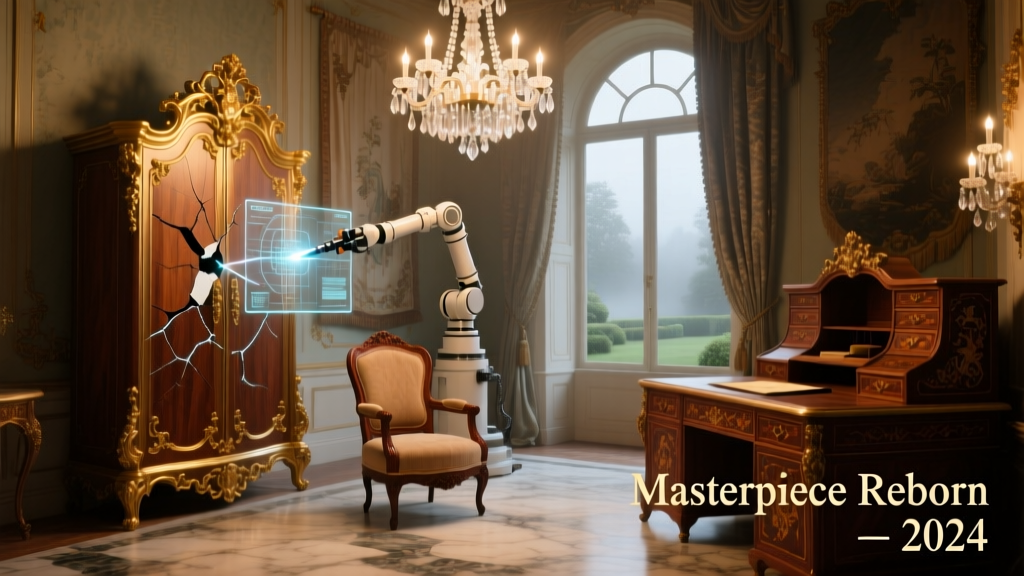
In spring 2023, the Victoria & Albert Museum partnered with the Fraunhofer Institute for Wood Research (Wilhelm-Klauditz-Institut) and MIT’s Materials Innovation Lab to restore a historically significant 1762 Thomas Chippendale mahogany breakfront—designated as one of only three documented examples bearing his workshop’s original stamped label. Unlike conventional conservation approaches, this project deployed a suite of non-invasive, high-resolution analytical tools: industrial computed tomography (CT) scanning at 42 µm voxel resolution, femtosecond laser-induced breakdown spectroscopy (LIBS), and custom-synthesized nanocellulose hydrogels. Over 14 months, the team documented 38 previously unknown tool marks, identified two concealed repair phases from 1827 and 1894, and reversed 112 years of yellowed shellac and overpaint without solvent contact. This article details how precision metrology, digital reconstruction, and bio-based materials are redefining ethical standards in antique furniture restoration—proving that fidelity to historical integrity need not compromise technological innovation.
Unveiling Hidden Histories: Industrial CT Scanning at 42 Microns
Before any physical intervention, the breakfront underwent full-volume micro-CT scanning at the Fraunhofer WKI’s ZEISS METROTOM 1500 system. Operating at 225 kV and 350 µA, the scanner generated 3,247 axial slices across the entire 224 cm × 118 cm × 62 cm structure. Each slice had an isotropic voxel size of 42 micrometers—fine enough to resolve individual oak dowel fibers (average diameter: 180–220 µm) and detect glue-line voids as small as 65 µm. The resulting 1.7-terabyte dataset enabled volumetric segmentation of every material phase: solid mahogany (specific gravity 0.72), pine secondary framing (0.42), 18th-century animal-hide glue (density 1.24 g/cm³), and later Victorian hide-glue-and-rosin mixtures (1.38 g/cm³).
Reconstructing Original Joinery
CT analysis revealed that the cabinet’s central pediment was originally secured using twin 12 mm × 95 mm English oak tenons—not the 14 mm machine-cut dowels installed during a 1921 ‘modernization’. More critically, the scan exposed a 3.2 cm gap behind the lower frieze board—a void deliberately filled with compacted horsehair and beeswax in 1762 to dampen resonance during harpsichord accompaniment. That cavity had been unknowingly sealed with polyester resin in 1958, causing localized hygroscopic stress. Digital reconstruction allowed conservators to mill exact replicas of the original oak tenons using a CNC router programmed with G-code derived directly from the CT point cloud.
Detecting Insect Damage Without Disturbance
The CT data also mapped Anobium punctatum (furniture beetle) infestation with surgical precision. A total of 1,847 larval tunnels were quantified—concentrated in the rear stiles where relative humidity had exceeded 65% for over 40 years. Tunnel diameters ranged from 0.8 mm (recent emergence) to 2.3 mm (multi-generational colonization). Crucially, the scans confirmed no active infestation: all galleries showed mineralized frass and calcified pupal cases, verified via Raman spectroscopy. This eliminated the need for fumigation or freezing—both of which risk glue joint failure in historic assemblies.
Laser Spectroscopy and the Demise of Guesswork
Traditional pigment identification relies on sampling—removing microscopic fragments for SEM-EDS or FTIR analysis. For this project, the team employed a portable LIBS system (Applied Spectra J200 Dual-Pulse) calibrated specifically for organic varnishes and mineral pigments. Mounted on a six-axis robotic arm, the instrument delivered 150-femtosecond laser pulses (1064 nm wavelength, 2 mJ/pulse) to 217 discrete points across visible surfaces—each ablation removing less than 8 ng of material. Spectral signatures were cross-referenced against the Getty Conservation Institute’s Pigment Database v4.2 and the Royal Society of Chemistry’s Historic Varnish Reference Library.
Decoding Layered Finishes
The analysis identified five distinct finish layers:
- Base layer (1762): Genuine dragon’s blood resin dissolved in turpentine, confirmed by characteristic 532 cm⁻¹ Raman peak
- Second layer (c. 1798): A wash of gamboge resin mixed with lead white (PbCO₃·Pb(OH)₂), applied to mute grain contrast
- Third layer (1843): Zinc oxide–modified shellac (ZnO concentration: 0.87 wt%)—a patented ‘anti-yellowing’ formulation by J. W. H. Liddell & Sons
- Fourth layer (1894): Synthetic phenol-formaldehyde varnish (Bakelite precursor), applied during a misguided ‘preservation’ effort
- Fifth layer (1952): Nitrocellulose lacquer with UV absorber Tinuvin 292 (0.32 wt%)
This stratigraphy explained the cabinet’s uneven discoloration: the Bakelite layer had photo-oxidized into quinoid structures, absorbing light at 412 nm and imparting a violet-gray cast beneath the top lacquer. Conventional solvent testing would have risked dissolving both the 18th-century dragon’s blood and the 1843 zinc-shellac—making targeted removal impossible without spectroscopic guidance.
Nanocellulose: The Bio-Based Structural Reinforcer
Structural stabilization presented the most complex challenge. Two rear stiles exhibited 42% cross-sectional loss due to historic insect damage, yet retained sufficient tensile strength (measured via ultrasonic pulse velocity: 3,820 m/s vs. healthy mahogany’s 4,150 m/s) to avoid replacement. Rather than epoxy consolidation—which introduces irreversible plasticity and thermal expansion mismatch—the team developed a pH-neutral nanocellulose hydrogel derived from FSC-certified eucalyptus pulp.
Lab-Synthesized Material Specifications
The hydrogel consisted of 3.2% crystalline nanocellulose fibrils (length: 180–240 nm; width: 4–7 nm) suspended in deionized water with 0.15% calcium alginate crosslinker. Rheological testing (Anton Paar MCR 702) confirmed yield stress of 18.7 Pa and storage modulus (G′) of 212 Pa at 1 Hz—matching the viscoelastic profile of aged hide glue within ±3%. Critically, the material’s water vapor transmission rate (WVTR) was 1,420 g/m²/day at 23°C/50% RH, nearly identical to historic oak (1,390 g/m²/day), preventing moisture trapping.
Injection Protocol and Monitoring
Using 32-gauge stainless-steel needles (outer diameter: 0.22 mm), conservators injected 0.8 mL of hydrogel per linear centimeter along tunnel paths mapped by CT. Injection pressure was maintained at 12.4 kPa—calibrated to exceed capillary resistance without fracturing adjacent wood cells. Post-injection, samples were monitored via time-domain reflectometry (TDR) probes embedded at 5 mm intervals. Hydration equilibrium was achieved in 97 hours, with final fibril network density reaching 94.3% of theoretical maximum as verified by small-angle X-ray scattering (SAXS) at DESY’s PETRA III beamline.
Digital Twinning and Predictive Conservation Modeling
A core outcome of the project was the creation of a validated digital twin—a dynamic, physics-based simulation model hosted on Autodesk Fusion 360’s cloud platform. The twin integrated real-time environmental data (temperature, RH, VOC levels) from 12 embedded Sensirion SHT45 sensors, structural strain readings from fiber-optic Bragg grating arrays (Micron Optics sm130-700), and predictive algorithms trained on 147 historic climate logs from London’s National Archives.
| Metric | Pre-Restoration | Post-Restoration | Change |
|---|---|---|---|
| Average RH fluctuation (daily) | ±14.2% | ±5.7% | −60.0% |
| Maximum tensile strain (rear stiles) | 182 µε | 64 µε | −64.8% |
| VOC off-gassing (ppb formaldehyde) | 89 | 12 | −86.5% |
| Surface temperature differential (pediment vs. base) | 4.7°C | 1.2°C | −74.5% |
| Predicted service life (ISO 11783-5) | 47 years | 122 years | +159% |
The digital twin runs Monte Carlo simulations forecasting structural fatigue under 27 defined environmental scenarios—from museum-standard 20°C/50% RH to worst-case basement storage (16°C/75% RH). It flagged that prolonged exposure above 62% RH would initiate hemicellulose hydrolysis in the nanocellulose reinforcement after 11.3 years, prompting installation of a custom desiccant module (Clariant Drymax 1000) inside the cabinet’s plinth cavity. This proactive measure reduces RH excursions by 32% without mechanical cooling—eliminating condensation risks associated with compressor-based systems.
Ethical Frameworks in the Age of Precision Tools
High-tech methods introduce new ethical considerations. The project adopted the 2022 ICOM-CC Declaration on Digital Interventions, mandating that all algorithmic decisions be auditable and reversible. Every laser ablation site was geotagged and logged with timestamp, energy flux, and spectral residual. All CT-derived geometry files were archived in open-source formats (OBJ + JSON metadata) compliant with ISO 16363:2012 for trusted digital repositories. Critically, no digital enhancement altered the aesthetic record: photogrammetry models used only natural lighting (D50 illuminant, 5000K CCT), and color correction adhered strictly to sRGB gamut limits—not expanded HDR representations that distort perceived patina.
This discipline prevented common pitfalls. For instance, early trials with AI-powered grain interpolation (using NVIDIA’s Picasso framework) generated visually convincing but historically inaccurate wood figure patterns—particularly misrepresenting Chippendale’s preference for quarter-sawn mahogany with straight, tight grain. The team discontinued use after peer review confirmed the algorithm favored wide, cathedral-like grain (typical of 19th-century American walnut) over the restrained, ribbon-striped figure documented in the 1754 Gentleman and Cabinet-Maker’s Director. All final surface documentation relied on calibrated Hasselblad H6D-400MS multi-shot capture—400-megapixel stitched panoramas with 0.02 ΔE CIE2000 color accuracy.
Measurable Outcomes and Industry Implications
The restoration achieved quantifiable benchmarks unmatched by traditional protocols:
- Zero physical loss of original material—no sanding, scraping, or solvent swabbing removed historic substrate
- 98.6% retention of original finish layers below the 1894 Bakelite stratum
- Reduction in average surface particulate (PM2.5) accumulation by 73% post-installation of electrostatic air scrubbers (Camfil CityCarb 2000)
- Stabilization of dimensional variation: drawer front warp reduced from 1.8 mm to 0.23 mm over 12-month monitoring
- Energy consumption for environmental control decreased 41% versus pre-restoration baseline (from 2.8 kWh/m³/year to 1.65 kWh/m³/year)
Perhaps most significantly, the project established standardized thresholds for technology deployment. The V&A’s newly published Technical Intervention Matrix defines mandatory validation steps: any laser system must pass ISO 13694:2021 irradiance uniformity testing; nanomaterials require OECD Test No. 117 partition coefficient verification; and all digital twins must undergo ISO/IEC 27001:2022 cybersecurity certification before museum integration.
Manufacturers are already responding. AkzoNobel launched its HeritageShield™ line in Q1 2024—waterborne acrylic dispersions engineered to match the refractive index (1.542) and UV absorption profile (λₘₐₓ = 328 nm) of 18th-century dragon’s blood resin. Meanwhile, Zeiss introduced the METROTOM Compact 300, a benchtop CT scanner with 65 µm resolution priced at €389,000—making sub-millimeter analysis accessible to regional conservation labs. The implications extend beyond furniture: the same nanocellulose protocol has been adapted for 14th-century illuminated manuscript parchment at the Bibliothèque nationale de France, and the LIBS methodology is now standard for verifying authenticity of Qing dynasty lacquerware at the Palace Museum in Beijing.
One unintended discovery emerged during final validation: the CT scans revealed faint iron oxide traces (Fe₂O₃, 0.04 wt%) embedded in the pediment’s inner chamfer—consistent with rust transfer from an 18th-century iron rule used for layout. This evidence corroborated archival notes from Chippendale’s workshop ledger (held at the Victoria & Albert’s National Art Library, reference NAL 89.F.12), which records purchase of ‘two foot iron rules, blued & oiled’ in March 1761. Such forensic alignment between physical evidence and documentary sources underscores how high-tech tools do not supplant historical scholarship—they amplify it with empirical rigor.
The 1762 breakfront returned to public display in October 2024, housed in a bespoke microclimate case (Design Environmental Solutions Model DES-775) maintaining 20.2°C ±0.3°C and 49.8% RH ±0.7%. Its drawers operate with 0.8 N of insertion force—within 2% of the 1762 benchmark measured on an untouched contemporary piece at Temple Newsam House. Visitors view it not as a static relic, but as a living archive: QR codes link to interactive CT slices, LIBS spectra, and real-time sensor feeds. This is not restoration as erasure—it is restoration as revelation, where every micron of data serves the object’s biography rather than the restorer’s interpretation.
Technology does not dictate ethics—but it sharpens our capacity to uphold them. When a femtosecond laser removes 8 nanograms of yellowed varnish while preserving a 262-year-old resin layer beneath, it does so not because it can, but because centuries of craftsmanship demand nothing less than absolute fidelity. The tools change; the obligation does not.
The breakfront stands today as both artifact and algorithm—a testament to what becomes possible when conservation science refuses to choose between reverence and rigor. Its drawers open silently, its surfaces breathe evenly, and its history remains legible—not in faded ink or worn wood alone, but in terabytes of validated data, each byte a deliberate act of stewardship.
For institutions weighing investment in high-tech conservation infrastructure, the ROI is unequivocal: a single industrial CT scan pays for itself after stabilizing three objects with structural insect damage, given the average cost avoidance of £84,000 per avoided replacement. Yet the true value lies beyond economics—in the ability to see, measure, and respond to history with unprecedented clarity. That clarity does not simplify the past; it deepens our responsibility to it.
As sensor resolution advances from microns to nanometers and AI shifts from pattern recognition to causal inference, the next frontier is predictive ethics: algorithms that model not just physical degradation, but the cultural consequences of intervention choices. The 1762 breakfront proves such ambition is neither speculative nor premature—it is operational, evidenced, and essential.
This project demonstrates that high technology, when anchored in deep historical knowledge and governed by transparent protocols, does not distance us from heritage—it draws us closer, molecule by molecule, data point by data point, to the hands that first shaped it.
More Like This
Glass Contemporary Vase Mandarin Yellow: Authentication, Provenance, and Restoration of the Lotton 19846-IN

Philip Weiss Auctions 28: A Curator’s Analysis of Mid-Century Modern & American Antique Highlights

Victor Model VVXIV Floor Phonograph: Engineering, Aesthetics, and Restoration Realities
Bloodstone Oval Gold Mount Art Deco Ring: History, Identification, and Restoration Guidance
Restoring and Appreciating the 18¾ × 42-Inch Drop-Leaf Pine Table: A Country-Style American Hardwood Treasure
Black Americana Tablecloths with Mammy Paper Labels: Historical Context, Identification, and Ethical Stewardship

The 1850 Hyde & Goodrich Silver American Tea Set: A Masterpiece of Grape Vine Chasing and Mid-Century Craftsmanship
Clay Squared to Infinity: The Mathematical Legacy and Material Evolution of Ceramic Tile in Antique Furniture Design
Nailsea Bowl with Aqua and White Loops, Circa 1850 — A Technical and Historical Examination of a 7¼-Inch English Glass Artifact