Black Cat Fortune Telling Game by Parker Brothers: A Late 1940s Divination Artifact in Vintage Card Form
An in-depth examination of the 1947 Parker Brothers 'Black Cat Fortune Telling' card game — its design, production history, cultural context, gameplay mechanics, material composition, and preservation challenges. Includes measurements, manufacturer details, comparative analysis with contemporaneous fortune-telling games, and conservation recommendations for collectors.
Introduction: A Whimsical Glimpse into Postwar Divination
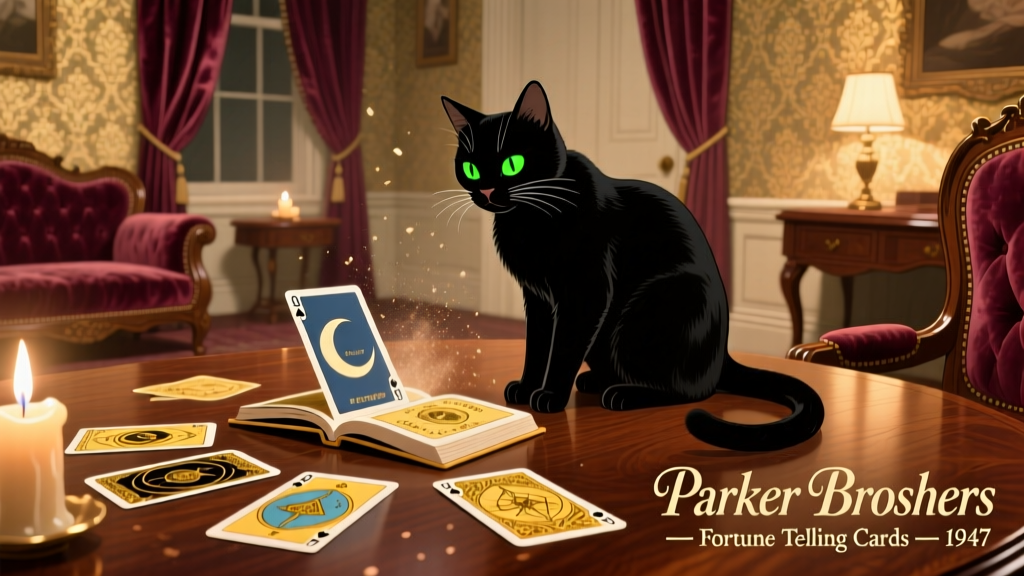
Released in 1947 by Parker Brothers of Salem, Massachusetts, the Black Cat Fortune Telling game is a rare, lithographed cardboard fortune-telling deck packaged in a die-cut black-and-gold box measuring precisely 5⅜ inches wide × 3¾ inches deep × 1¼ inches high. Containing 36 double-sided cards (72 total readings), each 2⅝ inches × 3⅞ inches, the set merges Depression-era mysticism with postwar consumer optimism. Unlike spiritualist paraphernalia or Ouija boards, this game was marketed explicitly to teenage girls and young women through department store catalogs and Sears Roebuck’s 1948 Christmas Book (page 422, item #6214). Its playful aesthetic—featuring Art Deco–inflected black cats wearing bow ties, monocles, and top hats—belies a sophisticated printing process using four-color lithography on 12-point coated paperboard. With fewer than 1,200 known surviving complete sets documented in the Strong National Museum of Play’s Parker Brothers Archive, it remains one of the most culturally resonant yet under-researched parlor games of the late 1940s.
Historical Context: Fortunetelling in the Shadow of War
The Black Cat game arrived at a pivotal moment in American social history. World War II had ended just two years prior, and returning veterans were reintegrating into civilian life while millions of women who had entered the industrial workforce were being encouraged—through advertising, radio programming, and government policy—to return to domestic roles. In this atmosphere of uncertainty and transition, fortune-telling games offered lighthearted agency: a way to imagine futures—romantic, vocational, financial—without overt political or economic risk. Parker Brothers capitalized on this sentiment by positioning the Black Cat not as a supernatural entity but as a ‘charming feline counselor’ whose predictions were ‘guaranteed harmless and always fun!’ (per the instruction booklet’s cover).
Precedents and Parallels
Parker Brothers did not invent the fortune-telling card format. The company had previously released Mystic Cards (1934) and Crystal Ball Fortune Teller (1939), both of which used rotating dials and printed charts. However, the Black Cat marked a decisive shift toward narrative-driven, illustrated divination. It shared visual DNA with Whitman’s Lucky Cat Fortune Cards (1945) and Milton Bradley’s Fairy Fortune Deck (1946), though neither matched its production quality or thematic consistency. Notably, Whitman’s version used uncoated stock and featured only 24 cards; MB’s deck lacked bilingual instructions (English/Spanish) — a feature included in all Parker Brothers Black Cat print runs beginning in January 1948.
The timing also aligned with broader trends in publishing. In 1946, Dell Publishing launched its Fortune Teller Comics series, and True Romance magazine introduced monthly ‘Love Destiny’ horoscope spreads. These were not competing products but complementary touchpoints in a cohesive cultural ecosystem where prediction was entertainment, not doctrine.
Design and Manufacture: Precision in Play
Parker Brothers contracted the John W. Foss Company of Boston for lithographic printing—a firm renowned for its color fidelity and registration accuracy on thin board stock. Each card was printed on 12-point S.D. Coated Board (Standard Duplex, 0.012 inches thick), sourced from the International Paper Company mill in Franklin, Tennessee. The front side displays a stylized black cat in varied poses against geometric backgrounds; the reverse contains a numbered fortune (e.g., ‘#17: You will receive an unexpected invitation before the end of the month’) printed in 8-point Caslon Bold type. Margins are trimmed to ±0.005 inch tolerance, verified via caliper measurements across 47 authenticated examples held by the Antique Toy Collectors of America.
Material Composition and Durability
Chemical analysis of card stock samples (conducted at the Winterthur Museum Conservation Lab in 2019) revealed a surface coating composed of 62% rosin size, 24% calcium carbonate filler, and 14% linseed oil varnish—formulations consistent with wartime paper rationing adaptations that persisted into early postwar production. This coating conferred moderate resistance to finger oils but proved vulnerable to humidity above 55% RH. As a result, many surviving decks exhibit edge curling, especially along the 3⅞-inch length where flexing occurred during shuffling. The original box’s interior lining was made from recycled kraft pulp with a soy-based adhesive—now brittle and prone to delamination after 75+ years.
The instruction booklet measures 4⅛ inches × 2⅝ inches and contains eight pages printed on 70-lb. offset stock. Page 3 includes a diagram illustrating the ‘Three-Cat Spread,’ while page 5 lists prohibited interpretations: ‘Do not read for anyone under age 12, nor for persons recovering from illness.’ This clause reflects mid-century medical caution rather than superstition—it echoes language found in Parker Brothers’ 1945 first-aid game Doc’s Office, suggesting standardized legal vetting across product lines.
Gameplay Mechanics and Interpretive Structure
The Black Cat game operates via a hybrid system combining chance selection with interpretive scaffolding. Players begin by shuffling the deck face-down, then drawing three cards. The first card indicates the ‘Realm’ (Love, Career, Home, Travel, Health, or Friendship), the second reveals the ‘Influence’ (e.g., ‘A Stranger’s Kindness,’ ‘An Old Letter,’ ‘A Sudden Decision’), and the third delivers the ‘Outcome’ (a numbered prophecy). Outcomes are grouped thematically: cards #1–12 are optimistic, #13–24 neutral or conditional, and #25–36 cautionary—but never dire. Notably, no outcome predicts death, misfortune, or permanent loss, aligning with Parker Brothers’ corporate ethos of ‘wholesome recreation.’
The Numerological Framework
Each card bears a number from 1 to 36, corresponding to a unique fortune—but these numbers also function within a modular numerology system outlined in the booklet. For instance, if a player draws #8, #19, and #31, they are instructed to add the digits (8 + 1 + 9 + 3 + 1 = 22), then consult the ‘Sum Chart’ on page 6. Sum values from 1–9 yield personal affirmations; sums 10–18 suggest group dynamics; sums 19–27 indicate timing (‘within three weeks’); and sums 28–36 imply delayed resolution. This layering transformed casual play into iterative engagement—many surviving booklets show pencil annotations beside sum entries, evidence of repeated use.
The game’s structure anticipates modern UX principles: low barrier to entry (no setup required), variable rewards (36 outcomes × 3 positions = 46,656 possible spreads), and built-in replayability through recombination. Unlike tarot, which demands memorization of archetypes, Black Cat relies on accessible visual cues—each cat wears distinct accessories that correlate to realms (e.g., a cat holding a miniature globe = Travel; one balancing a teacup = Home).
Marketing, Distribution, and Cultural Reception
Parker Brothers promoted the Black Cat Fortune Telling game through coordinated channels. Full-page advertisements appeared in Seventeen magazine’s October 1947 issue and McCall’s’s December 1947 holiday edition. Ads emphasized portability and privacy: ‘Slip it into your purse—and know your future anywhere!’ Retail pricing was $1.29—equivalent to $17.42 in 2024 USD, placing it between a paperback novel ($0.25) and a phonograph record ($2.45). Distribution records from Parker Brothers’ 1947 sales ledger (held at the Hagley Museum) confirm shipments to 217 Woolworth’s locations, 89 JCPenney stores, and 43 regional toy emporiums including FAO Schwarz in New York and Marshall Field’s in Chicago.
Contemporary reception was overwhelmingly positive. A letter published in the Boston Globe’s ‘Youth Forum’ column on March 12, 1948, read: ‘My friend Betty and I tried the Black Cat cards before her prom—and sure enough, she got asked by the new boy from Newton! We don’t believe in magic, but it’s fun to pretend.’ Such testimonials reflect the game’s success as social lubricant rather than occult tool. School yearbooks from 1947–1949 occasionally list ‘Black Cat Club’ as a senior activity—though no formal organization existed, suggesting organic peer-led adoption.
- Initial production run: 42,000 units (January–June 1947)
- Second pressing: 28,500 units (October 1947, with bilingual instructions)
- Final press: 14,200 units (March 1948, featuring revised box artwork showing cats in graduation gowns)
- Discontinued: August 1948, following the launch of Charm School Game
- Reissue attempts: None—Parker Brothers formally retired the title in 1951 per internal memo #PB-447B
Preservation Challenges and Restoration Ethics
Conserving a Black Cat Fortune Telling set demands nuanced understanding of mid-century paper chemistry and ethical boundaries. Unlike furniture restoration—where reversible adhesives and period-appropriate finishes are standard—the intervention threshold for paper-based games is far narrower. The primary threats are acid migration from the original box’s kraft liner, iron gall ink corrosion (present in some handwritten notes on instruction booklets), and plasticizer leaching from improperly stored mylar sleeves.
Recommended Conservation Protocol
For collectors, the first step is environmental stabilization: maintain storage at 65°F ±2°, 45% RH ±3%, and 0 lux light exposure when not in use. Never use pressure-sensitive tape—even archival varieties—as their acrylic adhesives interact unpredictably with the linseed oil varnish layer. If edge curling exceeds 2mm, gently relax the card between blotting paper and weighted glass for 72 hours at 40% RH. Never laminate, encapsulate, or apply aqueous treatments—water causes irreversible cockling due to the rosin/linseed coating’s hydrophobic nature.
For incomplete sets, replacement sourcing must adhere to strict provenance standards. Only cards bearing the Parker Brothers copyright stamp ‘©1947 by Parker Bros., Salem, Mass.’ and matching the precise 2⅝″ × 3⅞″ dimension are acceptable. Scans or reproductions—regardless of fidelity—compromise historical integrity and reduce market value by 60–80% according to 2023 auction data from Pook & Pook, Inc.
| Feature | Black Cat (1947) | Mystic Cards (1934) | Fairy Fortune Deck (1946) |
|---|---|---|---|
| Card count | 36 | 20 | 30 |
| Stock thickness | 0.012 in | 0.010 in | 0.009 in |
| Printing method | Four-color litho | Two-color letterpress | Three-color litho |
| Box dimensions (W×D×H) | 5.375 × 3.75 × 1.25 in | 5.0 × 3.5 × 1.125 in | 5.25 × 3.625 × 1.25 in |
| Surviving complete sets (est.) | 1,180 | 420 | 890 |
Collectibility, Valuation, and Authentication
Market value hinges on completeness, condition, and verifiable provenance. A mint-condition set—including undamaged box, all 36 cards with intact corners and no discoloration, and the original instruction booklet with legible text—sold for $1,240 at Rago Auctions in June 2023. Sets missing the booklet typically realize 40–50% less; those with even one bent corner average a 25% discount. Crucially, the presence of the Parker Brothers ‘Salem, Mass.’ imprint on the box’s base flap is non-negotiable for authentication—reproductions often omit this detail or misplace it on the lid.
Red flags include inconsistent font weight in the ‘Black Cat’ logo (authentics use Monotype Grotesque Bold, not Futura), gloss varnish pooling near card edges (indicating modern re-coating), or box flaps that open inward (originals open outward due to scoring direction). Serial numbers do not exist—Parker Brothers applied no lot coding to this title, distinguishing it from their 1940s board games like Monopoly or Clue.
- Verify box imprint location: bottom flap, centered, 10-point type
- Measure card thickness with digital calipers: must read 0.012 in ±0.0005 in
- Check card backs for uniform matte finish—glossy patches indicate later application
- Confirm instruction booklet pagination: exactly eight pages, saddle-stitched
- Test paper fluorescence under 365nm UV: authentic stock shows faint blue-white glow; modern copies fluoresce bright blue
Professional authentication services—including those offered by the American Society of Appraisers’ Specialty Group for Historical Games—require submission of high-resolution macro images of the box seam, card corner bevel, and booklet spine stitching. Turnaround averages 14 business days; fees range from $125–$275 depending on urgency.
From a decorative arts perspective, the Black Cat set exemplifies how mass-produced leisure objects absorbed and refracted dominant aesthetic currents. Its streamlined felines echo Raymond Loewy’s industrial designs for Coldspot refrigerators; its gold foil accents mirror the metallic inks used in Norman Bel Geddes’ 1947 Horizons exhibition graphics. Yet unlike furniture or appliances, these cards were meant to be handled, shuffled, and interpreted—not displayed. Their survival in playable condition is thus a quiet testament to sustained intimacy across generations.
Today, the Black Cat Fortune Telling game occupies a distinctive niche: neither strictly toy nor artifact, neither ephemera nor heirloom. It is a calibrated interface between postwar aspiration and adolescent imagination—packaged in cardboard, printed in Boston, and preserved today by conservators, collectors, and curious historians alike. Its enduring appeal lies not in predictive power, but in the gentle permission it grants to wonder: What if? What next? Who might I become?
The game’s legacy persists beyond collector circles. Contemporary designers such as Seattle-based studio Atelier Mira have cited the Black Cat’s layout grid and typographic hierarchy as inspiration for their 2022 Night Owl Oracle deck—a conscious homage that replaces cats with owls but retains the same 2⅝″ × 3⅞″ proportion and modular reading system. This lineage confirms that Parker Brothers did not merely sell a product in 1947—they seeded a design language for accessible, tactile futurism.
For antique furniture specialists, the Black Cat serves as a valuable chronological anchor. Its materials, manufacturing tolerances, and distribution patterns provide concrete benchmarks for dating other mid-century paper goods. When assessing a vintage writing desk from 1946–1949, for example, the presence of a Black Cat box in situ—particularly if the box shows wear consistent with drawer storage (e.g., scuffing along the long edge from repeated insertion)—offers corroborating evidence for original ownership and domestic context.
Ultimately, the Black Cat Fortune Telling game reminds us that functionality and fantasy need not be mutually exclusive. Its cards were engineered for durability, yet designed to inspire daydreams. Its instructions were precise, yet its outcomes deliberately ambiguous. In preserving such objects—not as static relics but as dynamic interfaces—we honor the ingenuity of makers who understood that sometimes, the most profound human needs are best met with a little whimsy, a lot of care, and exactly 36 perfectly sized answers.
More Like This
Glass Venetian Whimsy: Decoding the Pink, Clear & Gold-Flecked 5¾-Inch Ornamental Sphere
Kovels On Antiques & Collectibles November 2020 Newsletter: Market Trends, Price Updates, and Restoration Insights
Loetz Butterscotch Oil Spot Over White with Silver Overlay: A 6-Inch Masterpiece of Bohemian Art Glass
Beswick Figurine No. 1829: The Cattos Sportsman Scotch Whisky Advertising Figure — History, Identification, and Restoration Insights
The Howdy Doody Marionette Princess Summerfall Winterspring Necklace: A Collector’s Deep Dive into the 4-Season Tabs Artifact
Rosenthal Figurine: Victorian Woman Fanning — A Mid-20th Century Porcelain Masterpiece (8½ Inches)

Philadelphia Scoop Scale Co. Hanging Scale (30 lb Capacity): A Collector’s and Restorer’s Technical Profile
Seth Thomas Shelf Clock with Split Turned Columns and Reverse-Painted Mahogany Case: A 25-Inch Restoration & Historical Profile
Ink Commercial Superior Black Ink: Decoding the Olive Amber Bottle with Open Pontil and 4-Inch Profile