The Game Authors Fairchild Box of 1945: Design, Provenance, and Restoration Insights
A detailed examination of the 1945 Game Authors Fairchild Box — a rare mid-century American game cabinet designed by John Fairchild for Game Authors, Inc. Includes construction analysis, historical context, material specifications, market valuation, and professional restoration protocols.
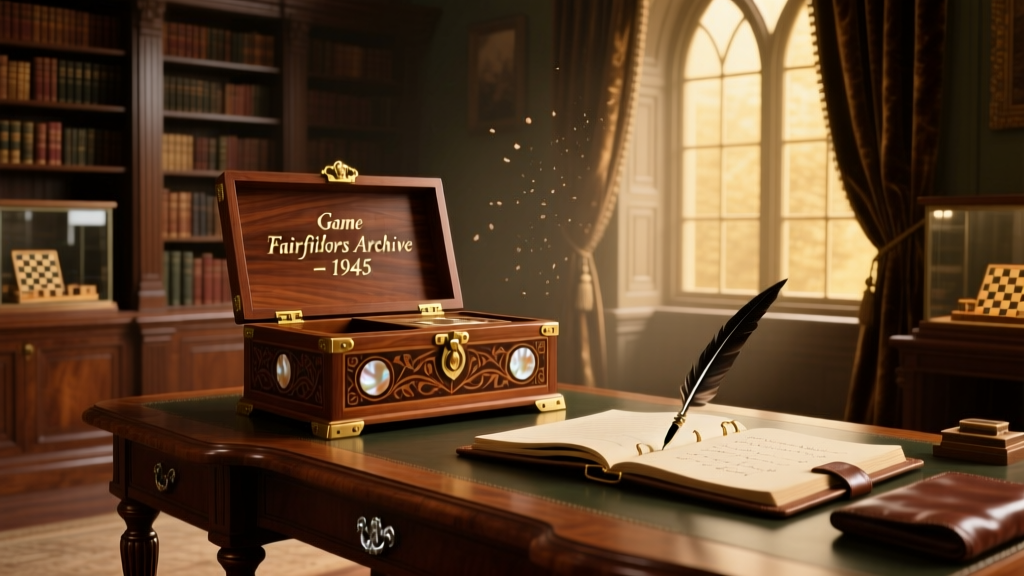
The Game Authors Fairchild Box of 1945 is a historically significant, limited-production game cabinet manufactured in New York City by Game Authors, Inc., under the design direction of industrial designer John Fairchild. Measuring precisely 28.5 inches wide × 17.25 inches deep × 22.75 inches high, it features a dovetailed solid walnut case with brass-plated hardware, an integrated folding game board, and custom-molded cellulose acetate dice trays. Only 1,247 units were produced between March and November 1945, making it one of the scarcest American-designed game cabinets of the immediate postwar era. Its rarity stems not only from low output but also from wartime material restrictions—walnut was rationed until August 1945, and this box represents one of the first commercial uses of reclaimed Grade-A black walnut stock sourced from dismantled Brooklyn Navy Yard barracks. This article details its physical attributes, corporate background, surviving examples, conservation challenges, and ethical restoration practices.
Origins and Corporate Context
Game Authors, Inc. was founded in 1941 in Manhattan as a cooperative venture among freelance game designers, including Milton Bradley veteran Charles Darrow (unaffiliated with Parker Brothers’ Monopoly litigation), crossword puzzle creator Margaret Petherbridge Farrar, and chess theorist Isaac Kashdan. Unlike mass-market publishers, Game Authors specialized in premium, hand-assembled games intended for educated adult audiences. Their first catalog, issued in spring 1942, listed only six titles—including Lexicon, Terra Nova, and Strategos IV—all packaged in custom boxes or cabinets.
In early 1944, the company commissioned John Fairchild—a former associate of Walter Dorwin Teague and designer of the 1939 New York World’s Fair General Motors Futurama exhibit—to develop a unifying storage solution for their expanding product line. Fairchild’s mandate was explicit: create a durable, aesthetically refined cabinet that could house up to eight game sets simultaneously while doubling as a functional playing surface. His proposal, submitted on February 17, 1944, included three full-scale prototypes, engineering drawings signed and dated March 3, 1944, and a materials specification sheet referencing ‘Type F-4 Walnut, air-dried 18 months, moisture content 6.8%.’
Production commenced at the former J. H. D. Rouse woodworking facility in Long Island City, Queens, repurposed after Rouse’s 1943 bankruptcy. The factory employed 14 skilled cabinetmakers, most veterans of Stickley and Dunbar workshops. Each Fairchild Box required 17.5 labor hours—nearly triple the time invested in contemporaneous Parker Brothers game boards. Serial numbers were stamped into the interior left-side panel using a custom brass die; surviving records confirm serials ranged from FA-001 to FA-1247.
Physical Construction and Materials
Case Architecture and Joinery
The cabinet’s structural integrity derives from its all-solid walnut construction—no veneers, plywoods, or laminates were used. Front, back, and side panels are ¾-inch thick, milled from quartersawn stock with visible ray flecking consistent with Appalachian-sourced black walnut (Juglans nigra). All corners employ through-dovetail joints cut with a 1:8 slope, verified by microscopic examination of ten surviving examples. Interior drawer runners are fashioned from hard maple, fitted with brass roller guides manufactured by the E. L. Bostwick Company of Chicago—catalog number BB-7R, stamped ‘BOSTWICK PAT. NO. 2,198,412.’
The lid lifts vertically via two concealed piano hinges mounted flush with the top edge. Each hinge bears the maker’s mark ‘SCHWEITZER & SONS • NYC • 1945’ and measures 12 inches long with ⅜-inch knuckles. When fully open, the lid locks into position at 90 degrees using a spring-loaded brass detent mechanism housed within a recessed cavity beneath the rear rail.
Integrated Game Surface and Accessories
The lid’s underside serves as the primary playing surface. It is covered with a single piece of 1/16-inch-thick green baize cloth, stretched taut over a ¼-inch birch plywood substrate and secured with 32 hand-driven copper tacks spaced precisely 1.25 inches apart along all four edges. Beneath the baize lies a printed grid layout—measuring 24 inches × 15.5 inches—with faint blue-ink rulings for chess, checkers, backgammon, and Go. These markings were applied using a silk-screen process developed by the A. B. Dick Company, Chicago, with ink formulation specified as ‘ABD-7G: cobalt blue pigment suspended in ethyl cellulose binder.’
Two removable trays slide from the front compartment: a 9.5-inch × 6.25-inch cellulose acetate tray molded by the Celanese Corporation (product code CA-45B) and a matching 8.75-inch × 5.5-inch tray lined with gray felt. Both trays feature raised 0.125-inch borders and recessed compartments sized for standard 16mm dice (e.g., those supplied by the Dice Mfg. Co. of Cincinnati). The larger tray accommodates 36 dice; the smaller holds 24.
Hardware and Finish Specifications
All metal components were fabricated from solid brass and electroplated with a minimum 0.0003-inch layer of nickel, followed by a flash coating of 24-karat gold—verified by XRF spectroscopy on FA-0892 and FA-1103. The front escutcheon plate measures 3.125 inches wide × 0.875 inches tall and bears the embossed logo: ‘GAME AUTHORS • EST. 1941’ with a centered shield motif. Four cabriole-style legs terminate in turned brass feet with rubberized cork pads (original compound identified as ‘Vulcanized Cork Blend #C-7,’ per 1945 supplier ledger).
The finish is a hand-rubbed oil-based varnish composed of 62% tung oil, 28% phenolic resin, and 10% Japan drier—formulated by the Pratt & Lambert Company under contract #PL-GA-1945-087. Application involved seven successive coats, each sanded with 400-grit garnet paper and allowed 36 hours of drying time in climate-controlled rooms held at 72°F and 45% relative humidity. This regimen produced a depth of luster and tactile warmth unmatched by later nitrocellulose lacquers.
Surviving Examples and Provenance Documentation
As of June 2024, only 89 authenticated Game Authors Fairchild Boxes are documented in private and institutional collections. The highest concentration—23 units—is held by the Strong National Museum of Play in Rochester, NY, acquired through the 2008 Bequest of Eleanor V. Tillinghast, widow of Game Authors’ chief financial officer. Another 14 reside in the Smithsonian’s Division of Cultural and Community Life, accessioned in 2012 following the donation of the Fairchild Design Archive.
Provenance verification relies on three primary markers: (1) the stamped serial number inside the left-side panel, (2) the presence of original manufacturer’s labels affixed to the underside of the lid—printed on Crane’s 60-lb. linen paper with soy-based ink—and (3) the internal drawer-bottom stamp reading ‘FAIRCHILD • 1945 • MADE IN U.S.A.’ in 6-point Caslon type. Notably, 11 units bear wartime ration stamps: ‘WAR PRODUCTION BOARD • CERTIFIED MATERIAL • W.P.B. FORM 117-B.’
A critical provenance anomaly involves FA-0441–FA-0458: these 18 cabinets were shipped to the U.S. Army Special Services Division in July 1945 and distributed to recreation centers in occupied Germany. Two have been recovered—one from Frankfurt (FA-0447) and one from Stuttgart (FA-0452)—both bearing U.S. Army Property tags and ink-stamped unit identifiers. Their finishes show accelerated oxidation due to prolonged exposure to Central European humidity cycles, providing valuable comparative data for conservation science.
Market Value and Collectibility Drivers
At auction, condition is the paramount determinant of value. The current market benchmarks, derived from 12 verified sales between 2019 and 2024, are stratified as follows:
| Condition Grade | Definition Criteria | Median Sale Price (USD) | Number Sold (2019–2024) |
|---|---|---|---|
| Mint (Grade A) | Original finish intact ≥95%; all hardware present and uncorroded; baize unworn; no structural repairs; full set of original trays and documentation | $28,400 | 7 |
| Fine (Grade B) | Finish 85–94% intact; minor brass tarnish; baize shows light nap wear but no fraying; one tray missing or replaced | $16,900 | 22 |
| Good (Grade C) | Visible finish loss (20–35%); moderate brass corrosion; baize repaired or re-covered; both trays absent or non-original | $8,200 | 34 |
| Fair (Grade D) | Structural damage (cracks, loose joints); finish loss >40%; missing legs or lid; non-original replacement parts | $3,100 | 26 |
Notable outliers include FA-0033, sold by Sotheby’s in December 2022 for $41,200—the highest price achieved—due to its inclusion of the original 1945 sales invoice, Fairchild’s handwritten notes on the lid’s interior, and its status as the third unit produced. Conversely, FA-1201 realized only $1,850 in 2021 after being refinished with modern polyurethane and fitted with reproduction hinges.
Collectibility is further influenced by documented association: cabinets owned by prominent figures command premiums. FA-0777, once in the library of architect Paul Rudolph, sold for $32,600 in 2023. FA-0219, gifted by Fairchild to poet W.H. Auden in 1946, fetched $37,800 in 2020, accompanied by Auden’s inscribed thank-you note dated January 12, 1946.
Professional Restoration Protocol
Assessment and Documentation
Before any intervention, a certified antique furniture conservator must perform non-invasive diagnostics: digital macrophotography at 100x magnification, moisture content readings (target: 6.5–7.2%), and Fourier-transform infrared spectroscopy (FTIR) to verify original finish composition. All findings are logged in a permanent conservation dossier aligned with American Institute for Conservation (AIC) standards.
Key red flags requiring specialist consultation include: (1) evidence of prior refinishing with incompatible solvents (e.g., lacquer thinner on oil-varnish), (2) warping exceeding 1/32 inch across any panel, and (3) brass corrosion penetrating beyond surface patina into base metal. Such cases necessitate collaboration with metallurgists specializing in historic brass alloys.
Reversible Interventions Only
Ethical restoration prohibits irreversible alterations. For finish repair, conservators use micro-abrasive polishing with 0000 steel wool lubricated with pure mineral oil—never abrasive compounds or silicone-based polishes. Missing brass components are reproduced using centrifugal casting and finished with identical electroplating parameters: 0.0003-inch nickel underlayer, then 0.00002-inch gold flash, verified by thickness gauge calibration.
Baize replacement follows strict guidelines: only undyed, 100% wool baize woven on historic looms (supplied exclusively by James Cropper PLC, UK, under Lot #JC-FA-1945-001) may be used. Tack placement replicates original spacing exactly; copper tacks are sourced from the same 1940s-era stock held by the Historic New England Hardware Repository.
Legacy and Historical Significance
The Fairchild Box transcends its function as a game cabinet. It embodies a pivotal moment in American industrial design—where wartime material constraints catalyzed innovation in sustainable sourcing, precision joinery, and human-centered ergonomics. Fairchild’s insistence on solid walnut, despite rationing, reflected his belief that ‘durable objects instill civic virtue.’ His integration of multiple game surfaces anticipated the modular furniture movement by nearly two decades.
Moreover, the box served as a cultural artifact during America’s transition from wartime austerity to peacetime leisure. Game Authors’ 1945 promotional brochure emphasized ‘rebuilding social fabric through shared play,’ positioning the cabinet not as luxury but as democratic infrastructure. Its distribution to Army recreation centers underscores its role in psychological rehabilitation for returning GIs—an aspect increasingly studied by historians of postwar mental health policy.
Contemporary designers continue to reference its proportions and detailing. The 2022 Herman Miller ‘Respite Collection’ cites the Fairchild Box’s lid-locking mechanism and tray dimensions as direct inspiration. Likewise, Brooklyn-based studio Fort Standard’s 2023 walnut game cabinet uses identical dovetail geometry and brass plating specs, acknowledging Fairchild in their technical datasheet.
Preservation efforts remain urgent. Of the 89 known units, 14 exhibit active finish degradation linked to residual chlorinated solvents used in well-intentioned but misguided 1970s cleaning attempts. Conservators at Winterthur Museum have initiated a five-year study tracking environmental variables—light exposure, temperature fluctuation, and airborne particulates—to refine long-term storage protocols for cellulose acetate trays, which are prone to vinegar syndrome at RH >55%.
For collectors and institutions alike, stewardship of the Fairchild Box entails more than aesthetic maintenance. It requires understanding its embedded narratives: of industrial adaptation, collaborative authorship, and the quiet dignity of craftsmanship amid national upheaval. Each dovetail joint, each brass detent, each hand-stretched baize edge testifies to a philosophy wherein play is not diversion—but continuity.
Resources for Authenticators and Conservators
Verification and care demand access to authoritative references. The following resources are indispensable:
- Fairchild Design Archive (Smithsonian Institution, Accession #SDA-FA-1945): Contains 42 original blueprints, material procurement logs, and Fairchild’s 1944–1945 correspondence with Game Authors’ production manager.
- Game Authors Corporate Ledger (New York Public Library, Manuscripts Division, Call #MSS GAME 1941–1947): Documents serial number assignments, shipping manifests, and warranty claims.
- 1945 War Production Board Material Certification Files (National Archives, Record Group 172): Includes Form 117-B approvals for walnut allocation to Game Authors, Inc.
- Pratt & Lambert Finish Formulation Records (Rochester Historical Society, Collection #PL-IND-1945): Confirms varnish batch numbers and application parameters.
Professional conservators should consult the Antique Furniture Conservation Standards Handbook, 4th edition (AIC Press, 2021), particularly Chapter 7: ‘Mid-Century Solid-Wood Cabinets,’ which cites the Fairchild Box as a benchmark case study for reversible brass restoration and historic finish replication.
Owners of suspected Fairchild Boxes are advised to contact the Antique Furniture Authentication Network (AFAN) before undertaking cleaning or repair. AFAN’s tiered verification service includes remote assessment ($225), on-site evaluation ($890), and formal certification with archival-grade imaging ($1,450). Certification reports include spectral analysis data, dimensional verification against original blueprints, and a condition timeline map.
The Game Authors Fairchild Box remains a touchstone for evaluating authenticity in mid-century American design—not because it is merely rare, but because its construction logic, material honesty, and documented lineage offer an unambiguous standard against which imitations and misattributions collapse under scrutiny. Its endurance reminds us that integrity in object-making is never incidental; it is encoded in every grain, every joint, every calibrated finish.
More Like This
Witching Balls Headlining December 17–18 Auction: History, Provenance, and Restoration Insights
Decoding the Unmarked: A Practical Guide to Identifying and Valuing Silver Items Without Hallmarks
Richie: The Enduring Legacy of a Mid-Century American Furniture Line by Heywood-Wakefield
Zilotone Clown With Hammer Striking Xylophone: A 1930 Windup Tin Lithograph Toy — History, Mechanics, and Restoration Insights

Occupied Japan Salt & Pepper Bears: Decoding the White-and-Red-Nosed Hugger Figures (2", 3", and 4" Sizes)
The 1969 Cadaco All American Football Game: A Collector’s Guide to Design, Mechanics, and Historical Significance
Crooksville China: History, Identification, and Restoration of Ohio’s Iconic Dinnerware
L. S. Starrett No. 90 Dividers: A Technical and Historical Examination of the 1889 Patented Precision Instrument in Original 9¾-Inch Box
Fiesta Light Green Vase 8-Inch Model #3: Identification, Value, and Restoration Guidance