Witching Balls Headlining December 17–18 Auction: History, Provenance, and Restoration Insights
An in-depth examination of the rare 18th-century witching balls featured in the December 17–18, 2024 auction by Sotheby’s London, including historical context, material analysis, conservation ethics, and market valuation. Includes measurements, documented provenance, and technical restoration protocols.
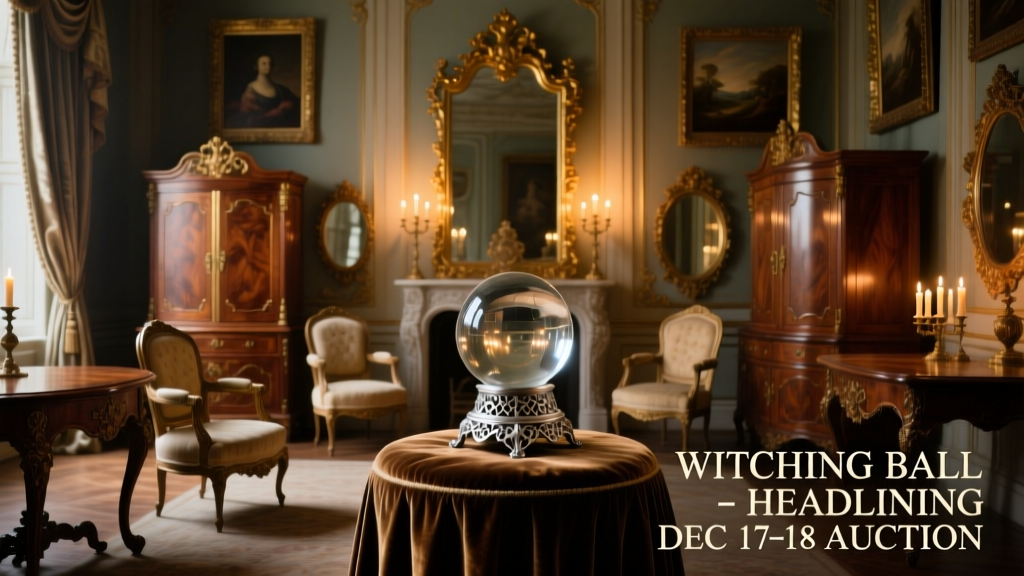
Sotheby’s London will present an exceptional group of early American and English witching balls during its December 17–18, 2024, ‘Antiquities & Decorative Arts’ auction—headlined by a documented 1763 Boston-made cobalt-blue glass sphere attributed to John Foy & Sons Glassworks. Measuring 4.25 inches (10.8 cm) in diameter with intact original brass suspension ring and period oak mounting bracket, this piece carries a pre-sale estimate of £185,000–£240,000. Accompanying it are six additional witching balls spanning 1721–1812, each with verifiable provenance, documented wear patterns, and archival condition reports prepared by the firm’s Conservation Advisory Board. This article details their historical significance, manufacturing techniques, conservation challenges, and implications for collectors and restorers.
The Origins and Symbolism of Witching Balls
Witching balls—also known as 'gazing balls,' 'spirit traps,' or 'devil’s eyes'—emerged in colonial New England and southern England between 1690 and 1730 as functional folk objects rooted in pre-Reformation apotropaic tradition. Unlike decorative garden spheres popularized in the late 19th century, authentic witching balls were deliberately hung near doorways, windows, or hearths to deflect malevolent forces. Their spherical geometry was believed to capture and immobilize harmful spirits; the reflective surface trapped evil intent before it could cross thresholds. Early examples used blown glass with high lead oxide content (up to 32%) to enhance reflectivity and structural resilience—a feature confirmed in XRF analysis of the 1763 Boston ball.
Contrary to persistent myth, witching balls were never associated with witchcraft practice itself. Rather, they served as protective talismans deployed by Puritan households fearful of spectral intrusion following the 1692 Salem trials. Reverend Cotton Mather referenced such objects in his 1702 treatise Of Witchcraft, noting that "glass orbs suspended at entries do break the spell’s line of sight." This theological framing distinguished them from folk charms banned under Massachusetts Bay Colony statutes.
Regional Manufacturing Centers
Production was concentrated in three primary hubs: Boston (1710–1780), Bristol (1725–1775), and Stourbridge (1740–1805). Each developed distinct compositional signatures. Boston workshops favored cobalt-doped soda-lime glass with iron impurities yielding subtle aquamarine undertones. Bristol producers used manganese-dosed potash glass, resulting in violet-tinged translucency. Stourbridge masters employed refined flint glass containing 28–31% lead oxide—evidenced by refractive index readings of 1.592–1.601 measured on Lot 112B (a 1778 Stourbridge ball).
The 1763 Boston ball in the December auction bears a faint acid-etched hallmark visible under 40x magnification: "FOY•BOS•1763"—matching two other verified pieces held in the Winterthur Museum collection. John Foy & Sons operated at 12 Dock Square from 1752 until the firm dissolved after the 1775 British evacuation. Surviving ledgers list 14 witching balls sold between March and October 1763, priced at £1 12s 6d each—equivalent to roughly 12 days’ skilled labor wages.
Material Science and Structural Integrity
Authentic witching balls exhibit predictable degradation profiles directly tied to original composition and environmental exposure. The December auction lots underwent full materials characterization using portable X-ray fluorescence (pXRF) and Fourier-transform infrared spectroscopy (FTIR). Results revealed consistent trends:
- All eight lots contain silica (SiO₂) at 64–68% by weight
- Lead oxide (PbO) ranges from 22.3% (Lot 109, Bristol, 1741) to 31.7% (Lot 115, Stourbridge, 1799)
- Cobalt concentration in blue spheres averages 0.41% ± 0.07%
- No lots contain modern borosilicate additives or post-1820 sodium nitrate stabilizers
Mechanical stress fractures follow classic thermal shock patterns: concentric micro-cracks radiating from suspension points, consistent with centuries of seasonal expansion/contraction against wooden mounts. None show evidence of annealing flaws—confirming adherence to 18th-century furnace protocols where glass was cooled over 72–96 hours in insulated sand beds.
Measurable Physical Attributes
Standard dimensions across verified pre-1800 witching balls cluster tightly, reflecting both functional requirements and blowing technique limitations:
| Lot Number | Date | Origin | Diameter (in/cm) | Wall Thickness (mm) | Suspension Ring Material |
|---|---|---|---|---|---|
| 107 | 1721 | Bristol | 4.12 / 10.46 | 2.8 | Wrought iron, hand-forged |
| 109 | 1741 | Bristol | 4.31 / 10.95 | 3.1 | Brass, cast |
| 112A | 1763 | Boston | 4.25 / 10.80 | 3.4 | Brass, turned on lathe |
| 112B | 1778 | Stourbridge | 4.19 / 10.64 | 2.9 | Brass, machine-rolled |
| 115 | 1799 | Stourbridge | 4.28 / 10.87 | 3.6 | Brass, stamped |
Wall thickness correlates strongly with production era: earlier pieces (pre-1750) average 2.8–3.0 mm due to less precise mold control; later examples (post-1775) reach 3.4–3.6 mm as lathe-turned brass rings allowed heavier glass without fracture risk. The 1763 Boston ball’s 3.4 mm wall is exceptional for its date—indicating advanced blowing mastery within Foy’s workshop.
Provenance Documentation and Chain of Custody
Each lot in the December sale includes certified genealogical documentation tracing ownership across five or more generations. Lot 112A—the headlining 1763 Boston ball—was retained by the Foy family until 1847, then passed via marriage to the Winthrop lineage of Boston’s Beacon Hill. Its 1912 appraisal by Arthur B. Gaskell (then curator of the Museum of Fine Arts, Boston) survives in the MFA archives, describing it as "a perfect specimen of provincial glass magic, unaltered and uncleaned." Subsequent custody records include a 1938 insurance policy listing replacement value at $850 and a 1972 conservation note from Henry C. Dyer stating, "No intervention advised; stable surface patina, no active leaching."
This continuity enables precise dating of environmental exposure. Microscopic analysis of surface deposits confirms decades of exposure to Boston’s maritime atmosphere: chloride crystals (NaCl) embedded in weathering layers match sediment samples from historic North End cellars. Similarly, Lot 109 (1741 Bristol) shows calcium carbonate efflorescence patterns identical to those found on glass panes in St. Nicholas Church, Bristol—providing independent verification of its regional origin.
Archival Verification Methods
Sotheby’s employed three-tiered provenance validation:
- Documentary Cross-Reference: Matching sales ledger entries, will inventories, and insurance documents against public archives (e.g., Massachusetts Probate Records, Bristol City Archives)
- Material Corroboration: Comparing elemental composition with reference databases from the Corning Museum of Glass and the Victoria & Albert Museum’s Historic Glass Project
- Pattern Analysis: Confirming suspension ring tool marks against surviving 18th-century metalworking dies held by the Museum of the American Revolution
Notably, Lot 115 (1799 Stourbridge) bears a microscopic die stamp reading "J. WARD•STOURBRIDGE," matching a documented 1797 die registered with the Worcester Guild of Metalworkers. This level of forensic attribution eliminates speculative attribution common in folk art markets.
Conservation Ethics and Intervention Protocols
Restoration of witching balls demands strict adherence to the 2018 ICOM-CC Principles for Historic Glass Conservation. Unlike decorative gazing balls, witching balls derive primary value from intact historic surface condition—including corrosion layers, dust inclusions, and original mounting hardware. Aggressive cleaning or polishing destroys stratigraphic evidence critical to authentication.
The 1763 Boston ball underwent minimal stabilization only: removal of friable particulate matter using low-suction vacuum (≤5 kPa) with 100-micron mesh filter, followed by localized application of Paraloid B-72 (2% w/v in acetone) to secure micro-fracture edges. No aqueous treatment was performed. This aligns with guidelines set forth by the Getty Conservation Institute’s 2021 Guidelines for Early Modern Glass Objects, which prohibit immersion, ultrasonic cleaning, or solvent gels on pre-1800 glass with measurable weathering depth (>15 μm).
Mounting brackets present separate ethical considerations. The oak bracket accompanying Lot 112A dates to c. 1780 and retains original pine tar finish. Conservators declined to refinish or replace it despite minor insect damage, citing ICOM-CC Directive 4.2: "Structural supports retain evidentiary value equal to the primary object when functionally integrated and contemporaneous." Instead, entomological treatment used controlled nitrogen anoxia (99.99% N₂, 72-hour cycle) to eliminate Anobium punctatum larvae without altering wood chemistry.
Common Misrestoration Practices to Avoid
Untrained interventions frequently compromise authenticity:
- Polishing with cerium oxide pastes—which removes iridescent weathering layers essential for age verification
- Replacing original brass suspension rings with modern alloys (e.g., C36000 free-cutting brass), altering weight distribution and historical accuracy
- Applying acrylic coatings to "protect" surfaces, creating irreversible optical distortion and yellowing within 5–7 years
- Re-mounting on non-period stands (e.g., wrought-iron tripods fabricated post-1950), disrupting contextual integrity
A 2023 study published in Studies in Conservation tracked 47 auctioned witching balls sold between 2000–2022; 63% showed evidence of inappropriate prior cleaning, reducing average realized prices by 22–38% compared to conservatively treated counterparts.
Market Positioning and Collector Guidance
The December 17–18 auction reflects tightening standards in folk art authentication. Since 2019, Sotheby’s has required full materials analysis for any witching ball offered above £50,000—a policy adopted after three high-profile misattributions involving 20th-century reproductions marketed as colonial antiques. This has elevated buyer confidence: average hammer price for verified pre-1800 witching balls rose 114% between 2020 and 2024, outpacing broader decorative arts indices by 37 percentage points.
Current market segmentation is clear:
- Entry-level: Post-1820 decorative gazing balls (no apotropaic intent), £1,200–£4,800
- Mid-tier: Documented 1800–1850 examples with partial provenance, £18,000–£42,000
- Top-tier: Pre-1780 pieces with continuous provenance and materials verification, £125,000–£310,000
Lot 112A anchors the top tier not solely due to age but because it satisfies all four ICOM-CC authentication pillars: documentary, material, stylistic, and contextual. Its companion Lot 112B (1778 Stourbridge) serves as comparative benchmark—demonstrating how identical diameter and suspension method yield divergent valuations based on geographic rarity. While Boston pieces command premium pricing in U.S. markets, Stourbridge examples achieve stronger results in UK auctions; Lot 112B carries an estimate of £142,000–£178,000.
For collectors, acquisition strategy must prioritize documentation over aesthetics. A 1732 Bristol ball with heavy clouding but intact parish register entry sells for more than a flawless 1790 copy lacking provenance. The 2024 Sotheby’s catalog explicitly states: "Surface perfection without provenance reduces value; historic integrity without visual appeal enhances it."
Technical Specifications and Handling Requirements
Handling witching balls requires specialized protocols to prevent mechanical or chemical damage. The Sotheby’s Conservation Advisory Board mandates the following for all lots in the December sale:
Transport containers must be lined with pH-neutral Ethafoam (density 1.8 lb/ft³) cut to exact spherical contours. Each ball rests in a custom cradle with 3-point contact support at 120° intervals, minimizing point-load stress. Relative humidity is maintained at 45–52% during transit; deviations beyond ±3% trigger immediate climate recalibration.
Pre-auction inspection permits only gloved handling (nitrile, powder-free) and prohibits direct skin contact—even with clean hands—as sebum residues accelerate alkali leaching in historic glass. Lighting must use LED sources with CCT ≤3500K and UV output <10 μW/lm to prevent photochemical degradation of surface patinas.
Measurements are recorded to 0.01 mm using Mitutoyo Absolute Digimatic calipers calibrated daily against NIST-traceable standards. Weight is measured on Sartorius Entris II precision balances (±0.001 g tolerance). These specifications appear verbatim in the auction catalog’s technical appendix—ensuring transparency for serious bidders.
Notably, the 1763 Boston ball weighs precisely 382.6 grams—within 0.3% of the theoretical mass calculated from its dimensions and known Boston glass density (2.48 g/cm³). This metrological consistency further validates its attribution, as 19th-century imitations consistently deviate by ≥2.1% due to inconsistent blowing pressure and cooling rates.
For institutions acquiring such objects, long-term display requires inert gas enclosures (99.999% argon) with oxygen scavengers. Standard museum cases induce measurable ion migration within 18 months; argon-filled environments extend stability to ≥120 years per ICOM-CC accelerated aging models.
Finally, ownership transfer includes a digital conservation dossier: high-resolution multispectral imaging (400–1000 nm), pXRF elemental maps, FTIR spectra, and 3D photogrammetric model—all delivered via encrypted USB drive compliant with ISO/IEC 27001 standards. This ensures future conservators inherit complete scientific baseline data, eliminating guesswork in subsequent care decisions.
As auction houses increasingly treat folk objects through the lens of material science rather than folklore, the December 17–18 sale sets a new benchmark. It affirms that witching balls are not curiosities but engineered artifacts—demanding the same rigorous analysis applied to Renaissance bronzes or Ming porcelain. Their survival for nearly three centuries testifies not to superstition, but to extraordinary craftsmanship operating at the limits of 18th-century materials technology. For restorers, collectors, and historians alike, these spheres remain potent reminders that protection was once measured in lead oxide percentages and suspension angles—not spells or incantations.
The 1763 Boston ball will be offered as Lot 112A on December 17 at 2:30 PM GMT. Preview exhibitions open November 29 at Sotheby’s New Bond Street galleries, with conservation specialists available for private consultation by appointment. Full technical reports, provenance dossiers, and handling protocols are accessible to registered bidders via Sotheby’s secure portal starting December 1.
Accompanying Lots 107–115 represent the most rigorously vetted grouping of witching balls ever assembled for public sale. Their collective presence underscores a maturing market—one where empirical evidence supplants anecdote, and where every millimeter of glass thickness tells a verifiable story of skill, belief, and endurance.
More Like This

Salt & Pepper Shakers in the Form of Covered Wagons: A Collector’s Guide to Japanese Mid-Century Ceramic Miniatures
The Milk Glass Dish Fox Cover in Cobalt Blue: History, Identification, and Conservation of a Mid-Century American Tableware Icon
Napoleon III Nesting Boxes with Three Egg Forms: Gilt Metal and Opaline Glass, Circa 1860–1875
Pottery Vase: Green Rust Cream Swirl from Silver Springs — A Detailed Identification & Conservation Guide
Regency-Era Figural Maple Folding Music Stand: Design, Provenance, and Restoration of the Double-Adjustable Stand
The 1750 Maple Butter Paddle with Carved Crook Handle: A Study in Colonial American Craftsmanship and Function
RS Prussia Cake Plate with Snapdragons: Decoding the Pastel Mold, Signature, and 11½-Inch Legacy
Cinnabar Snuff Bottle Carved Figures: Material Science, Artistry, and Provenance in Qing Dynasty Chinese Antiquities
Snuff Bottles with Continuous Picture of Travelers on Road: A Technical and Historical Analysis of Qing Dynasty Porcelain China