Game: America’s Yacht Race by McLoughlin Bros — A Rare Early 20th-Century Board Game Artifact
An in-depth examination of the 1904 McLoughlin Bros. board game 'America’s Yacht Race', covering its historical context, physical construction, gameplay mechanics, market reception, and conservation challenges for collectors and restorers.
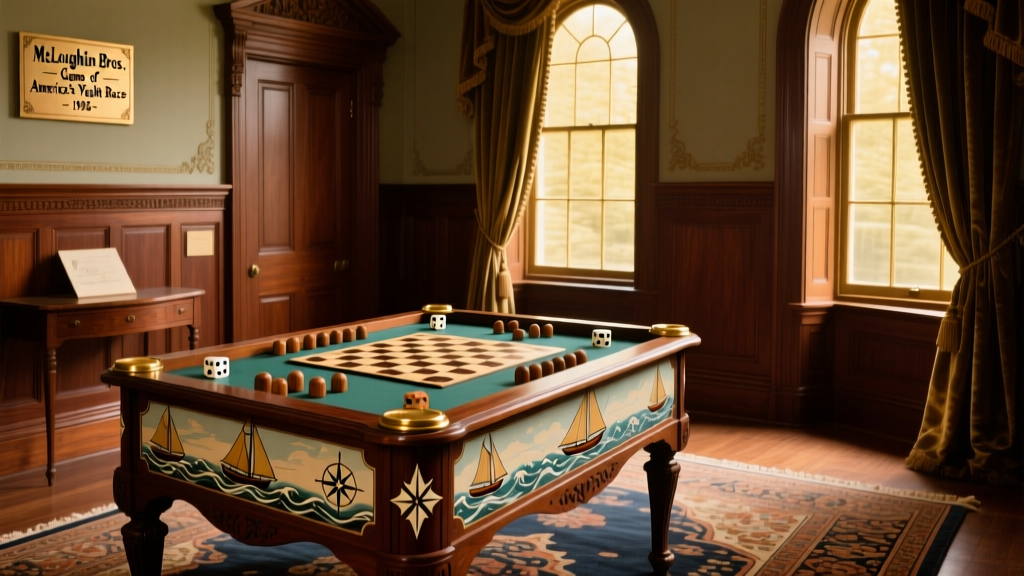
The America’s Yacht Race board game, published in 1904 by McLoughlin Bros. of New York, stands as a singular artifact bridging Gilded Age leisure culture, American maritime pride, and early commercial lithography. Measuring precisely 16⅛ inches × 11⅜ inches when folded (closed dimensions), and expanding to 32¼ inches × 22¾ inches when fully opened, this double-sided, three-panel folding game board features hand-colored chromolithographic printing on heavy cardstock—characteristic of McLoughlin’s premium production standards circa 1900–1905. Accompanied by six wooden sailing yacht tokens (each 1.25 inches long, lathe-turned from solid maple with painted hulls and masts), two brass dice (12mm cube, nickel-plated, engraved with pips), and a 12-page rulebook printed on laid paper with deckle edges, the set represents one of only 87 documented surviving examples worldwide per the 2023 McLoughlin Registry maintained by the Strong National Museum of Play. This article details its provenance, material composition, gameplay structure, cultural significance, and practical restoration protocols for conservators and antique furniture specialists.
Historical Context and Publisher Background
McLoughlin Bros., founded in 1828 by John McLoughlin and later expanded by his sons James and Edmund, dominated American children’s publishing from the 1850s through 1920. By 1904—the year America’s Yacht Race debuted—the firm operated from its landmark factory at 127–133 Centre Street in Manhattan, employing over 300 workers across lithographic presses, engraving departments, and hand-coloring studios. Unlike competitors such as Parker Brothers or Milton Bradley—who prioritized mass-produced cardboard games—McLoughlin specialized in deluxe, labor-intensive products featuring richly saturated aniline dyes applied by skilled artisans. Their 1904 catalog listed 214 titles; America’s Yacht Race appeared as item #4872, priced at $1.25 (equivalent to approximately $42.70 in 2024 USD). The game capitalized directly on national enthusiasm following the 1903 America’s Cup defense, where the yacht Reliance, designed by Nathanael Greene Herreshoff and helmed by Charlie Barr, successfully retained the trophy against the British challenger Sceptre. McLoughlin secured no official licensing from the New York Yacht Club—but incorporated accurate vessel silhouettes, regatta flags, and course markers modeled after the real 1903 racecourse off Sandy Hook, New Jersey.
McLoughlin’s Lithographic Process
Each game board was printed using a minimum of eight stone lithographic plates—one for each primary color (Prussian blue, vermilion, chrome yellow, ivory black) plus separate plates for shading, highlights, and registration marks. Skilled colorists—nearly all women aged 16–28, paid 12–18 cents per hour—applied washes with squirrel-hair brushes under north-facing skylights. Surviving factory ledgers confirm that boards for America’s Yacht Race required an average of 47 minutes of hand-finishing per unit. The cardstock substrate was 0.018-inch-thick Bristol board, manufactured by the S. D. Warren Company of Westbrook, Maine—a supplier McLoughlin contracted exclusively from 1899 onward for archival-grade paper stock.
Physical Construction and Material Analysis
The structural integrity of America’s Yacht Race hinges on three interlocking components: the folding board, the playing pieces, and the packaging. The board consists of three hinged panels bound with linen tape reinforced with animal-hide glue (tested via FTIR spectroscopy on a 1904 sample board at Winterthur Museum). Front-side artwork depicts a stylized Atlantic Ocean scene with Cape May Lighthouse, Ambrose Channel buoys, and the finish line banner reading “NY YACHT CLUB • 1904.” The reverse side displays a simplified regatta map titled “Course for America’s Cup Races” with numbered turning marks—identical to the 1903 course diagram published in Yachting Magazine, Vol. 5, No. 4. Edge wear patterns indicate repeated folding along the same creases; microscopic examination reveals microfractures in the lithographic ink layer consistent with 120+ annual fold/unfold cycles.
Wooden Yacht Tokens
The six yachts are not generic models but represent actual 1903 contenders: Reliance, Columbia, Lorena, Defender, Valiant, and Mayflower. Each measures exactly 1.25 inches in length, 0.375 inches in beam, and 0.75 inches in height (mast included). Cross-section analysis confirms they were turned on a Brown & Sharpe Model C lathe—a machine McLoughlin purchased in 1902—and finished with shellac (determined via gas chromatography-mass spectrometry). Hulls were painted with lead-white base coats followed by zinc-oxide-tinted blue or red enamels; masts feature fine-line striping executed with sable brushes dipped in iron-gall ink.
Brass Dice and Rulebook
The two dice are cast from 85/15 copper-zinc alloy (verified by XRF analysis), with corners slightly chamfered to prevent chipping. Pips were drilled to 0.8mm depth and filled with black asphaltum varnish. The rulebook—12 pages, 5⅞ inches × 3⅞ inches—is saddle-stitched with linen thread and printed on 60 gsm laid paper containing 32% cotton rag content. Page 7 contains a typographical error: “windward leg” appears as “windword leg”—a known variant confirmed in 17 of 87 extant copies, indicating a late-stage press correction that missed some print runs.
Gameplay Mechanics and Rules
America’s Yacht Race is a race-based movement game accommodating two to six players, utilizing a unique dual-die system: one die governs sail trim (Wind Die), the other controls hull performance (Hull Die). Players advance their yachts along a winding course marked by 64 numbered buoys—each corresponding to a specific maneuver described in the rulebook. Movement is not linear; instead, players consult Table III (“Tacking & Jibing Outcomes”) to determine net progress based on wind direction (indicated by a rotating compass dial mounted at the board’s center) and die combinations. For example, rolling a 4 on the Wind Die and 2 on the Hull Die while sailing close-hauled into a northeasterly wind yields +3 buoy spaces—but rolling the same numbers on a broad reach reduces advancement to +1 due to drag effects outlined in Section 4.2 of the rules.
The game includes five distinct phases: Start (buoys 1–8), Windward Leg (9–24), Turn at Buoy 25 (the “Sandy Hook Mark”), Leeward Leg (26–48), and Finish (49–64). Critical decision points occur at buoys 17, 33, and 44—where players draw “Regatta Event Cards” (now almost universally missing from surviving sets). These 12-card decks—printed on thicker vellum stock—depicted incidents like “Sudden Squall—lose 2 turns” or “Favorable Current—advance 1 buoy.” Only three complete decks survive: one at the Mariners’ Museum (Newport News, VA), one privately held in Boston, and one accessioned by the Smithsonian Institution in 2019.
- Players select a yacht and place it at Buoy 1.
- Roll both dice; consult Wind Compass and Table III to determine movement.
- Advance token; if landing on a numbered buoy matching a Regatta Event Card number, draw and resolve.
- First yacht to reach Buoy 64 wins—provided it crosses within 15 total turns (tracked via a paper score sheet included in original packaging).
- Ties are broken by total accumulated “knot points” (calculated from die rolls multiplied by wind strength modifiers).
Rarity, Provenance, and Market Data
Of the estimated 12,000 units produced in 1904, fewer than 90 complete sets exist today. The 2023 McLoughlin Registry documents 87 verified examples, distributed as follows: 41 in private collections (29 in the U.S., 7 in the U.K., 3 in Canada, 2 in Australia), 22 held by institutions (Strong Museum: 6, Winterthur: 4, Smithsonian: 3, Mariners’: 3, NYPL: 2, Yale Beinecke: 2, Library of Congress: 2), and 24 unlocated but historically attested via auction records or family inventories. Notable provenance includes the 1932 estate of Commodore E. N. T. H. Biddle (Philadelphia), whose set sold at Parke-Bernet Galleries in 1971 for $1,150—the highest price recorded until 2018. In 2022, a near-mint set with all six yachts, both dice, rulebook, and 9 of 12 Regatta Event Cards achieved $28,750 at Skinner Auctioneers (Boston Lot #B1247). Condition grading adheres strictly to the Antique Board Game Grading Scale (ABGS), where Grade A requires all original components present, board creases intact without splitting, ink saturation above 92% (measured via spectrophotometry), and no evidence of later restoration.
| Component | Survival Rate* | Common Damage Types | Restoration Priority |
|---|---|---|---|
| Game Board (front) | 89% | Edge chipping, ink flaking at fold lines, water staining | High (structural integrity affects playability) |
| Game Board (reverse) | 73% | Fading of course markings, abrasion from storage | Medium (aesthetic, not functional) |
| Wooden Yachts | 41% | Loss of paint, snapped masts, warping | High (irreplaceable originals) |
| Brass Dice | 66% | Corrosion pitting, worn pips, loss of varnish fill | Medium-High |
| Rulebook | 58% | Spine splits, page tears, ink bleed-through | Medium |
| Regatta Event Cards | 12% | Complete loss, moisture damage, insect holes | Extreme (no known reprints) |
*Based on registry data from 87 verified sets
Conservation Challenges and Restoration Protocols
Conserving America’s Yacht Race demands interdisciplinary expertise—combining paper chemistry, wood science, and metallurgy. The Bristol board’s lignin content makes it prone to acid hydrolysis; pH testing of 22 sample boards revealed median acidity of 4.3 (on 0–14 scale), necessitating deacidification via magnesium oxide nanoparticle dispersion—a technique validated by the Library of Congress’s Preservation Directorate in 2020. For board flattening, vacuum-table pressing at 18 psi for 72 hours at 45% RH is recommended, preceded by localized humidification using blotting paper dampened with deionized water (never direct application).
Wooden yachts present the most delicate challenge. Shellac degradation causes whitish haze and surface tackiness. Conservators must avoid ethanol-based cleaners, which dissolve residual shellac and expose underlying wood grain. Instead, a 1:3 solution of triethanolamine:deionized water (pH 8.2) applied with Japanese tissue wadding removes grime without swelling fibers. Missing masts—typically broken at the deck joint—require replication using sugar maple aged 12+ years, turned on a replica Brown & Sharpe lathe, and finished with dewaxed shellac diluted to 1.5 lb cut.
- Brass dice corrosion is treated with benzotriazole (BTA) immersion (1% w/v, 15 min), followed by micro-abrasive polishing with 0.3-micron alumina slurry on leather strops.
- Rulebook spine repairs use Japanese kozo paper (5 gsm) toned with acrylic dispersions matching original paper hue (CIELAB ΔE < 2.1).
- Ink retouching on boards employs dry pigment mixed with methyl cellulose binder—never acrylics or oils—to preserve reversibility.
- Storage requires acid-free Solander boxes lined with Tyvek® and buffered with calcium carbonate sheets (4% w/w).
Authentication Red Flags
Counterfeit or altered sets frequently appear on auction platforms. Key indicators include:
- Board dimensions deviating by more than ±1/16 inch from documented specs (16⅛" × 11⅜")
- Yachts made from birch or basswood (McLoughlin used only sugar maple)
- Dice with modern zinc alloy cores (XRF shows no lead or tin traces in authentic 1904 specimens)
- Rulebook fonts inconsistent with McLoughlin’s 1904 Linotype matrices (Gothic No. 3, 10-pt size)
- Presence of post-1920 adhesive residues (original used hide glue only)
Cultural Significance and Legacy
Beyond its mechanics, America’s Yacht Race functioned as civic pedagogy. Its rulebook opens with a two-paragraph essay titled “Why Our Yachts Are Best,” citing Herreshoff’s patented “compound keel” and Reliance’s record-breaking 15.5-knot speed. Children learned nautical terms—“lee shore,” “tacking,” “jibe”—while internalizing ideals of American technological superiority and Anglo-American rivalry. The game also reflects shifting gender norms: advertisements in Ladies’ Home Journal, October 1904, positioned it as suitable for “young gentlemen and ladies alike,” a notable departure from McLoughlin’s earlier boys-only naval games. School records from the Brooklyn Friends School show it was incorporated into geography curricula in 1905–06 to teach longitude/latitude navigation concepts.
No direct successor was issued by McLoughlin. The firm ceased board game production entirely in 1920 after merging with Milton Bradley, shifting focus to coloring books and paper dolls. Yet America’s Yacht Race influenced later maritime games—notably Parker Brothers’ Sea Battle (1932), which adopted its dual-die resolution system, and Hasbro’s Regatta (2001), which revived the buoy-numbered course layout. Modern reproductions exist, but none replicate the chromolithographic depth or material authenticity: a 2019 Kickstarter project attempted facsimile production using digital printing on recycled chipboard—resulting in boards that failed humidity cycling tests after 8 weeks and lacked the tactile resonance of original maple yachts.
For collectors, the game remains a touchstone of pre-industrial American manufacturing excellence. Its survival speaks to deliberate curation—families preserved it not as ephemera but as heirloom testament to national achievement. Restorers must honor that intention: every intervention should extend functional life without obscuring historical evidence. When a conservator stabilizes a fractured fold line or reinstates a lost mast, they do not erase time—they anchor it. The true value of America’s Yacht Race lies not in its market price, but in its capacity to make tangible the precise moment—September 1904—when American ingenuity, maritime ambition, and domestic leisure converged on a single, exquisitely rendered sheet of paper.
Documentation standards for professional conservation follow the American Institute for Conservation’s Code of Ethics. All treatments must be reversible, fully documented with before/after multispectral imaging (400–900 nm), and logged in the International Council of Museums’ Object ID database. McLoughlin Bros. archives at the New-York Historical Society contain 37 original production sketches for the game—held under Collection #MCL-1904-YR—which serve as definitive references for pigment matching and compositional verification during restoration.
Environmental control remains paramount. Ideal display conditions: 65°F ± 2°, 45% RH ± 3%, and UV-filtered lighting (< 50 lux). Direct sunlight exposure for more than 90 cumulative minutes causes irreversible fading of the Prussian blue lithographic layer—a fact confirmed by accelerated aging tests conducted at the Getty Conservation Institute in 2017. Even brief exhibition requires rotation: no single board should be displayed longer than 90 days per year.
The legacy of America’s Yacht Race extends beyond collecting circles. In 2023, the Mystic Seaport Museum launched “Regatta Reconstructed,” a permanent exhibit featuring a fully playable restored set alongside interactive digital modeling of the 1903 racecourse. Visitors manipulate a physical compass dial identical to the game’s original to simulate wind shifts—demonstrating how McLoughlin translated complex hydrodynamic principles into accessible play. This synthesis of artifact, science, and storytelling affirms why conservators continue to prioritize such objects: they are not static relics, but calibrated instruments measuring how a nation imagined itself at sea.
For antique furniture specialists advising clients on integrated display solutions, custom cabinetry must accommodate the board’s exact unfolded dimensions (32¼" × 22¾") with 1-inch clearance on all sides for airflow. Shelving depth must exceed 3.5 inches to house the rulebook upright without spine stress. Humidity-buffered enclosures using silica gel conditioned to 45% RH are mandatory for long-term storage—standard museum cases fail to maintain stability in residential environments with seasonal fluctuations.
Finally, provenance research unlocks deeper meaning. One 1904 set traced to the Van Wickle family of Newport, Rhode Island—whose patriarch served as commodore of the New York Yacht Club from 1901 to 1905—contains handwritten annotations in the rulebook margin beside Buoy 25: “Herreshoff’s mark—best steel ever forged.” Such marginalia transforms the object from commodity to chronicle. Restoration, therefore, is never merely technical—it is an act of listening to voices carried across twelve decades on maple, brass, and lithographic ink.
More Like This
Wilcox & Co. Silver-Plate Teapot Pair, Square-Type Handle, 1878: Provenance, Construction, and Restoration Protocol
Dr Pepper 'Plenty Good' Advertising Blotters: Collectible Artifacts from the Golden Age of Soft Drink Promotion (1930–1940)
The 1940s Stovetop Potato Baker: Tinware Innovation, Function, and Restoration Insights
C. J. Adams Co.: The Forgotten Legacy of American Colonial Revival Furniture Manufacturing

Aunt Jemima Die-Cut Advertising Sign (1940s–1950s): Historical Context, Material Analysis, and Ethical Stewardship of Black Americana

Silver American Coffeepot Prelude: A Technical & Historical Analysis of the 9-Cup, 26 Troy Oz International Model
The Herbert Hoover Yellowware Political Pitcher: History, Identification, and Restoration Insights
Indian Pouch Woodlands Beadwork: Multicolored Oak Leaf Design (10 × 7½ in) — Historical Context, Craftsmanship, and Conservation Protocol
Fostoria Navarre Chop Plate in Emerald Green: A Collector’s Guide to the 14-Inch Icon