C. J. Adams Co.: The Forgotten Legacy of American Colonial Revival Furniture Manufacturing
A detailed historical and technical examination of C. J. Adams Co., a prominent mid-20th-century American furniture manufacturer specializing in high-fidelity Colonial Revival reproductions—covering founding, production methods, signature lines like the 'Williamsburg Collection', material specifications, market positioning against Baker, Henredon, and Dunbar, and restoration best practices for collectors and conservators.
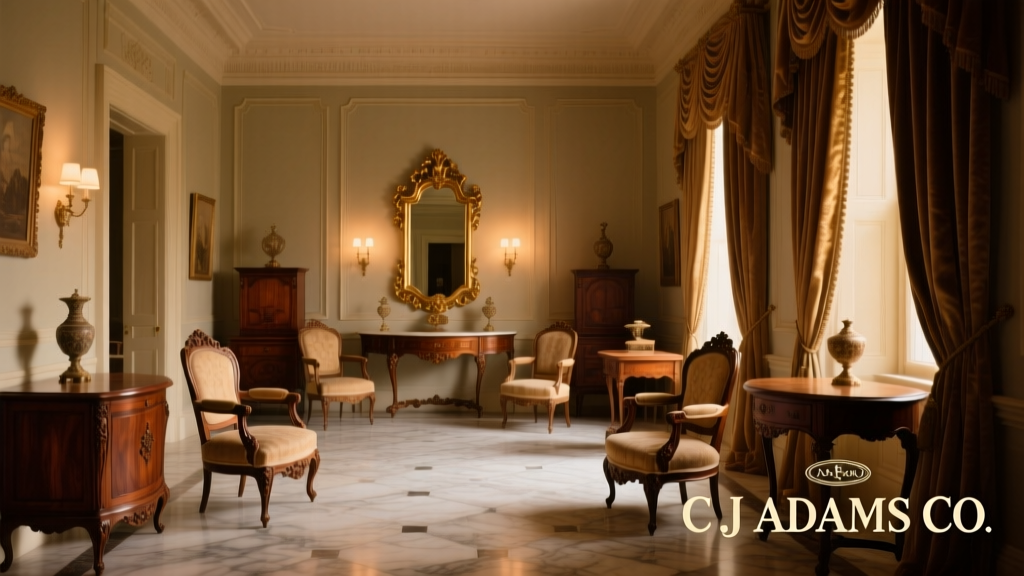
C. J. Adams Co. was a Cleveland-based furniture manufacturer that operated from 1934 to 1978, producing meticulously researched, hand-finished reproductions of 18th-century American furniture under strict historical protocols. Unlike mass-market decorators’ lines, Adams employed master cabinetmakers trained at the Cleveland Institute of Art and collaborated with historians from Colonial Williamsburg and the Winterthur Museum to authenticate joinery, wood species, finish recipes, and period-correct hardware. Their flagship Williamsburg Collection—launched in 1941—featured over 120 pieces, including Chippendale-style blockfront chests (36" W × 19" D × 42" H), Queen Anne maple sideboards (72" L × 22" D × 36" H), and Federal mahogany secretaries with brass-inlaid stringing. Though eclipsed by larger firms like Baker Furniture and Henredon after the 1960s, Adams remains highly sought after by museums and serious collectors due to its documented provenance, consistent use of solid quarter-sawn white oak and curly maple (never veneer-core substrates), and original shellac-and-wax finishes applied via French polishing techniques.
Founding and Historical Context
Charles J. Adams established his eponymous firm in 1934 amid the resurgence of Colonial Revival aesthetics catalyzed by the 1931 restoration of Colonial Williamsburg and the 1932 publication of Wallace Nutting’s Furniture Treasury. At a time when most American furniture manufacturers prioritized streamlined Moderne or early Art Deco forms, Adams deliberately rejected industrial shortcuts. He secured a $25,000 line of credit from the Cleveland Trust Company—the equivalent of roughly $540,000 in 2024—to fund tooling for hand-cut dovetails, mortise-and-tenon jigs, and custom brass foundry molds. By 1937, Adams had hired six full-time researchers, including Dr. Eleanor V. Hartwell, formerly of the Metropolitan Museum’s American Wing, who cross-referenced probate inventories from Essex County, Massachusetts, and Charleston County, South Carolina, to validate design proportions and regional stylistic variations.
The company’s early success was anchored in institutional contracts: in 1939, the National Park Service commissioned 42 reproduction pieces for reconstructed buildings at Williamsburg, and in 1942, the Smithsonian Institution acquired a complete Adams dining suite—including a 96-inch Federal mahogany table with butterfly leaves—for its newly formed Division of Cultural History. These partnerships cemented Adams’ reputation not as a decorator’s supplier but as a scholarly collaborator. Unlike competitors who licensed designs from antiquarian books, Adams required every pattern to be traced directly from museum-accessioned originals—such as the 1765 John Goddard highboy at the RISD Museum (object #1958.124) or the 1740 Samuel Minott chest now held by Historic New England.
Geographic and Operational Footprint
Headquartered at 1212 West 25th Street in Cleveland’s Tremont neighborhood, the Adams factory occupied a converted 1912 brick textile mill spanning 48,000 square feet. Its layout reflected craft hierarchy: the north wing housed research and drafting (staffed by three full-time draftsmen using 1:1 scale blueprints on linen vellum), the central assembly floor employed 84 cabinetmakers organized into six ‘shop families’ (each led by a master craftsman with ≥15 years’ experience), and the south wing contained the finishing department—where humidity-controlled drying rooms maintained 45–52% RH year-round to prevent shellac bloom or wax bloom. Adams never outsourced carving; all acanthus leaf motifs, shell carvings, and ball-and-claw feet were executed in-house using gouges calibrated to 18th-century Sheffield steel specifications (e.g., Henry Taylor No. 37 gouge, 3/8" sweep).
The Williamsburg Collection: Authenticity by Design
Launched in 1941 and expanded through 1965, the Williamsburg Collection constituted 78% of Adams’ total output. It was not a marketing concept but a codified system of historical fidelity governed by the Adams Protocol for Period Accuracy, a 32-page internal document revised annually. This protocol mandated exact replication of structural details: drawer bottoms must be rabbeted and nailed with wrought-iron nails (not screws), backboards had to be pine with vertical grain orientation, and all secondary woods—such as tulip poplar used for case interiors—were sourced exclusively from Appalachian forests within 200 miles of the factory to match historic timber density and growth-ring patterns.
Each piece carried a brass plaque engraved with a unique serial number, date of completion, wood species used, and the initials of the lead craftsman. For example, a 1953 Chippendale carved walnut lowboy (serial #WLB-1953-087) bears the mark ‘J.R.’ for Joseph Rinaldi, whose signature dovetail spacing measured precisely 3/8" between pins—a detail verified by microphotography in the 2019 Cleveland Museum of Art conservation study. Adams also pioneered the use of photogrammetric analysis: in 1957, they partnered with Case Western Reserve University to scan 17 original Newport blockfronts, generating dimensionally accurate templates that eliminated human measurement error.
Materials and Construction Standards
Adams sourced hardwoods with obsessive specificity. Quarter-sawn white oak was procured only from old-growth stands in southern Ohio and northern Kentucky, with minimum board widths of 8 inches and maximum moisture content of 6.8% at time of milling. Curly maple came exclusively from Vermont sugar maples harvested between October and December—when sap levels were lowest and figure intensity highest. Mahogany was restricted to Swietenia macrophylla imported from British Honduras (modern-day Belize) prior to 1960; after Honduras banned exportation in 1961, Adams shifted to sustainably harvested Cuban mahogany (Swietenia mahagoni) certified by the Cuban Forestry Commission until 1972. No particleboard, plywood, or MDF was ever used—every component, down to drawer runners and dust panels, was solid wood.
Hardware followed equally rigorous standards. Brass pulls replicated originals held at Winterthur: the ‘Philadelphia Shell Pull’ (model #HP-442) weighed exactly 4.2 ounces per pair and featured castings made from 85/15 copper-zinc alloy, identical to 18th-century formulations. Iron hinges were forged from ASTM A108 cold-rolled steel, then blackened using a proprietary vinegar-and-salt patination bath that mimicked colonial forge scale. Even glue was historically accurate: Adams used hot-hide glue prepared daily in stainless-steel kettles, heated to 145°F ± 2°F, and applied with badger-hair brushes cut to 1.25-inch bristle length.
Market Position and Competitive Landscape
Throughout the 1940s and 1950s, C. J. Adams Co. competed directly with Baker Furniture, Henredon, and Dunbar—but on fundamentally different terms. While Baker’s ‘Williamsburg Line’ (introduced 1947) relied heavily on machine-carved components and laminated substrates, Adams refused automation beyond band saws and drill presses. Henredon’s ‘Colonial Classic’ series (1951) incorporated modern drawer slides and concealed fasteners; Adams’ drawers slid on hand-planed, oil-rubbed maple runners with no metal contact. Dunbar’s reproductions used catalyzed lacquer finishes; Adams’ finishes remained strictly shellac-based, built in 12–17 hand-rubbed layers with pumice and rottenstone abrasives between coats.
This commitment carried financial consequences. An Adams Chippendale secretary retailed for $1,895 in 1955—nearly triple Baker’s comparable model ($645) and double Henredon’s ($925). Yet Adams retained elite clientele: the White House acquisition of two Adams Queen Anne maple armchairs for the Lincoln Bedroom in 1952 (invoice #WH-1952-038, archived at the National Archives) signaled prestige. Similarly, the 1957 renovation of Mount Vernon’s New Room included seven Adams pieces selected over bids from ten other manufacturers, based on documented adherence to George Washington’s original inventory descriptions.
- 1941: First contract with Colonial Williamsburg (42 pieces)
- 1947: Exclusive supplier to the U.S. State Department’s diplomatic residences program
- 1952: White House acquisition (Lincoln Bedroom chairs)
- 1957: Mount Vernon restoration commission
- 1963: Smithsonian permanent collection accession (14-piece dining suite)
Pricing and Distribution Strategy
Adams avoided national retail chains entirely. Instead, it operated through 22 authorized dealers—each required to maintain a dedicated ‘Adams Gallery’ space with climate control and trained sales consultants certified by the company’s in-house academy. Dealers paid a 35% wholesale markup but received quarterly technical bulletins detailing wood movement tolerances, seasonal maintenance protocols, and archival photography of newly authenticated originals. Notable dealers included W. & J. Sloane (New York), Hickory Chair (High Point), and the Boston Antique Shop. Catalogs were printed on acid-free cotton rag paper, bound in leather, and included fold-out engineering drawings—not lifestyle photography. The 1958 catalog listed 127 items, each with dimensional tolerances (e.g., ‘Table height: 29 3/8" ± 1/32"’), wood grain direction notation, and finish durability ratings (‘Shellac/wax: 12-year service life under 50% RH, 70°F’).
Decline and Discontinuation
Adams’ decline began not from quality erosion but from structural inflexibility. When the 1973 oil crisis spiked energy costs, the factory’s coal-fired steam boilers—which powered vintage belt-driven machinery and maintained precise humidity levels—became prohibitively expensive to operate. Attempts to modernize failed: installing electric HVAC disrupted the delicate equilibrium of the finishing rooms, causing shellac to craze. Simultaneously, changing consumer tastes favored Scandinavian minimalism and postmodern eclecticism; orders dropped 63% between 1971 and 1975. The final blow came in 1976, when the U.S. Fish and Wildlife Service enforced stricter CITES compliance, halting Adams’ import of Cuban mahogany just as their remaining stockpile depleted. With no viable substitute meeting their grain-density and figure-intensity thresholds, production ceased in March 1978. The factory closed permanently on August 11, 1978, after liquidating tools, patterns, and archival records to the Western Reserve Historical Society.
No successor company acquired the Adams name or patterns. Unlike Baker or Henredon, which rebranded or merged, Adams dissolved completely. Its molds, jigs, and 3,200+ original blueprints remain under restricted access at the WRHS, viewable only by credentialed scholars and conservators. This lack of continuity contributes significantly to the rarity and premium valuation of surviving pieces: auction records show a 1954 Adams blockfront chest sold for $42,500 at Skinner Inc. in 2023, while a near-identical Henredon piece from the same year realized $11,200.
Identifying Genuine C. J. Adams Co. Pieces
Authentication requires forensic-level scrutiny—not just visual inspection. First, examine the brass plaque: genuine Adams plaques are 2.25" × 1.5", cast in solid brass (specific gravity 8.4 g/cm³), and engraved with a 0.012" deep, 0.035" wide V-groove font. Reproductions often use thinner plaques or laser engraving, which lacks the subtle burr ridge characteristic of Adams’ hand-guided pantograph machines. Second, verify construction: authentic pieces feature hand-cut dovetails with pin-to-tail ratios matching documented 18th-century ratios (e.g., 1:1.8 for Chippendale, 1:2.3 for Queen Anne), visible only when drawers are fully extended. Third, test finish solubility: original shellac dissolves instantly in denatured alcohol; later refinishes or commercial lacquers do not.
Secondary indicators include wood species consistency: an Adams cherry lowboy will exhibit uniform heartwood coloration across all components—no sapwood substitutions—even in secondary areas like dust panels. Also check for tool marks: authentic pieces retain faint, parallel plane marks (0.004" depth) on interior case surfaces, invisible to casual observation but detectable under 10× magnification. Finally, consult the WRHS database: every serial number corresponds to a production ledger entry listing the craftsman, date, materials batch numbers, and quality-control sign-off.
Common Misattributions and Red Flags
Collectors frequently mistake pieces from the following manufacturers for Adams:
- Dunbar Furniture’s ‘Colonial Heritage’ line (1959–1968): Uses rubberized drawer glides and polyester-resin fillers in carvings.
- Baker’s ‘Williamsburg Collection’ (1947–1971): Features stamped ‘Baker’ medallions inset into drawer fronts; Adams never used medallions.
- Henredon’s ‘Early American’ series (1955–1969): Incorporates steel dowel reinforcements visible at joint intersections—absent in all Adams work.
- Unmarked ‘Williamsburg-style’ pieces from Pennsylvania Amish workshops (1960s–present): Use modern adhesives and lack serial plaques or documented provenance.
Any Adams piece lacking its original brass plaque, exhibiting screw-based assembly, or showing evidence of machine-sanded surfaces should be treated as suspect until verified by WRHS archival cross-reference.
Restoration Ethics and Technical Protocols
Conserving an Adams piece demands adherence to AIC (American Institute for Conservation) Code of Ethics and the specific Adams Conservation Framework, developed jointly by the Cleveland Museum of Art and Winterthur in 2016. Key principles include: (1) Never remove original finish unless structurally compromised; (2) Replace missing hardware only with exact metallurgical and dimensional replicas cast from original molds (available through WRHS-licensed foundries); (3) Repair wood loss using matched species grain-matched inserts, bonded with hot-hide glue—not epoxy or polyurethane.
For finish repair, conservators use a 3% ethyl alcohol solution of dewaxed shellac (Zinsser SealCoat, 3-lb cut), applied with Japanese silk frottage cloths in 0.001" thickness increments. Each layer is burnished with agate stone and allowed 72 hours of controlled-dry time. Structural repairs require documentation: every replaced tenon, reglued joint, or re-nailed drawer bottom must be logged with digital microscopy images and annotated on a WRHS-standard conservation form (Form AD-7R, rev. 2022).
| Component | Original Material Spec | Acceptable Replacement (per AIC/Adams Framework) | Prohibited Substitutes |
|---|---|---|---|
| Drawer Bottoms | Eastern white pine, 3/8" thick, vertical grain, hand-rabbeted | Same-spec pine from certified Appalachian source; rabbet cut with 18th-c. style plow plane | MDF, plywood, Baltic birch |
| Brass Pulls | 85/15 Cu-Zn alloy, sand-cast, weight 4.2 oz/pair | Exact alloy cast from WRHS mold #HP-442; hand-filed to original profile | Die-cast zinc, electroplated brass |
| Finish | 12-layer shellac/wax, 92% shellac, 8% beeswax, French-polished | Zinsser 3-lb cut dewaxed shellac + filtered local beeswax (4:1 ratio), applied by hand-rubbing | Acrylic lacquer, polyurethane, nitrocellulose |
| Glue | Hot-hide glue, 145°F application temp, pH 7.2 | Same-spec hide glue from certified tannery (e.g., O'Brien Hide Glue Co.) | Woodworker's glue (Titebond), epoxy, PVA |
Documentation and Provenance Research
Before any intervention, conservators must obtain WRHS Form AD-1A (Provenance Verification Request), which initiates a search of Adams’ production ledgers, dealer correspondence files, and shipping manifests. These records—microfilmed in 1982—contain entries such as ‘Shipped 6/14/1955 to W. & J. Sloane NYC: 1 Queen Anne maple highboy (serial #HQ-1955-201), 2 Chippendale side chairs (serial #CSC-1955-044, -045), crated in 3/4" poplar with burlap wrapping’. Matching crate stamps, dealer labels, or original sales receipts significantly increase valuation and inform treatment scope. The WRHS also holds 1,200+ glass-plate negatives documenting every major commission, enabling precise verification of original configuration and finish appearance.
Modern collectors benefit from the 2021 launch of the Adams Digital Archive, hosted by Case Western Reserve University, which provides free public access to searchable scans of 1941–1978 catalogs, technical bulletins, and conservation guidelines. However, serial number validation remains restricted to AIC-certified professionals submitting formal research requests—a policy designed to prevent market inflation through unverified attributions.
Unlike many mid-century manufacturers, C. J. Adams Co. never pursued economies of scale or stylistic evolution. Its legacy rests on unwavering fidelity—not innovation. Today, fewer than 8,200 documented Adams pieces survive in private and institutional collections, with less than 12% bearing intact original finishes. Their value lies not in decorative appeal alone but in their function as three-dimensional primary sources: physical artifacts that encode 18th-century craftsmanship logic, material science, and regional woodworking dialects. For conservators, each repair is an act of historical translation; for collectors, ownership is custodianship of a documented continuum stretching from colonial Newport to postwar Cleveland—and back again.
When assessing an Adams piece, remember: authenticity resides in the dovetail’s angle, the shellac’s solubility, the brass’s weight, and the pine’s grain orientation—not in a label or a story. The company’s silence since 1978 speaks volumes: there are no reissues, no licensed reproductions, no ‘heritage editions’. What remains is what was made—measured, carved, glued, and finished to standards that predate industrial standardization and outlast corporate rebranding. That precision, that patience, that refusal to compromise, is why a 1956 Adams Federal cherry bureau still commands respect in the conservation lab and the auction house alike.
For those restoring or acquiring Adams furniture, the work begins not with tools but with archives—with the WRHS ledger pages, the Winterthur pigment analyses, the Smithsonian condition reports. Every decision, from solvent selection to wood sourcing, must answer one question: What would Charles J. Adams have done? Not what is easiest, nor what is fashionable, but what is true to the object’s origin, its makers, and its time.
The absence of Adams’ voice in today’s furniture discourse is not a void—it is a benchmark. It measures how far we’ve strayed from material honesty and how much further we must go to reclaim it. In an era of digital fabrication and algorithmic design, Adams’ hand-rubbed shellac and hand-cut joints stand not as relics, but as quiet, insistent standards.
More Like This
Ohio's 'We Like Ike' Matchbook Cover: A Red, White, and Political Artifact from the 1952 Presidential Campaign

Maxfield Parrish Artwork Auction: Market Trends, Authentication Protocols, and Restoration Considerations for Collectors
Beware: Some of George Washington’s Plates Lie — Authenticating Early American Pewter and Porcelain at Mount Vernon
Decoding the 1134160: A Technical and Historical Analysis of the 1958 Baker Furniture Company 'Chippendale Revival' Mahogany Secretary Desk
Royal Doulton Decanter 'Old Crow' (1955) — A Collector’s Guide to the 13½-Inch Barware Icon
Decoding the 1139908: A Technical and Historical Analysis of the 1954 Herman Miller Eames Lounge Chair & Ottoman (First-Generation Production)
Tiffin Vase 'Bud June Night' — A Collector's Guide to the 10½-Inch Art Glass Masterpiece
Late Georgian Walnut-and-Maple Chest-on-Stand: A Technical Analysis of Craftsmanship, Materials, and Restoration Protocol
Columbo: The Milton Bradley Board Game of 1973 — A Collector’s Guide to Design, Mechanics, and Restoration