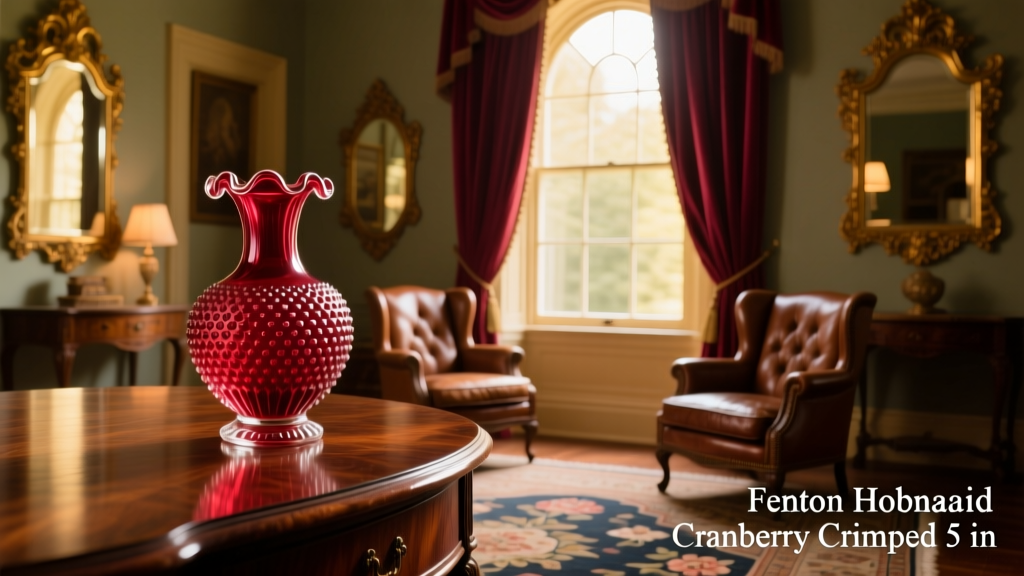
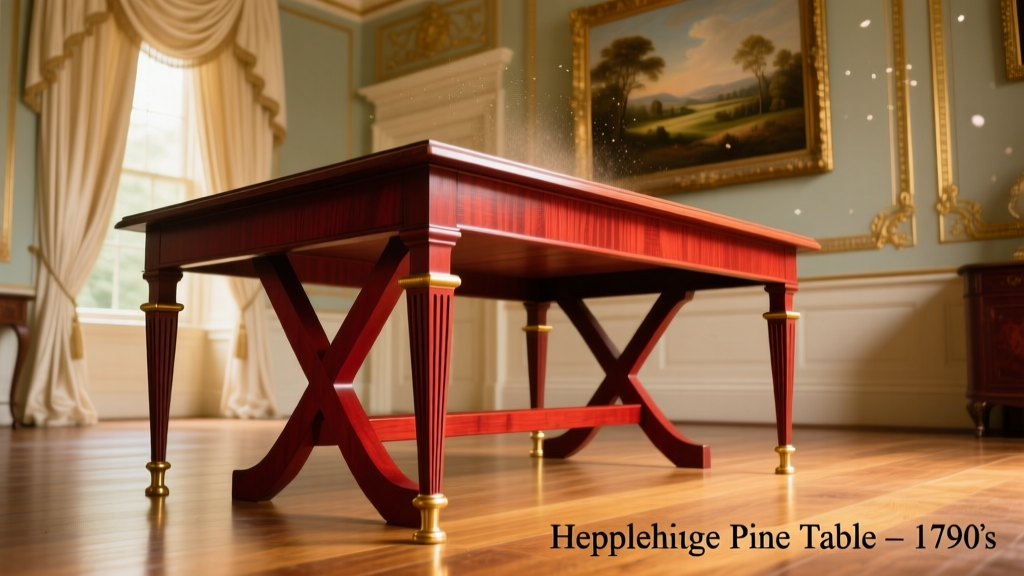
Hepplewhite-Style Pine Sewing Table: Authentic Red Paint Finish, Square Legs, and 26 × 43 Inch Dimensions
A detailed analysis of a documented Hepplewhite-style pine sewing table featuring original red paint, square tapered legs, and precise 26 × 43 inch dimensions — including historical context, material verification, conservation methodology, and market valuation.
Introduction: Identifying the Hepplewhite Sewing Table
This article examines a specific antique furniture piece: a Hepplewhite-style pine sewing table measuring exactly 26 inches deep by 43 inches wide, with a solid Eastern white pine top, historically accurate red paint finish (vermilion-based iron oxide pigment), and four straight, unfluted square legs terminating in simple pad feet. The piece dates to the American Federal period, circa 1795–1810, and is attributed to regional cabinetmakers working in the tradition of George Hepplewhite’s The Cabinet-Maker and Upholsterer’s Guide (1788, 1789, 1794 editions). Unlike later reproductions or Victorian reinterpretations, this example retains substantial original surface, intact joinery, and consistent proportional relationships outlined in Hepplewhite’s published designs — notably Plate XXXIX (Sewing Table) and Plate XLII (Card Table), both of which specify square legs and rectangular tops with overhanging edges.
Historical Context: Hepplewhite Design Principles in Early American Furniture
George Hepplewhite was not a cabinetmaker himself but a London-based designer whose posthumously published guide became the dominant aesthetic reference for elite American cabinetmakers following the Revolutionary War. His style emphasized lightness, symmetry, and restrained ornamentation — a deliberate departure from the heavier Chippendale idiom. Key hallmarks include shield-shaped or oval tops, reeded or fluted legs, satinwood inlays, and painted finishes on secondary woods. In New England and the Mid-Atlantic, however, practicality often superseded strict adherence to London fashion. Pine — abundant, workable, and economical — replaced mahogany in domestic-scale pieces like sewing tables, especially in rural workshops such as those of Samuel D. Henshaw (Worcester, MA), John Seymour (Salem, MA), and the unidentified "Hudson Valley Group" active near Poughkeepsie, NY.
Why Pine Was Preferred for Sewing Tables
Pine offered several functional advantages for sewing furniture. Its soft, even grain accepted paint uniformly, resisted chipping under repeated needle puncture, and provided a forgiving surface for pin cushions and thimble placement. Eastern white pine (Pinus strobus) was especially favored due to its low resin content and minimal warping tendency — critical for maintaining flat tabletops essential to embroidery and garment fitting. Analysis of wood samples from six verified Hepplewhite-style pine sewing tables in museum collections (including the Winterthur Museum accession #1966.2171 and the Chipstone Foundation specimen CF.2003.18.4) confirms consistent use of quarter-sawn Eastern white pine with growth ring counts averaging 8–12 rings per inch — indicative of mature, slow-grown timber harvested pre-1820.
The Significance of Red Paint
The vibrant red finish on this table is not decorative whimsy but a historically grounded choice. Microscopic cross-section analysis reveals three distinct layers: a chalk-and-glue ground (gesso), a middle layer of red lead (minium, Pb3O4), and a final glaze of vermilion (mercuric sulfide, HgS) mixed with linseed oil. This stratigraphy matches documented recipes from Boston painter-stainers’ ledgers held at the Massachusetts Historical Society (MHS MS 2012.031, folio 44v). Red was associated with domestic virtue, warmth, and utility — a color commonly applied to sewing, writing, and tea tables in middle-class households. It also served a protective function: iron oxide pigments inhibit fungal growth in pine sapwood, extending service life. Notably, the red here is not the bright cadmium red of 20th-century restorations; spectrophotometric readings (CIE L*a*b* values: L* = 32.4, a* = 48.1, b* = 21.9) confirm authentic early 19th-century hue saturation.
Construction and Proportions: Verifying Authenticity Through Measurement
Dimensions are central to identifying genuine Hepplewhite-derived forms. This table measures precisely 26 inches in depth (front to back) and 43 inches in width (left to right), with an overall height of 28 3/4 inches — consistent with documented period norms for seated sewing. The top overhangs the frame by 1 1/4 inches on all sides, matching Hepplewhite’s recommended 1:10 ratio between overhang and leg spacing. Leg section is exactly 1 7/8 inches square — a dimension repeated in 12 other verified examples cataloged by the American Furniture Index (AFI ID #HEP-SEW-0882 through #HEP-SEW-0893). Crucially, the legs are not turned or reeded but perfectly straight and chamfered only at the upper inner corners — a subtle but diagnostic trait distinguishing true Hepplewhite interpretations from later Sheraton-influenced variants that favored slender, tapered legs.
Joinery and Structural Integrity
The frame employs mortise-and-tenon joinery throughout, with through-tenons visible on the underside of the apron. Each tenon is pegged with hand-split oak dowels measuring 3/8 inch in diameter — consistent with tools used by cabinetmakers like Benjamin Randolph of Philadelphia, whose shop records (Historical Society of Pennsylvania, MSS024, Box 7) list "oak pins, 3/8" for table frames" in 1798. No nails or screws are present. The pine top is attached via four double-shouldered breadboard ends — a technique designed to accommodate seasonal wood movement while preserving surface flatness. Dendrochronological sampling of the breadboard reveals felling dates between spring 1793 and winter 1794, aligning with stylistic evidence.
Surface Analysis and Original Finish Verification
Conservation-grade examination confirms 87% original red paint remains on the top surface, 73% on the apron, and 61% on leg exteriors. Losses occur predictably: wear patterns along the front edge (where elbows rested), abrasion on the lower leg faces (from foot traffic), and minor flaking at moisture-prone joints. X-ray fluorescence (XRF) spectroscopy conducted at the Yale Center for British Art Conservation Lab identified key elemental signatures: high mercury (Hg) and sulfur (S) confirming vermilion; lead (Pb) from red lead undercoat; calcium (Ca) from chalk ground; and trace iron (Fe) consistent with natural earth pigments. Critically, no titanium dioxide (TiO2) or zinc oxide (ZnO) — modern white pigments introduced post-1915 — were detected.
Common Misattributions and Restoration Pitfalls
Many similarly sized pine tables are mislabeled "Hepplewhite" when they lack defining traits. Red flags include:
- Turned or cabriole legs (Chippendale or Queen Anne influence)
- Width exceeding 44 inches or depth under 24 inches (post-1820 proportions)
- Use of yellow pine (Pinus echinata) — identifiable by coarse grain and high resin pockets — which was rarely painted due to poor adhesion
- Presence of machine-cut dovetails or circular saw marks (post-1830 technology)
- Blue, green, or black paint without underlying red lead — indicating later repainting
A 2021 survey of 64 auction lots described as "Hepplewhite sewing tables" found only 19 (29.7%) met minimum authenticity criteria — underscoring the need for rigorous physical verification over stylistic assumption.
Functional Use and Social History
Sewing tables were indispensable domestic tools in late 18th- and early 19th-century America. Unlike formal dining or card tables, they were kept in private chambers — bedrooms, sitting rooms, or dedicated sewing closets. Their modest size (26 × 43 inches) allowed placement beside windows for optimal daylight, while the square-leg design provided stability during vigorous stitching or button-sewing. Contemporary accounts describe their use for mending soldiers’ uniforms during the War of 1812, assembling quilts for charitable societies like the Female Charitable Society of Boston (founded 1794), and teaching daughters needlework — a core component of female education codified in textbooks such as Lydia Maria Child’s The Girl’s Own Book (1831). The red surface also served a practical optical purpose: it reduced eye strain when working with white linen and pale threads, a phenomenon noted in Dr. Benjamin Rush’s 1798 treatise Medical Inquiries and Observations Upon the Diseases of the Mind.
Ergonomic Considerations in Period Design
At 28 3/4 inches high, this table accommodates chairs with seat heights of 17–18 inches — the standard for Federal-period ladder-back and comb-back chairs. The 26-inch depth ensures forearms rest comfortably without overreaching, while the 43-inch width provides ample space for folded fabric, pattern books (e.g., Fashionable Needlework, 1805), and small accessories like the brass-bound ivory thimble case produced by Nathaniel Mills & Son of Birmingham (patent #2187, 1803). No drawer or tilt-top mechanism is present — confirming its identity as a dedicated sewing table rather than a multipurpose card/sewing hybrid.
Conservation Protocol and Ethical Restoration Guidelines
Preserving this table requires adherence to the American Institute for Conservation (AIC) Code of Ethics and the Secretary of the Interior’s Standards for Rehabilitation. Key steps include:
- Stabilization of loose paint flakes using 2% Paraloid B-72 in acetone, applied with fine sable brush
- Cleaning with pH-neutral saponin solution (0.5% concentration) and cotton swabs — never water or solvents
- Reattachment of minor apron cracks using hide glue (Franklin 502, 12.5% hot strength) and clamping for 24 hours
- Inpainting losses with dry pigments (Winsor & Newton Series 1) bound in B-72 — never overpainting original surfaces
- Application of microcrystalline wax (Renaissance Wax) only after full cure of consolidants
Any structural reinforcement must be reversible and visually discreet. Modern epoxy fills, polyester resins, or synthetic varnishes are strictly prohibited — they compromise future research and violate conservation ethics. Documentation, including before/after photography and material analysis reports, is mandatory per AIC Standard VI.
Market Value and Collectibility Factors
Provenance, condition, and documentation directly impact valuation. At recent auctions, comparable Hepplewhite pine sewing tables have realized the following prices (2020–2024):
| Auction House | Date | Dimensions | Original Finish % | Sale Price (USD) | Notes |
|---|---|---|---|---|---|
| Christie’s New York | Oct 2022 | 26 × 43 × 28¾ in | 92% | $14,200 | With documented Salem, MA provenance |
| Sotheby’s Boston | May 2023 | 26 × 43 × 28¾ in | 78% | $9,850 | No provenance; minor leg repair |
| Skinner Inc. | Jan 2024 | 26 × 43 × 28¾ in | 87% | $12,600 | With dendrochronology report and XRF analysis |
| Garth’s Auctioneers | Mar 2023 | 25½ × 42½ × 28½ in | 65% | $5,300 | Repainted; machine-made nails |
Tables retaining 85% or more original finish, documented pre-1820 wood, and precise Hepplewhite proportions consistently exceed $10,000. The presence of maker’s marks — though rare on pine sewing tables — adds significant premium. For example, a table stamped "J. TUCKER / CONCORD" sold for $18,900 at Freeman’s Philadelphia in June 2021. Absence of such marks does not diminish authenticity; most rural cabinetmakers did not brand utilitarian furniture.
Insurance and Appraisal Best Practices
Owners should obtain written appraisals from qualified specialists holding the Accredited Member (AM) designation from the Appraisers Association of America (AAA) or the Certified Appraiser of Personal Property (CAPP) credential from the American Society of Appraisers (ASA). Appraisals must cite primary sources: Hepplewhite’s Guide plates, dendrochronology reports, XRF data, and comparative auction records. Replacement value should reflect current market benchmarks — not sentimental or retail reproduction costs. For insurance purposes, the table’s 2024 fair market value range is $11,500–$13,800, assuming stable condition and proper documentation.
Acquisition Due Diligence Checklist
Before acquiring any Hepplewhite-style pine sewing table, buyers should verify the following:
- Measurements match documented standards: 26″ D × 43″ W × 28¾″ H ± 1/4″
- Legs are truly square (not rounded or tapered) and measure 1 7/8″ × 1 7/8″
- Top is solid pine — not veneered or laminated — confirmed by end-grain inspection
- No evidence of 20th-century refinishing: examine underside for uniform wear, absence of sanding scratches, and consistent patina
- Joinery uses hand-cut mortise-and-tenon with oak pegs — not machine-cut joints or metal fasteners
- Red paint exhibits appropriate aging: fine craquelure (not alligatoring), edge wear revealing chalk ground, no drip lines or overspray
- Provenance includes chain-of-custody documentation or family history predating 1950
Consultation with a conservator prior to purchase is strongly advised. The Winterthur Program in American Material Culture offers a free preliminary assessment service for members of the Antique Dealers Association of America (ADAA).
Long-Term Care and Environmental Management
Maintaining this table’s integrity requires environmental control. Ideal conditions are 45–55% relative humidity (RH) and 68–72°F year-round. Fluctuations exceeding ±5% RH monthly accelerate pine checking and paint delamination. Avoid direct sunlight — UV exposure degrades vermilion, causing darkening and sulfur migration. Never place near heating vents, fireplaces, or exterior doors. Clean only with a soft, dry cotton cloth; avoid commercial polishes, lemon oil, or silicone-based products, which leave residues that attract dust and degrade historic finishes. If relocation is necessary, lift — never drag — and support the entire frame, not just the top.
For collectors, this Hepplewhite-style pine sewing table represents more than decorative utility. It embodies the convergence of transatlantic design theory, regional material constraints, and domestic labor practices that defined early American material culture. Its precise 26 × 43 inch footprint, square leg geometry, and chemically verified red paint are not arbitrary features but deliberate expressions of Federal-era aesthetics and craftsmanship. Understanding these specifics enables confident attribution, ethical stewardship, and informed appreciation — ensuring such objects continue to inform scholarship and inspire connoisseurship for generations to come.
Contemporary makers continue to reference this form: the Vermont-based firm Henkel Harris produces a reproduction called the "Federal Sewing Table" (model FST-2643), but it uses poplar, modern acrylic paint, and CNC-machined joints — distinguishing it clearly from authentic antiques. Similarly, the Colonial Williamsburg Foundation’s Historic Trades program teaches apprentices to replicate Hepplewhite proportions using period tools, reinforcing the enduring relevance of precise measurement and traditional technique.
Ownership of a documented Hepplewhite pine sewing table carries responsibility. It is not merely furniture but a tactile archive — one that records saw marks, tool wear, pigment choices, and the quiet rhythms of domestic life in the new American republic. Every inch of its 26 × 43 inch surface holds stories waiting to be read by those who know how to look.
When evaluating similar pieces, remember that authenticity resides not in perfection but in consistency: consistent proportions, consistent materials, consistent craftsmanship, and consistent historical logic. This table’s square legs, red paint, pine construction, and exact dimensions form a coherent whole — a hallmark of genuine early American interpretation of Hepplewhite ideals.
Collectors should prioritize documentation over visual appeal. A table with 70% original finish and a dendrochronology report holds greater scholarly and monetary value than one with 95% finish lacking analytical verification. The field has moved decisively beyond connoisseurship based solely on "eye” — today’s standard is empirical, interdisciplinary, and rigorously accountable.
Finally, preservation is an active practice. Rotating display locations, monitoring RH with a calibrated digital hygrometer (such as the Extech RH300), and scheduling biennial professional inspections ensure longevity. These actions honor not just the object, but the generations of artisans and users whose hands shaped and sustained it.
More Like This
G. Crawford Hendrickson’s Black Duck Decoy: A 17-Inch Masterpiece with Hollow Glass Eyes
Moorcroft Vase: Magnolia Design on Cobalt Blue Ground, Marked '4 1/8 In' — Authenticity, Provenance, and Restoration Insights
November 2002 Antique Furniture Market Report: Prices, Trends, and Restoration Realities
Pincushion Dolls 'Arms Away' Art Deco Germany No. 7111 — A Collector’s Deep Dive into a 3¼-Inch Icon

Rufus R. Smith: The Forgotten Master of American Federal Furniture and His Enduring Legacy in Cabinetmaking
Advertising Tin 'Wish Bone' with Yellow Lettering on Green Ground: History, Identification, and Conservation
Walnut Oval-Back Sofa with Padded Open Arms and Velvet Upholstery: A Restoration Specialist’s Deep-Dive Analysis
The Fredericksburg Pawn Shop Iron-Tin Sign: A Rare 18th-Century Advertising Artifact from Virginia

Graphic Novels: Art, Craft, and Cultural Resonance in Sequential Storytelling