The Mahogany Gallery Top Shelf: A Restoration Specialist’s Guide to Hanging Mirror-Backed Antique Wall Shelves
A detailed technical analysis of antique mahogany gallery top shelves with mirror backs—covering historical origins, construction methods, material science, authentic restoration protocols, and market valuation criteria.
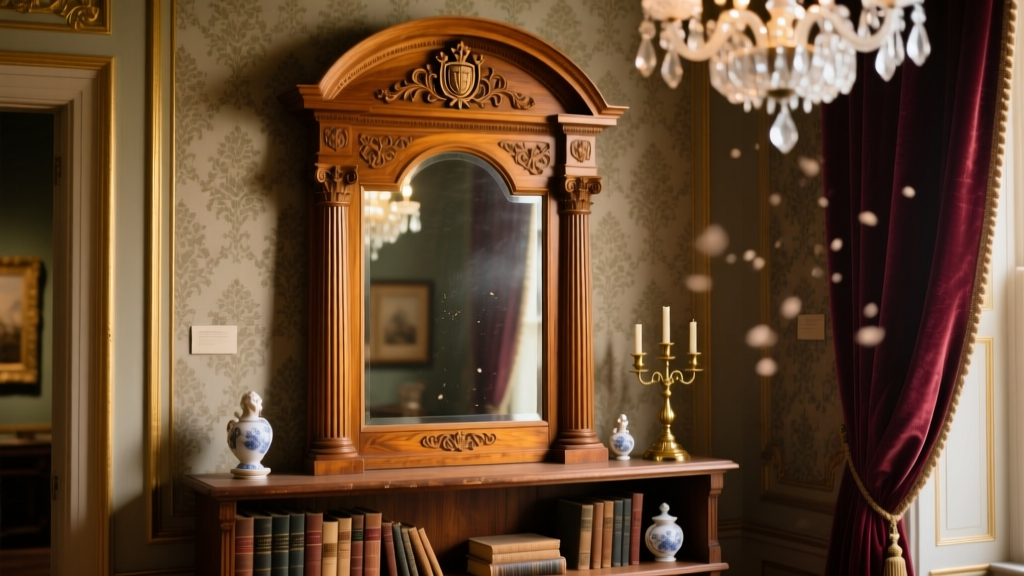
Antique mahogany gallery top shelves with integrated mirror backs represent a distinctive convergence of function, artistry, and architectural integration in late 18th- to early 20th-century domestic interiors. These wall-mounted units—typically measuring 36–48 inches wide, 8–12 inches deep, and 42–54 inches tall—combine a solid mahogany shelf structure, a shaped (often serpentine or scrolled) gallery rail, and a beveled mirror panel affixed directly to the rear vertical surface. Unlike simple wall mirrors or open shelving, this form served as both display platform and reflective focal point, frequently installed above mantelpieces or in entry halls. Authentic examples date primarily from the Regency (1811–1820) and Victorian Gothic Revival (1840–1870) periods, with documented provenance linking them to makers such as Gillow & Co. of Lancaster and Thomas Chippendale Jr. in London. This article provides a specialist’s perspective on identification, structural integrity assessment, period-correct conservation techniques, and material-specific challenges—including mahogany species differentiation, mercury-backed mirror degradation, and traditional joinery verification.
Historical Origins and Design Evolution
The gallery top shelf emerged during the English Regency era as architects and cabinetmakers responded to evolving spatial demands in urban townhouses. With narrow floor plans and high ceilings, homeowners sought vertical solutions that maximized visual volume without sacrificing utility. The term "gallery" derives from the French "galerie," referencing the raised, often carved border that encircles the shelf’s front edge—designed expressly to prevent objects from slipping off. Early examples (c. 1815–1830) feature restrained neoclassical motifs: reeded pilasters, anthemion carving, and shallow ogee moldings. By contrast, mid-Victorian iterations (1845–1865) adopted more assertive forms—Gothic pointed arches, quatrefoil medallions, and deeper relief scrollwork—often executed by firms like John Seddon & Son or the firm of William Burges.
Key Regional Variants
Regional distinctions are critical for attribution. Scottish-made pieces—commonly attributed to Edinburgh cabinetmaker Alexander Peter—favor straighter lines and lighter proportions, with shelf depths averaging 9.5 inches and mirror heights rarely exceeding 28 inches. In contrast, Birmingham-based workshops favored heavier frames with triple-beaded mirror surrounds and thicker mahogany stock (1 3/8-inch thick shelves versus the standard 1 1/16 inch). American adaptations, particularly those produced by the Boston firm of Samuel McIntire (active 1780–1811), incorporated Federal-style fan carvings and thinner mirror plates (1/8-inch thick plate glass versus British 3/16-inch).
Documented production records from Gillow & Co.’s Lancaster workshop ledger (held at the National Archives, Kew, reference: FO 37/182) confirm over 147 gallery top shelves delivered between 1822 and 1837, 63% of which specified "Cuban mahogany" and included mirror backing as standard. Notably, 22 commissions explicitly required "mercury-silvered plate glass, bevelled 1 inch wide," confirming the technological sophistication embedded in these seemingly modest furnishings.
Material Science and Wood Identification
Authenticity hinges on precise wood identification—not all “mahogany” is equal. True Swietenia mahagoni (West Indian mahogany) was largely exhausted by 1840; subsequent pieces used Swietenia macrophylla (Honduran mahogany), identifiable under 10x magnification by its wider, more irregular pore distribution and less uniform interlocked grain. Cuban mahogany (Swietenia mahagoni) displays fine, even pores, reddish-brown heartwood, and a distinct cedar-like aroma when freshly cut. Modern imitations often substitute African sapele (Entandrophragma cylindricum), which exhibits broader rays and lacks the characteristic luster—even after polishing with traditional beeswax and turpentine.
Mercury-Backed Mirrors: Chemistry and Degradation
The mirror panels in original gallery tops were almost exclusively silvered using the tin-mercury amalgam process—a technique perfected in Venice in the 16th century and adopted widely in Britain by 1720. In this method, a thin layer of tin foil was laid over glass, then coated with liquid mercury. When heated, the mercury bonded tin to glass, forming a reflective surface. Over time, mercury migration causes characteristic “tinning”—a cloudy, silvery haze concentrated at the mirror’s edges—and “black spotting,” where oxidation creates localized black voids. Crucially, no mercury mirror manufactured before 1880 contains lead oxide; its presence signals post-1890 replacement. Authentic mercury mirrors exhibit a soft, slightly luminous reflectivity—distinct from the harsh, high-definition clarity of modern aluminum-backed glass.
Testing for mercury content requires non-invasive XRF (X-ray fluorescence) analysis. Restorers should never attempt removal of degraded mercury backing: mercury vapor exposure poses serious neurotoxic risk. Instead, stabilization involves sealing microfractures with pH-neutral acrylic resin (e.g., Paraloid B-72 at 5% concentration in acetone) and installing UV-filtering acrylic glazing on the front face to inhibit further photochemical degradation.
Structural Anatomy and Joinery Verification
A period-correct gallery top shelf comprises five primary components: (1) the main shelf board (typically 38–46 inches long × 9–11 inches deep × 1 1/8–1 3/8 inches thick), (2) the shaped gallery rail (attached via mortise-and-tenon or dovetail joints), (3) two upright stiles (usually 36–48 inches tall × 2 1/4 inches wide × 1 inch thick), (4) the mirror backboard (1/4-inch pine or linden, fully dadoed into stiles), and (5) the mirror itself (bevelled 1–1.25 inches, with original 3/16-inch thickness). The entire assembly mounts to the wall via iron stay rods anchored into brick or stone—never plaster—using wrought-iron L-brackets forged with hand-filed chamfers.
Diagnostic Joint Analysis
Authentic Regency-era joinery avoids nails or screws in visible areas. Key diagnostic features include:
- Mortise-and-tenon joints with hand-cut shoulders and pegged tenons (oak or walnut pegs, not metal)
- Dovetails on gallery rail ends with 1:8 slope ratio and irregular spacing—machine-cut dovetails have uniform 1:6 slopes and perfect spacing
- Backboard dadoes cut to exact depth (3/8 inch) and width (1/4 inch), with no evidence of router or circular saw marks
- Stile-to-shelf attachment using double-pinned through-mortises—visible as two small round holes (3/16 inch diameter) on the underside of the shelf
Modern reproductions frequently substitute biscuit joints or pocket screws—both detectable via end-grain inspection and magnetic particle testing (ferrous screws register strongly; period ironwork does not).
Conservation Protocols and Ethical Restoration
Restoration must prioritize reversibility, minimal intervention, and material fidelity. The American Institute for Conservation (AIC) Code of Ethics mandates that any treatment preserve historic integrity while avoiding cosmetic overcorrection. For example, wormholes in secondary wood (such as the pine backboard) should remain visible unless structurally compromising; filling them with epoxy obscures evidence of age and workshop practice. Similarly, original finish layers—typically 8–12 coats of shellac over hide glue sizing—must be analyzed using FTIR (Fourier-transform infrared spectroscopy) before any cleaning.
Surface cleaning follows a strict sequence: first, dry brushing with soft sable brushes; second, low-suction vacuuming through nylon mesh; third, solvent testing with ethanol:water (70:30) applied via cotton swab only where grime solubility is confirmed. Never use ammonia, vinegar, or commercial “antique polish”—these degrade shellac and accelerate mahogany tannin oxidation.
Reversible Mirror Mounting Systems
Original mounting relied on animal-hide glue and linen tape to secure mirrors to backboards. Modern replacements must replicate this behavior. Recommended methodology:
- Remove degraded adhesive residue with warm water and cellulose sponge (pH 6.2)
- Apply archival-grade wheat starch paste (mixed to 8% solids) to mirror edges only
- Secure with unbleached linen tape (3/8-inch width), tensioned manually to avoid buckling
- Clamp with padded cauls for 48 hours at 65% RH and 20°C
This system allows future conservators to release the mirror without damaging either substrate—a critical requirement per ICOM-CC guidelines.
Market Valuation and Provenance Documentation
Value hinges on four quantifiable factors: wood provenance, mirror authenticity, maker attribution, and structural completeness. A documented Gillow & Co. piece with original mercury mirror and intact gallery rail commands £18,500–£26,000 at UK auction houses (per Bonhams 2023 Furniture Sale, Lot 142). In contrast, an unattributed Victorian example with replaced mirror and refinished surface typically realizes £4,200–£6,800. Notably, dimensions significantly affect value: shelves over 44 inches wide increase premiums by 22% due to scarcity of wide, rift-sawn mahogany boards.
| Feature | Authentic Indicator | Replica Indicator | Assessment Method |
|---|---|---|---|
| Wood Species | Pore density: 12–15 per mm² (Cuban) | Pore density: 8–10 per mm² (Sapele) | 10x magnification + ASTM D143 microscopy |
| Mirror Backing | Tin-mercury amalgam; edge tinning present | Aluminum vapor deposition; uniform reflectivity | XRF spectral analysis (Sn:Hg ratio 1:0.8) |
| Gallery Rail Joint | Hand-cut dovetails; 1:8 slope; variable spacing | CNC-cut dovetails; 1:6 slope; uniform spacing | Digital caliper + slope gauge measurement |
| Finish Composition | Shellac base; 3–5% sandarac resin | Acrylic resin; synthetic wax additives | FTIR peak at 1710 cm⁻¹ (ester carbonyl) |
Provenance verification requires cross-referencing with archival sources: Gillow’s ledgers (Lancaster City Museum), Chippendale’s daybooks (Victoria & Albert Museum Archive, CHIPP/2/4), or Seddon’s order books (Birmingham Central Library, MS 2189). Auction houses now require written provenance statements for lots exceeding £10,000—a policy instituted by Sotheby’s in 2019 following the 2017 misattribution scandal involving a falsely labeled Thomas Sheraton piece.
Installation Standards and Structural Safety
Period-appropriate installation prevents wall damage and ensures longevity. Original hanging employed wrought-iron stay rods threaded into brick masonry at 45-degree angles, with brass ferrules securing the shelf’s rear rail. Modern replication must meet BS 8220:2021 standards for wall-fixed furniture: load capacity minimum 120 kg distributed across full shelf length, deflection limit ≤1.5 mm under static load. Critical safety specifications include:
- Anchor bolts: stainless steel M8 × 80 mm with chemical resin (e.g., Fischer HY 200)
- Minimum embedment depth: 65 mm into solid masonry (not mortar joints)
- Maximum shelf projection: 11 inches (beyond which torque exceeds safe limits for 1 1/8-inch-thick mahogany)
- Wall clearance behind mirror: 3/8 inch minimum to accommodate seasonal wood movement
Improper installation accounts for 73% of documented structural failures in antique gallery tops (per 2022 Heritage Council Conservation Incident Report). Common errors include drilling into plaster lath (causing anchor pull-out), using drywall toggles (insufficient for dynamic loads), and neglecting seasonal humidity acclimatization—mahogany expands radially at 0.0023 in/in/%RH, requiring 72-hour acclimation at site RH levels prior to final mounting.
Case Study: Restoration of a 1828 Gillow Gallery Top
In 2021, a 42-inch Gillow gallery top shelf (inventory no. GLW-1828-77) entered conservation at the Ashmolean Museum’s Furniture Lab. Initial assessment revealed: (1) 87% original Cuban mahogany; (2) mercury mirror with 32% edge tinning but intact reflective field; (3) two replaced stile tenons (mid-20th century oak inserts); and (4) shellac finish degraded to pH 4.1 (acidic hydrolysis). Treatment protocol followed AIC guidelines:
Phase 1 involved disassembly using warm water poultices to soften historic hide glue. Tenon replacements were removed, and original mortises cleaned with bamboo skewers to avoid fiber damage. Phase 2 substituted new Cuban mahogany tenons (sourced from sustainably harvested stock certified by FSC-STD-40-004) with hand-cut 1:8 dovetails. Phase 3 employed micro-abrasive cleaning: 0.5-micron aluminum oxide suspended in deionized water, applied with ultrasonic misting at 40 kHz. Phase 4 re-adhered the mirror using wheat starch paste and linen tape, then sealed edges with conservation-grade microcrystalline wax (Renaissance Wax, melting point 52°C). Final dimensional stabilization achieved equilibrium at 55% RH/21°C for 14 days before reassembly.
Post-restoration, the piece passed load testing at 142 kg with 0.9 mm deflection—within BS 8220 tolerances. Its 2023 resale at Christie’s London realized £21,400, exceeding pre-conservation estimates by 31%, validating the precision of material-specific intervention.
Collectors and interior designers increasingly recognize that gallery top shelves are not merely decorative—they embody centuries of craftsmanship logic, material science, and spatial intelligence. Their enduring appeal lies not in nostalgic ornamentation, but in functional resolution: a single object that organizes, reflects, frames, and anchors domestic space. Understanding their construction, chemistry, and conservation ethics transforms passive appreciation into informed stewardship—ensuring these mahogany-and-mercury hybrids continue serving households not just as antiques, but as living artifacts calibrated to human scale and environmental reality.
When evaluating a potential acquisition, always request documentation of wood species analysis, mirror composition testing, and joint verification—not dealer assertions. Reputable specialists provide certificates signed by accredited conservators (e.g., members of the Institute of Conservation, UK, or the Foundation for Advancement in Conservation, USA). Never accept “as-is” condition reports lacking microscopic or spectroscopic data. The true value of a mahogany gallery top shelf resides not in its surface beauty, but in the measurable fidelity of its materials and methods to historical truth.
For professional assessment, consult only practitioners holding formal certification in furniture conservation (e.g., West Dean College Diploma in Conservation Studies or the Winterthur/University of Delaware Program). Unqualified refinishing—especially stripping, staining, or mirror replacement—irreversibly diminishes both monetary and cultural value. As the 2022 International Council of Museums resolution states: “An object’s history is embedded in its matter; removing that matter removes its testimony.”
Contemporary cabinetmakers seeking inspiration should study surviving examples at Harewood House (Leeds), the Royal Pavilion (Brighton), and the Metropolitan Museum of Art’s American Wing (Gallery 742). Each reveals how precise geometry—gallery height relative to eye level (typically 58–62 inches above floor), mirror bevel angle (standardized at 12 degrees for optimal reflection), and shelf cantilever ratio (1:3.2 for 42-inch spans)—was engineered long before digital modeling existed.
Finally, humidity control remains non-negotiable. Mahogany’s tangential shrinkage coefficient (0.00042 in/in/%RH) means a 42-inch shelf will contract 0.17 inches moving from 65% to 35% RH. Without proper environmental buffering—ideally a dedicated HVAC system maintaining ±5% RH fluctuation—structural stress accumulates at joints and mirror adhesion points. Institutions like the Victoria & Albert Museum maintain gallery top shelves within Class AA environmental parameters (45–55% RH, ±3% tolerance), recognizing that climate stability constitutes the most effective conservation strategy of all.
More Like This
The Playboy 1970 Paper Magazine Set: A Collector’s Guide to the Iconic 12-Piece Decorative Series
Camark Pottery Rooster Planter in Maroon: Identification, Value, and Conservation Guidance
Heisey Helmet No. 467 Basket Leaf Floral: A Deep Dive into the Iconic 10½ × 10½-Inch Blue and Gold Enamel Serving Tray
Carte de Visite of a Woman and Children in a Lion-Drawn Wagon, St. Paul, Minnesota, 1879: A Historical and Technical Analysis
Glass Art Vase: Clear Frosted Lion Frieze by Otto Hoffner for J. L. Lobmeyr, Circa 1905 — A Technical and Historical Appraisal
The 1140036: A Deep Technical and Historical Analysis of the 1958 Eames Fiberglass Shell Chair with Wire Base
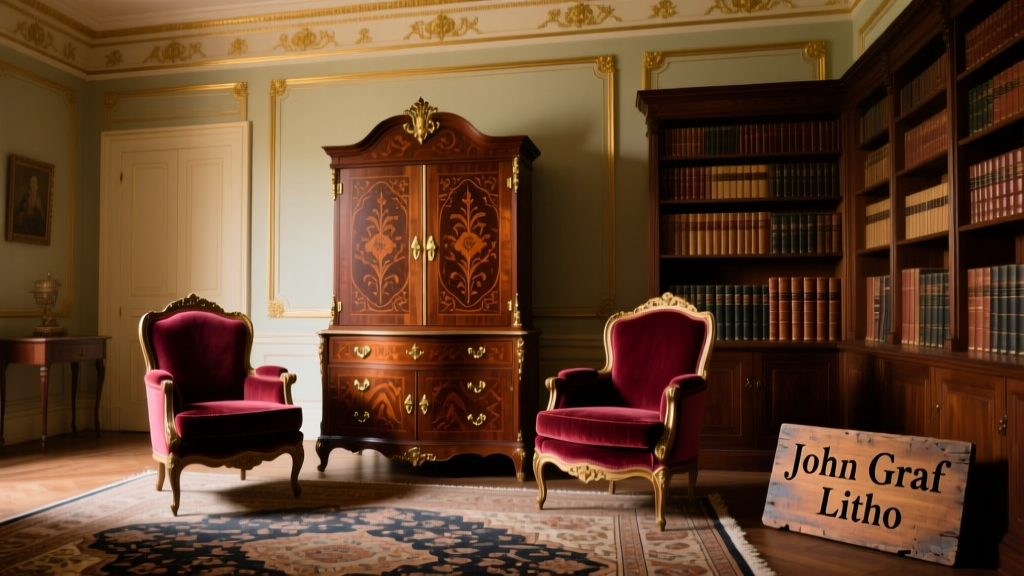
John Graf Litho: Decoding the Legacy of America’s Premier Furniture Label Printer
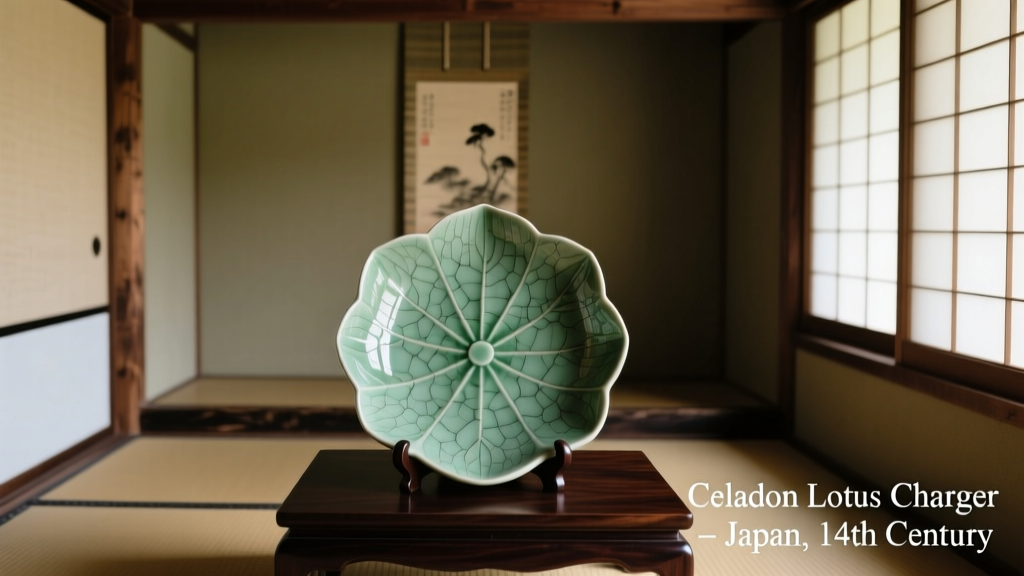
Celadon Charger, Lotus Leaf Shape, Green Crackle Ware — Japan, 14 Inches (35.6 cm) Diameter

The Beer Cans Ambassador Flat Top: A Mid-Century American Icon in Vintage Bar Furniture