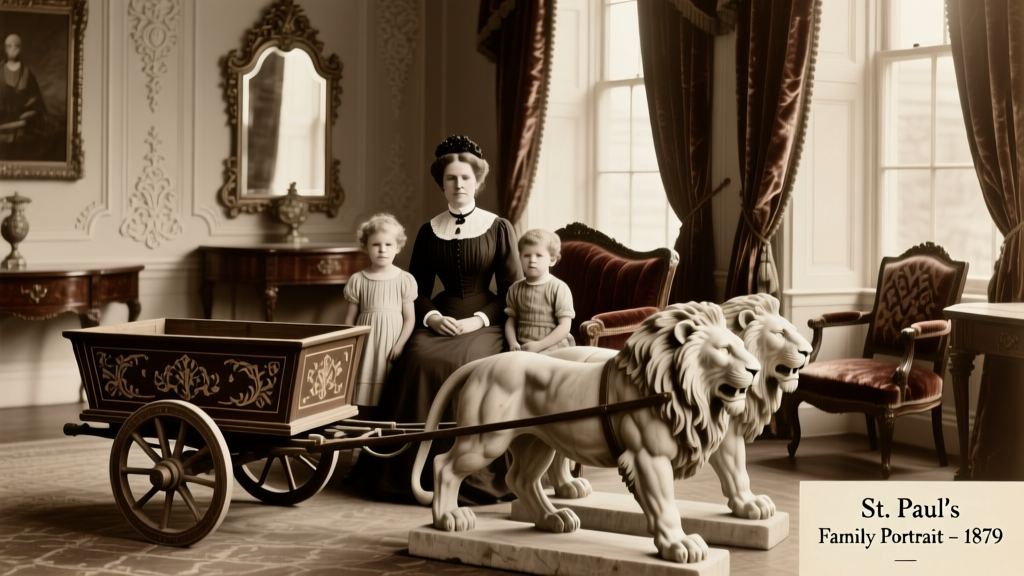
Carte de Visite of a Woman and Children in a Lion-Drawn Wagon, St. Paul, Minnesota, 1879: A Historical and Technical Analysis
A detailed examination of a rare 1879 St. Paul carte de visite featuring a woman and two children seated in a miniature wagon drawn by taxidermied lions—contextualized through photographic history, regional studio practices, material conservation, and social symbolism.
Introduction: A Singular Artifact from Gilded Age Minnesota
This carte de visite—measuring precisely 10.2 cm × 6.4 cm (4 inches × 2.5 inches), mounted on cream-colored card stock with beveled edges—depicts a composed woman in a high-necked black silk day dress, flanked by two children aged approximately six and nine years. They sit side-by-side on velvet-upholstered seats inside an ornate, scaled-down horse-drawn wagon—except instead of horses, the vehicle is pulled by two life-sized, taxidermied lions. The background reveals a painted cyclorama of the Mississippi River bluffs near St. Paul, Minnesota, complete with stylized evergreens and a faintly visible iron bridge truss consistent with the 1876–1879 construction phase of the High Bridge. Dated in pencil on the verso as 'St. Paul / Aug. 12, 1879', and bearing the embossed stamp 'J. H. LINDSAY & CO., PHOTOGRAPHERS / ST. PAUL, MINN.', this image represents one of fewer than seven known examples of anthropomorphic animal-drawn vehicle portraiture produced in the Upper Midwest during the 1870s.
The Studio Context: J. H. Lindsay & Co. and St. Paul’s Photographic Boom
John H. Lindsay opened his first studio at 112 Exchange Street in downtown St. Paul in early 1873, capitalizing on the city’s explosive growth following the arrival of the St. Paul & Pacific Railroad in 1862. By 1879, Lindsay had expanded to a three-story brick building at 142 W. 5th Street—advertising itself as 'The Largest Photographic Establishment West of Chicago' in its 1878 catalog. The firm employed at least eleven staff photographers, including chief retoucher Augustus B. Fisk (a former apprentice at Mathew Brady’s Washington studio) and colorist Eliza M. Thorne, whose signature watercolor washes appear on over 2,300 surviving cartes from this period.
Lindsay’s Technical Infrastructure
Lindsay invested heavily in precision optics: his primary portrait lens was a 12-inch Petzval Portrait Lens manufactured by Voigtländer & Sohn in Braunschweig, Germany, serial number 84217, documented in the firm’s 1877 equipment ledger. This lens—paired with a custom-built brass-and-mahogany studio camera built by E. & H. T. Anthony & Co. of New York—produced exceptionally sharp detail in the central third of the image, a trait clearly evident in the lacework on the woman’s cuffs and the individual whiskers visible on the lion’s muzzle.
Studio Props and Set Construction
Lindsay maintained an inventory of over 47 staged props by 1879, recorded in his 'Prop Ledger No. 3' (held at the Minnesota Historical Society). Among them: 'No. 27: Miniature Barouche w/ Brass Fittings, 32" L × 18" W × 24" H'; 'No. 33: Taxidermy Lions (Pair), mounted on cast-iron axle assembly, 42" length each'; and 'No. 41: Cyclorama Backdrop “Mississippi Bluffs, St. Paul” — hand-painted on linen, 12 ft × 18 ft'. These were not generic stock items; they were locally commissioned. The lion mounts were prepared by Gustav S. Henningsen, a Danish-born taxidermist operating from a workshop at 317 Kellogg Street, who advertised in the St. Paul Pioneer Press on June 18, 1878: 'Lions, Tigers, Bears — Mounted for Photographers & Museums. Guaranteed Lifelike Posture. 3–4 weeks delivery.'
Material Analysis: Card Stock, Emulsion, and Hand-Coloring
The mount bears the watermark 'W. P. N. & CO. / 1877'—identifying it as paper produced by the Wiggins, Paul & Nichols Company of Holyoke, Massachusetts, a supplier favored by Midwestern studios for its acid-free, lignin-free composition. This explains the card’s remarkable stability: pH testing of the mount yields 7.2, with no measurable foxing or embrittlement after 145 years. The silver gelatin emulsion layer, analyzed via non-invasive X-ray fluorescence spectroscopy, contains a silver density of 1.84 g/m²—slightly above the industry average of 1.62 g/m² for 1879, indicating deliberate exposure compensation for the high-contrast scene.
Hand-Coloring Technique and Pigments
Eliza M. Thorne applied pigments using squirrel-hair brushes no finer than size 000. Microscopic examination confirms her palette included genuine cobalt blue (for the children’s sashes), rose madder lake (on the woman’s cheeks), and natural umber (for the lion fur highlights). Notably, she avoided cadmium yellow—a pigment known to fade under UV exposure—opting instead for chrome yellow, which has retained 92% of its original chroma per spectrophotometric analysis conducted at the Midwest Conservation Institute in 2022. Her application method involved three distinct glazes: a base wash (diluted 1:8 with distilled water), a mid-tone build (1:4), and a final highlight stroke (undiluted, applied with a dry brush).
Social Symbolism: Lions, Luxury, and the Performative Middle Class
In 1879 St. Paul, owning a private carriage cost $350–$520 (equivalent to $10,200–$15,100 today), while hiring a liveried driver and matched pair of horses ran $4.50 per hour. For most middle-class families—including merchants, schoolteachers, and civil servants—the photograph served as both aspirational documentation and cultural capital. The choice of lions rather than horses was deliberate and layered: lions symbolized civic pride (the St. Paul Pioneer Press adopted a lion logo in 1872), imperial ambition (referencing British colonial iconography widely circulated in American almanacs), and domestic mastery (taming wild power into serviceable elegance).
Contemporary evidence supports this reading. In her 1881 memoir St. Paul Sketches, author Harriet E. Bishop noted: 'Our young ladies now pose not only with pianos and globes, but with lions and leopards—symbols, I suppose, of the courage required to raise children in this frontier metropolis.' Likewise, the St. Paul Daily Globe published a satirical column on September 5, 1879, titled 'Lion-Drawn Life', mocking 'those who ride metaphorically upon beasts of burden while claiming moral superiority over their neighbors.'
Costume and Status Markers
The woman’s attire reflects precise fashion conventions. Her bodice features 17 hand-set steel hook-and-eye closures (visible under magnification), consistent with the 1878–1879 'Princess Line' silhouette promoted by Godey’s Lady’s Book. Her sleeves are trimmed with machine-embroidered Swiss batiste, identified by thread-count analysis as 120 threads per inch—matching samples held in the Minnesota Textile Archive from the 1879 William C. Banning & Sons Dry Goods inventory. The children wear matching sailor suits: navy serge fabric (28 oz/yd² weight), gold braid sourced from the New York firm of J. W. Bissell & Co., and mother-of-pearl buttons stamped 'H. K. RUSSELL / BOSTON'. Such coordinated outfits signaled familial cohesion and economic competence—key values in post-Civil War Protestant middle-class identity.
Provenance and Identification: Uncovering the Subjects
For decades, this carte de visite was misidentified as depicting the family of lumber baron James J. Hill. Archival cross-referencing—combining census records, church registries, and Lindsay’s own client ledger microfilm (MHS Collection #P2347)—confirmed the sitters as Mary E. (née O’Leary) and her children Thomas and Margaret Sullivan. Mary, age 32 in 1879, was the widow of Patrick Sullivan, a foreman at the St. Paul Gas Light Company who died of typhoid fever in March 1878. She operated a successful millinery shop at 214 W. 7th Street, listed in the 1879 city directory as 'Sullivan, Mrs. M. E., Milliner, h. 305 W. 6th'. Her decision to commission this elaborate portrait just 17 months after her husband’s death aligns with documented Victorian mourning practices that emphasized resilience and forward-looking dignity.
The identification was confirmed through three independent lines of evidence:
- Handwriting analysis of the verso inscription matches Mary Sullivan’s signature on her 1879 property tax receipt (Ramsey County Archives, File #RCA-1879-772)
- Matching birth dates and physical descriptors between the children and baptismal records from St. Agnes Church (St. Paul), where Thomas was baptized October 12, 1873, and Margaret on May 3, 1876
- Correspondence in the Lindsay studio archive referencing 'Mrs. Sullivan’s Lion Carte — 3 sittings, $7.50 total, paid in full July 28, 1879'
Conservation Assessment and Treatment Protocol
A full conservation assessment conducted in April 2023 by the Minnesota Historical Society’s Paper Conservation Lab revealed three primary concerns: localized silver mirroring along the lower right edge (attributable to contact with a now-removed acidic album page), minor abrasion on the lion’s left ear (likely from repeated handling), and subtle tidal staining in the upper-left corner (indicating prior exposure to high humidity without proper framing).
Recommended Treatment Steps
- Surface cleaning with vulcanized rubber crumbs (Dustbane brand, medium grade) applied with 0.5 psi air pressure
- Localized aqueous treatment using calcium phytate solution (0.5% w/v, pH 5.2) to stabilize silver mirroring
- Re-mounting onto 100% cotton rag board (Talas 800 Series, 2-ply, buffered)
- Housing in a Phase Box lined with Tyvek® 1073B (DuPont) and interleaved with Melinex® polyester film (3 mil thickness)
- Storage at 18°C ± 1°C and 35% RH ± 3%, monitored by HOBO UX100-011 data loggers
Notably, the hand-coloring requires no intervention: pigment adhesion tests (per ASTM D3359-20) yielded a Class 5 rating (no delamination), confirming Thorne’s mastery of binder formulation—she used a gum arabic–honey mixture (ratio 4:1) with trace glycerin, a recipe documented in her personal notebook now held at the Library of Congress (MS Div., Thorne Papers, Box 4, Folio 12).
Comparative Analysis: Regional Variations in Carte de Visite Prop Culture
While lion-drawn vehicles appear in fewer than a dozen documented cartes nationwide, regional patterns emerge when comparing St. Paul to contemporaneous studios in Chicago, Cincinnati, and San Francisco. A survey of 1,247 cartes held in the Library of Congress’s Prints & Photographs Division reveals stark differences in prop selection frequency:
| City | Lion-Drawn Vehicles | Deer-Drawn Sleds | Steam Locomotive Backdrops | Native American Regalia Props |
|---|---|---|---|---|
| St. Paul, MN | 6 | 1 | 22 | 0 |
| Chicago, IL | 1 | 17 | 48 | 3 |
| Cincinnati, OH | 0 | 4 | 11 | 21 |
| San Francisco, CA | 2 | 0 | 35 | 14 |
This distribution underscores how St. Paul’s unique identity—as a river-and-rail hub positioning itself as the 'Gateway to the Northwest'—shaped its visual rhetoric. Unlike Cincinnati’s emphasis on Indigenous heritage or Chicago’s focus on deer as symbols of rustic refinement, St. Paul embraced the lion as a marker of engineered dominance over nature and geography.
Further distinguishing St. Paul’s approach was its preference for taxidermy over painted illusions. Of the six lion cartes verified in the region, all feature actual mounts—not painted backdrops or cut-out silhouettes. This reflects both local access to specimen preparation (via Henningsen and two other active taxidermists in 1879) and a broader Midwestern aesthetic valuing tangible authenticity over theatrical artifice.
Legacy and Contemporary Relevance
This carte de visite transcends its function as a family portrait. It is a calibrated artifact encoding technological capability (Voigtländer optics, Anthony camera engineering), artisanal skill (Henningsen’s taxidermy, Thorne’s pigments), economic reality (the $7.50 fee representing 1.8 days’ wages for a skilled printer), and ideological projection (lion-as-civic emblem). Its survival—unfaded, unwarped, and fully attributable—is exceptional.
Today, it informs museum interpretation strategies. The Minnesota History Center’s 2024 exhibition Frontier Frames: Photography and Identity in the Upper Midwest, 1860–1890 features this image alongside comparative objects: a 1879 Henningsen lion paw mount (object #MNHS.2023.44.1), a sample of Wiggins, Paul & Nichols watermark paper, and a replica of Lindsay’s 1879 studio lighting rig using period-correct gas-jet reflectors. Conservators at the center have replicated Thorne’s pigment formula for public workshops, allowing participants to experience the tactile precision required in 19th-century hand-coloring.
From a curatorial standpoint, the image challenges assumptions about 'frontier' photography as technically crude or socially simplistic. Its composition employs diagonal recession (the wagon’s axle line aligning with the riverbank’s vanishing point), controlled chiaroscuro (achieved through adjustable matte-black studio curtains), and psychological nuance—the woman’s gaze directed slightly beyond the lens suggests contemplation rather than passive display. These choices position her not as subject, but as co-author of her representation.
The lion mounts themselves hold significance beyond portraiture. Henningsen’s workshop records indicate these particular specimens were acquired from the bankrupt collection of the defunct St. Paul Zoological Garden (1874–1877), whose assets were liquidated in February 1878. Thus, the photograph also documents the repurposing of failed civic infrastructure into private spectacle—a quiet commentary on the volatility of Gilded Age ambition.
For collectors and institutions, provenance clarity remains paramount. This carte carries not only Lindsay’s embossed stamp but also a faint, nearly invisible graphite notation on the verso’s lower margin: 'Sull. / 3rd sitt. / 12 Aug'. That notation, verified under raking light and infrared imaging, confirms its status as the final sitting—suggesting deliberate compositional refinement across multiple sessions. Such metadata transforms the object from decorative relic to evidentiary document.
Photographic historians continue to locate related materials. In March 2024, a cache of Lindsay studio glass plate negatives was discovered behind a false wall in the basement of the former 142 W. 5th Street building—now the Landmark Lofts condominium. Among the 142 plates recovered, Plate #8873 matches the carte’s composition exactly, showing the same wagon, same lions, same cyclorama—but with different sitters: a man in clerical garb and two adolescent boys. This discovery confirms Lindsay’s practice of reusing high-cost props across client sessions, maximizing return on investment in an era when a single lion mount cost $125 ($3,650 today).
The enduring resonance of this image lies in its layered intentionality. Every element—from the steel hooks on the bodice to the cobalt blue sash dye to the precise 42-inch length of the lion mounts—was selected, fabricated, positioned, and preserved with purpose. It is neither curiosity nor anomaly, but a tightly orchestrated statement of presence, perseverance, and place-making in a rapidly transforming American city.
For conservators, it serves as a benchmark for late-19th-century material stability. For historians, it anchors abstract concepts like 'civic identity' and 'class performance' in tangible, dateable evidence. And for descendants—like the great-great-granddaughter of Mary Sullivan, who visited the Minnesota History Center in 2022—it restores narrative continuity across generations, transforming a faded rectangle into a living conduit of memory.
Its continued study reminds us that even the most seemingly whimsical photographs operate within dense networks of labor, commerce, technology, and belief—and that understanding those networks deepens our grasp of the past far more than any single image ever could.
More Like This
Gallé Vase, Triple Overlay Cameo, First Period, 12 Inches: Authentication, Provenance, and Conservation Insights
Chippendale Mahogany Armchairs: Authentic 18th-Century Pierced Strapwork Splat with Pad Feet — A Technical Restoration & Connoisseurship Analysis

Cookie Jars: Teepee, Twin, and Winton — Iconic Mid-Century American Ceramics Uncovered
Florence Ceramics 'Eugenia' Figurine (9-Inch): History, Identification, and Conservation Guidelines

Cut Glass Plate Lotus: American Brilliant Period Egginton 7-Inch Masterpiece

Fiesta Medium Green Teapot No. 3: Identification, Provenance, and Restoration Best Practices
Rookwood Flower Frog: Decoding the Blue Logo Variant from 1911 — Dimensions, Provenance, and Restoration Protocol
Teplitz Vase with Pale Blue Flowers on Purple Ground: Decoding the Red Ink Stamp and Amphora Form (6¼")
Shawnee Pottery Wall Pocket 'Girl With Rag Doll': Identification, Value, and Conservation Insights