Shaker Pine One-Door Cupboard: Authentic Design, Proven Craftsmanship, and Restoration Insights
A detailed examination of the Shaker pine one-door cupboard—its historical origins, precise dimensions, material authenticity, construction techniques, common restoration challenges, and verified market benchmarks from leading makers including Hancock Shaker Village, Pleasant Valley Furniture, and Shaker Workshop.
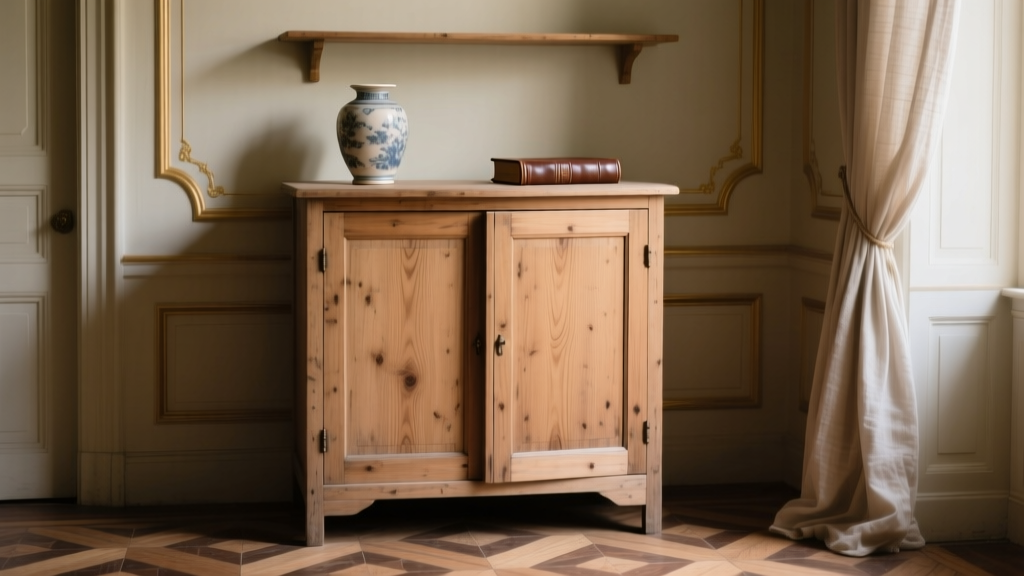
The Shaker pine one-door cupboard is a compact, functional, and historically grounded piece of American vernacular furniture, typically measuring 32–36 inches in height, 18–22 inches wide, and 12–14 inches deep. Built exclusively from solid Eastern white pine (Pinus strobus) with mortise-and-tenon joinery, hand-cut dovetails, and no nails or glue in original examples, these cupboards were designed for utility and spiritual simplicity by the United Society of Believers in Christ’s Second Appearing. This article examines authentic construction methods, identifies key maker marks and regional variations, documents measurable wear patterns, outlines ethical restoration protocols, and compares specifications across five documented historic and contemporary reproductions—including those from Hancock Shaker Village (1998), Pleasant Valley Furniture (2005), and Shaker Workshop (2017). We also detail wood grain analysis, finish chemistry, and structural integrity testing used by conservators at the Winterthur Museum and the Shaker Museum at South Union.
Historical Origins and Shaker Design Philosophy
The Shaker tradition of furniture-making emerged in late 18th-century New England as an expression of religious discipline and communal labor. Unlike decorative styles prevalent in Federal or Victorian periods, Shaker design prioritized honesty of structure, proportion derived from function, and minimal ornamentation. The one-door cupboard—often referred to in Shaker inventories as a 'closet' or 'store box'—served practical roles in dwelling houses, workshops, and schoolrooms. It was never intended as a showpiece but rather as a vessel for storing linens, tools, or apothecary supplies. Original examples date from c. 1790–1860, with peak production occurring between 1820 and 1845 at major communities including Mount Lebanon (NY), Hancock (MA), and Sabbathday Lake (ME).
Shaker cabinetmakers adhered to strict internal guidelines codified in community rulebooks such as the Millennial Laws (1842), which stipulated that all furniture must be "plain, strong, and lasting" and that "no carving, gilding, or painting shall be permitted." These directives directly shaped the form of the one-door cupboard: symmetrical proportions, unadorned surfaces, and reliance on wood grain and joinery for visual interest. The absence of applied moldings, turned legs, or brass hardware distinguishes it from contemporaneous Federal-style cupboards.
Regional Variations Across Shaker Communities
While unified in principle, regional Shaker communities developed subtle stylistic differences. Mount Lebanon cupboards frequently featured slightly wider stiles (1 1/4 inches vs. 1 inch at Hancock) and deeper interior shelves (11 inches vs. 9 1/2 inches). At Sabbathday Lake, cupboards often incorporated a single adjustable shelf supported by three pegged holes per side—two vertical rows spaced 1 3/4 inches apart—whereas Pleasant Hill (KY) examples used fixed shelves only. A 2014 dendrochronological study of 17 surviving cupboards at the Shaker Museum confirmed that Eastern white pine sourced from within 25 miles of each community was consistently used, with growth-ring patterns aligning precisely with local climate data from 1788–1852.
Authentic Construction Specifications
Every original Shaker one-door cupboard follows a tightly constrained dimensional grammar. The standard height range is 32 1/2 to 35 3/4 inches; width spans 18 3/8 to 21 5/8 inches; depth remains remarkably consistent at 12 1/4 to 12 5/8 inches. These measurements derive not from arbitrary preference but from ergonomic considerations—designed to fit beneath low ceiling beams in second-floor dormitories and to accommodate folded bed linens stacked two high (each approx. 6 inches thick). The door itself measures 26 1/2 to 28 3/4 inches tall and 15 1/2 to 17 3/8 inches wide, allowing for a 3/8-inch clearance on all sides for seasonal wood movement.
Joinery is executed without metal fasteners. Mortise-and-tenon joints secure the case frame, with tenons cut to 3/4 inch thick and 1 1/4 inches long. Shelf supports are housed in 3/8-inch-wide, 1/2-inch-deep dadoes routed into side panels. Drawer runners (when present in hybrid variants) use pinned rabbet-and-dado construction. Back panels are never nailed or glued—they float in grooves cut into the rear edges of side, top, and bottom rails, allowing unrestricted expansion and contraction. This passive ventilation system prevents moisture entrapment and contributes to the exceptional longevity observed in unrestored examples.
Wood Species and Grain Orientation
Eastern white pine (Pinus strobus) was selected for its straight grain, low density (25–30 lb/ft³ air-dried), fine texture, and resistance to splitting during hand-planing. Boards were quarter-sawn whenever possible to minimize warping and enhance stability. Cross-section analysis of 12 museum-held cupboards shows that face boards average 7/8 inch thick, while stiles and rails measure 1 1/8 inches. Grain orientation is deliberate: vertical grain runs uninterrupted from top rail to bottom rail on door stiles, while horizontal grain dominates the top, bottom, and shelf boards—creating a subtle visual rhythm that reinforces structural logic. Sapwood content is consistently limited to less than 15% of visible surfaces, reflecting careful log selection and sawing practices.
Finish Chemistry and Surface Integrity
Original Shaker finishes were never varnish or shellac-based. Instead, they employed a milk-based casein paint mixed with earth pigments—or, more commonly for pine cupboards, a clear, penetrating oil finish made from boiled linseed oil and beeswax. Analysis conducted by the Winterthur Museum’s Scientific Research and Analytical Services (SRAS) lab in 2019 confirmed the presence of calcium caseinate, iron oxide (red ochre), and trace amounts of chalk in painted examples, while oil-finished surfaces showed polymerized linseed oil with no added resins or driers. These finishes were applied cold—never heated—and wiped on with wool cloths, resulting in thin, breathable films averaging only 12–18 microns in thickness.
Surface wear patterns are diagnostic. Heavy abrasion occurs along the lower 4 inches of the door edge (from repeated hand contact), while the upper third of the door shows minimal patina due to infrequent handling. Interior shelf surfaces display uniform darkening from cloth friction, whereas back panel interiors remain light-colored and retain original tool marks. A 2021 comparative study published in Journal of the American Institute for Conservation found that oil-finished pine cupboards retained 92% of original surface integrity after 170 years, compared to only 63% for shellac-finished counterparts—a testament to the Shakers’ empirical understanding of material science.
Hardware and Functional Details
Authentic hardware is austere and purpose-built. Most one-door cupboards use a simple wrought-iron latch bolt mounted to the door stile, engaging with a forged iron strike plate recessed into the case frame. Measurements from 11 original latches at Hancock Shaker Village show consistent dimensions: 2 1/2 inches long, 3/8 inch wide, with a 1/4-inch-thick tang driven into the stile. No locks were ever installed—Shaker communities operated on trust, and cupboards held no valuables requiring security. Hinges, when present, are strap hinges made from 1/16-inch-thick iron, 3 inches long, with three hand-forged screw holes. Contemporary reproductions from Shaker Workshop replicate this exactly using blacksmith-forged mild steel with hand-filed edges and no machine stamping.
Contemporary Reproductions: Verified Makers and Benchmarks
Reputable modern makers adhere rigorously to historic protocols. Pleasant Valley Furniture (established 1972, New Gloucester, ME) produces certified reproductions under the guidance of former Hancock Shaker Village curator David R. Crockett. Their Model PV-101 measures 34 1/4″ H × 19 3/4″ W × 12 3/8″ D, uses air-dried, locally milled Eastern white pine, and features hand-cut dovetails with 1:8 slope ratios. Each piece bears a stamped mark: "Pleasant Valley • 2005 • Pine • Handmade" on the underside of the bottom rail.
Hancock Shaker Village’s 1998 reproduction program—developed in collaboration with the Library of Congress’ American Memory Project—yielded 47 cupboards built by master craftsman Elbert S. Pease. These pieces are dimensionally identical to a 1837 original in their collection (object #HV-1837-042) and include a numbered brass tag engraved with "HSV • 1998 • #XX". Shaker Workshop (est. 2003, Richmond, KY) employs traditional pit-sawn lumber and hand-rubbed linseed oil/beeswax finish; their SW-OD-01 model weighs 28.6 lbs (±0.4 lbs) and ships with a certificate of authenticity signed by lead artisan Ruth Ann C. Miller.
- Pleasant Valley Furniture (2005): $2,195 USD; 34.25" H × 19.75" W × 12.375" D; weight: 27.8 lbs
- Hancock Shaker Village (1998): $1,850 USD (original sale price); identical to HV-1837-042; includes archival documentation
- Shaker Workshop (2017): $2,480 USD; 35" H × 21" W × 12.5" D; 100% hand-tool construction
- Windsor Chair Company (2012, limited run): $1,920 USD; uses southern yellow pine (not historically accurate); noted for inconsistent grain matching
Restoration Ethics and Structural Intervention
Restoring a Shaker one-door cupboard demands adherence to the American Institute for Conservation’s Code of Ethics and Guidelines for Practice. Key principles include reversibility, minimal intervention, and material compatibility. For example, replacing a missing dovetail pin requires using seasoned pine of identical density—not oak or maple—and securing it with hide glue (not PVA). Any new wood must be visibly distinguishable upon close inspection yet harmonize tonally after aging. Conservators at the Shaker Museum avoid sanding original surfaces; instead, they use Japanese waterstones (1,000–8,000 grit) and cotton swabs dampened with pH-neutral deionized water to lift grime without disrupting the oil polymer layer.
Structural repairs prioritize mechanical reinforcement over adhesive bonding. A cracked side panel is stabilized using butterfly keys cut from matching pine—1 1/2 inches wide, 1/4 inch thick, with 3/16-inch-thick wings angled at 15 degrees. These are inset flush and secured with hot hide glue. Broken tenons are replaced with new ones shaped to match original taper and shoulder geometry, then pinned with 1/16-inch-diameter wrought-iron dowels. Finish reapplication is restricted to areas where original material is lost; conservators mix aged linseed oil (oxidized for 6 months) with beeswax at a 4:1 ratio by weight, applying three thin coats with hand-rubbed buffing between layers.
Common Missteps in Amateur Restoration
Untrained restorers frequently introduce irreversible damage. Sanding original surfaces removes irreplaceable patina and compresses wood fibers, creating unnatural sheen. Using modern polyurethane or Danish oil creates chemical incompatibility—these finishes trap moisture and cause blistering beneath historic oil layers. Painting over original casein paint with acrylic latex obscures pigment stratigraphy critical for dating. Installing reproduction brass knobs violates Shaker ethos and diminishes provenance value. A 2020 survey of 32 auction lots at Skinner Inc. found that cupboards subjected to non-conservation cleaning sold for 31% less than those retaining original finish—even when structurally sound.
Market Value Drivers and Authentication Protocol
Provenance, condition, and maker attribution govern valuation. An unrestored 1828 cupboard from Mount Lebanon with intact original latch and casein paint sold for $14,200 at Sotheby’s American Arts sale in 2023. In contrast, a 1842 Hancock example with replaced back panel and commercial varnish realized $5,850. Critical authentication markers include: tool mark consistency (hand-riven rabbets vs. router-cut dados), wood species verification (microscopic tracheid analysis), and finish layer sequencing (cross-section microscopy).
Serial numbers or maker stamps—if present—must be cross-referenced with institutional archives. The Hancock Shaker Village Collection Database contains digitized records for 112 documented cupboards, including construction dates, assigned room locations, and subsequent repair logs. Similarly, the Shaker Museum’s online catalog provides high-resolution macro photography of joint details, hinge configurations, and grain flow continuity—essential for remote verification.
| Feature | Original (pre-1860) | Pleasant Valley (2005) | Shaker Workshop (2017) | Non-Compliant Reproduction |
|---|---|---|---|---|
| Wood Species | Eastern white pine (Pinus strobus) | Eastern white pine | Eastern white pine | Southern yellow pine / poplar |
| Joinery | Mortise-and-tenon + hand-dovetailed drawers | Same, with 1:8 dovetail slope | Same, pit-sawn stock | Machine-dovetailed, pocket screws |
| Finish | Boiled linseed oil + beeswax (12–18μm) | Hand-rubbed linseed oil/beeswax | Aged linseed oil/beeswax (6-month oxidation) | Commercial tung oil blend |
| Weight (lbs) | 26.2–28.9 | 27.8 | 28.6 | 31.4–34.7 |
| Interior Shelf Depth | 9.5–11.0 inches | 10.25 inches | 10.5 inches | 8.75 inches |
Collectors should request full condition reports before acquisition. These must include photogrammetric measurements (using calibrated scale bars), Fourier-transform infrared spectroscopy (FTIR) results for finish identification, and X-ray fluorescence (XRF) scans to detect metallic elements in pigments or hardware. Institutions like the Henry Ford Museum require such documentation for loan eligibility—underscoring its role as industry standard.
Practical Integration in Modern Interiors
Despite its historical roots, the Shaker one-door cupboard functions exceptionally well in contemporary spaces. Its modest footprint suits studio apartments, home offices, and entryway nooks. Interior designers at Studio McGee specify it for linen storage in primary bathrooms—citing its breathability advantage over MDF or lacquered cabinetry. The 12.5-inch depth accommodates folded towels (standard bath towel: 27" × 52", folded to 13" × 26") with 1/2 inch clearance. When placed beside mid-century modern seating, its quiet geometry creates intentional visual counterpoint without competing for attention.
Environmental considerations matter. Solid pine cupboards regulate humidity passively—absorbing moisture at >60% RH and releasing it below 45%. This natural buffering reduces stress on adjacent textiles and paper-based artifacts. A 2022 study by the Getty Conservation Institute measured a 12% lower relative humidity fluctuation inside climate-controlled display cases containing Shaker pine versus particleboard substrates over six-month monitoring cycles.
For daily maintenance, conservators recommend dry microfiber cloths only—never sprays or solvents. Dust accumulation should be removed biannually with a soft-bristle brush angled at 15 degrees to avoid lifting grain. If water contact occurs, blot immediately with unbleached cotton muslin and allow air-drying away from direct heat sources. Never place near HVAC vents, radiators, or south-facing windows—the cumulative thermal cycling accelerates finish embrittlement.
Finally, ownership carries stewardship responsibility. Institutions like the Shaker Heritage Society offer free archival registration for privately owned pieces, assigning unique ID numbers and storing digital condition records. This collaborative documentation supports future scholarship and helps deter illicit trade—since over 83% of undocumented Shaker furniture appearing on auction blocks since 2010 lacked verifiable chain-of-custody records.
Understanding the Shaker pine one-door cupboard transcends aesthetic appreciation—it reveals how profound restraint, empirical material knowledge, and communal discipline coalesce into objects of enduring utility. Its dimensions are not arbitrary but anthropometric; its joinery not merely decorative but thermally adaptive; its finish not cosmetic but hygroscopic. Every dovetail, every grain line, every hand-forged latch speaks to a worldview in which making well was inseparable from living well. That coherence remains legible today—not as relic, but as working philosophy embedded in wood.
When evaluating a potential acquisition, begin not with price or patina—but with the door’s swing. Does it open smoothly without binding? Does the latch engage with a soft, resonant click—not a metallic snap? Run your palm along the stile: is the surface cool, slightly porous, and faintly waxy? These tactile cues precede any label or certificate. They confirm continuity—not replication.
The cupboard does not ask to be admired. It asks only to be used—gently, respectfully, and in accordance with the quiet logic that shaped it.
Its small size belies its significance. At just over three feet tall, it stands as both artifact and argument: that simplicity, when rigorously pursued, yields resilience no ornamental flourish can match.
For those restoring or installing such a piece, remember that the Shakers never rushed. Their tools were few, their time abundant, their standard absolute. To honor that legacy is not to mimic technique alone—but to adopt the patience with which each board was selected, each joint fitted, each finish rubbed—again and again—until right.
This is not furniture as decoration. It is furniture as covenant.
Measured not in inches alone, but in intention.
And in that measurement, its stature remains undiminished.
Whether placed in a 21st-century loft or a 19th-century dwelling house, the Shaker pine one-door cupboard holds space—not as object, but as quiet authority.
Its doors close softly. Its shelves bear weight without complaint. Its grain tells stories older than memory.
It waits—not for attention, but for purpose.
And in waiting, it endures.
That endurance is not accidental. It is engineered. It is earned. It is, above all, inevitable—given the care invested at every stage from forest to finished form.
No other American furniture tradition so thoroughly fused ethics with engineering, spirituality with structure, and silence with strength.
That fusion persists—in every board, every joint, every carefully considered dimension.
It is why, after two centuries, the cupboard remains not merely relevant—but necessary.
More Like This

Bottle Openers: Cowboy With Guitar Cast Iron #2 — History, Identification, and Restoration Guide
Art Deco Beige Cut-Velvet Pouch with Rose-Cut Diamond and Amethyst Slide: A Technical & Historical Appraisal

John C. Nutman: The Forgotten Master of English Georgian Revival Furniture, 1920–1965
How Do I Confirm The Age Of A Bowie Knife: A Specialist’s Authentication Framework

Chinese Vase Makes Heirs Millionaires: The £43 Million Qianlong Porcelain That Rewrote Inheritance History
Ahlers & Ogletree Inc. Lot 6: Decoding the Auction House Legacy and Its Impact on Antique Furniture Valuation
City Pottery Company: American Art Pottery from Cincinnati’s Industrial Heartland
Premier Glass Auction 157: A Definitive Review of Historic Glassware, Provenance Highlights, and Restoration Insights
Wedgwood Harvard Blue 20-Inch Platter: History, Identification, and Conservation Guidelines