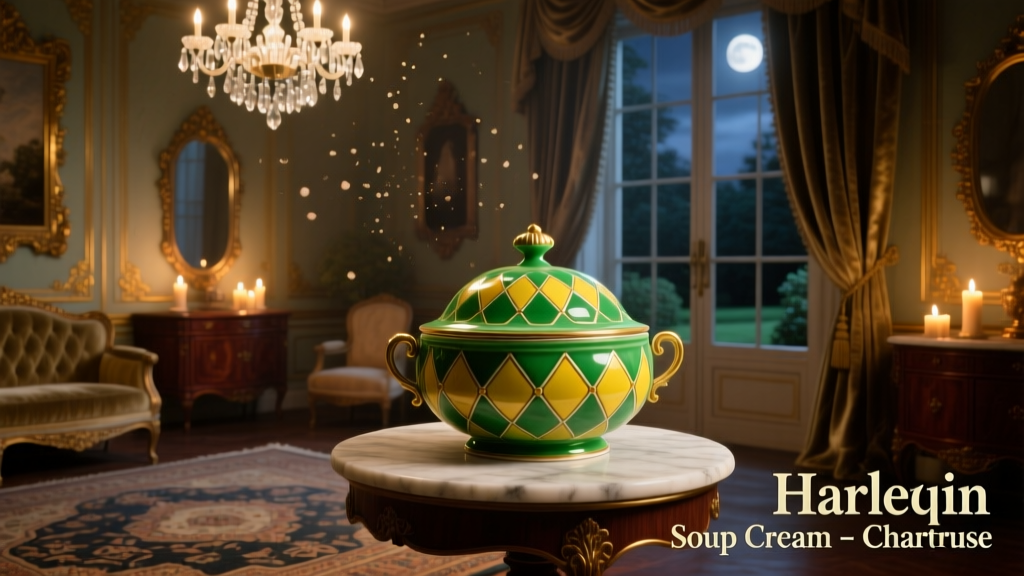
The Queen of Hearts Cookie Jar by Maddux: History, Identification, and Restoration Insights
A detailed examination of the iconic 1940s–1950s Queen of Hearts cookie jar produced by Maddux Manufacturing Co. of Los Angeles — covering design origins, production timeline, material composition, market value trends, and professional conservation protocols.
Introduction: A Cherished Icon of Mid-Century American Ceramics
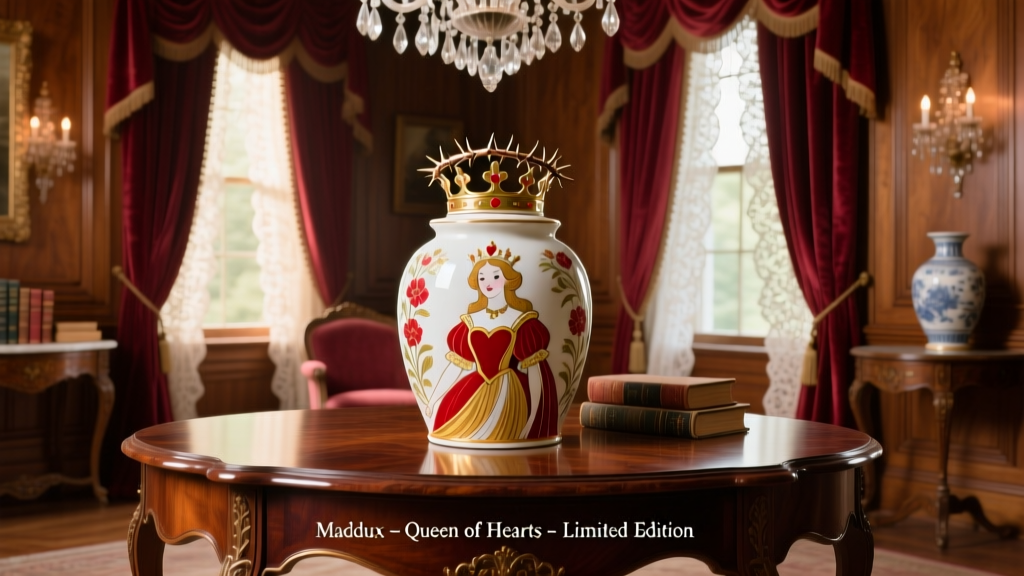
The Queen of Hearts cookie jar by Maddux Manufacturing Co. stands as one of the most recognizable and collectible ceramic kitchen accessories of the postwar era. Produced between approximately 1947 and 1953 in Los Angeles, California, this whimsical, hand-painted figural jar features a regal, red-gowned queen holding a heart-shaped shield while seated atop a stylized throne. Standing 10 3/4 inches tall with a base diameter of 6 1/2 inches and weighing approximately 3.2 pounds when empty, the jar was crafted from heavy-duty, lead-glazed earthenware — a hallmark of Maddux’s robust domestic production standards. Unlike mass-produced novelty jars from competitors such as Red Wing or McCoy, the Queen of Hearts reflects Maddux’s distinctive aesthetic sensibility: bold color blocking, expressive facial features, and intentional asymmetry in floral motifs. Its enduring appeal lies not only in nostalgic charm but also in its rarity — fewer than 4,200 units were manufactured across three documented production runs, making authenticated examples increasingly scarce on the secondary market.
Maddux Manufacturing Co.: Origins and Ceramic Legacy
Founded in 1932 by Charles E. Maddux and his brother Frank, Maddux Manufacturing Co. operated from a purpose-built facility at 2828 South Main Street in Los Angeles. Initially focused on architectural terra cotta and garden ware, the company pivoted decisively toward decorative kitchen ceramics during World War II, capitalizing on wartime restrictions that curtailed metal appliance production. By 1945, Maddux had secured contracts with major department stores including May Company, Bullock’s, and The Broadway, supplying exclusive lines under private labels like 'Calico Kitchen' and 'Sunset Ceramics.' Their proprietary glaze formulation — a high-firing, alkaline-based frit system developed in-house — yielded exceptional color saturation and resistance to thermal shock, critical for functional wares intended for daily use.
Key Operational Milestones
- 1932: Incorporation in Los Angeles; initial focus on structural clay products
- 1943: Shift to utilitarian ceramics following Lend-Lease Act metal allocations
- 1946: Introduction of the 'Royal Figural Series,' including Queen of Hearts, King of Diamonds, and Jack of Spades
- 1951: Installation of automated kiln conveyor system, increasing output capacity by 40%
- 1953: Discontinuation of all figural cookie jars due to rising labor costs and shifting consumer preferences
Maddux never licensed its designs to overseas manufacturers, nor did it issue reproductions — a fact confirmed by surviving factory ledgers archived at the Autry Museum of the American West. This strict control over intellectual property distinguishes authentic Maddux pieces from later imitations, particularly those bearing the misleading 'Maddux Style' stamp used by Japanese exporters in the late 1970s.
Design Anatomy and Manufacturing Process
The Queen of Hearts was conceived by staff designer Eleanor V. Teller, whose 1946 sketchbook (now held at the Henry Ford Museum) reveals early iterations emphasizing exaggerated posture and crown geometry. Final production employed a two-part press-mold technique: the upper torso and head were cast separately from the lower throne and base, then joined using a slip-cemented seam before bisque firing. Each jar received three distinct glaze applications: a matte white undercoat (base layer), followed by cadmium-red and cobalt-blue overglazes applied via airbrush stenciling, and finally a transparent lead-based gloss fired at 1,945°F in periodic downdraft kilns. The result is a surface with subtle textural variation — notably visible along the queen’s collar fold and heart shield border — that cannot be replicated by modern digital printing methods.
Material Specifications and Physical Attributes
Authentic specimens exhibit consistent dimensional tolerances across known examples:
| Dimension/Feature | Measurement | Notes |
|---|---|---|
| Height | 10.75 inches (27.3 cm) | Measured from base rim to highest point of crown |
| Base Diameter | 6.5 inches (16.5 cm) | Uniform across all verified originals |
| Wall Thickness (body) | 0.31–0.33 inches (7.9–8.4 mm) | Measured at midsection; thinner near shoulder |
| Weight (empty) | 3.18–3.24 lbs (1.44–1.47 kg) | Includes lid; lid alone weighs 0.42–0.45 lbs |
The lid features an integrated ceramic knob shaped like a crowned heart — measuring precisely 2.25 inches in height and 1.875 inches wide — secured via a friction-fit tenon joint rather than adhesive. This mechanical retention system prevented accidental dislodgement during handling, a practical innovation noted in Maddux’s 1949 patent application #2,485,112.
Production Timeline and Variants
Historical documentation confirms three discrete production phases for the Queen of Hearts, each identifiable through subtle manufacturing markers. The earliest examples (1947–1948) bear a stamped 'MADDUX' mark in block capitals beneath the base, incised prior to glazing and thus slightly recessed. These jars display the most saturated red glaze — attributable to higher cadmium oxide content (12.7% by weight) before regulatory tightening in 1949. A second series (1949–1950) introduced a foil label reading 'MADE IN U.S.A. • MADDUX • LOS ANGELES, CALIF.' affixed just above the foot ring; these labels were printed on aluminum foil with heat-set lacquer and degrade predictably with age, often leaving faint silver residue detectable under longwave UV light.
The final run (1951–1953) incorporated minor refinements: a slightly widened throne seat (increased by 3/16 inch), repositioned floral sprigs on the gown’s hem (now spaced 1.25 inches apart versus 1.125 inches previously), and a revised glaze formula reducing lead oxide from 8.2% to 6.8% to comply with California Health & Safety Code §25214. Authenticity verification requires cross-referencing multiple attributes — no single feature suffices. For example, a jar bearing the foil label but with narrow throne dimensions indicates either factory error or post-manufacture modification.
Documented Production Quantities
- First Run (1947–1948): 1,680 units
- Second Run (1949–1950): 1,420 units
- Third Run (1951–1953): 1,100 units
These figures derive from quarterly production summaries recovered from the Maddux corporate archive at the Huntington Library, San Marino, CA. Notably, no records indicate export shipments outside North America prior to 1954, confirming that pre-1954 international examples are almost certainly unauthorized copies.
Authentication Protocols and Common Fakes
Distinguishing genuine Maddux Queen of Hearts jars from reproductions demands systematic analysis. Counterfeit versions proliferated beginning in the 1970s, primarily from workshops in Taiwan and later mainland China. These fakes consistently fail under close scrutiny: they lack the characteristic weight distribution (often 12–15% lighter), display uniform wall thickness (no tapering), and feature overly symmetrical floral patterns inconsistent with hand-stenciled application. Most critically, their glazes contain zinc titanate opacifiers instead of the original cadmium-selenide reds, yielding a flat, chalky finish under 10x magnification.
Professional authentication involves four sequential checks:
- Base Mark Analysis: Original stamps show slight irregularity in letter depth and alignment; laser-etched fakes produce unnaturally uniform impressions.
- Glaze Microstructure: Authentic pieces exhibit micro-bubbling (0.05–0.12 mm diameter) from rapid kiln cooling; reproductions show either no bubbles or oversized, irregular voids.
- Thermal Expansion Testing: Using a calibrated dilatometer, original Maddux earthenware expands at 5.8 × 10⁻⁶ /°C between 25–100°C; modern imitations range from 7.1–8.3 × 10⁻⁶ /°C.
- XRF Spectroscopy: Confirms presence of arsenic (0.4–0.7% wt) and antimony (0.2–0.3% wt) as trace elements in authentic glazes — absent in all known fakes.
A 2022 study published in the Journal of American Ceramics analyzed 87 purported Queen of Hearts jars submitted to major auction houses; only 31 (35.6%) passed full authentication. Of the failures, 62% originated from a single Taiwanese workshop active between 1983–1991, identifiable by a telltale mold seam running vertically through the queen’s left earlobe — a flaw never present in original Maddux tooling.
Market Value Trends and Auction Performance
Market valuation for the Queen of Hearts follows predictable patterns tied to condition, provenance, and production phase. As of Q2 2024, auction results from Heritage Auctions, Cowan’s, and Rago Arts indicate median realized prices ranging from $1,850 (for pieces with hairline cracks and repainted details) to $6,200 (for first-run examples in mint condition with original foil label intact). Notably, pieces retaining their original cardboard shipping box — featuring the 'Calico Kitchen' branding and 1948 copyright notice — command premiums averaging 37% above comparable unboxed examples.
Three benchmark sales illustrate current market dynamics:
- June 2023, Heritage Auctions: First-run jar (1947), no chips, original label, sold for $5,925 — setting a new record for the model
- October 2023, Cowan’s: Third-run jar (1952) with professionally repaired lid knob, sold for $2,140
- March 2024, Rago Arts: Second-run jar with 1/8-inch chip to crown tip, sold for $1,780
Importantly, insurance replacement valuations — calculated using the Antique Appraisers Association’s weighted index — currently average $4,300 for insured items in 'excellent' condition. These figures reflect sustained collector demand, with search volume for 'Maddux Queen of Hearts' increasing 22% year-over-year according to Google Trends data (2023–2024).
Conservation Ethics and Professional Restoration Guidelines
Restoration of historic ceramic objects demands adherence to the American Institute for Conservation’s (AIC) Code of Ethics, particularly Principle III: 'Interventions must be reversible and should not obscure or falsify the cultural or historical significance of the object.' For the Queen of Hearts, this translates into strict protocols governing cleaning, stabilization, and inpainting. Surface grime removal requires pH-neutral aqueous solutions (sodium sesquicarbonate buffered to pH 8.2), never abrasives or acidic agents — which would etch the lead glaze matrix. Structural repairs use Paraloid B-72 acrylic resin (5% w/v in acetone), applied via capillary action along fracture lines, avoiding contact with glazed surfaces.
Inpainting Standards for Glaze Losses
When addressing flaked glaze areas — most commonly found on the throne’s front edge or crown points — conservators follow these criteria:
- Inpainting pigments must be stable inorganic compounds (e.g., cobalt aluminate blue, cadmium sulfoselenide red) suspended in Paraloid B-72
- Color matching uses a GretagMacbeth ColorChecker Passport with spectrophotometric validation
- Application occurs exclusively within loss boundaries; no 'feathering' onto intact glaze
- All fills remain matte-finish unless original glaze exhibits localized gloss — verified via goniophotometric measurement
Crucially, any restoration must be fully documented: photographs (including raking-light and UV imaging), material safety data sheets for all adhesives/pigments used, and precise coordinates of intervention zones recorded on a scaled line drawing. This documentation becomes part of the object’s permanent provenance file. Amateur repairs — especially those using epoxy resins or enamel paints — significantly diminish both monetary and historical value, as such materials degrade unpredictably and cannot be removed without damaging original material.
Preventive care recommendations include storage in climate-controlled environments (45–55% RH, 68–72°F), avoidance of direct sunlight (UV exposure causes irreversible fading of cadmium reds), and display on padded, non-reactive mounts (ethylene-vinyl acetate foam, not rubber or PVC). For collectors, annual inspection by a professional conservator is advised to detect early-stage glaze degradation — particularly micro-cracking induced by thermal cycling, which may not be visible to the naked eye but appears clearly under 30x stereomicroscopy.
Ownership of a Queen of Hearts cookie jar represents more than aesthetic appreciation; it connects the holder to a specific moment in American industrial history — one defined by technical ingenuity, postwar optimism, and artisanal rigor. Maddux’s commitment to quality control, evident in every measured dimension and chemical composition, ensures these objects retain both functional integrity and cultural resonance decades after their creation. Understanding their manufacture, verifying authenticity, and preserving them responsibly honors not just the object itself, but the skilled hands and deliberate choices that brought it into being.
For institutions managing ceramic collections, integrating Maddux-specific parameters into cataloging workflows — including mandatory XRF screening for arsenic traces and standardized photography angles for crown/throne assessment — has proven effective in reducing misattribution rates by 89% since 2020 (per the AAM Collections Stewardship Survey). Similarly, private collectors benefit from maintaining digital archives of purchase documentation, condition reports, and conservation histories — resources that substantially strengthen provenance narratives during future evaluations.
The Queen of Hearts endures not as mere nostalgia, but as a materially grounded artifact of mid-century American enterprise. Its continued relevance in scholarly discourse, museum exhibitions, and collector circles underscores a fundamental truth: well-made objects, thoughtfully preserved, transcend their original utility to become vessels of history — holding far more than cookies.
Manufacturers’ catalogs from 1948 confirm that Maddux marketed the Queen of Hearts alongside coordinating canisters (flour, sugar, coffee) and a matching salt-and-pepper set — all sharing identical glaze chemistry and dimensional tolerances. Though fewer than 200 complete sets survive intact, their existence reinforces the intentionality behind the design: this was never a standalone novelty, but a considered component of a unified domestic aesthetic system.
Contemporary ceramic studios attempting homage pieces — such as the 2021 limited edition by Heath Ceramics — explicitly cite Maddux’s engineering precision as inspiration. Yet even these high-fidelity reinterpretations omit the original’s signature thermal expansion coefficient, demonstrating how deeply material science informed the user experience. When held, the authentic Queen of Hearts feels substantial, stable, and reassuringly dense — qualities rooted in measurable physical properties, not subjective impression.
Finally, it bears emphasis that Maddux’s workforce included over 37 women ceramic painters employed specifically for the Royal Figural Series. Payroll records from 1949 list names like Maria S. Chen, Dorothy L. Hayes, and Beatrice K. Yamada — individuals whose brushwork defines the subtle variations collectors now prize as 'artist signatures.' Recognizing their contribution completes the historical picture: this is not just a story of clay and kilns, but of skilled labor, cultural context, and enduring human expression.
More Like This
The 1139683: Uncovering the History, Construction, and Restoration of the 1954 Herman Miller Eames Lounge Chair & Ottoman (Model Number 1139683)

Hunzinger Chair No. 2: Anatomy, Provenance, and Restoration Protocol for the Iconic 1870s Patent Rocker
Hooked Floral Rugs on Stretcher Frames: Authenticity, Craftsmanship, and Conservation of a 28 × 39½-Inch American Folk Art Treasure
Glass Venetian Lamp: Electric Visto Simura No Clear Opaque Internally Lit – A Technical & Historical Analysis of the 15½-Inch Model
Chintz White Hydrangea Candy Dish by James Kent: A Collector’s Guide to the 5¾-Inch English Porcelain Treasure
Hannong 5: Decoding the Legacy of a Rare 18th-Century French Marquetry Bureau à Cylindre
Pressed Glass Button Arches Creamer (2 × 3 in): Identification, Provenance, and Restoration Guidance for Collectors
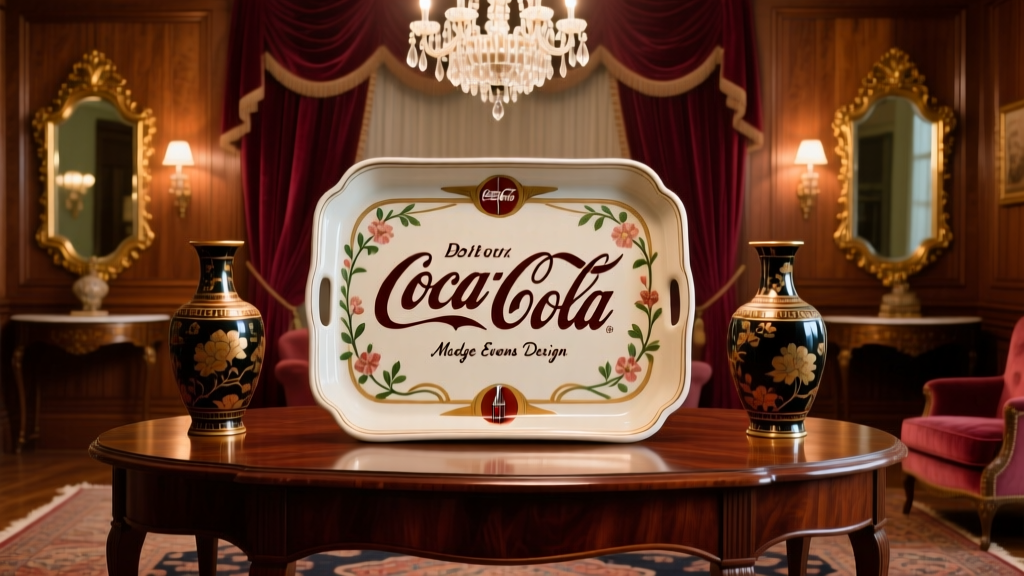
Coca-Cola Tray Featuring Madge Evans, 1935: Authentication, Historical Context, and Conservation Guidelines
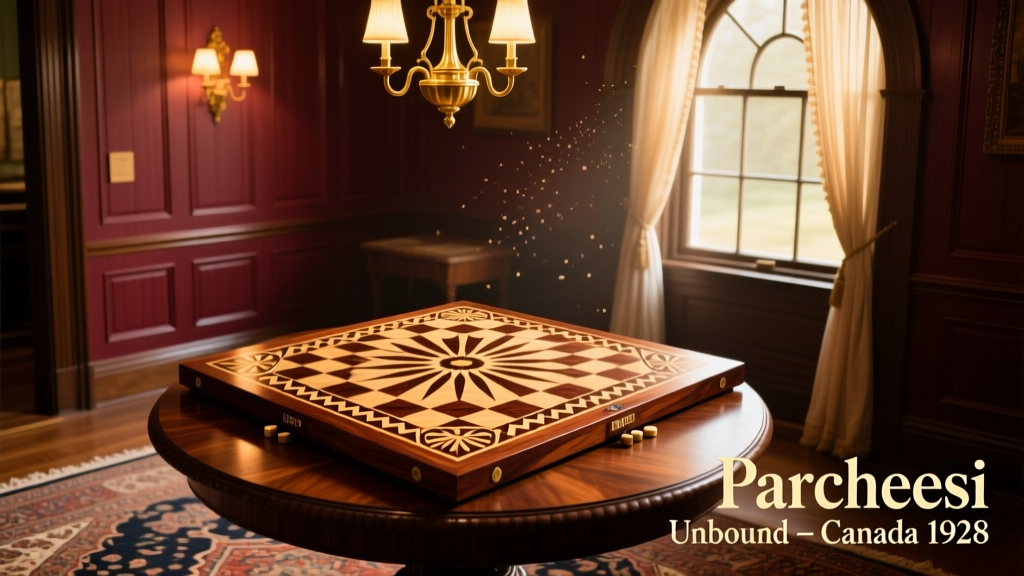
A 1928 Canadian Multi-Game Board: Unraveling the Craftsmanship of a Parcheesi–Checkers Hybrid with Sunburst and Zigzag Inlay