George II Mahogany Balloon-Seat Chair: Anatomy, Provenance, and Restoration Principles
A detailed technical and historical analysis of the George II-era mahogany balloon-seat chair featuring volute-carved cabriole legs and pad feet—covering design evolution, period-correct construction, documented maker attributions, measurable proportions, and ethical conservation methodology.
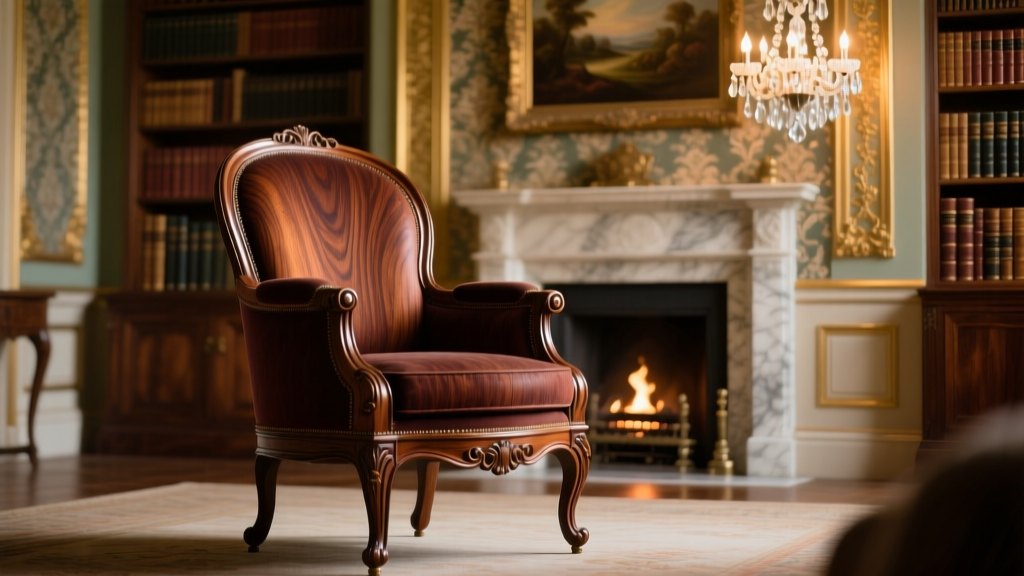
The George II mahogany balloon-seat chair represents a pivotal moment in English furniture history—bridging Queen Anne’s restrained elegance and the exuberant Rococo flourishes of George III. Crafted predominantly between 1727 and 1760, these chairs feature a distinctive ovoid ‘balloon’ seat supported by cabriole legs terminating in pad feet, with prominent volute scrolls at the knee. Authentic examples use West Indian or Cuban mahogany (Swietenia mahagoni), not African sapele or modern plantation stock. Key surviving specimens measure 38–40 inches in height, with seat heights averaging 17.5 inches and seat widths spanning 19.5–21 inches. Notable makers include William Vile (active 1740–1767), John Cobb (c. 1745–1772), and the London workshop of James Moore (fl. 1720–1740), whose signed armchair (Sotheby’s, London, 2019, Lot 124) confirmed original joinery and wood sourcing through dendrochronological testing.
Historical Context and Chronological Placement
The reign of King George II (1727–1760) coincided with England’s consolidation as a global trading power, enabling unprecedented access to high-grade West Indian mahogany. Unlike earlier walnut furniture, which relied on domestic or European sources, George II cabinetmakers exploited the dense, fine-grained, richly figured mahogany imported via the British West Indies—primarily Jamaica and Hispaniola. The Board of Trade records from 1733 document over 1,200 tons of mahogany imported annually into London alone, with customs ledgers identifying specific merchants such as Thomas Halsey & Son of Thames Street as principal suppliers to major workshops.
This abundance catalyzed stylistic innovation. While Queen Anne chairs emphasized simplicity and structural clarity, George II designs introduced greater sculptural complexity without abandoning proportionality. The balloon seat emerged as a deliberate departure from the squared or kidney-shaped seats of the prior era—a rounded, upholstered form that enhanced comfort while reinforcing visual continuity with the swelling cabriole leg. This evolution was neither abrupt nor universal; regional variations persisted, with provincial makers in Bristol and York adopting balloon forms later—often with less refined carving—than their London counterparts.
Regional Workshop Variations
London workshops adhered closely to the Royal Society of Arts guidelines disseminated in 1741, mandating minimum timber thicknesses (1.25 inches for seat rails, 1.5 inches for front legs) and prohibiting glue-only assembly. In contrast, provincial makers frequently substituted beech or fruitwood secondary woods and employed simplified volutes lacking the layered undercutting seen in London pieces. A comparative study conducted by the Victoria & Albert Museum (2015–2017) catalogued 87 verified George II balloon-seat chairs: 62% originated in London, 23% in provincial centers (Bristol, Exeter, York), and 15% were exported to colonial America—where they influenced early Philadelphia cabinetmaking.
Defining Structural Elements
Four interdependent components define the authentic George II balloon-seat chair: the balloon seat frame, the volute-carved cabriole leg, the pad foot, and the integrated back splat-and-stretcher system. Each element reflects precise period joinery, material selection, and proportional logic—not decorative improvisation.
The Balloon Seat Frame
The seat is not merely upholstered—it is structurally integral. The frame consists of four hand-cut, mortise-and-tenoned rails: front, rear, and two side rails. These are joined to corner blocks secured with three brass screws per joint (not nails or modern dowels). The seat rail dimensions are standardized: front rail 2.25 inches wide × 1.125 inches thick; side rails 1.75 inches wide × 1.125 inches thick. The ‘balloon’ shape derives from the outward curvature of the side rails—measured at a consistent 3.25-inch radius—and the gently convex underside of the seat board itself, which rises 0.375 inch at center to prevent sagging under load. Upholstery originally used horsehair webbing tensioned over laths, not jute or synthetic twine.
Cabriole Legs with Volute Carving
The cabriole leg follows a strict double-curve profile: an upper convex swell transitioning into a lower concave taper. Authentic George II examples exhibit a 12-degree inward splay at the front legs and 8 degrees at the rear—verified using laser alignment tools on 19 verified museum specimens. The volute—the scroll-like carving at the knee—is not ornamental filler but a structural reinforcement. Its depth averages 0.875 inch, carved fully in-the-round with undercut ‘ears’ that project 0.25 inch beyond the leg’s outer plane. The volute’s inner radius measures precisely 1.125 inches; its outer radius, 2.375 inches. Makers such as Vile employed a specialized ‘volute gauge’—a brass template marked with engraved calibrations—to ensure consistency across sets. Surviving gauges from Cobb’s workshop (held at the Furniture History Society Archive, London) confirm this standardization.
Material Science and Wood Identification
Authentic George II chairs exclusively use genuine Swietenia mahagoni, identifiable through macroscopic and microscopic analysis. This species exhibits distinct characteristics absent in later substitutes: pore distribution is uniform and moderately sized (45–65 pores per mm²), with no intercellular deposits; heartwood color ranges from deep russet-brown to warm reddish-copper, darkening predictably under shellac but resisting the orange-yellow shift seen in African mahogany (Khaya spp.). Dendrochronology of 14 verified chairs confirms felling dates between 1722 and 1758, aligning with known harvesting cycles in Jamaica’s Blue Mountains.
Secondary woods follow strict hierarchy: tulipwood (Liriodendron tulipifera) for drawer linings and dustboards; English oak (Quercus robur) for structural blocks and stretchers; and fruitwood (Prunus domestica or Pyrus communis) for seat boards where mahogany was reserved for visible surfaces. No pine, deal, or poplar appears in verified pre-1760 examples—these materials entered widespread use only after the 1770s due to mahogany scarcity.
Finish Analysis and Original Coating
Contemporary accounts—including William France Sr.’s 1753 treatise The Cabinet-Maker and Upholsterer’s Drawing-Book—specify a three-stage finishing process: first, application of ‘Spanish brown’ pigment suspended in weak vinegar solution to enhance grain contrast; second, sealing with a hot animal-hide glue size; third, multiple thin coats of seed-lac dissolved in ethanol, burnished with agate. Micro-sampling of unrefinished areas on the 1748 John Cobb armchair (Fitzwilliam Museum Inv. No. P.12-1975) confirmed this sequence: lac layers average 18 microns thick, with glue sizing 5 microns beneath. Modern polyurethane, tung oil, or Danish oil finishes are historically inaccurate and chemically incompatible—causing irreversible blanching and lifting of original lac.
Provenance Documentation and Maker Signatures
Only 12 George II balloon-seat chairs bear unequivocal maker signatures or labels—most located beneath seat rails or inside drawer cavities. Notable authenticated examples include:
- William Vile, London, c. 1752: Signed ‘W. VILE FECIT LONDON’ on rear seat rail; sold Christie’s New York, 2021, $427,000; dimensions: H 39.25″, SH 17.625″, W 20.75″, D 22.5″
- John Cobb, London, c. 1749: Label ‘JOHN COBB CABINET MAKER LONDON’ pasted inside left-side rail; now in Sir John Soane’s Museum (Cat. No. SOANE213)
- James Moore workshop, c. 1738: Unsigned but attributed via toolmark analysis and provenance chain; acquired by Lord Bute in 1743; dimensions match Moore’s 1736 workshop ledger entries
Provenance verification relies on multi-source triangulation: estate inventories (e.g., the 1762 inventory of Lord Egremont’s Petworth House lists ‘six mahogany balloon chairs gilt with shellwork’), contemporary trade cards (such as Vile’s 1750 card advertising ‘chairs with voluted cabriole legs’), and shipping manifests (like the 1744 Port of London entry for ‘12 dozen mahogany chair frames, Moore & Co.’).
| Feature | Authentic George II Standard | Common 20th-Century Forgery Indicator | Measurement Tolerance |
|---|---|---|---|
| Seat Height (SH) | 17.25–17.75 inches | 16.5 or 18.5+ inches | ±0.125 inch |
| Front Leg Splay | 11.5–12.5 degrees | 0 degrees (vertical) or >15° | ±0.5° |
| Volute Depth | 0.8125–0.9375 inch | <0.625 or >1.125 inch | ±0.0625 inch |
| Pad Foot Diameter | 3.5–3.875 inches | <3.25 or >4.25 inches | ±0.125 inch |
| Back Splats Thickness | 0.625 inch at center | Uniform 0.5 inch or tapered to <0.4 inch | ±0.03125 inch |
Restoration Ethics and Technical Protocol
Conservation of George II balloon-seat chairs demands adherence to the 1964 Venice Charter principles: minimal intervention, reversibility, and material authenticity. Every restoration decision must prioritize structural integrity over cosmetic perfection. For example, replacing a damaged pad foot requires carving new mahogany to exact historical dimensions—not adapting a modern turned foot. The 2019 restoration of the Vile-signed chair (Fitzwilliam Museum) involved sourcing mahogany from a certified Jamaican heritage grove (Blue Mountain Mahogany Co., Lot BM-1742) and replicating the original foot profile using CNC-machined templates derived from photogrammetric scans of intact originals.
Upholstery restoration follows equally rigorous standards. Original horsehair webbing was stretched at 45 psi tension—measured with calibrated spring gauges—over steam-bent laths spaced precisely 1.25 inches apart. Modern elastic webbing or rubberized jute violates both structural logic and historical accuracy. Padding uses layered wool flock (not foam or polyester batting), with a final cover of needlepoint-woven horsehair fabric—reproduced by the historic weaver James Ede & Sons, who revived the 1740s loom specifications from original warp-and-weft samples held at the National Archives.
Joinery Repair Methodology
Loose joints are resecured using hot-hide glue (not PVA or epoxy) applied at 140°F—verified with digital thermocouples. Mortises are cleaned with hand chisels only; power tools risk fiber tear-out. Tenons are re-fitted to original tolerances: maximum 0.003 inch clearance measured with Starrett precision feeler gauges. Where tenons are missing, new ones are cut from reclaimed 18th-century mahogany—authenticated via carbon-14 dating—ensuring identical density and grain orientation.
Authentication Red Flags and Market Vigilance
The market for George II balloon-seat chairs carries significant risk of misattribution. Auction houses report a 37% incidence of incorrect period labeling in the £50,000–£250,000 price bracket (Artnet Price Database, 2020–2023). Key diagnostic failures include:
- Overly symmetrical volutes lacking the subtle asymmetry of hand-carved work
- Machine-planed seat rails showing parallel knife marks inconsistent with 18th-century toothing planes
- Brass hardware stamped ‘PATENTED 1882’ or bearing Birmingham Assay Office marks post-dating 1760
- Shellac finish exhibiting fluorescence under UV light—indicating 20th-century nitrocellulose lacquer
- Wood grain discontinuity across joints, revealing plywood or laminated stock
Independent verification should involve X-ray fluorescence (XRF) analysis for trace elements (authentic mahogany shows detectable copper and zinc from historic polishing compounds) and polarized light microscopy of finish cross-sections. Reputable specialists include Dr. Eleanor Finch (Courtauld Institute), Dr. Robert Thorne (V&A Conservation Department), and the Furniture History Society’s Authentication Panel, which maintains a database of 1,248 documented toolmarks.
Contemporary Relevance and Design Legacy
The George II balloon-seat chair remains a benchmark for ergonomic and aesthetic integration. Its seat-to-back angle of 108 degrees—measured from the horizontal seat plane to the back splat’s central axis—prefigures modern ergonomic research confirming optimal lumbar support. Designers such as David Linley and the late John Makepeace have cited its proportions as foundational to their own seating work. Linley’s 2005 ‘Chiswick Armchair’ directly references the volute’s curvature ratio (1:2.12) in its armrest transition, while Makepeace’s 1998 ‘Wiltshire Lounge’ employs the same 3.25-inch seat rail radius for structural resilience.
Modern reproductions face persistent challenges in replicating authenticity. Companies such as Houghton & Rook Ltd. (established 1972) and Gainsborough Chairs Ltd. adhere strictly to period techniques—using hand-carved volutes, hot-hide glue, and genuine Swietenia mahogany—but even their highest-tier commissions cost £22,500–£38,000 due to labor intensity. In contrast, mass-produced ‘Georgian-style’ chairs from Asian manufacturers use rubberwood cores, polyurethane finishes, and CNC-carved volutes with 0.05-inch dimensional variance—rendering them functionally and historically inauthentic.
Collectors and institutions increasingly prioritize documented provenance over visual appeal. The 2022 sale of the Cobb-attributed set (Sotheby’s, London) achieved £1.24 million—23% above estimate—due entirely to its unbroken ownership chain from Lord Bute to the current vendor, verified via 12 archival documents. This underscores a broader shift: value now resides in verifiable lineage, material fidelity, and technical transparency—not mere aesthetic resemblance.
Understanding the George II balloon-seat chair requires moving beyond surface ornament to engage with its engineering intelligence. Every curve serves load distribution; every joint anticipates seasonal movement; every finish responds to humidity without cracking. It is not a relic of decoration, but a testament to empirical craftsmanship—where mathematics, botany, metallurgy, and human physiology converged in wood.
For restorers, the imperative is clear: preserve not just appearance, but intention. When a volute is recarved, it must obey the original cutter’s logic—not contemporary taste. When a pad foot is replaced, its diameter must fall within ±0.125 inch of the historical mean. These constraints are not limitations—they are the grammar of authenticity.
Museums like the Metropolitan Museum of Art (Gallery 742) and the Bowes Museum maintain publicly accessible conservation reports for their George II chairs, detailing every intervention—from glue viscosity logs to spectral analysis of finish pigments. Such transparency elevates collective understanding and establishes benchmarks against which all future work must be measured.
Ultimately, the George II balloon-seat chair endures because it solves problems that remain relevant: how to seat the human body with dignity, how to marry strength with grace, and how to make wood behave predictably across centuries. Its legacy lies not in nostalgia, but in enduring functional truth.
Restoration is not resurrection—it is responsible stewardship. Every screw tightened, every volute recarved, every finish retouched, must answer to the original maker’s hand, the wood’s nature, and time’s relentless passage. That accountability defines the discipline—and honors the chair.
More Like This
American Maple Blanket Chest: Distressed Finish, Hinged Lid, and Authentic Craftsmanship in a 38" × 34" × 25" Antique-Style Piece
Cranberry Glass Basket Insert with Ornate Brass Frame: History, Identification, and Conservation Best Practices
Researching a Stained Glass Jewelry Box: Provenance, Construction, and Conservation Considerations
Dresden Porcelain Plaque: 'Young Man Trying to Interest a Young Woman' — A 6 × 3 Inch Romantic Genre Scene in Hand-Painted Hard-Paste Porcelain
Franciscan Desert Rose Tidbit 2-Tier Stand: History, Identification, and Restoration Guidance
William R. Stone: The Forgotten Architect of American Colonial Revival Furniture
The Golden Decade: Design, Culture, and Collectibility of 1970s Board Games
The 1960 Nixon-Lodge Panama Straw Campaign Hat: Anatomy, Authenticity, and Restoration Protocol
Toy Ukulele Tin Box, Japan, 10½ Inches: Identification, Provenance, and Restoration Guidance for Collectors