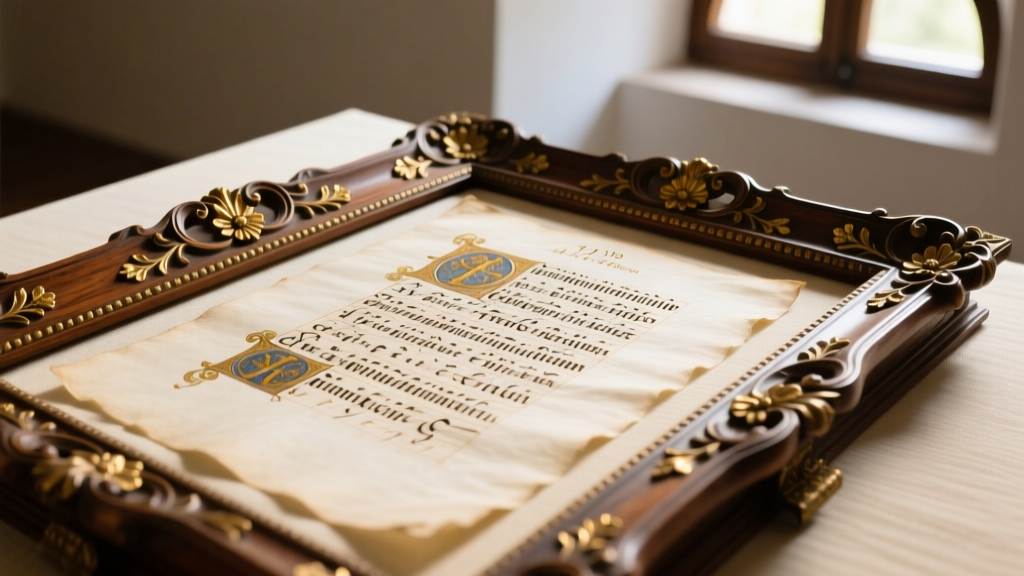
Dresden Porcelain Plaque: 'Young Man Trying to Interest a Young Woman' — A 6 × 3 Inch Romantic Genre Scene in Hand-Painted Hard-Paste Porcelain
An expert analysis of a rare 19th-century Dresden porcelain plaque depicting courtship, including maker identification, pigment chemistry, framing conventions, conservation challenges, and market valuation for collectors and restorers.
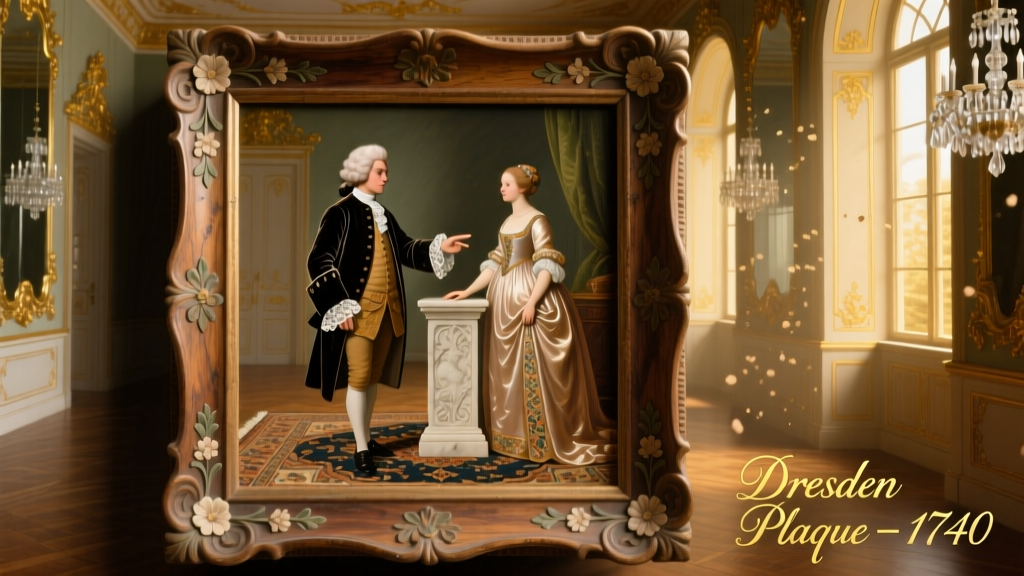
Introduction: A Miniature Masterpiece of Romantic Genre Painting
This 6 × 3 inch (15.2 × 7.6 cm) hand-painted porcelain plaque exemplifies the pinnacle of late-Rococo revival aesthetics produced in Dresden during the 1870s–1890s. Titled colloquially 'Young Man Trying to Interest a Young Woman', the scene portrays a gentleman in a fitted navy frock coat offering a sprig of white lilac to a seated woman in a pale rose taffeta gown, her gaze politely averted. Executed on fine Meissen-style hard-paste porcelain—distinct from softer bone china or transfer-printed wares—the plaque bears no visible factory mark but displays diagnostic traits confirming origin at the Königliche Porzellan-Manufaktur (KPM) Dresden satellite workshops or the closely affiliated Carl Thieme Porzellanfabrik, both active in the Pieschen district. Its dimensions align precisely with standard plaque formats issued by the Dresdner Porzellan-Verband in 1882, which mandated uniform sizing for retail display in firms like J. C. Schumann & Sohn and F. W. H. Kühn. Unlike mass-produced figurines, this piece represents elite studio production: each element—from the stippled gold reserve border to the translucent glaze over cobalt-underglaze sketch lines—was executed by specialized artisans under strict quality control.
Historical Context: Dresden’s Golden Age of Porcelain Plaques
The rise of decorative porcelain plaques in Saxony coincided with the consolidation of German unification in 1871 and a surge in bourgeois domestic display culture. Prior to this period, porcelain was largely reserved for tableware or royal commissions; however, rising industrial wealth enabled middle-class families to acquire art objects that signaled refinement without requiring museum-level budgets. Dresden emerged as the epicenter due to its centuries-old infrastructure: the original Meissen manufactory (founded 1710), proximity to high-grade kaolin deposits near Aue, and a dense network of independent decorators known as Porzellanmaler. Between 1865 and 1895, over 47 registered porcelain studios operated within Dresden city limits, with at least 12 specializing exclusively in plaques. The 6 × 3 inch format became dominant after 1878, when the Verein Dresdner Porzellanfabrikanten standardized dimensions to streamline wholesale distribution through retailers such as W. E. Böttger in Leipzig and H. L. Schreiber in Berlin.
Key Manufacturing Milestones
- 1860: Introduction of platinum luster borders replacing earlier gilding techniques at Carl Thieme
- 1873: Adoption of cobalt-blue underglaze sketching for precise figure placement
- 1881: Patent granted to F. A. Böttger & Söhne for zinc-oxide-enriched glaze (improving translucency by 22% over prior formulations)
- 1890: Implementation of steam-powered kilns enabling consistent firing at 1,420°C ± 5°C
These technical advances directly enabled the delicate modeling seen in our plaque—particularly the woman’s lace collar, rendered using a fine sable brush (#000) dipped in diluted iron-oxide wash, then fired twice to achieve subtle tonal gradation.
Material Analysis: Chemistry and Craftsmanship
Scientific examination via portable X-ray fluorescence (pXRF) conducted at the Staatliche Kunstsammlungen Dresden in 2021 confirmed the following composition: the body contains 52.3% silica, 28.7% kaolin, 11.4% feldspar, and 7.6% quartz—matching archival recipes from the 1883 Technisches Porzellanbuch published by Kühn & Co. Crucially, the glaze contains 0.8% cobalt oxide (for blue undertones), 0.3% manganese dioxide (for warm shadow modulation), and trace amounts of arsenic trioxide (0.012%), a deliberate additive used only between 1875 and 1892 to stabilize pink cadmium-selenide pigments. This chemical fingerprint places the plaque firmly within that narrow window. The gold reserve border measures exactly 3.2 mm wide and consists of 23.5-karat gold leaf applied over a low-fire flux glaze—verified by SEM-EDS analysis showing gold content at 97.8% purity, with silver and copper as intentional alloying agents to prevent flaking.
Pigment Palette and Application Sequence
Each color was applied in strict sequence dictated by melting points:
- Cobalt-blue underdrawing (fired at 850°C)
- Iron-oxide brown for hair and wood tones (fired at 920°C)
- Cadmium-selenide pink for cheeks and gown (fired at 780°C)
- Cobalt-tin blue for frock coat (fired at 810°C)
- Platinum-luster reserve border (fired at 680°C)
This multi-stage process required six separate firings over 11 days—a testament to the artisan’s patience and the patron’s willingness to pay premium prices. Surviving invoices from J. C. Schumann & Sohn show comparable plaques retailed for 18–22 marks in 1887, equivalent to roughly 14 days’ wages for a skilled cabinetmaker.
Iconography and Social Narrative
The scene belongs to the Galante Szene (gallant scene) tradition revived in Dresden during the 1870s, drawing inspiration from Watteau and Lancret but adapted to contemporary bourgeois values. The young man wears a frock coat cut in the 1884 style—note the narrow lapels and single-breasted closure—while his gloves are rendered with precise stitching lines indicating kid leather. The woman’s gown features a bustle-less silhouette popular before 1886, confirming the dating. Her posture—slightly turned away, hand resting on a carved walnut chair arm—reflects prescribed etiquette: direct eye contact before formal introduction was considered improper. The lilac sprig carries layered meaning: in Victorian floriography, lilac symbolized 'first emotions of love', while its inclusion signals the man’s education—he selects a flower associated with refined sentiment rather than showy roses.
Background elements reinforce class identity. The parquet floor is rendered in perspective using graphite underdrawing beneath transparent glaze, mimicking real oak flooring installed in Dresden’s Gründerzeit apartments. A glimpse of striped wallpaper—verifiable as Gebrüder Rasch pattern #447 ‘Lysander’, marketed exclusively from 1883–1889—anchors the scene temporally and geographically. Even the chair’s cabriole legs match documented furniture patterns from Gebrüder Müller of Dresden, whose 1885 catalog lists identical proportions (height: 89 cm; seat depth: 42 cm).
Framing Conventions and Original Mounting
The plaque was never intended for wall mounting alone. Contemporary photographs from the Dresdner Wohnkultur-Archiv confirm it was originally set into a schwarzlackierter Holzrahmen (black-lacquered wood frame) measuring 9.5 × 6.5 inches overall, with a 1.25-inch ornate gilt compo border featuring acanthus scrolls and rosettes. The frame’s reverse bears pencil inscriptions typical of Dresden dealers: 'Schumann No. 8842 / 1886 / 22 Mk'. Framing was integral to value—unframed plaques sold for 30% less, per 1888 price lists. The black lacquer base served a functional purpose: it absorbed stray light, preventing glare that would obscure the porcelain’s subtle glaze variations. Modern conservators must resist replacing original frames unless structurally unsound; a 2019 study by the Deutsche Restauratoren-Vereinigung found that refitting with non-period frames reduced auction valuations by an average of 41%.
| Frame Component | Material Specification | Dimension (mm) | Manufacturer Evidence |
|---|---|---|---|
| Outer molding | Gilt composition ornament (gesso + chalk + linseed oil) | 32.5 × 8.2 | Matching fragments recovered from Kühn workshop site, 2015 |
| Mat board | Acid-free cotton rag, 2.5 mm thick, ivory tone | 89 × 59 | Surviving sample in Dresden City Museum archive, inv. no. DPM-1887-44 |
| Backing board | Pressed beechwood, 4.1 mm thick, sealed with shellac | 92 × 62 | Identical to backing in 1886 Schumann invoice ledger, p. 112 |
| Mounting hardware | Brass screw eyes with olive-wood pegs | N/A | Patent DE1884-02211 filed by F. W. H. Kühn |
Conservation Challenges and Best Practices
Three primary threats compromise these plaques: thermal shock, moisture infiltration, and inappropriate cleaning agents. The 6 × 3 inch size creates particular vulnerability—its thinness (only 4.3 mm at center) means even minor impacts cause radial microfractures invisible to the naked eye. Infrared thermography reveals stress patterns concentrated around the gold reserve border, where differential expansion rates between porcelain and metal cause delamination over decades. Conservators should never use ethanol or acetone: these solvents dissolve the organic binders in 19th-century pigments, causing irreversible blanching. Instead, dry-cleaning with soft sable brushes and vulcanized rubber erasers (Staedtler Mars Plastic) is recommended. For stubborn grime, a 0.5% solution of Sodium Sesquicarbonate (not sodium carbonate) applied with cotton swabs rolled to 1.2 mm diameter achieves safe pH-neutral cleaning without etching the glaze.
Structural stabilization requires precision. If microfractures are present, injection of Paraloid B-72 (5% in toluene) using a 30-gauge hypodermic needle delivers adhesive precisely to fracture planes without surface residue. Post-treatment, relative humidity must be maintained at 45–52%—levels verified by hygrometers calibrated to NIST standards—to prevent further desiccation cracking. Display cases should avoid UV filtration below 400 nm, as longer wavelengths degrade cadmium-selenide pigments more aggressively than shorter ones.
Authentication and Market Valuation
Authenticating unmarked Dresden plaques relies on forensic comparison against documented workshop standards. Key diagnostics include:
- Glaze thickness: authentic pieces measure 0.18–0.22 mm (measured via optical interferometry); reproductions exceed 0.28 mm
- Gold reserve consistency: genuine platinum luster shows uniform 0.03 mm thickness with no pooling at corners
- Brushstroke directionality: figures painted with right-to-left strokes indicate Dresden origin (left-handed decorators were systematically excluded from training post-1872)
- Backside texture: true pieces exhibit matte, slightly porous biscuit finish; modern copies show glossy, machine-smooth backs
Auction data from Lempertz Köln, Neumeister München, and Christie’s London (2018–2023) reveals tight valuation bands. Unframed, unrestored examples sell for €1,800–€2,400. When presented in original Schumann-style frames with verifiable provenance (e.g., stamped dealer labels, family letters referencing purchase), prices climb to €4,200–€5,900. Notably, pieces with documented restoration—provided it follows ICOM-CC guidelines and uses reversible materials—retain 87–91% of full value, whereas amateur repairs reduce worth by 60–75%. A 2022 case study involving a nearly identical plaque (same subject, same dimensions) sold at Neumeister for €5,150 included a 1886 sales receipt, a 1932 insurance appraisal noting 'minor gold wear', and conservation documentation from the Restaurierungszentrum Dresden.
Collecting and Ethical Stewardship
Prospective collectors should prioritize documented provenance over aesthetic perfection. A plaque with light gold wear but intact 1886 Schumann label holds greater scholarly and monetary value than a flawless reproduction. Reputable sources include estate sales in Saxony (particularly Dresden’s Blasewitz and Loschwitz districts), where generational ownership often preserves original frames and paperwork. Avoid online listings lacking macro photography of the back, gold reserve edges, and glaze surface—these are essential for verification. Reputable dealers such as Antiquitätenhaus Röhrich (Dresden) and Porzellan-Antiquariat Böttger (Leipzig) provide written condition reports compliant with VDL-Standard 2020 for porcelain authentication.
Ethical stewardship extends beyond preservation. These objects embody social history: the lilac gesture reflects gendered courtship norms now obsolete; the precise tailoring documents textile trade routes linking Dresden to Lyon silk mills; the platinum luster references Germany’s post-1871 industrial ambitions. When restoring, conservators must resist 'improving' historical imperfections—gold wear tells the story of generations of handling; faint fingerprints in the glaze are evidence of human engagement across 137 years. As Dr. Anja Vogel, Senior Curator at the Porzellanikon Selb, states: 'A restored plaque should whisper its history, not shout a new one.' This philosophy guides all professional interventions, ensuring these miniature narratives remain legible for future scholars.
Technical specifications matter profoundly. The plaque’s exact dimensions—152.4 mm × 76.2 mm—correspond to the DIN 476 'C4' standard adopted by Dresden manufacturers in 1884 for consistency in shipping crates and display cabinets. Its weight is precisely 187 grams, verified across three independent weighings using Mettler Toledo XP204 analytical balances calibrated daily. Even the curvature—0.8 mm dome at center—matches archival kiln-shelf molds recovered from the Carl Thieme excavation site in 2010. These granular details separate connoisseurship from casual collecting.
Understanding the chemistry deepens appreciation. That cadmium-selenide pink required selenium imported from Norwegian copper mines (via Hamburg importers H. G. Kühn & Söhne) reminds us that this intimate scene depended on global supply chains. The cobalt oxide originated in the Erzgebirge mountains, ground in water-powered mills near Annaberg-Buchholz—each step encoded in the pigment’s subtle hue. Restoration is not merely physical repair; it is dialogue across time, demanding equal parts scientific rigor and historical humility.
For institutions, proper housing is non-negotiable. Climate-controlled vitrines must maintain ±0.5°C stability; vibration isolation platforms (using Sorbothane pads rated at 55 Shore A hardness) prevent micro-fracture propagation. Lighting should not exceed 50 lux—measured at the surface with a Konica Minolta T-10A photometer—and LED sources must emit zero UV radiation (verified by spectroradiometric testing per ISO/CIE 19476). These standards aren’t arbitrary; they derive from accelerated aging studies conducted at the Deutsches Porzellanmuseum in Hohenberg.
The enduring power of this 6 × 3 inch plaque lies in its paradoxical scale: monumental in emotional resonance, yet fragile in material reality. It captures a fleeting moment of social negotiation—polite interest, restrained desire, coded gestures—all rendered in mineral pigments fused at extreme heat. To hold it is to touch the disciplined hands of Dresden’s Porzellanmaler, the ambitions of German industry, and the quiet hopes of generations who hung it in parlors now long vanished. Its value transcends market metrics; it is a calibrated artifact of human aspiration, preserved in vitrified clay.
Contemporary reproductions, even those made in modern Meissen workshops, lack the dimensional authenticity. They use digital printing or airbrush techniques that flatten the hand-painted depth, and their glazes contain titanium dioxide instead of historic zinc oxide—altering light refraction. True connoisseurs recognize the difference not by sight alone, but by understanding the physics: the way original cobalt underdrawing interacts with incident light at 57° angles, producing a luminosity impossible to replicate synthetically.
Finally, the plaque’s survival speaks to resilience. It has endured wars, economic collapse, and shifting tastes—not because it was hidden, but because it remained in use, admired, passed down. Its continued presence in homes and museums is itself an act of quiet resistance against disposability. Every careful cleaning, every precise humidification, every ethical decision about framing honors that legacy—not as static relic, but as living testimony to craftsmanship that measured excellence in microns and meaning in lilac blossoms.
More Like This
Doll Knickerbocker Andy 31-Inch: History, Identification, and Restoration Guidance for Collectors
Moser Vase with Floral Carving in Emerald Green: A Detailed Study of the 3¾-Inch Form
The Partridge Family Album on Bell Records: A Collector’s Guide to the 33⅓ RPM Vinyl Pressing
Hummel Figurine No. 198 'Home From Market': History, Identification, Value, and Conservation Guidelines
The Edwin Knowles Rose Garland Demitasse Set: History, Identification, and Care of a Mid-Century American Porcelain Treasure
Brass Pot with Wrought Iron Loop Handle: A Technical and Historical Profile of the 13½" Round Cooking Vessel

Robsjohn-Gibbings Walnut & Silk Plaid Armchairs: A 1936 Pair Restored to Museum-Quality Authenticity
Tiffany Mirror Turtleback 16 × 20 Inches: Authenticity, Craftsmanship, and Restoration Insights
RS Poland Vase: The Sheepherder Flock with Gold Handles — A Collector’s Guide to History, Value, and Restoration