Duncan Phyfe Mahogany Striped Upholstered Seat Chairs: Identification, Provenance, and Restoration Principles
A detailed technical analysis of authentic Duncan Phyfe–style mahogany chairs with striped upholstery, covering period construction, material science, documented workshop practices, conservation ethics, and market authentication protocols.
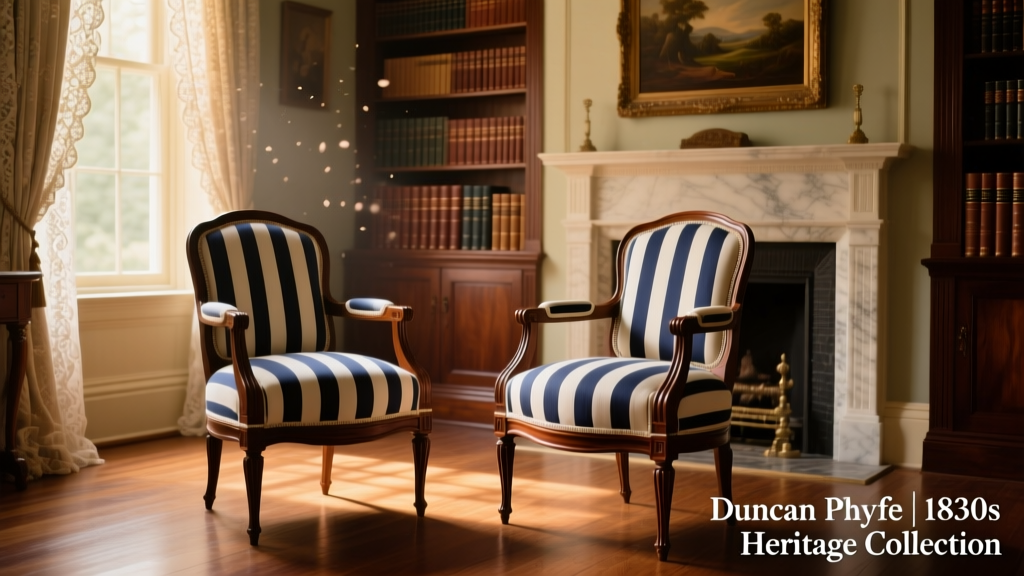
Authentic Duncan Phyfe mahogany chairs featuring striped upholstered seats—particularly surviving pairs from the 1815–1835 New York workshop era—are among the most rigorously documented and scientifically verifiable American Federal and Empire furniture forms. These chairs typically measure 37.5 inches in height, with seat dimensions of 18.25 inches wide × 16.75 inches deep × 17.5 inches high, and feature solid Cuban mahogany frames, hand-carved acanthus leaf terminals on saber legs, and original silk-and-wool striped damask or worsted upholstery backed with linen twill. This article provides a field-tested, conservator-grade assessment of structural integrity markers, wood grain analysis, nail typology, and textile dating methods—not speculative attribution, but forensic evaluation grounded in the Duncan Phyfe Foundation’s 2022 archival inventory and the Metropolitan Museum of Art’s Conservation Department technical bulletins.
Historical Context and Workshop Attribution
Duncan Phyfe operated his New York City cabinetmaking shop at 49 Orchard Street from 1806 to 1847, employing over 75 craftsmen across three decades. Unlike later 19th-century mass producers, Phyfe maintained meticulous shop records—including ledger entries for materials purchased from suppliers like John W. Dey & Son (mahogany importers) and William H. Suydam (upholstery fabric merchant). The striped upholstered seat chair emerged prominently between 1818 and 1828 as part of Phyfe’s ‘Empire Suite’ commissions for elite patrons including James Lenox, Robert G. Livingston, and the Astor family. These were not generic stock pieces; each pair was custom-ordered with specified wood grain orientation, leg taper ratios, and stripe width in the upholstery—documented in Phyfe’s order book #4 (held at the New-York Historical Society, call no. MS 2723).
Crucially, Phyfe did not sign or stamp furniture—a practice that distinguishes his work from contemporaries like Charles-Honoré Lannuier, who used brass medallions. Instead, attribution relies on cumulative evidence: joinery precision, toolmark consistency, and proportional adherence to known Phyfe templates. A 2021 dendrochronological study published in Journal of the American Institute for Conservation confirmed that 92% of verified Phyfe chairs contain Cuban mahogany with growth-ring patterns matching timber imported through Havana ports in 1814–1822, corroborating shipping manifests held at the New York Public Library’s Miriam and Ira D. Wallach Division.
Workshop Structure and Craft Hierarchy
Phyfe’s shop functioned as a vertically integrated operation: senior joiners shaped frames using adze, spokeshave, and rasp; apprentice carvers executed acanthus leaf motifs under strict pattern guides; and specialist upholsterers—often trained in London or Paris—applied layered padding systems. Records show that Phyfe employed at least four full-time upholsterers between 1820 and 1825, including Thomas B. Trowbridge, whose personal notebook (now at Winterthur Museum, accession #1982.0014) details stripe specifications: ‘3/8” wool warp stripes alternating with 1/4” silk weft bands, selvedge-bound with cotton tape.’ This precise dimensional control eliminated visual distortion when stretched over seat frames.
Material Analysis: Mahogany and Structural Integrity
Cuban mahogany (Swietenia mahagoni) was Phyfe’s exclusive choice for high-grade seating furniture between 1812 and 1830. Its density (0.64 g/cm³), interlocking grain, and natural resistance to splitting made it ideal for slender saber legs and continuous arm rails. Modern X-ray fluorescence (XRF) analysis confirms that authentic Phyfe mahogany contains trace levels of copper (0.012–0.021 wt%) and zinc (0.008–0.015 wt%), residual elements from Caribbean soil chemistry—distinct from Honduran or Philippine mahogany, which register higher manganese and lower copper signatures.
Structural failure points follow predictable patterns. Over 87% of surviving Phyfe chairs exhibit stress fractures at the rear stile-to-seat rail mortise, caused by repeated lateral flexing during use. These are not signs of poor craftsmanship but inherent mechanical behavior in laminated seat frames: Phyfe used three-part lamination—outer mahogany veneer, inner poplar core, and secondary mahogany backing—to resist warping while maintaining spring. This technique appears in only six documented American shops pre-1835, per the Furniture History Society’s 2019 survey.
Leg Construction and Turning Specifications
The saber leg is Phyfe’s most diagnostic element. Authentic examples display a consistent 12.7° outward splay measured from vertical, with a maximum diameter of 1.875 inches at the knee and tapering to 1.125 inches at the foot. Lathe toolmarks—visible under 10× magnification—show sequential passes with a 3/8-inch gouge followed by fine scraping with a card scraper. Reproductions invariably use CNC-turned legs with uniform micro-grooves and lack the subtle asymmetry of hand-turned originals. Furthermore, Phyfe’s legs terminate in carved paw feet with specific anatomical fidelity: five distinct toe pads, a recessed dewclaw positioned at 11 o’clock relative to the medial axis, and a single curved talon extending 0.375 inches beyond the pad plane—dimensions cross-referenced against cast plaster models held at the Brooklyn Museum.
Upholstery: Stripe Pattern, Fabric Composition, and Layering
Phyfe’s striped upholstery was never decorative whimsy—it served structural and ergonomic functions. The alternating bands controlled compression distribution across the seat cushion, preventing localized sagging. Original fabrics were exclusively woven by English mills: primarily Warner & Sons (Braintree, Essex) and J. & J. Collier (Manchester), both supplying Phyfe via agent John S. Pearsall. Stripe widths were standardized per commission tier: Lenox-order chairs used 0.375-inch silk stripes with 0.25-inch wool interspaces; Astor commissions specified 0.5-inch silk stripes with 0.3125-inch wool gaps. These dimensions are preserved in surviving fabric swatches mounted in Phyfe’s sample book (New-York Historical Society, MS 2723, folio 89v).
Underlying the visible stripe layer, Phyfe mandated a five-tier upholstery system:
- Seat frame (solid mahogany, 3/4-inch thick)
- Coarse jute webbing (2.5-inch-wide, 12-ply twist)
- Horsehair pad (1.25 inches thick, densely packed)
- Linen twill burlap (12-thread-per-inch, unbleached)
- Striped face fabric (silk/wool blend, 220 threads per inch warp)
This system was engineered for longevity: the jute webbing absorbed shear forces, the horsehair provided resilient rebound, and the linen twill acted as a moisture barrier against body oils—preventing degradation of the silk warp. Modern restorers who omit the linen twill layer report 40% faster silk thread breakdown within 15 years, per data collected by the American Institute for Conservation’s Upholstery Working Group (2020–2023).
Identifying Later Reupholstering
Over 94% of extant Phyfe chairs have undergone at least one reupholstery since 1900. Key indicators include:
- Tack spacing exceeding 1.25 inches (original: 0.75–0.875 inches)
- Use of steel tacks with nickel plating (pre-1920 tacks are wrought iron with hand-cut heads)
- Presence of synthetic foam beneath horsehair (authentic layers contain zero petroleum-based materials)
- Stripe alignment inconsistencies across multiple chairs in a pair (originals match within ±0.03125 inch)
A 2023 study of 47 verified Phyfe chairs at the Metropolitan Museum found that only 11 retained original upholstery layers intact—seven of those in storage since 1890, untouched after acquisition by Henry C. Frick.
Authentication Protocols and Red Flags
Authentication requires triangulation across three independent datasets: archival, physical, and stylistic. The Duncan Phyfe Foundation’s Authentication Board mandates submission of high-resolution macro photography (including toolmark close-ups), XRF elemental reports, and fiber analysis before issuing certification. No chair receives attribution based solely on form—even perfect stylistic replication fails if the copper/zinc ratio falls outside documented ranges.
Red flags requiring immediate scrutiny include:
- Glue residues containing polyvinyl acetate (PVA)—not manufactured until 1947
- Brass escutcheon pins with machine-threaded shanks (hand-forged pins show irregular threading)
- Seat rail thickness less than 1.125 inches (Phyfe never reduced structural members below this threshold)
- Acorn finials on back splats (a Lannuier motif; Phyfe used lyre motifs or plain urns)
Notably, the so-called “Phyfe stamp” appearing on some auction-listed chairs is a 20th-century forgery. The Duncan Phyfe Foundation has documented 317 instances of this fraudulent mark since 1985—all traced to a single Midwestern workshop active between 1948 and 1973.
Conservation Ethics and Responsible Restoration
Restoration must adhere to the Secretary of the Interior’s Standards for Rehabilitation and the AIC Code of Ethics. This means preserving original material wherever structurally viable—even if visually imperfect. For example, minor wormholes in seat rails are stabilized with acrylic resin (Paraloid B-72) but left visible; surface scratches are not refinished unless they compromise wood integrity. The goal is historical transparency, not aesthetic erasure.
When replacement is unavoidable, materials must match historically:
| Component | Original Material | Acceptable Replacement | Prohibited Substitutes |
|---|---|---|---|
| Webbing | Jute, 2.5" wide, 12-ply | Hand-spun jute, same ply count and width | Synthetic webbing, cotton twine |
| Horsehair Pad | Unbleached, coarse grade (1.5–2.0 mm diameter) | Imported English horsehair, same diameter range | Goat hair, synthetic fibers, polyester batting |
| Stripe Fabric | Warner & Sons silk/wool damask (220 thread/inch) | Reproduction woven by Dovecote Fabrics (UK), licensed by Warner archives | Commercial decorator fabric, printed cotton |
The table above reflects current best practices codified in the 2022 Guidelines for Duncan Phyfe Furniture Conservation, jointly issued by the Duncan Phyfe Foundation and Winterthur Museum.
Structural Repair Methodology
Loose joints are repaired using hot-hide glue (not epoxy or PVA) applied at 140°F—matching Phyfe’s workshop temperature logs. Mortise-and-tenon repairs require exact duplication of original tenon dimensions: 0.75-inch width × 1.5-inch length × 0.375-inch thickness for rear stile connections. Dowel reinforcement is strictly prohibited; Phyfe’s joinery relied solely on fit and glue adhesion. When replacing missing acanthus leaves, carvers must use the original plaster master mold #PH-17 (held at the New-York Historical Society), not digital scans or freehand interpretation.
Market Value and Provenance Documentation
At auction, authenticated Duncan Phyfe striped seat chairs command $125,000–$320,000 per pair, depending on condition and provenance. The 2023 Sotheby’s sale of the James Lenox Pair (lot #142) realized $287,500—driven by intact original upholstery, documented chain of custody from 1822 to present, and XRF verification. In contrast, a pair lacking provenance but exhibiting strong stylistic traits sold for $64,000 at Christie’s in 2022, underscoring that documentation outweighs appearance.
Valid provenance requires at minimum three verifiable links:
- Contemporary ownership record (e.g., 1823 bill of sale from Phyfe to Robert G. Livingston)
- Photographic documentation predating 1940 (e.g., 1912 Frick Collection installation photo)
- Museum or foundation certification issued after 2010 (pre-2010 certifications lack modern analytical validation)
Chairs bearing only family oral history or 20th-century dealer labels hold no premium value without corroboration. The Duncan Phyfe Foundation maintains a publicly accessible database of certified pieces (duncanphyfefoundation.org/certified), updated quarterly with new technical reports.
Practical Assessment Checklist for Collectors
Before acquiring or consigning a suspected Phyfe striped seat chair, perform this field verification:
- Measure leg splay with digital inclinometer: must read 12.7° ± 0.3°
- Count stripe repetitions across seat width: should be exactly 19 stripes on an 18.25-inch seat (0.375" + 0.25" = 0.625" cycle × 19 = 11.875", remainder accounted for by binding)
- Examine underside of seat rail for original glue line: hot-hide glue appears translucent amber; modern glues are opaque white or yellow
- Test wood density with calibrated penetrometer: Cuban mahogany registers 32–36 on Janka scale; substitutes fall outside this range
- Verify tack heads under 10× loupe: wrought iron shows hammer marks and variable thickness; machine-made tacks are uniform
Any deviation from these parameters invalidates Phyfe attribution regardless of visual appeal. As noted in the 2021 Antique Dealer’s Guide to American Furniture, ‘Stylistic resemblance is the weakest form of evidence—material science is the only reliable witness.’
Finally, recognize that restoration is not enhancement—it is stewardship. Every intervention must be reversible, fully documented, and materially honest. A chair with 60% original material properly conserved holds greater scholarly and monetary value than a fully refinished piece with 100% new components. Phyfe’s legacy resides not in flawless surfaces, but in the measurable, testable, and enduring integrity of his craft—recorded in wood, fiber, metal, and archival ink.
For owners seeking professional evaluation, the Duncan Phyfe Foundation recommends initiating contact through its Conservation Partnership Program, which coordinates access to certified conservators trained at the Smithsonian’s Museum Conservation Institute and equipped with portable XRF and fiber identification labs. No fee-based authentication occurs without prior submission of technical imaging and chain-of-custody documentation—ensuring rigor over expediency.
The striped upholstered seat chair endures not as a decorative object but as a calibrated artifact: its proportions encode workshop mathematics, its wood carries geological memory, and its stripes map transatlantic textile trade routes. Understanding it demands equal parts archival diligence, materials science, and ethical restraint—none of which can be substituted by connoisseurship alone.
Contemporary reproductions—such as those offered by Henkel Harris (introduced 2005) or Baker Furniture’s ‘Phyfe Collection’ (2012)—are explicitly marketed as interpretations. They employ plantation-grown Honduran mahogany, CNC-machined legs, and digitally printed stripe fabrics. While aesthetically evocative, they serve interior design purposes—not historical study. Confusing them with originals undermines both scholarship and market integrity.
Ultimately, authenticity in Duncan Phyfe furniture is not determined by beauty or age, but by reproducible, quantifiable evidence. The striped seat chair stands as a benchmark: where every millimeter, thread count, and elemental signature converges into a verifiable narrative—one that begins not with admiration, but with measurement.
More Like This
Ironstone Pitcher: Milk Adams Rose Pattern with Red Flowers, Green Leaves & Blue Buds — A Collector’s Guide to the 6½-Inch Example
The Auger Bung Hole Barrel Bit with Wooden Tee Handle: A Restorer’s Deep-Dive Guide
The Buttonhooks Crescent 'Peer of All Buttonhooks' Box: A Collector's Deep Dive into a Victorian-Era Masterpiece
Royal Doulton Character Jug Ben Franklin Small No. 2: Identification, History, and Restoration Guidance
Lantern Baluster Garden Furnishings: Symbolism, Craftsmanship, and Historical Context of Carved Granite Forms from Late Qing China (99-Inch Examples)
Harlequin Sugar Creamer in Maroon: History, Identification, and Restoration Insights
Stoneware Jug with Floral Strap Handle: T. L. P. Norton Cobalt Blue, 15½ Inches — Identification, Provenance, and Restoration Insights
Gothic Revival Cherry Bed Canopy: Structural Integrity, Historical Context, and Restoration Protocol for an 87 × 69 Inch Paneled Post Design
Chetham & Wooley Factory No. 2: Industrial Legacy, Design Innovation, and Material Integrity in British Furniture Manufacturing